
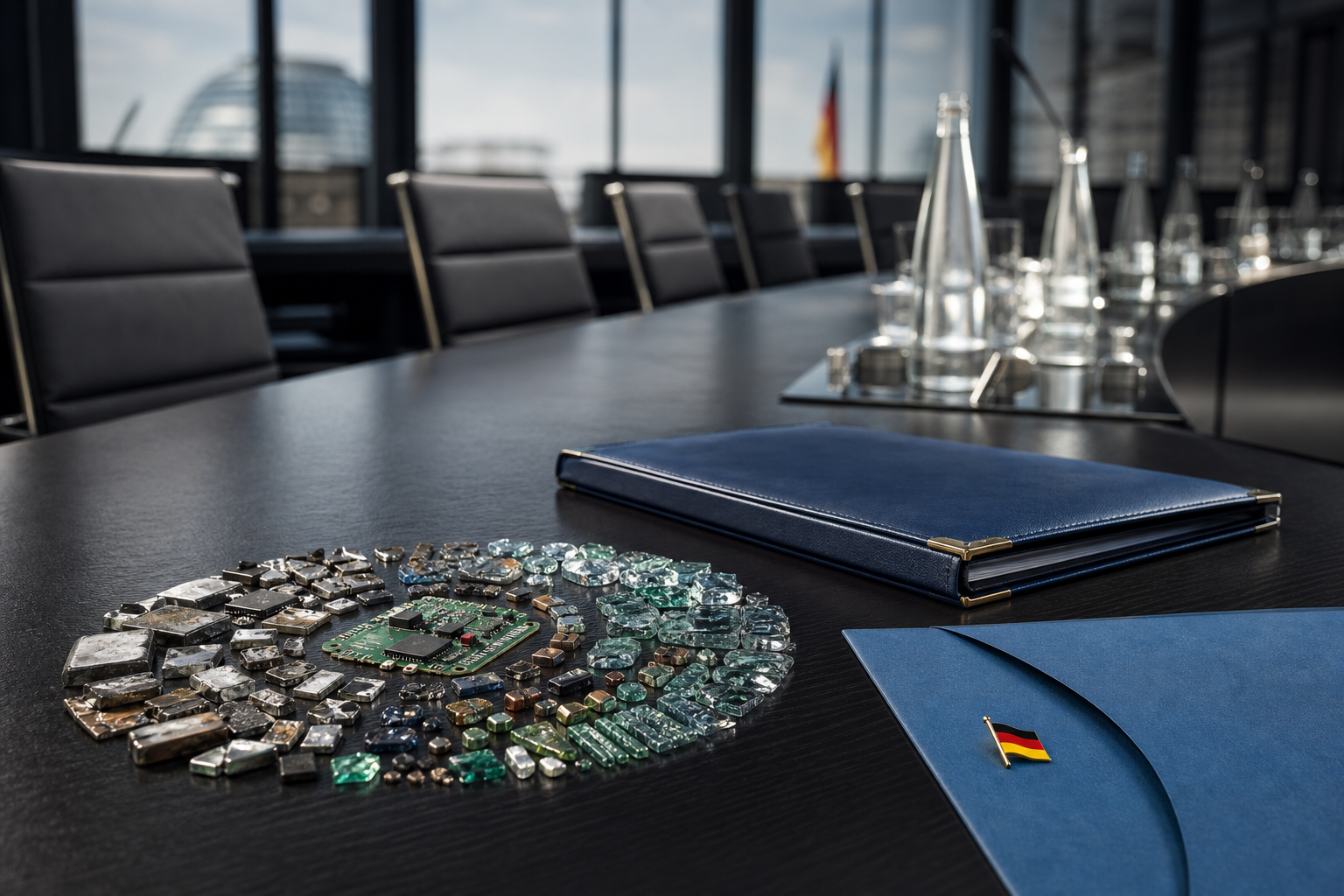
Circular economy and foreign policy
Federal government wants to save raw materials – and Germany could end up in the UN Security Council
The federal government wants to make Germany more independent from raw material imports and is therefore focusing on expanding the circular economy. The federal cabinet has decided on several measures for this purpose. At the same time, attention is turning to New York: The UN General Assembly will decide today whether Germany will receive a non-permanent seat on the UN Security Council in 2027 and 2028.
Circular economy: Cabinet relies on recycling and new processes
The focus of the cabinet decisions is the approach of keeping raw materials in the economic cycle for longer. Among other things, new production processes and the recycling of critical raw materials are to be promoted. The measures are to be financed from the Climate and Transformation Fund.
Politically, this is more than just industrial and environmental policy: the supply of raw materials is considered a strategic issue – both for traditional value creation and for the transformation of the economy and energy supply. The cabinet decision relies primarily on technological and industrial levers: material is to be reused, production processes are to become more efficient. How much the overall consumption of raw materials can be reduced will depend crucially on how bindingly the projects are implemented and monitored.
WWF criticizes lack of binding targets
Criticism comes from WWF. The environmental organization complains that there are no binding targets and concrete steps to actually reduce raw material consumption. Thus, the criticism is less about the direction than about the management: funding programs and technical innovations can accelerate change – but without clear guidelines, it remains open how verifiable progress will be and whether the measures will be sufficient to noticeably reduce resource consumption.
UN Security Council: Decision falls today
In terms of foreign policy, a course is also being set today. The UN General Assembly is voting on whether Germany will receive a non-permanent seat on the Security Council for the years 2027 and 2028. Federal Foreign Minister Johann Wadephul expressed confidence before the vote. He told Deutschlandfunk that he saw a "basic sympathy for Germany." Germany wants to be an advocate of international law in the Security Council.
The election is thus not decided. With Austria and Portugal, two other European candidates are running. Only the voting result will show whether Germany receives the necessary support in the General Assembly.
Further developments
Naturalizations at record level
The Federal Statistical Office reported more than 332,000 naturalizations for the past year. This corresponds to an increase of 14 percent compared to the previous year and the highest value since the introduction of the statistics in 2000. Most frequently, people from Syria, Turkey, and Russia were naturalized.
Federal Court of Justice confirms return obligation
In Karlsruhe, the Federal Court of Justice confirmed the return obligation for ride services after transporting a passenger. Drivers of services such as Uber must therefore return to their place of business after each ride – unlike taxis. The trigger was a case from Cologne: after a ride, a driver paused on site, which the court considered a violation. The taxi industry welcomed the decision as a contribution to fair competition; Uber criticized the regulation as ecologically nonsensical.
Between the cabinet decision and criticism, the central question for the circular economy remains how binding the course will ultimately be. As for the Security Council, only today's vote will bring clarity as to whether Germany will be represented in the most important UN body in 2027/28.
Frequently Asked Questions
Sources
- https://www.mdr.de/nachrichten/nachrichten-mdr-104.html, 03.06.262026