
Düsseldorf
Marktpl., 40213 Düsseldorf, Deutschland
City Founding Monument Düsseldorf | History & Photos
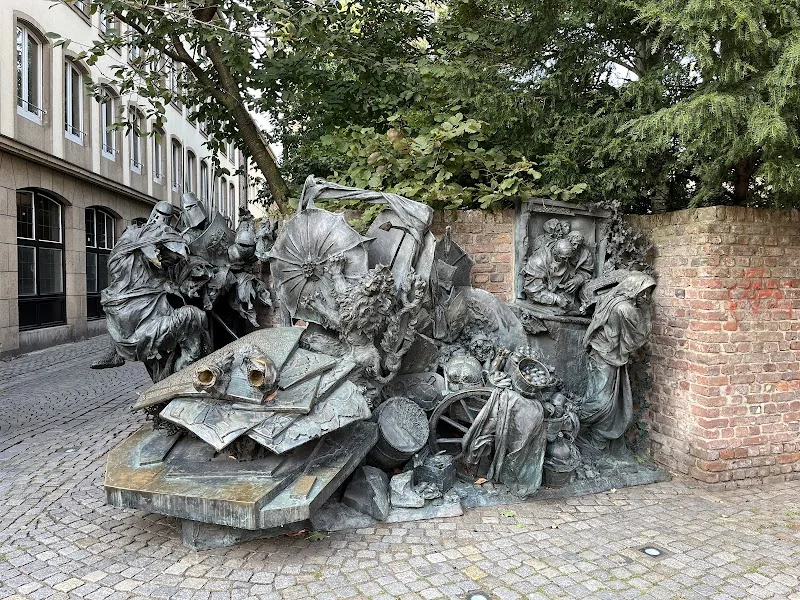
The City Founding Monument in Düsseldorf is much more than a memorial for a historical moment. It is a bronze narrative about the founding of the city, a work of art in public space, and a prominent anchor point in the old town that is hard to miss when visiting Burgplatz. Those searching for city founding monument düsseldorf photos, city founding memorial düsseldorf, or city founding düsseldorf quickly encounter this blend of history, symbolism, and urban landscape. The monument commemorates the year 1288, when Düsseldorf received city rights after the Battle of Worringen, and it was erected in 1988 for the 700th anniversary. The official description emphasizes the detailed bronze sculpture by Bert Gerresheim, which stands at the corner of Josef-Wimmer- and Müller-Schlösser-Gasse in Düsseldorf's old town. At the same time, the surroundings are vibrant: Burgplatz, Schlossturm, the Rhine promenade, and the old town with its sights are just a few steps apart. For this reason, the monument is not only a destination for history enthusiasts but also for walkers, photographers, and visitors who want to experience Düsseldorf in a concentrated yet very characteristic snapshot. ([visitduesseldorf.de](https://www.visitduesseldorf.de/attraktionen/stadterhebungsmonument-city-founding-monument-f2df78ccff))
City Founding Düsseldorf 1288: The History Behind the Monument
The central theme of the monument is the city founding of 1288. According to official sources, the year 1288 was crucial for Düsseldorf because the small settlement on the Düssel was granted city rights by Count Adolf V after the Battle of Worringen. The City Founding Monument refers to this historical turning point in its entire design. It does not merely commemorate a date but a political and cultural process: From a place of regional significance, it became a city with its own legal status and a history that increasingly differentiated itself. The museum description also highlights the connection to the city founding document and the elevation of the parish church dedicated to St. Lambertus to a canon's foundation. Thus, the monument spans the arc from the military situation to the formal legal act to the ecclesiastical and urban development. Those who read the surface of the relief understand not just a single event but the origin of an urban self-understanding that continues to shape Düsseldorf to this day. ([visitduesseldorf.de](https://www.visitduesseldorf.de/attraktionen/stadterhebungsmonument-city-founding-monument-f2df78ccff))
Particularly interesting is that the monument does not present history as a dry date but as a sequence of interconnected scenes. The inscriptions on the work refer to June 5, 1288, with the Battle of Worringen, to August 14, 1288, with the granting of city rights, and to September 8, 1288, with the elevation of St. Lambertus to a canon's foundation. This chronological arrangement makes the historical process visible and gives the monument a clear readability. Thus, those searching for düsseldorf city rights 1288 or battle of worringen düsseldorf find not an abstract memory but a very concrete reference point in the urban space. The bronze work connects political power relations, ecclesiastical development, and urban identity in a single public artwork. This explains why the monument is for many visitors not just a quick photo stop but a compressed entry into the early history of Düsseldorf. It is a monument that not only celebrates the origin of the city but makes it understandable. ([emuseum.duesseldorf.de](https://emuseum.duesseldorf.de/view/objects/asitem/items%240040%3A138077))
The formulation of the official texts also shows that this place is about more than just a culture of remembrance. The history of the city becomes visible as a result of decisions, conflicts, and symbolic images. The Battle of Worringen forms the prerequisite for the city founding, the document marks the legal act, and the depiction of St. Lambertus refers to the religious and institutional anchoring of the city. As a result, the City Founding Monument becomes a place where Düsseldorf tells its own story. This is important for visitors because one can read the location not just as a sight but as a historical signature. Therefore, those searching for city founding monument wikipedia often seek a quick explanation; however, the official interpretation provides a much richer perspective: It is about the history of a city that has visibly anchored its origins in public space. In connection with the old town and Burgplatz, this creates a very understandable historical tour that makes the location immediately accessible even for first-time visitors. ([visitduesseldorf.de](https://www.visitduesseldorf.de/attraktionen/stadterhebungsmonument-city-founding-monument-f2df78ccff))
Bert Gerresheim and the City Founding Monument in Bronze
The City Founding Monument is not only historically significant but also artistically remarkable. The official object description names Bert Gerresheim as the sculptor, with the date 8.8.1988 as the date of installation and bronze as the material. Additionally, the work is classified as a relief; its dimensions are 2.4 meters in height and 5 meters in length, and the bronze weight is 5.5 tons. These figures make it clear that this is a large, permanently designed work of art that was deliberately created for public space. For those searching for bert gerresheim city founding monument, this connection is important: A local artist shapes a central narrative of the city in a monument that does not stand in a museum but right in the old town. The casting was carried out by Karl-Heinz Schmäke KG, the sponsorship lies with the Düsseldorfer Jonges, and the local heritage association is also mentioned as a donor. Thus, the artwork is simultaneously sculpture, city narrative, and civic project. ([emuseum.duesseldorf.de](https://emuseum.duesseldorf.de/view/objects/asitem/items%240040%3A138077))
The official description also makes it clear that the monument functions like a multi-part collage. Gerresheim describes, in essence, that it must be read: from left to right to discover chronological sequences, from front to back to gain insights and perspectives, and from top to bottom to experience history as layering. This is central to the perception of the work because the monument cannot be fully understood with a single glance. Instead, it invites a slow, almost detective-like observation. The museum explanation also mentions the symbolic elements: Plans of the growing city, coat of arms images of the involved princes, the Bergische lion, the anchor from the city coat of arms, and the market cart as a sign of the economic history of the city. Such details turn the relief into a visual history book. Therefore, those interested in city founding monument düsseldorf photos discover not only an attractive surface but many small hints that connect early urban development, politics, and economics. ([emuseum.duesseldorf.de](https://emuseum.duesseldorf.de/view/objects/asitem/items%240040%3A138077))
Additionally, there is the anniversary context: The monument was erected in 1988 for the 700th anniversary of the city founding of Düsseldorf. This timing is important because it shows that the work did not arise by chance but as a deliberate memorial. The history of its foundation and installation connects the city anniversary, civic engagement, and art in public space. For SEO terms like city founding monument wikipedia or city founding monument düsseldorf error, this is relevant because many search queries likely come from users looking for quick orientation or who are not entirely sure of the name of the monument. However, it is worthwhile to precisely categorize the content: It is a bronze relief installed in 1988 by Bert Gerresheim that tells the story of Düsseldorf's founding in several scenes. This accuracy makes the location so interesting, as the monument is neither merely decorative nor purely representative. It is a public narrative with artistic ambition and historical core. ([emuseum.duesseldorf.de](https://emuseum.duesseldorf.de/view/objects/asitem/items%240040%3A138077))
Burgplatz, Marketplace, and Old Town: How to Find the Monument
For orientation, it is advisable to take the official location information seriously: The City Founding Monument is located in the old town at the corner of Josef-Wimmer- and Müller-Schlösser-Gasse; the object description also mentions Burgplatz as the nearest house number. Therefore, those searching for city founding monument marketplace düsseldorf are likely looking for the area around the historic squares of the old town. However, the safe orientation is Burgplatz, as it is in immediate proximity and appears as a central reference point of the old town in the official visitor information. Burgplatz connects the old town and the Rhine promenade and is one of the most prominent places in the city. There, one encounters cobblestones, the Schlossturm, and the transition to the Rhine promenade. It is precisely in this urban fabric that the City Founding Monument unfolds its effect. It does not stand in isolation but in a space shaped equally by city history, tourism, and everyday life. ([visitduesseldorf.de](https://www.visitduesseldorf.de/attraktionen/stadterhebungsmonument-city-founding-monument-f2df78ccff))
The official old town description emphasizes how dense this environment is. The area covers only half a square kilometer and is still known as the longest bar in the world. Between Heinrich-Heine-Allee, Hofgarten, Rhine promenade, and Carlstadt, there are more than 260 options for dining and drinking, along with sights such as St. Lambertus Basilica, the Schlossturm at Burgplatz, the historic town hall, and the Jan-Wellem equestrian statue. For this reason, the City Founding Monument is easily integrable into a city tour for visitors: It can be incorporated into a larger walk with just a few steps, without long distances or complicated detours. Those interested in old town düsseldorf sights find here a place where history, gastronomy, and urban space come together directly. The search combination city founding monument access is also easier to answer, as the monument is located in a well-connected and heavily visited part of Düsseldorf. ([visitduesseldorf.de](https://www.visitduesseldorf.de/en/attractions/altstadt-old-town-e2f8426a5c))
Particularly appealing is the spatial connection with Burgplatz itself. According to the tourist description, it is one of the most beautiful German squares of the post-war period and connects the old town and the Rhine promenade. The old Schlossturm dominates the square and now houses the SchifffahrtMuseum Düsseldorf. The steps to the Rhine promenade are a popular spot for sunset views. For the City Founding Monument, this means: It stands in an ensemble that offers multiple perspectives within short distances. One can grasp the monument, the Schlossturm, the Rhine side, and the old town in a small tour. For guests who want to take photos, this is ideal because the location is not only a motif in itself but also has a strong backdrop. This mix of monument and city panorama makes the visit so worthwhile. Those who stroll around the place without haste quickly notice that the monument is important not only because of its history but also because of its strong integration into the visibility and pathways of the old town. ([visitduesseldorf.de](https://www.visitduesseldorf.de/attraktionen/burgplatz-e71a019220))
Access and Parking at the City Founding Monument
For access, it is especially important that Düsseldorf's old town is very centrally located and can be reached in various ways. The official visitor information for the Burgplatz and old town area refers to access by car, bike, on foot, by bus, and by train. Additionally, there is a hop-on-hop-off stop at Burgplatz, which shows that the location is intentionally connected to tourism. Those who want to visit the City Founding Monument can easily incorporate their route into a city walk or a tour. This is particularly helpful for first-time visitors because the old town, while compact, has very busy paths. The combination of footpaths, public transport, and tourist stops makes the location easily accessible. Therefore, the practical answer to the search query city founding monument access is: Central city location, good tourist integration, short distances between the main points of the old town. ([visitduesseldorf.de](https://www.visitduesseldorf.de/attraktionen/stadterhebungsmonument-city-founding-monument-f2df78ccff))
When it comes to city founding monument parking, the city's parking guidance system is helpful. Düsseldorf states that around 11,000 parking spaces in parking lots, garages, and underground garages are connected to the central computer of the system. Dynamic and static display boards are intended to guide drivers to available spaces, and current occupancy information is accessible online. This is useful for visitors to the old town because the historic core is heavily frequented, and available spaces can change rapidly depending on the time of day. Therefore, those coming by car should not rely on a single parking space but use the city's guidance system and current occupancy information. Additionally, Düsseldorf refers to park-and-ride offers in and around the city area, which facilitate the switch to public transport. For a visit to the City Founding Monument, this is often the more relaxing solution, especially if one wants to continue exploring the old town, the Rhine, or the Schlossturm afterward. ([duesseldorf.de](https://www.duesseldorf.de/verkehrsmanagement/mit-dem-auto/parken-in-duesseldorf.html))
It is also important to realistically assess the location: The monument does not stand in a traffic-quiet edge area but right in a bustling center. For this reason, short distances on-site are pleasant, but finding a direct parking space can sometimes be more complicated. Those who want to experience the old town leisurely should plan enough time, combine the visit with a walk, and use the available infrastructure whenever possible. The parking guidance system serves as a concrete orientation aid, while the tourist aspects of city marketing mark Burgplatz as the central starting point for exploration. In summary, this means: Access and parking are generally manageable, but in the city center, some planning is worthwhile. This leaves more time for the actual visit and less for searching for parking. This practical clarity is also relevant for users searching for city founding monument parking or quick access information. ([duesseldorf.de](https://www.duesseldorf.de/verkehrsmanagement/mit-dem-auto/parken-in-duesseldorf.html))
Photos, Tour, and Highlights Around the City Founding Monument
Those who want to photograph the City Founding Monument benefit from its open location in urban space and the strong imagery of the relief. The art thrives on richness of detail, symbolism, and layering, making not only overall views worthwhile but also close-ups. Especially because the work is a multi-part collage, a different impression arises with each step. This makes the location interesting for photos without requiring any special staging. The bronze surface, the plastic scenes, and the reference to Burgplatz together create a very typical Düsseldorf cityscape. For the search phrase city founding monument düsseldorf photos, it is particularly important: It is a monument that visually offers many layers. One can capture the work as a historical monument, as an art object, and as part of a vibrant old town landscape. Those who look closely will find that the impact of the monument lies more in careful observation than in quick passing. ([emuseum.duesseldorf.de](https://emuseum.duesseldorf.de/view/objects/asitem/items%240040%3A138077))
A visit can be very well combined with the sights at Burgplatz. Directly nearby is the Schlossturm, the last remnant of Düsseldorf Castle, now home to the SchifffahrtMuseum. The steps to the Rhine promenade are a popular spot for views of the river, and the old town itself offers a dense mix of historical places, gastronomy, and pathways through city history. The official city founding page even points out that several long-established breweries are located nearby. This is a nice example of how history and the present overlap at this location. Therefore, those planning an old town tour can use the monument as an entry point, a stopover, or a conclusion. It is also ideal for visitors who have little time because one can gather very different impressions in a short distance: art, history, river, town hall, Schlossturm, and old town life. ([visitduesseldorf.de](https://www.visitduesseldorf.de/attraktionen/burgplatz-e71a019220))
In the end, the City Founding Monument shows exactly what makes Düsseldorf in the old town so special: A city that does not keep its history at a distance but has integrated it into everyday life. The monument is public, accessible, and rich in meaning. It functions as a memory place for the city founding of 1288, as an artistic work by Bert Gerresheim, and as a starting point for a very compact city tour. Those interested in history receive a clear narrative. Those who want to take photos get strong motifs. Those who want to experience the old town find here a starting point with genuine depth. And those searching for a place that works for both short visits and longer walks will likely find it at Burgplatz. For this reason, the City Founding Monument remains one of the most prominent memorials in Düsseldorf. ([emuseum.duesseldorf.de](https://emuseum.duesseldorf.de/view/objects/asitem/items%240040%3A138077))
Sources:
Mehr anzeigenWeniger anzeigen
City Founding Monument Düsseldorf | History & Photos
The City Founding Monument in Düsseldorf is much more than a memorial for a historical moment. It is a bronze narrative about the founding of the city, a work of art in public space, and a prominent anchor point in the old town that is hard to miss when visiting Burgplatz. Those searching for city founding monument düsseldorf photos, city founding memorial düsseldorf, or city founding düsseldorf quickly encounter this blend of history, symbolism, and urban landscape. The monument commemorates the year 1288, when Düsseldorf received city rights after the Battle of Worringen, and it was erected in 1988 for the 700th anniversary. The official description emphasizes the detailed bronze sculpture by Bert Gerresheim, which stands at the corner of Josef-Wimmer- and Müller-Schlösser-Gasse in Düsseldorf's old town. At the same time, the surroundings are vibrant: Burgplatz, Schlossturm, the Rhine promenade, and the old town with its sights are just a few steps apart. For this reason, the monument is not only a destination for history enthusiasts but also for walkers, photographers, and visitors who want to experience Düsseldorf in a concentrated yet very characteristic snapshot. ([visitduesseldorf.de](https://www.visitduesseldorf.de/attraktionen/stadterhebungsmonument-city-founding-monument-f2df78ccff))
City Founding Düsseldorf 1288: The History Behind the Monument
The central theme of the monument is the city founding of 1288. According to official sources, the year 1288 was crucial for Düsseldorf because the small settlement on the Düssel was granted city rights by Count Adolf V after the Battle of Worringen. The City Founding Monument refers to this historical turning point in its entire design. It does not merely commemorate a date but a political and cultural process: From a place of regional significance, it became a city with its own legal status and a history that increasingly differentiated itself. The museum description also highlights the connection to the city founding document and the elevation of the parish church dedicated to St. Lambertus to a canon's foundation. Thus, the monument spans the arc from the military situation to the formal legal act to the ecclesiastical and urban development. Those who read the surface of the relief understand not just a single event but the origin of an urban self-understanding that continues to shape Düsseldorf to this day. ([visitduesseldorf.de](https://www.visitduesseldorf.de/attraktionen/stadterhebungsmonument-city-founding-monument-f2df78ccff))
Particularly interesting is that the monument does not present history as a dry date but as a sequence of interconnected scenes. The inscriptions on the work refer to June 5, 1288, with the Battle of Worringen, to August 14, 1288, with the granting of city rights, and to September 8, 1288, with the elevation of St. Lambertus to a canon's foundation. This chronological arrangement makes the historical process visible and gives the monument a clear readability. Thus, those searching for düsseldorf city rights 1288 or battle of worringen düsseldorf find not an abstract memory but a very concrete reference point in the urban space. The bronze work connects political power relations, ecclesiastical development, and urban identity in a single public artwork. This explains why the monument is for many visitors not just a quick photo stop but a compressed entry into the early history of Düsseldorf. It is a monument that not only celebrates the origin of the city but makes it understandable. ([emuseum.duesseldorf.de](https://emuseum.duesseldorf.de/view/objects/asitem/items%240040%3A138077))
The formulation of the official texts also shows that this place is about more than just a culture of remembrance. The history of the city becomes visible as a result of decisions, conflicts, and symbolic images. The Battle of Worringen forms the prerequisite for the city founding, the document marks the legal act, and the depiction of St. Lambertus refers to the religious and institutional anchoring of the city. As a result, the City Founding Monument becomes a place where Düsseldorf tells its own story. This is important for visitors because one can read the location not just as a sight but as a historical signature. Therefore, those searching for city founding monument wikipedia often seek a quick explanation; however, the official interpretation provides a much richer perspective: It is about the history of a city that has visibly anchored its origins in public space. In connection with the old town and Burgplatz, this creates a very understandable historical tour that makes the location immediately accessible even for first-time visitors. ([visitduesseldorf.de](https://www.visitduesseldorf.de/attraktionen/stadterhebungsmonument-city-founding-monument-f2df78ccff))
Bert Gerresheim and the City Founding Monument in Bronze
The City Founding Monument is not only historically significant but also artistically remarkable. The official object description names Bert Gerresheim as the sculptor, with the date 8.8.1988 as the date of installation and bronze as the material. Additionally, the work is classified as a relief; its dimensions are 2.4 meters in height and 5 meters in length, and the bronze weight is 5.5 tons. These figures make it clear that this is a large, permanently designed work of art that was deliberately created for public space. For those searching for bert gerresheim city founding monument, this connection is important: A local artist shapes a central narrative of the city in a monument that does not stand in a museum but right in the old town. The casting was carried out by Karl-Heinz Schmäke KG, the sponsorship lies with the Düsseldorfer Jonges, and the local heritage association is also mentioned as a donor. Thus, the artwork is simultaneously sculpture, city narrative, and civic project. ([emuseum.duesseldorf.de](https://emuseum.duesseldorf.de/view/objects/asitem/items%240040%3A138077))
The official description also makes it clear that the monument functions like a multi-part collage. Gerresheim describes, in essence, that it must be read: from left to right to discover chronological sequences, from front to back to gain insights and perspectives, and from top to bottom to experience history as layering. This is central to the perception of the work because the monument cannot be fully understood with a single glance. Instead, it invites a slow, almost detective-like observation. The museum explanation also mentions the symbolic elements: Plans of the growing city, coat of arms images of the involved princes, the Bergische lion, the anchor from the city coat of arms, and the market cart as a sign of the economic history of the city. Such details turn the relief into a visual history book. Therefore, those interested in city founding monument düsseldorf photos discover not only an attractive surface but many small hints that connect early urban development, politics, and economics. ([emuseum.duesseldorf.de](https://emuseum.duesseldorf.de/view/objects/asitem/items%240040%3A138077))
Additionally, there is the anniversary context: The monument was erected in 1988 for the 700th anniversary of the city founding of Düsseldorf. This timing is important because it shows that the work did not arise by chance but as a deliberate memorial. The history of its foundation and installation connects the city anniversary, civic engagement, and art in public space. For SEO terms like city founding monument wikipedia or city founding monument düsseldorf error, this is relevant because many search queries likely come from users looking for quick orientation or who are not entirely sure of the name of the monument. However, it is worthwhile to precisely categorize the content: It is a bronze relief installed in 1988 by Bert Gerresheim that tells the story of Düsseldorf's founding in several scenes. This accuracy makes the location so interesting, as the monument is neither merely decorative nor purely representative. It is a public narrative with artistic ambition and historical core. ([emuseum.duesseldorf.de](https://emuseum.duesseldorf.de/view/objects/asitem/items%240040%3A138077))
Burgplatz, Marketplace, and Old Town: How to Find the Monument
For orientation, it is advisable to take the official location information seriously: The City Founding Monument is located in the old town at the corner of Josef-Wimmer- and Müller-Schlösser-Gasse; the object description also mentions Burgplatz as the nearest house number. Therefore, those searching for city founding monument marketplace düsseldorf are likely looking for the area around the historic squares of the old town. However, the safe orientation is Burgplatz, as it is in immediate proximity and appears as a central reference point of the old town in the official visitor information. Burgplatz connects the old town and the Rhine promenade and is one of the most prominent places in the city. There, one encounters cobblestones, the Schlossturm, and the transition to the Rhine promenade. It is precisely in this urban fabric that the City Founding Monument unfolds its effect. It does not stand in isolation but in a space shaped equally by city history, tourism, and everyday life. ([visitduesseldorf.de](https://www.visitduesseldorf.de/attraktionen/stadterhebungsmonument-city-founding-monument-f2df78ccff))
The official old town description emphasizes how dense this environment is. The area covers only half a square kilometer and is still known as the longest bar in the world. Between Heinrich-Heine-Allee, Hofgarten, Rhine promenade, and Carlstadt, there are more than 260 options for dining and drinking, along with sights such as St. Lambertus Basilica, the Schlossturm at Burgplatz, the historic town hall, and the Jan-Wellem equestrian statue. For this reason, the City Founding Monument is easily integrable into a city tour for visitors: It can be incorporated into a larger walk with just a few steps, without long distances or complicated detours. Those interested in old town düsseldorf sights find here a place where history, gastronomy, and urban space come together directly. The search combination city founding monument access is also easier to answer, as the monument is located in a well-connected and heavily visited part of Düsseldorf. ([visitduesseldorf.de](https://www.visitduesseldorf.de/en/attractions/altstadt-old-town-e2f8426a5c))
Particularly appealing is the spatial connection with Burgplatz itself. According to the tourist description, it is one of the most beautiful German squares of the post-war period and connects the old town and the Rhine promenade. The old Schlossturm dominates the square and now houses the SchifffahrtMuseum Düsseldorf. The steps to the Rhine promenade are a popular spot for sunset views. For the City Founding Monument, this means: It stands in an ensemble that offers multiple perspectives within short distances. One can grasp the monument, the Schlossturm, the Rhine side, and the old town in a small tour. For guests who want to take photos, this is ideal because the location is not only a motif in itself but also has a strong backdrop. This mix of monument and city panorama makes the visit so worthwhile. Those who stroll around the place without haste quickly notice that the monument is important not only because of its history but also because of its strong integration into the visibility and pathways of the old town. ([visitduesseldorf.de](https://www.visitduesseldorf.de/attraktionen/burgplatz-e71a019220))
Access and Parking at the City Founding Monument
For access, it is especially important that Düsseldorf's old town is very centrally located and can be reached in various ways. The official visitor information for the Burgplatz and old town area refers to access by car, bike, on foot, by bus, and by train. Additionally, there is a hop-on-hop-off stop at Burgplatz, which shows that the location is intentionally connected to tourism. Those who want to visit the City Founding Monument can easily incorporate their route into a city walk or a tour. This is particularly helpful for first-time visitors because the old town, while compact, has very busy paths. The combination of footpaths, public transport, and tourist stops makes the location easily accessible. Therefore, the practical answer to the search query city founding monument access is: Central city location, good tourist integration, short distances between the main points of the old town. ([visitduesseldorf.de](https://www.visitduesseldorf.de/attraktionen/stadterhebungsmonument-city-founding-monument-f2df78ccff))
When it comes to city founding monument parking, the city's parking guidance system is helpful. Düsseldorf states that around 11,000 parking spaces in parking lots, garages, and underground garages are connected to the central computer of the system. Dynamic and static display boards are intended to guide drivers to available spaces, and current occupancy information is accessible online. This is useful for visitors to the old town because the historic core is heavily frequented, and available spaces can change rapidly depending on the time of day. Therefore, those coming by car should not rely on a single parking space but use the city's guidance system and current occupancy information. Additionally, Düsseldorf refers to park-and-ride offers in and around the city area, which facilitate the switch to public transport. For a visit to the City Founding Monument, this is often the more relaxing solution, especially if one wants to continue exploring the old town, the Rhine, or the Schlossturm afterward. ([duesseldorf.de](https://www.duesseldorf.de/verkehrsmanagement/mit-dem-auto/parken-in-duesseldorf.html))
It is also important to realistically assess the location: The monument does not stand in a traffic-quiet edge area but right in a bustling center. For this reason, short distances on-site are pleasant, but finding a direct parking space can sometimes be more complicated. Those who want to experience the old town leisurely should plan enough time, combine the visit with a walk, and use the available infrastructure whenever possible. The parking guidance system serves as a concrete orientation aid, while the tourist aspects of city marketing mark Burgplatz as the central starting point for exploration. In summary, this means: Access and parking are generally manageable, but in the city center, some planning is worthwhile. This leaves more time for the actual visit and less for searching for parking. This practical clarity is also relevant for users searching for city founding monument parking or quick access information. ([duesseldorf.de](https://www.duesseldorf.de/verkehrsmanagement/mit-dem-auto/parken-in-duesseldorf.html))
Photos, Tour, and Highlights Around the City Founding Monument
Those who want to photograph the City Founding Monument benefit from its open location in urban space and the strong imagery of the relief. The art thrives on richness of detail, symbolism, and layering, making not only overall views worthwhile but also close-ups. Especially because the work is a multi-part collage, a different impression arises with each step. This makes the location interesting for photos without requiring any special staging. The bronze surface, the plastic scenes, and the reference to Burgplatz together create a very typical Düsseldorf cityscape. For the search phrase city founding monument düsseldorf photos, it is particularly important: It is a monument that visually offers many layers. One can capture the work as a historical monument, as an art object, and as part of a vibrant old town landscape. Those who look closely will find that the impact of the monument lies more in careful observation than in quick passing. ([emuseum.duesseldorf.de](https://emuseum.duesseldorf.de/view/objects/asitem/items%240040%3A138077))
A visit can be very well combined with the sights at Burgplatz. Directly nearby is the Schlossturm, the last remnant of Düsseldorf Castle, now home to the SchifffahrtMuseum. The steps to the Rhine promenade are a popular spot for views of the river, and the old town itself offers a dense mix of historical places, gastronomy, and pathways through city history. The official city founding page even points out that several long-established breweries are located nearby. This is a nice example of how history and the present overlap at this location. Therefore, those planning an old town tour can use the monument as an entry point, a stopover, or a conclusion. It is also ideal for visitors who have little time because one can gather very different impressions in a short distance: art, history, river, town hall, Schlossturm, and old town life. ([visitduesseldorf.de](https://www.visitduesseldorf.de/attraktionen/burgplatz-e71a019220))
In the end, the City Founding Monument shows exactly what makes Düsseldorf in the old town so special: A city that does not keep its history at a distance but has integrated it into everyday life. The monument is public, accessible, and rich in meaning. It functions as a memory place for the city founding of 1288, as an artistic work by Bert Gerresheim, and as a starting point for a very compact city tour. Those interested in history receive a clear narrative. Those who want to take photos get strong motifs. Those who want to experience the old town find here a starting point with genuine depth. And those searching for a place that works for both short visits and longer walks will likely find it at Burgplatz. For this reason, the City Founding Monument remains one of the most prominent memorials in Düsseldorf. ([emuseum.duesseldorf.de](https://emuseum.duesseldorf.de/view/objects/asitem/items%240040%3A138077))
Sources:
City Founding Monument Düsseldorf | History & Photos
The City Founding Monument in Düsseldorf is much more than a memorial for a historical moment. It is a bronze narrative about the founding of the city, a work of art in public space, and a prominent anchor point in the old town that is hard to miss when visiting Burgplatz. Those searching for city founding monument düsseldorf photos, city founding memorial düsseldorf, or city founding düsseldorf quickly encounter this blend of history, symbolism, and urban landscape. The monument commemorates the year 1288, when Düsseldorf received city rights after the Battle of Worringen, and it was erected in 1988 for the 700th anniversary. The official description emphasizes the detailed bronze sculpture by Bert Gerresheim, which stands at the corner of Josef-Wimmer- and Müller-Schlösser-Gasse in Düsseldorf's old town. At the same time, the surroundings are vibrant: Burgplatz, Schlossturm, the Rhine promenade, and the old town with its sights are just a few steps apart. For this reason, the monument is not only a destination for history enthusiasts but also for walkers, photographers, and visitors who want to experience Düsseldorf in a concentrated yet very characteristic snapshot. ([visitduesseldorf.de](https://www.visitduesseldorf.de/attraktionen/stadterhebungsmonument-city-founding-monument-f2df78ccff))
City Founding Düsseldorf 1288: The History Behind the Monument
The central theme of the monument is the city founding of 1288. According to official sources, the year 1288 was crucial for Düsseldorf because the small settlement on the Düssel was granted city rights by Count Adolf V after the Battle of Worringen. The City Founding Monument refers to this historical turning point in its entire design. It does not merely commemorate a date but a political and cultural process: From a place of regional significance, it became a city with its own legal status and a history that increasingly differentiated itself. The museum description also highlights the connection to the city founding document and the elevation of the parish church dedicated to St. Lambertus to a canon's foundation. Thus, the monument spans the arc from the military situation to the formal legal act to the ecclesiastical and urban development. Those who read the surface of the relief understand not just a single event but the origin of an urban self-understanding that continues to shape Düsseldorf to this day. ([visitduesseldorf.de](https://www.visitduesseldorf.de/attraktionen/stadterhebungsmonument-city-founding-monument-f2df78ccff))
Particularly interesting is that the monument does not present history as a dry date but as a sequence of interconnected scenes. The inscriptions on the work refer to June 5, 1288, with the Battle of Worringen, to August 14, 1288, with the granting of city rights, and to September 8, 1288, with the elevation of St. Lambertus to a canon's foundation. This chronological arrangement makes the historical process visible and gives the monument a clear readability. Thus, those searching for düsseldorf city rights 1288 or battle of worringen düsseldorf find not an abstract memory but a very concrete reference point in the urban space. The bronze work connects political power relations, ecclesiastical development, and urban identity in a single public artwork. This explains why the monument is for many visitors not just a quick photo stop but a compressed entry into the early history of Düsseldorf. It is a monument that not only celebrates the origin of the city but makes it understandable. ([emuseum.duesseldorf.de](https://emuseum.duesseldorf.de/view/objects/asitem/items%240040%3A138077))
The formulation of the official texts also shows that this place is about more than just a culture of remembrance. The history of the city becomes visible as a result of decisions, conflicts, and symbolic images. The Battle of Worringen forms the prerequisite for the city founding, the document marks the legal act, and the depiction of St. Lambertus refers to the religious and institutional anchoring of the city. As a result, the City Founding Monument becomes a place where Düsseldorf tells its own story. This is important for visitors because one can read the location not just as a sight but as a historical signature. Therefore, those searching for city founding monument wikipedia often seek a quick explanation; however, the official interpretation provides a much richer perspective: It is about the history of a city that has visibly anchored its origins in public space. In connection with the old town and Burgplatz, this creates a very understandable historical tour that makes the location immediately accessible even for first-time visitors. ([visitduesseldorf.de](https://www.visitduesseldorf.de/attraktionen/stadterhebungsmonument-city-founding-monument-f2df78ccff))
Bert Gerresheim and the City Founding Monument in Bronze
The City Founding Monument is not only historically significant but also artistically remarkable. The official object description names Bert Gerresheim as the sculptor, with the date 8.8.1988 as the date of installation and bronze as the material. Additionally, the work is classified as a relief; its dimensions are 2.4 meters in height and 5 meters in length, and the bronze weight is 5.5 tons. These figures make it clear that this is a large, permanently designed work of art that was deliberately created for public space. For those searching for bert gerresheim city founding monument, this connection is important: A local artist shapes a central narrative of the city in a monument that does not stand in a museum but right in the old town. The casting was carried out by Karl-Heinz Schmäke KG, the sponsorship lies with the Düsseldorfer Jonges, and the local heritage association is also mentioned as a donor. Thus, the artwork is simultaneously sculpture, city narrative, and civic project. ([emuseum.duesseldorf.de](https://emuseum.duesseldorf.de/view/objects/asitem/items%240040%3A138077))
The official description also makes it clear that the monument functions like a multi-part collage. Gerresheim describes, in essence, that it must be read: from left to right to discover chronological sequences, from front to back to gain insights and perspectives, and from top to bottom to experience history as layering. This is central to the perception of the work because the monument cannot be fully understood with a single glance. Instead, it invites a slow, almost detective-like observation. The museum explanation also mentions the symbolic elements: Plans of the growing city, coat of arms images of the involved princes, the Bergische lion, the anchor from the city coat of arms, and the market cart as a sign of the economic history of the city. Such details turn the relief into a visual history book. Therefore, those interested in city founding monument düsseldorf photos discover not only an attractive surface but many small hints that connect early urban development, politics, and economics. ([emuseum.duesseldorf.de](https://emuseum.duesseldorf.de/view/objects/asitem/items%240040%3A138077))
Additionally, there is the anniversary context: The monument was erected in 1988 for the 700th anniversary of the city founding of Düsseldorf. This timing is important because it shows that the work did not arise by chance but as a deliberate memorial. The history of its foundation and installation connects the city anniversary, civic engagement, and art in public space. For SEO terms like city founding monument wikipedia or city founding monument düsseldorf error, this is relevant because many search queries likely come from users looking for quick orientation or who are not entirely sure of the name of the monument. However, it is worthwhile to precisely categorize the content: It is a bronze relief installed in 1988 by Bert Gerresheim that tells the story of Düsseldorf's founding in several scenes. This accuracy makes the location so interesting, as the monument is neither merely decorative nor purely representative. It is a public narrative with artistic ambition and historical core. ([emuseum.duesseldorf.de](https://emuseum.duesseldorf.de/view/objects/asitem/items%240040%3A138077))
Burgplatz, Marketplace, and Old Town: How to Find the Monument
For orientation, it is advisable to take the official location information seriously: The City Founding Monument is located in the old town at the corner of Josef-Wimmer- and Müller-Schlösser-Gasse; the object description also mentions Burgplatz as the nearest house number. Therefore, those searching for city founding monument marketplace düsseldorf are likely looking for the area around the historic squares of the old town. However, the safe orientation is Burgplatz, as it is in immediate proximity and appears as a central reference point of the old town in the official visitor information. Burgplatz connects the old town and the Rhine promenade and is one of the most prominent places in the city. There, one encounters cobblestones, the Schlossturm, and the transition to the Rhine promenade. It is precisely in this urban fabric that the City Founding Monument unfolds its effect. It does not stand in isolation but in a space shaped equally by city history, tourism, and everyday life. ([visitduesseldorf.de](https://www.visitduesseldorf.de/attraktionen/stadterhebungsmonument-city-founding-monument-f2df78ccff))
The official old town description emphasizes how dense this environment is. The area covers only half a square kilometer and is still known as the longest bar in the world. Between Heinrich-Heine-Allee, Hofgarten, Rhine promenade, and Carlstadt, there are more than 260 options for dining and drinking, along with sights such as St. Lambertus Basilica, the Schlossturm at Burgplatz, the historic town hall, and the Jan-Wellem equestrian statue. For this reason, the City Founding Monument is easily integrable into a city tour for visitors: It can be incorporated into a larger walk with just a few steps, without long distances or complicated detours. Those interested in old town düsseldorf sights find here a place where history, gastronomy, and urban space come together directly. The search combination city founding monument access is also easier to answer, as the monument is located in a well-connected and heavily visited part of Düsseldorf. ([visitduesseldorf.de](https://www.visitduesseldorf.de/en/attractions/altstadt-old-town-e2f8426a5c))
Particularly appealing is the spatial connection with Burgplatz itself. According to the tourist description, it is one of the most beautiful German squares of the post-war period and connects the old town and the Rhine promenade. The old Schlossturm dominates the square and now houses the SchifffahrtMuseum Düsseldorf. The steps to the Rhine promenade are a popular spot for sunset views. For the City Founding Monument, this means: It stands in an ensemble that offers multiple perspectives within short distances. One can grasp the monument, the Schlossturm, the Rhine side, and the old town in a small tour. For guests who want to take photos, this is ideal because the location is not only a motif in itself but also has a strong backdrop. This mix of monument and city panorama makes the visit so worthwhile. Those who stroll around the place without haste quickly notice that the monument is important not only because of its history but also because of its strong integration into the visibility and pathways of the old town. ([visitduesseldorf.de](https://www.visitduesseldorf.de/attraktionen/burgplatz-e71a019220))
Access and Parking at the City Founding Monument
For access, it is especially important that Düsseldorf's old town is very centrally located and can be reached in various ways. The official visitor information for the Burgplatz and old town area refers to access by car, bike, on foot, by bus, and by train. Additionally, there is a hop-on-hop-off stop at Burgplatz, which shows that the location is intentionally connected to tourism. Those who want to visit the City Founding Monument can easily incorporate their route into a city walk or a tour. This is particularly helpful for first-time visitors because the old town, while compact, has very busy paths. The combination of footpaths, public transport, and tourist stops makes the location easily accessible. Therefore, the practical answer to the search query city founding monument access is: Central city location, good tourist integration, short distances between the main points of the old town. ([visitduesseldorf.de](https://www.visitduesseldorf.de/attraktionen/stadterhebungsmonument-city-founding-monument-f2df78ccff))
When it comes to city founding monument parking, the city's parking guidance system is helpful. Düsseldorf states that around 11,000 parking spaces in parking lots, garages, and underground garages are connected to the central computer of the system. Dynamic and static display boards are intended to guide drivers to available spaces, and current occupancy information is accessible online. This is useful for visitors to the old town because the historic core is heavily frequented, and available spaces can change rapidly depending on the time of day. Therefore, those coming by car should not rely on a single parking space but use the city's guidance system and current occupancy information. Additionally, Düsseldorf refers to park-and-ride offers in and around the city area, which facilitate the switch to public transport. For a visit to the City Founding Monument, this is often the more relaxing solution, especially if one wants to continue exploring the old town, the Rhine, or the Schlossturm afterward. ([duesseldorf.de](https://www.duesseldorf.de/verkehrsmanagement/mit-dem-auto/parken-in-duesseldorf.html))
It is also important to realistically assess the location: The monument does not stand in a traffic-quiet edge area but right in a bustling center. For this reason, short distances on-site are pleasant, but finding a direct parking space can sometimes be more complicated. Those who want to experience the old town leisurely should plan enough time, combine the visit with a walk, and use the available infrastructure whenever possible. The parking guidance system serves as a concrete orientation aid, while the tourist aspects of city marketing mark Burgplatz as the central starting point for exploration. In summary, this means: Access and parking are generally manageable, but in the city center, some planning is worthwhile. This leaves more time for the actual visit and less for searching for parking. This practical clarity is also relevant for users searching for city founding monument parking or quick access information. ([duesseldorf.de](https://www.duesseldorf.de/verkehrsmanagement/mit-dem-auto/parken-in-duesseldorf.html))
Photos, Tour, and Highlights Around the City Founding Monument
Those who want to photograph the City Founding Monument benefit from its open location in urban space and the strong imagery of the relief. The art thrives on richness of detail, symbolism, and layering, making not only overall views worthwhile but also close-ups. Especially because the work is a multi-part collage, a different impression arises with each step. This makes the location interesting for photos without requiring any special staging. The bronze surface, the plastic scenes, and the reference to Burgplatz together create a very typical Düsseldorf cityscape. For the search phrase city founding monument düsseldorf photos, it is particularly important: It is a monument that visually offers many layers. One can capture the work as a historical monument, as an art object, and as part of a vibrant old town landscape. Those who look closely will find that the impact of the monument lies more in careful observation than in quick passing. ([emuseum.duesseldorf.de](https://emuseum.duesseldorf.de/view/objects/asitem/items%240040%3A138077))
A visit can be very well combined with the sights at Burgplatz. Directly nearby is the Schlossturm, the last remnant of Düsseldorf Castle, now home to the SchifffahrtMuseum. The steps to the Rhine promenade are a popular spot for views of the river, and the old town itself offers a dense mix of historical places, gastronomy, and pathways through city history. The official city founding page even points out that several long-established breweries are located nearby. This is a nice example of how history and the present overlap at this location. Therefore, those planning an old town tour can use the monument as an entry point, a stopover, or a conclusion. It is also ideal for visitors who have little time because one can gather very different impressions in a short distance: art, history, river, town hall, Schlossturm, and old town life. ([visitduesseldorf.de](https://www.visitduesseldorf.de/attraktionen/burgplatz-e71a019220))
In the end, the City Founding Monument shows exactly what makes Düsseldorf in the old town so special: A city that does not keep its history at a distance but has integrated it into everyday life. The monument is public, accessible, and rich in meaning. It functions as a memory place for the city founding of 1288, as an artistic work by Bert Gerresheim, and as a starting point for a very compact city tour. Those interested in history receive a clear narrative. Those who want to take photos get strong motifs. Those who want to experience the old town find here a starting point with genuine depth. And those searching for a place that works for both short visits and longer walks will likely find it at Burgplatz. For this reason, the City Founding Monument remains one of the most prominent memorials in Düsseldorf. ([emuseum.duesseldorf.de](https://emuseum.duesseldorf.de/view/objects/asitem/items%240040%3A138077))
Sources:
Upcoming Events
No events found
Frequently Asked Questions
Reviews
Floyd Cooper
26. April 2026
A stunning, exquisitely crafted sculpture dedicated to Düsseldorf obtaining city rights in the 13th century. Proves that modern artists can create beauty too.
Maksym Check
1. January 2026
Stadterhebungsmonument is one of Düsseldorf’s most impressive public sculptures. The bronze monument is incredibly detailed and tells the story of the city’s beginnings and the year 1288, so you can discover new scenes every time you look closer. It’s a great photo spot in the Old Town and worth a short stop while walking around Burgplatz. Take a minute to read the inscriptions/plaques to fully appreciate the historical context.
Mohammad Alrefai
12. October 2025
Very nice and beautiful area.
Maciej Polakowski
20. July 2025
Between the basilica and the old town there is an interesting sculpture. Apparently it's a memorial for the city receiving the rights, though without context everyone could create his own story. Depending on the angle you look at it there are other details to see.
satheesh kantam
4. October 2025
Very impressive sculpture.