
Düsseldorf
Bilker Allee, 40219 Düsseldorf-Stadtbezirk 3, Deutschland
St. Martin | Directions & Opening Hours
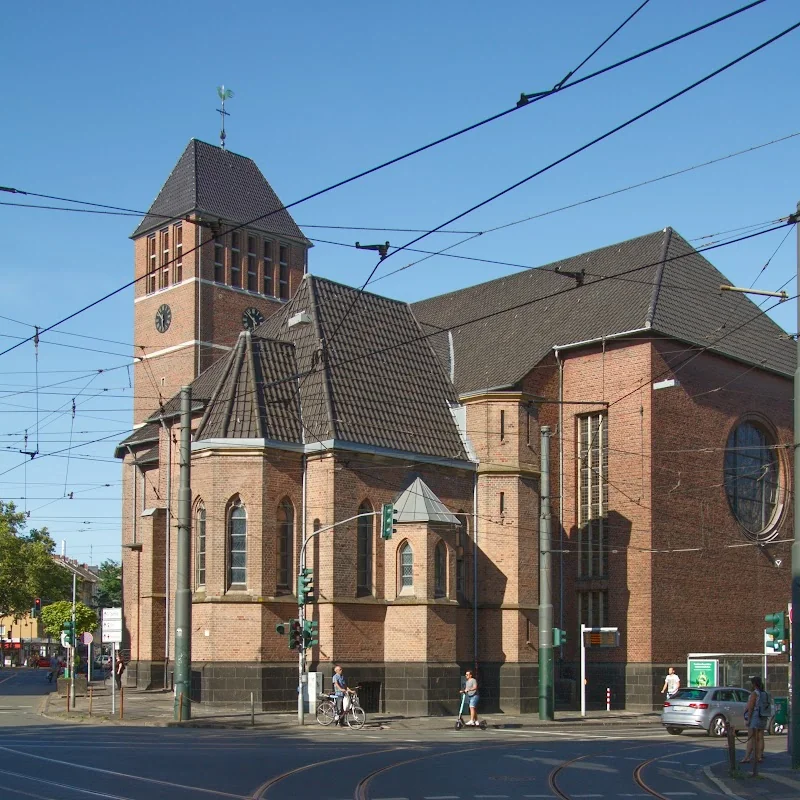
St. Martin in Düsseldorf-Unterbilk is a place where city, history, and vibrant community life come together. The church is described on the official site as the westernmost church of the pastoral area and is also referred to as Bilker Church, as it is closely connected to the stop and the developed neighborhood. Those who come to St. Martin today experience not just a parish church, but a space with many levels: a place for quiet reflection, for liturgy, for music, and for encounters in the community forum. It is this mixture that defines the character of the church, as it is neither just a monument nor just an event venue, but an active ecclesiastical center in the district. The history of the place goes back far and connects Marian devotion, the old Bilker church square, the reconstruction after war destruction, and the careful redesign at the beginning of the 21st century. Today, St. Martin is open daily, easily accessible by public transport, and immediately recognizable in the neighborhood due to its clear shape. This is particularly attractive for visitors, as historical depth, modern community structure, and an open, accessible atmosphere come together here. Those looking for a church in Düsseldorf that does not seem isolated but remains present in its environment will find in St. Martin an authentic place with a strong identity. ([turmhochsechs.de](https://www.turmhochsechs.de/unsere-kirchen/mar_martin/index.html))
Directions, Opening Hours, and the Bilker Church
For orientation on site, St. Martin is surprisingly uncomplicated, even though the church is located in a densely built and lively district. The official church overview lists the address for St. Martin as Benzenbergstraße 5 and recommends entering Neusser Straße 88 for navigation devices. This dual orientation is helpful because St. Martin does not stand as an isolated structure in the neighborhood but is embedded in a developed street structure. The connection to public transport is particularly practical: The stop Bilker Kirche is served by the Rheinbahn lines 706, 707, and 709 as well as the bus lines 723 and 726; additionally, the S-Bahn stop Völklinger Straße with the lines S8, S11, and S28 is within reach. This good connection fits the character of the church, as it is not an out-of-the-way excursion address but an everyday place that one can visit spontaneously. The page on opening hours also clearly states that St. Martin is open daily from 08:00 to 18:00. This means: those looking for a quiet break in Unterbilk can stop by in the morning on their way to work, during lunch between appointments, or in the evening. The open church invites, according to the official description, to linger, to light a candle, and to engage in silent prayer. This is an important feature for people who are on the move in the city center and seek a brief moment of peace. That the church is located in the middle of Unterbilk is also emphasized on the homepage, where St. Martin, along with the other church locations in the city, becomes visible as part of a closely connected community. For visitors, this results in a clear advantage: the journey is simple, the paths are short, and the location is so well integrated that one can easily include St. Martin in a city walk, a church service visit, or a cultural detour. Those who consciously come by public transport also have the advantage that they can immediately focus on the district and the atmosphere instead of having to search for parking spaces. This combination of accessibility and urban presence makes the location attractive. ([turmhochsechs.de](https://www.turmhochsechs.de/unsere-kirchen/uebersicht_kirchen/index.html))
History of the Parish Church St. Martin in Bilk
The history of St. Martin is significantly older than the current building and belongs to the most impressive historical layers in Düsseldorf-Unterbilk. On the site where the church stands, a religious center developed over centuries. The official history recalls that the Marian image Maria Hülf der Christen was already erected in 1641. In 1686, Elector Jan Wellem had the Lorettokapelle built, which was overbuilt by a hall church in the Renaissance style from 1730 to 1739. This early pilgrimage and prayer history continues to shape the place today and explains why St. Martin is not just a building but a spiritually charged space. In 1812, the patronage of the church now called Alt St. Martin on Martinsstraße was transferred to this location. At the end of the 19th century, from 1893 to 1895, a neo-Gothic brick building was constructed according to the plans of the Dutch architect Alfred Tepe, which was severely damaged in World War II and was almost completely destroyed on March 9, 1945. Very little remained from this catastrophe, including parts of the outer walls, the sacristy, and the baptismal chapel. On this ground, the current flat-roofed wall-pillar church in basilica style was built in 1951/52 under the direction of architects A. Dickmann and W. Dickmann. This new building preserved not only the place but also the continuity of the community. When a renovation of the parish center became necessary in the early 2000s and the church space was considered too large for the community, another important stage followed: the rear part of the church was opened for the forum, a parish hall, a kitchen, and other community rooms, while the sacred front area was reorganized. On the eve of the 4th Advent in 2007, the first service could be celebrated in the newly designed church. This development is typical for St. Martin because it does not set past and present against each other but consciously brings them together. Even later details, such as the return of the tower cross and weather vane in 2017, show that the church is continuously maintained and developed. Therefore, those who visit St. Martin encounter a place that unites destruction, reconstruction, reform, and renewal in a single building and community image. ([turmhochsechs.de](https://www.turmhochsechs.de/unsere-kirchen/mar_martin/mart_historie/))
Church Space, Artworks, and the Church Guide
The church space of St. Martin is not only architecturally interesting but is also intentionally designed as a spiritual experience space. The official church guide describes a series of stations that visitors can discover during their tour: main entrance, Maria Hilfe der Christen, altar, medallion path, tabernacle wall, Christ window, ambo, lectern, sedilia, evangelarium lectern, organ, and the baptismal chapel with Stations of the Cross. These elements are not randomly arranged but are designed to work together in liturgy, symbolism, and spatial effect. Particularly impressive is the medallion path, in which the seven sacraments are depicted in bronze and can be read as a path from the altar to the tabernacle. The tabernacle wall carries a theological imagery that recalls the houses of Bilk and reflects the place back into the district. The artistic redesign of the altar area is also noteworthy: for the redesign, the Chilean artist Maria J. Fernandez was commissioned, who re-conceived the altar, ambo, lectern, sedilia, medallions, stone path, tabernacle wall, and the evangelarium lectern. Additionally, important older works by Hermann Alfred Raddatz, Wilhelm Hanebal, and Josef Welling are included. Raddatz created, among other things, the round stained glass window, the Stations of the Cross, and other window works; Hanebal designed the baptismal font, Welling the Easter candlestick and an earlier ambo. The church guide also emphasizes that the overall impression of the church is bright, open, and inviting. This is not just a mere stylistic formula but a precise description of what visitors experience on site: the space feels calm, clearly structured, and yet not distant. The Marian devotion at this place is also interesting, as the veneration of the Mother of God has a long tradition here, dating back to a document from 1398 and the grace image donated in 1641. Therefore, those who look at the interior of St. Martin experience not only architecture but a religious imagery that has grown over centuries and continues to influence today’s community life. The official church guide makes these connections visible and is therefore particularly recommended for visitors, groups, and individuals. ([turmhochsechs.de](https://www.turmhochsechs.de/export/sites/turmhochsechs/.content/.galleries/downloads/09_publikationen/kirchenfuehrer-und-chroniken/Neugestaltung_St_Martin.pdf))
Services, Quiet Reflection, and Community Life
St. Martin is not only present in Düsseldorf as a building but also as a lively place of worship with regular community life. The official page on opening hours explicitly states that an open church offers the opportunity to linger in the atmosphere of the space, light a candle, and engage in silent prayer. This makes St. Martin relevant for people in different life situations: for residents, for walkers, for professionals passing through Unterbilk, and for all those who consciously seek a moment of concentration. The ecclesiastical aspect of the place is also reflected in the current service schedule of the pastoral area, which lists the Saturday evening mass at 18:00 and the Sunday mass at 11:00 for St. Martin, among others. Additionally, the homepage of the community points to various liturgical and pastoral formats that expand the spectrum of community life: there are offerings such as Agape, Eucharistic adoration, church coffee, and other forms in which community can be experienced after the service or in quieter prayer forms. This diversity is important because it does not reduce St. Martin to classical Sunday liturgy. Rather, the place is part of a larger pastoral landscape where families, seniors, volunteers, and music groups come together. The current homepage of the community not only mentions St. Martin itself but also the merged parishes of St. Antonius, St. Apollinaris, St. Josef, St. Martin, St. Peter, and St. Pius X. This makes it clear that St. Martin is now integrated into a larger network and does not see its role as an isolated entity but as part of an urban parish structure. For visitors, this means: those who experience St. Martin see a church that is defined not only by its history but by its ongoing use. The open door here is not a symbol but a practical reality. One can go in, become quiet, let the space affect them, or return for a mass. This combination of everyday openness and liturgical clarity makes St. Martin a place that appeals to both seekers and regular participants. ([turmhochsechs.de](https://www.turmhochsechs.de/unsere-kirchen/oeffnungszeiten/index.html?utm_source=openai))
Concerts, Choirs, and Events at St. Martin
Another strong aspect of St. Martin is the musical and cultural use of the church. On the official community page, St. Martin is visible as a place for church music, choir rehearsals, and concerts. The choirs of St. Martin and St. Peter rehearse together in the Forum St. Martin, and the choir schola also meets at this church location. The forum is thus not only a functional community space but an important place for musical practice, exchange, and preparation. Those interested in events can regularly find information about concerts and special formats on the church music page. Particularly well-known is the series Musik in d’ Lüchterkark – Folk meets Classic, which, according to the official description, takes place annually in St. Martin in Bilk and is considered an extraordinary musical tradition. The concerts are described as a winter program with warmth, candlelight, and a mix of folk, classical elegance, and Christmas atmosphere. In addition, the concert page of the community also features benefit concerts and other musical events at St. Martin. This is important for the community because the church thus acts as a cultural meeting point beyond the service. This also fits the architectural development of the space: since the rear part of the church has been developed as a forum with a hall and community rooms, liturgical and event-related uses can be better connected. The church thus remains open to musical forms that mediate between sacred tradition and urban present. Especially in the urban context of Unterbilk, this is a real added value, as St. Martin is perceived not only by the community but also by a broader audience. The combination of historical atmosphere, good acoustics, open spaces, and an active church music life makes the place attractive for visitors, choirs, and concert guests alike. Therefore, those who view St. Martin only as a church building see only half the reality. Only the music, the rehearsals, the series Musik in d’ Lüchterkark, and the other events show how strongly the place is now integrated into the cultural life of the city. ([gemeinden.erzbistum-koeln.de](https://gemeinden.erzbistum-koeln.de/st_peter_duesseldorf_alt/Kirchenmusik/?utm_source=openai))
Sources:
Mehr anzeigenWeniger anzeigen
St. Martin | Directions & Opening Hours
St. Martin in Düsseldorf-Unterbilk is a place where city, history, and vibrant community life come together. The church is described on the official site as the westernmost church of the pastoral area and is also referred to as Bilker Church, as it is closely connected to the stop and the developed neighborhood. Those who come to St. Martin today experience not just a parish church, but a space with many levels: a place for quiet reflection, for liturgy, for music, and for encounters in the community forum. It is this mixture that defines the character of the church, as it is neither just a monument nor just an event venue, but an active ecclesiastical center in the district. The history of the place goes back far and connects Marian devotion, the old Bilker church square, the reconstruction after war destruction, and the careful redesign at the beginning of the 21st century. Today, St. Martin is open daily, easily accessible by public transport, and immediately recognizable in the neighborhood due to its clear shape. This is particularly attractive for visitors, as historical depth, modern community structure, and an open, accessible atmosphere come together here. Those looking for a church in Düsseldorf that does not seem isolated but remains present in its environment will find in St. Martin an authentic place with a strong identity. ([turmhochsechs.de](https://www.turmhochsechs.de/unsere-kirchen/mar_martin/index.html))
Directions, Opening Hours, and the Bilker Church
For orientation on site, St. Martin is surprisingly uncomplicated, even though the church is located in a densely built and lively district. The official church overview lists the address for St. Martin as Benzenbergstraße 5 and recommends entering Neusser Straße 88 for navigation devices. This dual orientation is helpful because St. Martin does not stand as an isolated structure in the neighborhood but is embedded in a developed street structure. The connection to public transport is particularly practical: The stop Bilker Kirche is served by the Rheinbahn lines 706, 707, and 709 as well as the bus lines 723 and 726; additionally, the S-Bahn stop Völklinger Straße with the lines S8, S11, and S28 is within reach. This good connection fits the character of the church, as it is not an out-of-the-way excursion address but an everyday place that one can visit spontaneously. The page on opening hours also clearly states that St. Martin is open daily from 08:00 to 18:00. This means: those looking for a quiet break in Unterbilk can stop by in the morning on their way to work, during lunch between appointments, or in the evening. The open church invites, according to the official description, to linger, to light a candle, and to engage in silent prayer. This is an important feature for people who are on the move in the city center and seek a brief moment of peace. That the church is located in the middle of Unterbilk is also emphasized on the homepage, where St. Martin, along with the other church locations in the city, becomes visible as part of a closely connected community. For visitors, this results in a clear advantage: the journey is simple, the paths are short, and the location is so well integrated that one can easily include St. Martin in a city walk, a church service visit, or a cultural detour. Those who consciously come by public transport also have the advantage that they can immediately focus on the district and the atmosphere instead of having to search for parking spaces. This combination of accessibility and urban presence makes the location attractive. ([turmhochsechs.de](https://www.turmhochsechs.de/unsere-kirchen/uebersicht_kirchen/index.html))
History of the Parish Church St. Martin in Bilk
The history of St. Martin is significantly older than the current building and belongs to the most impressive historical layers in Düsseldorf-Unterbilk. On the site where the church stands, a religious center developed over centuries. The official history recalls that the Marian image Maria Hülf der Christen was already erected in 1641. In 1686, Elector Jan Wellem had the Lorettokapelle built, which was overbuilt by a hall church in the Renaissance style from 1730 to 1739. This early pilgrimage and prayer history continues to shape the place today and explains why St. Martin is not just a building but a spiritually charged space. In 1812, the patronage of the church now called Alt St. Martin on Martinsstraße was transferred to this location. At the end of the 19th century, from 1893 to 1895, a neo-Gothic brick building was constructed according to the plans of the Dutch architect Alfred Tepe, which was severely damaged in World War II and was almost completely destroyed on March 9, 1945. Very little remained from this catastrophe, including parts of the outer walls, the sacristy, and the baptismal chapel. On this ground, the current flat-roofed wall-pillar church in basilica style was built in 1951/52 under the direction of architects A. Dickmann and W. Dickmann. This new building preserved not only the place but also the continuity of the community. When a renovation of the parish center became necessary in the early 2000s and the church space was considered too large for the community, another important stage followed: the rear part of the church was opened for the forum, a parish hall, a kitchen, and other community rooms, while the sacred front area was reorganized. On the eve of the 4th Advent in 2007, the first service could be celebrated in the newly designed church. This development is typical for St. Martin because it does not set past and present against each other but consciously brings them together. Even later details, such as the return of the tower cross and weather vane in 2017, show that the church is continuously maintained and developed. Therefore, those who visit St. Martin encounter a place that unites destruction, reconstruction, reform, and renewal in a single building and community image. ([turmhochsechs.de](https://www.turmhochsechs.de/unsere-kirchen/mar_martin/mart_historie/))
Church Space, Artworks, and the Church Guide
The church space of St. Martin is not only architecturally interesting but is also intentionally designed as a spiritual experience space. The official church guide describes a series of stations that visitors can discover during their tour: main entrance, Maria Hilfe der Christen, altar, medallion path, tabernacle wall, Christ window, ambo, lectern, sedilia, evangelarium lectern, organ, and the baptismal chapel with Stations of the Cross. These elements are not randomly arranged but are designed to work together in liturgy, symbolism, and spatial effect. Particularly impressive is the medallion path, in which the seven sacraments are depicted in bronze and can be read as a path from the altar to the tabernacle. The tabernacle wall carries a theological imagery that recalls the houses of Bilk and reflects the place back into the district. The artistic redesign of the altar area is also noteworthy: for the redesign, the Chilean artist Maria J. Fernandez was commissioned, who re-conceived the altar, ambo, lectern, sedilia, medallions, stone path, tabernacle wall, and the evangelarium lectern. Additionally, important older works by Hermann Alfred Raddatz, Wilhelm Hanebal, and Josef Welling are included. Raddatz created, among other things, the round stained glass window, the Stations of the Cross, and other window works; Hanebal designed the baptismal font, Welling the Easter candlestick and an earlier ambo. The church guide also emphasizes that the overall impression of the church is bright, open, and inviting. This is not just a mere stylistic formula but a precise description of what visitors experience on site: the space feels calm, clearly structured, and yet not distant. The Marian devotion at this place is also interesting, as the veneration of the Mother of God has a long tradition here, dating back to a document from 1398 and the grace image donated in 1641. Therefore, those who look at the interior of St. Martin experience not only architecture but a religious imagery that has grown over centuries and continues to influence today’s community life. The official church guide makes these connections visible and is therefore particularly recommended for visitors, groups, and individuals. ([turmhochsechs.de](https://www.turmhochsechs.de/export/sites/turmhochsechs/.content/.galleries/downloads/09_publikationen/kirchenfuehrer-und-chroniken/Neugestaltung_St_Martin.pdf))
Services, Quiet Reflection, and Community Life
St. Martin is not only present in Düsseldorf as a building but also as a lively place of worship with regular community life. The official page on opening hours explicitly states that an open church offers the opportunity to linger in the atmosphere of the space, light a candle, and engage in silent prayer. This makes St. Martin relevant for people in different life situations: for residents, for walkers, for professionals passing through Unterbilk, and for all those who consciously seek a moment of concentration. The ecclesiastical aspect of the place is also reflected in the current service schedule of the pastoral area, which lists the Saturday evening mass at 18:00 and the Sunday mass at 11:00 for St. Martin, among others. Additionally, the homepage of the community points to various liturgical and pastoral formats that expand the spectrum of community life: there are offerings such as Agape, Eucharistic adoration, church coffee, and other forms in which community can be experienced after the service or in quieter prayer forms. This diversity is important because it does not reduce St. Martin to classical Sunday liturgy. Rather, the place is part of a larger pastoral landscape where families, seniors, volunteers, and music groups come together. The current homepage of the community not only mentions St. Martin itself but also the merged parishes of St. Antonius, St. Apollinaris, St. Josef, St. Martin, St. Peter, and St. Pius X. This makes it clear that St. Martin is now integrated into a larger network and does not see its role as an isolated entity but as part of an urban parish structure. For visitors, this means: those who experience St. Martin see a church that is defined not only by its history but by its ongoing use. The open door here is not a symbol but a practical reality. One can go in, become quiet, let the space affect them, or return for a mass. This combination of everyday openness and liturgical clarity makes St. Martin a place that appeals to both seekers and regular participants. ([turmhochsechs.de](https://www.turmhochsechs.de/unsere-kirchen/oeffnungszeiten/index.html?utm_source=openai))
Concerts, Choirs, and Events at St. Martin
Another strong aspect of St. Martin is the musical and cultural use of the church. On the official community page, St. Martin is visible as a place for church music, choir rehearsals, and concerts. The choirs of St. Martin and St. Peter rehearse together in the Forum St. Martin, and the choir schola also meets at this church location. The forum is thus not only a functional community space but an important place for musical practice, exchange, and preparation. Those interested in events can regularly find information about concerts and special formats on the church music page. Particularly well-known is the series Musik in d’ Lüchterkark – Folk meets Classic, which, according to the official description, takes place annually in St. Martin in Bilk and is considered an extraordinary musical tradition. The concerts are described as a winter program with warmth, candlelight, and a mix of folk, classical elegance, and Christmas atmosphere. In addition, the concert page of the community also features benefit concerts and other musical events at St. Martin. This is important for the community because the church thus acts as a cultural meeting point beyond the service. This also fits the architectural development of the space: since the rear part of the church has been developed as a forum with a hall and community rooms, liturgical and event-related uses can be better connected. The church thus remains open to musical forms that mediate between sacred tradition and urban present. Especially in the urban context of Unterbilk, this is a real added value, as St. Martin is perceived not only by the community but also by a broader audience. The combination of historical atmosphere, good acoustics, open spaces, and an active church music life makes the place attractive for visitors, choirs, and concert guests alike. Therefore, those who view St. Martin only as a church building see only half the reality. Only the music, the rehearsals, the series Musik in d’ Lüchterkark, and the other events show how strongly the place is now integrated into the cultural life of the city. ([gemeinden.erzbistum-koeln.de](https://gemeinden.erzbistum-koeln.de/st_peter_duesseldorf_alt/Kirchenmusik/?utm_source=openai))
Sources:
St. Martin | Directions & Opening Hours
St. Martin in Düsseldorf-Unterbilk is a place where city, history, and vibrant community life come together. The church is described on the official site as the westernmost church of the pastoral area and is also referred to as Bilker Church, as it is closely connected to the stop and the developed neighborhood. Those who come to St. Martin today experience not just a parish church, but a space with many levels: a place for quiet reflection, for liturgy, for music, and for encounters in the community forum. It is this mixture that defines the character of the church, as it is neither just a monument nor just an event venue, but an active ecclesiastical center in the district. The history of the place goes back far and connects Marian devotion, the old Bilker church square, the reconstruction after war destruction, and the careful redesign at the beginning of the 21st century. Today, St. Martin is open daily, easily accessible by public transport, and immediately recognizable in the neighborhood due to its clear shape. This is particularly attractive for visitors, as historical depth, modern community structure, and an open, accessible atmosphere come together here. Those looking for a church in Düsseldorf that does not seem isolated but remains present in its environment will find in St. Martin an authentic place with a strong identity. ([turmhochsechs.de](https://www.turmhochsechs.de/unsere-kirchen/mar_martin/index.html))
Directions, Opening Hours, and the Bilker Church
For orientation on site, St. Martin is surprisingly uncomplicated, even though the church is located in a densely built and lively district. The official church overview lists the address for St. Martin as Benzenbergstraße 5 and recommends entering Neusser Straße 88 for navigation devices. This dual orientation is helpful because St. Martin does not stand as an isolated structure in the neighborhood but is embedded in a developed street structure. The connection to public transport is particularly practical: The stop Bilker Kirche is served by the Rheinbahn lines 706, 707, and 709 as well as the bus lines 723 and 726; additionally, the S-Bahn stop Völklinger Straße with the lines S8, S11, and S28 is within reach. This good connection fits the character of the church, as it is not an out-of-the-way excursion address but an everyday place that one can visit spontaneously. The page on opening hours also clearly states that St. Martin is open daily from 08:00 to 18:00. This means: those looking for a quiet break in Unterbilk can stop by in the morning on their way to work, during lunch between appointments, or in the evening. The open church invites, according to the official description, to linger, to light a candle, and to engage in silent prayer. This is an important feature for people who are on the move in the city center and seek a brief moment of peace. That the church is located in the middle of Unterbilk is also emphasized on the homepage, where St. Martin, along with the other church locations in the city, becomes visible as part of a closely connected community. For visitors, this results in a clear advantage: the journey is simple, the paths are short, and the location is so well integrated that one can easily include St. Martin in a city walk, a church service visit, or a cultural detour. Those who consciously come by public transport also have the advantage that they can immediately focus on the district and the atmosphere instead of having to search for parking spaces. This combination of accessibility and urban presence makes the location attractive. ([turmhochsechs.de](https://www.turmhochsechs.de/unsere-kirchen/uebersicht_kirchen/index.html))
History of the Parish Church St. Martin in Bilk
The history of St. Martin is significantly older than the current building and belongs to the most impressive historical layers in Düsseldorf-Unterbilk. On the site where the church stands, a religious center developed over centuries. The official history recalls that the Marian image Maria Hülf der Christen was already erected in 1641. In 1686, Elector Jan Wellem had the Lorettokapelle built, which was overbuilt by a hall church in the Renaissance style from 1730 to 1739. This early pilgrimage and prayer history continues to shape the place today and explains why St. Martin is not just a building but a spiritually charged space. In 1812, the patronage of the church now called Alt St. Martin on Martinsstraße was transferred to this location. At the end of the 19th century, from 1893 to 1895, a neo-Gothic brick building was constructed according to the plans of the Dutch architect Alfred Tepe, which was severely damaged in World War II and was almost completely destroyed on March 9, 1945. Very little remained from this catastrophe, including parts of the outer walls, the sacristy, and the baptismal chapel. On this ground, the current flat-roofed wall-pillar church in basilica style was built in 1951/52 under the direction of architects A. Dickmann and W. Dickmann. This new building preserved not only the place but also the continuity of the community. When a renovation of the parish center became necessary in the early 2000s and the church space was considered too large for the community, another important stage followed: the rear part of the church was opened for the forum, a parish hall, a kitchen, and other community rooms, while the sacred front area was reorganized. On the eve of the 4th Advent in 2007, the first service could be celebrated in the newly designed church. This development is typical for St. Martin because it does not set past and present against each other but consciously brings them together. Even later details, such as the return of the tower cross and weather vane in 2017, show that the church is continuously maintained and developed. Therefore, those who visit St. Martin encounter a place that unites destruction, reconstruction, reform, and renewal in a single building and community image. ([turmhochsechs.de](https://www.turmhochsechs.de/unsere-kirchen/mar_martin/mart_historie/))
Church Space, Artworks, and the Church Guide
The church space of St. Martin is not only architecturally interesting but is also intentionally designed as a spiritual experience space. The official church guide describes a series of stations that visitors can discover during their tour: main entrance, Maria Hilfe der Christen, altar, medallion path, tabernacle wall, Christ window, ambo, lectern, sedilia, evangelarium lectern, organ, and the baptismal chapel with Stations of the Cross. These elements are not randomly arranged but are designed to work together in liturgy, symbolism, and spatial effect. Particularly impressive is the medallion path, in which the seven sacraments are depicted in bronze and can be read as a path from the altar to the tabernacle. The tabernacle wall carries a theological imagery that recalls the houses of Bilk and reflects the place back into the district. The artistic redesign of the altar area is also noteworthy: for the redesign, the Chilean artist Maria J. Fernandez was commissioned, who re-conceived the altar, ambo, lectern, sedilia, medallions, stone path, tabernacle wall, and the evangelarium lectern. Additionally, important older works by Hermann Alfred Raddatz, Wilhelm Hanebal, and Josef Welling are included. Raddatz created, among other things, the round stained glass window, the Stations of the Cross, and other window works; Hanebal designed the baptismal font, Welling the Easter candlestick and an earlier ambo. The church guide also emphasizes that the overall impression of the church is bright, open, and inviting. This is not just a mere stylistic formula but a precise description of what visitors experience on site: the space feels calm, clearly structured, and yet not distant. The Marian devotion at this place is also interesting, as the veneration of the Mother of God has a long tradition here, dating back to a document from 1398 and the grace image donated in 1641. Therefore, those who look at the interior of St. Martin experience not only architecture but a religious imagery that has grown over centuries and continues to influence today’s community life. The official church guide makes these connections visible and is therefore particularly recommended for visitors, groups, and individuals. ([turmhochsechs.de](https://www.turmhochsechs.de/export/sites/turmhochsechs/.content/.galleries/downloads/09_publikationen/kirchenfuehrer-und-chroniken/Neugestaltung_St_Martin.pdf))
Services, Quiet Reflection, and Community Life
St. Martin is not only present in Düsseldorf as a building but also as a lively place of worship with regular community life. The official page on opening hours explicitly states that an open church offers the opportunity to linger in the atmosphere of the space, light a candle, and engage in silent prayer. This makes St. Martin relevant for people in different life situations: for residents, for walkers, for professionals passing through Unterbilk, and for all those who consciously seek a moment of concentration. The ecclesiastical aspect of the place is also reflected in the current service schedule of the pastoral area, which lists the Saturday evening mass at 18:00 and the Sunday mass at 11:00 for St. Martin, among others. Additionally, the homepage of the community points to various liturgical and pastoral formats that expand the spectrum of community life: there are offerings such as Agape, Eucharistic adoration, church coffee, and other forms in which community can be experienced after the service or in quieter prayer forms. This diversity is important because it does not reduce St. Martin to classical Sunday liturgy. Rather, the place is part of a larger pastoral landscape where families, seniors, volunteers, and music groups come together. The current homepage of the community not only mentions St. Martin itself but also the merged parishes of St. Antonius, St. Apollinaris, St. Josef, St. Martin, St. Peter, and St. Pius X. This makes it clear that St. Martin is now integrated into a larger network and does not see its role as an isolated entity but as part of an urban parish structure. For visitors, this means: those who experience St. Martin see a church that is defined not only by its history but by its ongoing use. The open door here is not a symbol but a practical reality. One can go in, become quiet, let the space affect them, or return for a mass. This combination of everyday openness and liturgical clarity makes St. Martin a place that appeals to both seekers and regular participants. ([turmhochsechs.de](https://www.turmhochsechs.de/unsere-kirchen/oeffnungszeiten/index.html?utm_source=openai))
Concerts, Choirs, and Events at St. Martin
Another strong aspect of St. Martin is the musical and cultural use of the church. On the official community page, St. Martin is visible as a place for church music, choir rehearsals, and concerts. The choirs of St. Martin and St. Peter rehearse together in the Forum St. Martin, and the choir schola also meets at this church location. The forum is thus not only a functional community space but an important place for musical practice, exchange, and preparation. Those interested in events can regularly find information about concerts and special formats on the church music page. Particularly well-known is the series Musik in d’ Lüchterkark – Folk meets Classic, which, according to the official description, takes place annually in St. Martin in Bilk and is considered an extraordinary musical tradition. The concerts are described as a winter program with warmth, candlelight, and a mix of folk, classical elegance, and Christmas atmosphere. In addition, the concert page of the community also features benefit concerts and other musical events at St. Martin. This is important for the community because the church thus acts as a cultural meeting point beyond the service. This also fits the architectural development of the space: since the rear part of the church has been developed as a forum with a hall and community rooms, liturgical and event-related uses can be better connected. The church thus remains open to musical forms that mediate between sacred tradition and urban present. Especially in the urban context of Unterbilk, this is a real added value, as St. Martin is perceived not only by the community but also by a broader audience. The combination of historical atmosphere, good acoustics, open spaces, and an active church music life makes the place attractive for visitors, choirs, and concert guests alike. Therefore, those who view St. Martin only as a church building see only half the reality. Only the music, the rehearsals, the series Musik in d’ Lüchterkark, and the other events show how strongly the place is now integrated into the cultural life of the city. ([gemeinden.erzbistum-koeln.de](https://gemeinden.erzbistum-koeln.de/st_peter_duesseldorf_alt/Kirchenmusik/?utm_source=openai))
Sources:
Upcoming Events
No events found
Frequently Asked Questions
Reviews
Mi Lo
30. April 2019
Always a nice feeling to visit St. Martin.
Manuela Aramo
17. December 2019
Nice church.
Ната
14. March 2024
Beautiful place, we went in and lit candles, there's also a prayer book for suggestions. Free and no queue.)
Cindy
4. June 2025
An incredibly beautiful church that you must visit, a wonderful place with so much peace and love.
Philip Lehmenkühler
1. January 2022
Well, I really have nothing to say about that. I understand that New Year's is a Catholic holiday. But people are also awake longer on New Year's Eve, and I find it really more than rude to disturb the peace of every non-Catholic person at 10:50 for almost 10 minutes. The ringing is really outrageous; I have lived next to a church in Aachen and can truly say that this parish is excessively overdoing it. All year round.