
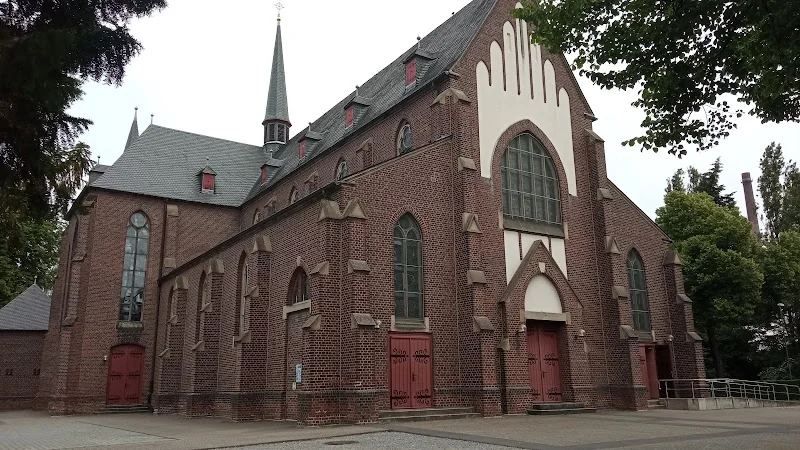
Am Langen Weiher 21, Düsseldorf-Stadtbezirk 9
Am Langen Weiher 21, 40589 Düsseldorf, Germany
St. Joseph Düsseldorf-Holthausen | History & Services
St. Joseph in Düsseldorf-Holthausen is a place where history, community, and church life connect in a very special way. The church is located at Am Langen Weiher 21 and was developed in response to the significant growth of the district around the industrial facilities of Henkel. Today, it is not only a house of worship but also a cultural meeting point for music, community events, and quiet visits. Those searching for St. Joseph will find much more than a sacred building: The church tells the story of Holthausen's development, a growing Catholic community, and a long tradition of participation in the southern part of Düsseldorf. Since January 1, 2026, St. Joseph has been part of the newly established parish of St. Nikolaus, Düsseldorf, while remaining an independent, clearly recognizable church location with a vibrant presence. This connection of historical depth, lived faith, and cultural openness makes St. Joseph equally interesting for visitors, community members, and music lovers. ([meinegemein.de](https://www.meinegemein.de/ueber-uns/unsere-kirchen/st.-joseph/))
History of St. Joseph Church in Holthausen
The history of St. Joseph begins with the changes of the 19th century. The parish traces back to St. Hubertus in Itter, which had become too small for the growing population by the mid-19th century. The official parish website describes that the new church was built in 1904 with the laying of the foundation stone right next to the industrial site of Henkel, at the corner of Ritastraße and Am Langen Weiher. The church was consecrated as early as 1905; on November 12, 1905, parish rector Johannes Adenauer, a brother of the later Chancellor Konrad Adenauer, celebrated the first mass there. These early years clearly show how closely church development and social change were connected in Holthausen. The establishment of industry, the influx of workers, and the rapid expansion of the district created a community that soon became not just a village church but the center of a growing urban area. ([meinegemein.de](https://www.meinegemein.de/ueber-uns/unsere-kirchen/st.-joseph/))
In 1908, St. Joseph was definitively separated from the mother parish of St. Hubertus in Itter, and Johannes Adenauer was ceremonially introduced to his parish office. At that time, Holthausen already had 2400 Catholics, 800 Protestants, and 22 dissenters, and a Catholic school with seven classes and 477 children was also located there. These are impressive numbers because they show how quickly the district had grown as a result of industrialization. With the further increase in parish members, which was also linked to the number of Henkel employees, the expansion of St. Joseph to its current size became necessary in 1912/13. This expansion was largely financed by donations from parish members. The church is thus not only architecturally but also socially a product of communal effort. This origin is still palpable today: St. Joseph does not appear as an isolated monument but as a building that has emerged from the heart of a district and continues to thrive from that center. ([meinegemein.de](https://www.meinegemein.de/ueber-uns/unsere-kirchen/st.-joseph/))
Throughout the 20th century, the church was repeatedly supplemented, maintained, and artistically developed. The community explicitly mentions a commemorative publication for the 100th anniversary, which was published in 2005 and documents the development in detail. For visitors, it is especially important: St. Joseph is not a static historical backdrop but a church location that has continuously adapted to new demands over more than a hundred years. This blend of historical continuity and vibrant change is what makes the church appealing. Therefore, those who want to understand the history should not only read St. Joseph as a monument but as a living testimony of Catholic life in an industrially shaped district of Düsseldorf. ([meinegemein.de](https://www.meinegemein.de/ueber-uns/unsere-kirchen/st.-joseph/))
Architecture, Art, and Furnishings
Architecturally, St. Joseph is described as a neo-Gothic cross church. The community explains that the new construction began in 1904 and that the church was initially conceived as a new solution for an overcrowded parish situation. The Wikipedia documentation adds that the construction took place in phases: in 1905, the choir and transept were built, followed by the second construction phase with the nave in 1913. Visible brick exterior walls shape the appearance of the house of worship and give it a clear, calm materiality. Particularly interesting is the fact that the church does not have a classic tall tower; instead, the bells are located in a bell cote. This makes the building appear more compact, almost protected, and distinguishes it from many other Düsseldorf churches with a prominent tower profile. The language of form of neo-Gothic remains evident: cross shape, vertical structure, and a historicizing expression define the appearance. ([de.wikipedia.org](https://de.wikipedia.org/wiki/St._Joseph_%28D%C3%BCsseldorf-Holthausen%29?utm_source=openai))
The interior furnishings are also closely linked to the community's history. The community reports that new windows were installed in 1953, designed by the artist Hubert Sperling from Krefeld and produced by the Derix glass workshop. This is noteworthy because the church thus received a new light and imagery after the war, which combines modern art and liturgical function. In 1979, the Düsseldorf artist Bert Gerresheim created the new celebration altar. The main image on the altar side facing the community depicts the crucifixion of Christ, with the St. Joseph Church and the Henkel works in the background. This connection of sacred motif and industrial surroundings is particularly fitting for Holthausen, as it artistically makes visible the church's location in the midst of a working and residential area. Such elements shape not only the exterior but also the atmosphere inside: St. Joseph is a space of liturgy, but also a place where history, district identity, and visual art intertwine. ([meinegemein.de](https://www.meinegemein.de/ueber-uns/unsere-kirchen/st.-joseph/))
According to literary and source evidence, the church was also restored in the 1970s and secured again in the 1990s. This shows that St. Joseph not only looks back on its time of origin but has been continuously maintained and preserved. Therefore, those who visit the building experience not an untouched original state but a carefully developed church space where historical substance and later additions speak to each other. For architecture enthusiasts, this is particularly exciting because here construction phases, liturgical reforms, and post-war art overlap in a clearly readable church space. St. Joseph thus stands exemplarily for many Rhineland churches that originate from a time of industrial upheaval and were later artistically and pastorally redesigned without losing their origins. ([de.wikipedia.org](https://de.wikipedia.org/wiki/St._Joseph_%28D%C3%BCsseldorf-Holthausen%29?utm_source=openai))
Services, Music, and Community Life
St. Joseph remains an active place of worship and music to this day. The community explicitly describes the church as a church in the midst of working life, which accurately reflects the character of the location. In the daily life of the community, not only liturgy plays a role, but also a broad network of choirs, musical offerings, and spiritual events. On the community's website, several ensembles and activities are listed under the section Music and Culture, including the St. Joseph Church choir, Holthausen, various choirs, and culture-related groups. This shows that music is not an accessory here but a central part of community life. Therefore, those who experience St. Joseph usually also experience a church where singing, listening, and liturgical celebrations are closely connected. This place is particularly attractive for visitors seeking church and concert, silence and sound. ([meinegemein.de](https://www.meinegemein.de/ueber-uns/unsere-kirchen/st.-joseph/))
The fact that St. Joseph is regularly used for special musical formats is clearly evidenced by current events. For December 2024, the Christmas Oratorio by Johann Sebastian Bach with members of the Düsseldorf Symphony Orchestra has been announced and promoted there. The community and archdiocese websites also show spiritual formats such as the All Hallows Evensong, where choirs from the pastoral unit performed in St. Joseph and names of the deceased were read. For 2026, further concerts in St. Joseph are announced on the young chamber choir Düsseldorf's page, as well as information about a Festival of Carols. This is a strong signal that the church is not only a liturgical place but also a sought-after address for choral culture and spiritual music in Düsseldorf. Therefore, those looking for a culturally shaped church environment will find it here. ([meinegemein.de](https://www.meinegemein.de/aktuelles-termine/aktuelles-events/aktuelles/Kartenvorverkauf-fuer-das-Weihnachtsoratorium-von-J.S.-Bach-unter-Mitwirkung-von-Orchestermitgliedern-der-Duesseldorfer-Symphoniker-Sonntag-den-15.12.-um-18-Uhr-in-St.-Joseph-Holthausen/?utm_source=openai))
Beyond the large concerts, the church is integrated into active community life. The community informs about kfd groups, the church choir, cultural circles, and other initiatives. Particularly important for the atmosphere on site is the church café, which takes place every third Sunday of the month after the mass; on these days, the library also remains open longer. This mix of worship, conversation, and encounters gives St. Joseph an open, neighborly atmosphere. The church is thus relevant not only for Sundays or holidays but also as a social meeting point in the district. Those who come into contact with the community experience a lively community structure rather than a purely visitor church. This is precisely what makes the attractiveness of this location: it is spiritual, cultural, and social at the same time. ([meinegemein.de](https://www.meinegemein.de/ueber-uns/unsere-kirchen/st.-joseph/))
Library, Parish Hall, and Neighborhood Offers
An important part of daily life around St. Joseph is the infrastructure for the neighborhood. The official website mentions a St. Joseph library in Holthausen at Ritastraße 9. It is open on Sundays from 10:30 AM to 12:30 PM and Thursdays from 4:00 PM to 6:00 PM. On every third Sunday of the month, when there is a church café after the mass, the library even remains open until 2 PM. This is a nice indication of how closely religious, cultural, and social use converge at this place. A library directly in the vicinity of the church creates short distances for families, children, volunteers, and community members, making St. Joseph a place where education and encounters are naturally considered. ([meinegemein.de](https://www.meinegemein.de/ueber-uns/unsere-kirchen/st.-joseph/))
Additionally, the community has a form for renting the parish hall. This means: There is a clear way to request spaces for meetings, celebrations, or community activities. Although the public page does not specify details about equipment, size, or specific rental conditions, the mere existence of this form shows that St. Joseph and the associated community offers are organized openly for external and internal events. This is practical for people from Holthausen and the surrounding districts, as the community hall and church location remain usable beyond purely liturgical use. This is an important advantage, especially for choirs, groups, family celebrations, or thematic events. Those looking for a church-shaped but also everyday location will find a place with existing structure and contacts here. ([meinegemein.de](https://www.meinegemein.de/ueber-uns/unsere-kirchen/st.-joseph/))
The community networking is also remarkable. The website mentions numerous areas, including music and culture, kfd groups, choirs, youth offerings, and various institutions in the Düsseldorf Rhine region. This means that St. Joseph is not isolated but embedded in a larger pastoral and social context. This connection makes the church interesting for visitors who do not just want to see a single church but a vibrant church environment with multiple actors, offerings, and meeting points. In everyday life, St. Joseph thus functions as a mix of house of worship, event location, cultural space, and neighborhood center. Therefore, those who visit the church enter not only a historical building but a network of faith, education, and community. ([meinegemein.de](https://www.meinegemein.de/ueber-uns/unsere-kirchen/st.-joseph/))
Address, Directions, and Current Position in the Düsseldorf Rhine Region
For practical orientation, one thing is especially important: St. Joseph is located at Am Langen Weiher 21, 40589 Düsseldorf. The Düsseldorf tourism website confirms this address, explicitly names the church as a Catholic church, and refers to the community website. Various church information pages also list the location in Holthausen. Thus, the church location is clearly situated in the southern part of Düsseldorf, specifically in district 9. Those wishing to visit the church can safely orient themselves to this address data. For further questions, the community provides contact options via the website and the pastoral office. ([visitduesseldorf.de](https://www.visitduesseldorf.de/attraktionen/st.-joseph-kirche-kath.-bcf797c655?utm_source=openai))
Particularly important is the current church assignment. The Archdiocese of Cologne has established in its official gazette in 2025 the dissolution of several parishes and the re-establishment of the parish of St. Nikolaus, Düsseldorf, effective January 1, 2026; St. Joseph in Düsseldorf-Holthausen is explicitly mentioned in this. For visitors, this means: The church location remains, but is organizationally part of the new parish of St. Nikolaus since 2026. This information is relevant when looking for dates, contacts, or pastoral responsibilities. At the same time, the community website shows that St. Joseph continues to be managed as its own church location with a clear identity within the Düsseldorf Rhine region. This dual character is typical for many modern pastoral structures: the place remains locally anchored, but the administration is integrated into larger units. ([erzbistum-koeln.de](https://www.erzbistum-koeln.de/export/sites/ebkportal/erzbistum/generalvikariat/.content/documentcenter/amtsblatt/2025/2025-07-15-amtsblatt-erzbistum-koeln.pdf))
Even though not all detailed questions about parking or public transport are listed in a separate section on the publicly accessible church page, the location at a clearly named address is a good starting point for directions. Those planning a concert, a service, or a library visit should therefore check the current dates of the community in advance and, if necessary, contact the pastoral office directly. The public communication of the community also shows that St. Joseph is regularly used for music, spiritual offerings, and community formats. This makes the church a reliable destination for those seeking a place with tradition, presence, and genuine community culture in the southern part of Düsseldorf. ([meinegemein.de](https://www.meinegemein.de/aktuelles-termine/aktuelles-events/aktuelles/Kartenvorverkauf-fuer-das-Weihnachtsoratorium-von-J.S.-Bach-unter-Mitwirkung-von-Orchestermitgliedern-der-Duesseldorfer-Symphoniker-Sonntag-den-15.12.-um-18-Uhr-in-St.-Joseph-Holthausen/?utm_source=openai))
Sources:
Show moreShow less
St. Joseph Düsseldorf-Holthausen | History & Services
St. Joseph in Düsseldorf-Holthausen is a place where history, community, and church life connect in a very special way. The church is located at Am Langen Weiher 21 and was developed in response to the significant growth of the district around the industrial facilities of Henkel. Today, it is not only a house of worship but also a cultural meeting point for music, community events, and quiet visits. Those searching for St. Joseph will find much more than a sacred building: The church tells the story of Holthausen's development, a growing Catholic community, and a long tradition of participation in the southern part of Düsseldorf. Since January 1, 2026, St. Joseph has been part of the newly established parish of St. Nikolaus, Düsseldorf, while remaining an independent, clearly recognizable church location with a vibrant presence. This connection of historical depth, lived faith, and cultural openness makes St. Joseph equally interesting for visitors, community members, and music lovers. ([meinegemein.de](https://www.meinegemein.de/ueber-uns/unsere-kirchen/st.-joseph/))
History of St. Joseph Church in Holthausen
The history of St. Joseph begins with the changes of the 19th century. The parish traces back to St. Hubertus in Itter, which had become too small for the growing population by the mid-19th century. The official parish website describes that the new church was built in 1904 with the laying of the foundation stone right next to the industrial site of Henkel, at the corner of Ritastraße and Am Langen Weiher. The church was consecrated as early as 1905; on November 12, 1905, parish rector Johannes Adenauer, a brother of the later Chancellor Konrad Adenauer, celebrated the first mass there. These early years clearly show how closely church development and social change were connected in Holthausen. The establishment of industry, the influx of workers, and the rapid expansion of the district created a community that soon became not just a village church but the center of a growing urban area. ([meinegemein.de](https://www.meinegemein.de/ueber-uns/unsere-kirchen/st.-joseph/))
In 1908, St. Joseph was definitively separated from the mother parish of St. Hubertus in Itter, and Johannes Adenauer was ceremonially introduced to his parish office. At that time, Holthausen already had 2400 Catholics, 800 Protestants, and 22 dissenters, and a Catholic school with seven classes and 477 children was also located there. These are impressive numbers because they show how quickly the district had grown as a result of industrialization. With the further increase in parish members, which was also linked to the number of Henkel employees, the expansion of St. Joseph to its current size became necessary in 1912/13. This expansion was largely financed by donations from parish members. The church is thus not only architecturally but also socially a product of communal effort. This origin is still palpable today: St. Joseph does not appear as an isolated monument but as a building that has emerged from the heart of a district and continues to thrive from that center. ([meinegemein.de](https://www.meinegemein.de/ueber-uns/unsere-kirchen/st.-joseph/))
Throughout the 20th century, the church was repeatedly supplemented, maintained, and artistically developed. The community explicitly mentions a commemorative publication for the 100th anniversary, which was published in 2005 and documents the development in detail. For visitors, it is especially important: St. Joseph is not a static historical backdrop but a church location that has continuously adapted to new demands over more than a hundred years. This blend of historical continuity and vibrant change is what makes the church appealing. Therefore, those who want to understand the history should not only read St. Joseph as a monument but as a living testimony of Catholic life in an industrially shaped district of Düsseldorf. ([meinegemein.de](https://www.meinegemein.de/ueber-uns/unsere-kirchen/st.-joseph/))
Architecture, Art, and Furnishings
Architecturally, St. Joseph is described as a neo-Gothic cross church. The community explains that the new construction began in 1904 and that the church was initially conceived as a new solution for an overcrowded parish situation. The Wikipedia documentation adds that the construction took place in phases: in 1905, the choir and transept were built, followed by the second construction phase with the nave in 1913. Visible brick exterior walls shape the appearance of the house of worship and give it a clear, calm materiality. Particularly interesting is the fact that the church does not have a classic tall tower; instead, the bells are located in a bell cote. This makes the building appear more compact, almost protected, and distinguishes it from many other Düsseldorf churches with a prominent tower profile. The language of form of neo-Gothic remains evident: cross shape, vertical structure, and a historicizing expression define the appearance. ([de.wikipedia.org](https://de.wikipedia.org/wiki/St._Joseph_%28D%C3%BCsseldorf-Holthausen%29?utm_source=openai))
The interior furnishings are also closely linked to the community's history. The community reports that new windows were installed in 1953, designed by the artist Hubert Sperling from Krefeld and produced by the Derix glass workshop. This is noteworthy because the church thus received a new light and imagery after the war, which combines modern art and liturgical function. In 1979, the Düsseldorf artist Bert Gerresheim created the new celebration altar. The main image on the altar side facing the community depicts the crucifixion of Christ, with the St. Joseph Church and the Henkel works in the background. This connection of sacred motif and industrial surroundings is particularly fitting for Holthausen, as it artistically makes visible the church's location in the midst of a working and residential area. Such elements shape not only the exterior but also the atmosphere inside: St. Joseph is a space of liturgy, but also a place where history, district identity, and visual art intertwine. ([meinegemein.de](https://www.meinegemein.de/ueber-uns/unsere-kirchen/st.-joseph/))
According to literary and source evidence, the church was also restored in the 1970s and secured again in the 1990s. This shows that St. Joseph not only looks back on its time of origin but has been continuously maintained and preserved. Therefore, those who visit the building experience not an untouched original state but a carefully developed church space where historical substance and later additions speak to each other. For architecture enthusiasts, this is particularly exciting because here construction phases, liturgical reforms, and post-war art overlap in a clearly readable church space. St. Joseph thus stands exemplarily for many Rhineland churches that originate from a time of industrial upheaval and were later artistically and pastorally redesigned without losing their origins. ([de.wikipedia.org](https://de.wikipedia.org/wiki/St._Joseph_%28D%C3%BCsseldorf-Holthausen%29?utm_source=openai))
Services, Music, and Community Life
St. Joseph remains an active place of worship and music to this day. The community explicitly describes the church as a church in the midst of working life, which accurately reflects the character of the location. In the daily life of the community, not only liturgy plays a role, but also a broad network of choirs, musical offerings, and spiritual events. On the community's website, several ensembles and activities are listed under the section Music and Culture, including the St. Joseph Church choir, Holthausen, various choirs, and culture-related groups. This shows that music is not an accessory here but a central part of community life. Therefore, those who experience St. Joseph usually also experience a church where singing, listening, and liturgical celebrations are closely connected. This place is particularly attractive for visitors seeking church and concert, silence and sound. ([meinegemein.de](https://www.meinegemein.de/ueber-uns/unsere-kirchen/st.-joseph/))
The fact that St. Joseph is regularly used for special musical formats is clearly evidenced by current events. For December 2024, the Christmas Oratorio by Johann Sebastian Bach with members of the Düsseldorf Symphony Orchestra has been announced and promoted there. The community and archdiocese websites also show spiritual formats such as the All Hallows Evensong, where choirs from the pastoral unit performed in St. Joseph and names of the deceased were read. For 2026, further concerts in St. Joseph are announced on the young chamber choir Düsseldorf's page, as well as information about a Festival of Carols. This is a strong signal that the church is not only a liturgical place but also a sought-after address for choral culture and spiritual music in Düsseldorf. Therefore, those looking for a culturally shaped church environment will find it here. ([meinegemein.de](https://www.meinegemein.de/aktuelles-termine/aktuelles-events/aktuelles/Kartenvorverkauf-fuer-das-Weihnachtsoratorium-von-J.S.-Bach-unter-Mitwirkung-von-Orchestermitgliedern-der-Duesseldorfer-Symphoniker-Sonntag-den-15.12.-um-18-Uhr-in-St.-Joseph-Holthausen/?utm_source=openai))
Beyond the large concerts, the church is integrated into active community life. The community informs about kfd groups, the church choir, cultural circles, and other initiatives. Particularly important for the atmosphere on site is the church café, which takes place every third Sunday of the month after the mass; on these days, the library also remains open longer. This mix of worship, conversation, and encounters gives St. Joseph an open, neighborly atmosphere. The church is thus relevant not only for Sundays or holidays but also as a social meeting point in the district. Those who come into contact with the community experience a lively community structure rather than a purely visitor church. This is precisely what makes the attractiveness of this location: it is spiritual, cultural, and social at the same time. ([meinegemein.de](https://www.meinegemein.de/ueber-uns/unsere-kirchen/st.-joseph/))
Library, Parish Hall, and Neighborhood Offers
An important part of daily life around St. Joseph is the infrastructure for the neighborhood. The official website mentions a St. Joseph library in Holthausen at Ritastraße 9. It is open on Sundays from 10:30 AM to 12:30 PM and Thursdays from 4:00 PM to 6:00 PM. On every third Sunday of the month, when there is a church café after the mass, the library even remains open until 2 PM. This is a nice indication of how closely religious, cultural, and social use converge at this place. A library directly in the vicinity of the church creates short distances for families, children, volunteers, and community members, making St. Joseph a place where education and encounters are naturally considered. ([meinegemein.de](https://www.meinegemein.de/ueber-uns/unsere-kirchen/st.-joseph/))
Additionally, the community has a form for renting the parish hall. This means: There is a clear way to request spaces for meetings, celebrations, or community activities. Although the public page does not specify details about equipment, size, or specific rental conditions, the mere existence of this form shows that St. Joseph and the associated community offers are organized openly for external and internal events. This is practical for people from Holthausen and the surrounding districts, as the community hall and church location remain usable beyond purely liturgical use. This is an important advantage, especially for choirs, groups, family celebrations, or thematic events. Those looking for a church-shaped but also everyday location will find a place with existing structure and contacts here. ([meinegemein.de](https://www.meinegemein.de/ueber-uns/unsere-kirchen/st.-joseph/))
The community networking is also remarkable. The website mentions numerous areas, including music and culture, kfd groups, choirs, youth offerings, and various institutions in the Düsseldorf Rhine region. This means that St. Joseph is not isolated but embedded in a larger pastoral and social context. This connection makes the church interesting for visitors who do not just want to see a single church but a vibrant church environment with multiple actors, offerings, and meeting points. In everyday life, St. Joseph thus functions as a mix of house of worship, event location, cultural space, and neighborhood center. Therefore, those who visit the church enter not only a historical building but a network of faith, education, and community. ([meinegemein.de](https://www.meinegemein.de/ueber-uns/unsere-kirchen/st.-joseph/))
Address, Directions, and Current Position in the Düsseldorf Rhine Region
For practical orientation, one thing is especially important: St. Joseph is located at Am Langen Weiher 21, 40589 Düsseldorf. The Düsseldorf tourism website confirms this address, explicitly names the church as a Catholic church, and refers to the community website. Various church information pages also list the location in Holthausen. Thus, the church location is clearly situated in the southern part of Düsseldorf, specifically in district 9. Those wishing to visit the church can safely orient themselves to this address data. For further questions, the community provides contact options via the website and the pastoral office. ([visitduesseldorf.de](https://www.visitduesseldorf.de/attraktionen/st.-joseph-kirche-kath.-bcf797c655?utm_source=openai))
Particularly important is the current church assignment. The Archdiocese of Cologne has established in its official gazette in 2025 the dissolution of several parishes and the re-establishment of the parish of St. Nikolaus, Düsseldorf, effective January 1, 2026; St. Joseph in Düsseldorf-Holthausen is explicitly mentioned in this. For visitors, this means: The church location remains, but is organizationally part of the new parish of St. Nikolaus since 2026. This information is relevant when looking for dates, contacts, or pastoral responsibilities. At the same time, the community website shows that St. Joseph continues to be managed as its own church location with a clear identity within the Düsseldorf Rhine region. This dual character is typical for many modern pastoral structures: the place remains locally anchored, but the administration is integrated into larger units. ([erzbistum-koeln.de](https://www.erzbistum-koeln.de/export/sites/ebkportal/erzbistum/generalvikariat/.content/documentcenter/amtsblatt/2025/2025-07-15-amtsblatt-erzbistum-koeln.pdf))
Even though not all detailed questions about parking or public transport are listed in a separate section on the publicly accessible church page, the location at a clearly named address is a good starting point for directions. Those planning a concert, a service, or a library visit should therefore check the current dates of the community in advance and, if necessary, contact the pastoral office directly. The public communication of the community also shows that St. Joseph is regularly used for music, spiritual offerings, and community formats. This makes the church a reliable destination for those seeking a place with tradition, presence, and genuine community culture in the southern part of Düsseldorf. ([meinegemein.de](https://www.meinegemein.de/aktuelles-termine/aktuelles-events/aktuelles/Kartenvorverkauf-fuer-das-Weihnachtsoratorium-von-J.S.-Bach-unter-Mitwirkung-von-Orchestermitgliedern-der-Duesseldorfer-Symphoniker-Sonntag-den-15.12.-um-18-Uhr-in-St.-Joseph-Holthausen/?utm_source=openai))
Sources:
St. Joseph Düsseldorf-Holthausen | History & Services
St. Joseph in Düsseldorf-Holthausen is a place where history, community, and church life connect in a very special way. The church is located at Am Langen Weiher 21 and was developed in response to the significant growth of the district around the industrial facilities of Henkel. Today, it is not only a house of worship but also a cultural meeting point for music, community events, and quiet visits. Those searching for St. Joseph will find much more than a sacred building: The church tells the story of Holthausen's development, a growing Catholic community, and a long tradition of participation in the southern part of Düsseldorf. Since January 1, 2026, St. Joseph has been part of the newly established parish of St. Nikolaus, Düsseldorf, while remaining an independent, clearly recognizable church location with a vibrant presence. This connection of historical depth, lived faith, and cultural openness makes St. Joseph equally interesting for visitors, community members, and music lovers. ([meinegemein.de](https://www.meinegemein.de/ueber-uns/unsere-kirchen/st.-joseph/))
History of St. Joseph Church in Holthausen
The history of St. Joseph begins with the changes of the 19th century. The parish traces back to St. Hubertus in Itter, which had become too small for the growing population by the mid-19th century. The official parish website describes that the new church was built in 1904 with the laying of the foundation stone right next to the industrial site of Henkel, at the corner of Ritastraße and Am Langen Weiher. The church was consecrated as early as 1905; on November 12, 1905, parish rector Johannes Adenauer, a brother of the later Chancellor Konrad Adenauer, celebrated the first mass there. These early years clearly show how closely church development and social change were connected in Holthausen. The establishment of industry, the influx of workers, and the rapid expansion of the district created a community that soon became not just a village church but the center of a growing urban area. ([meinegemein.de](https://www.meinegemein.de/ueber-uns/unsere-kirchen/st.-joseph/))
In 1908, St. Joseph was definitively separated from the mother parish of St. Hubertus in Itter, and Johannes Adenauer was ceremonially introduced to his parish office. At that time, Holthausen already had 2400 Catholics, 800 Protestants, and 22 dissenters, and a Catholic school with seven classes and 477 children was also located there. These are impressive numbers because they show how quickly the district had grown as a result of industrialization. With the further increase in parish members, which was also linked to the number of Henkel employees, the expansion of St. Joseph to its current size became necessary in 1912/13. This expansion was largely financed by donations from parish members. The church is thus not only architecturally but also socially a product of communal effort. This origin is still palpable today: St. Joseph does not appear as an isolated monument but as a building that has emerged from the heart of a district and continues to thrive from that center. ([meinegemein.de](https://www.meinegemein.de/ueber-uns/unsere-kirchen/st.-joseph/))
Throughout the 20th century, the church was repeatedly supplemented, maintained, and artistically developed. The community explicitly mentions a commemorative publication for the 100th anniversary, which was published in 2005 and documents the development in detail. For visitors, it is especially important: St. Joseph is not a static historical backdrop but a church location that has continuously adapted to new demands over more than a hundred years. This blend of historical continuity and vibrant change is what makes the church appealing. Therefore, those who want to understand the history should not only read St. Joseph as a monument but as a living testimony of Catholic life in an industrially shaped district of Düsseldorf. ([meinegemein.de](https://www.meinegemein.de/ueber-uns/unsere-kirchen/st.-joseph/))
Architecture, Art, and Furnishings
Architecturally, St. Joseph is described as a neo-Gothic cross church. The community explains that the new construction began in 1904 and that the church was initially conceived as a new solution for an overcrowded parish situation. The Wikipedia documentation adds that the construction took place in phases: in 1905, the choir and transept were built, followed by the second construction phase with the nave in 1913. Visible brick exterior walls shape the appearance of the house of worship and give it a clear, calm materiality. Particularly interesting is the fact that the church does not have a classic tall tower; instead, the bells are located in a bell cote. This makes the building appear more compact, almost protected, and distinguishes it from many other Düsseldorf churches with a prominent tower profile. The language of form of neo-Gothic remains evident: cross shape, vertical structure, and a historicizing expression define the appearance. ([de.wikipedia.org](https://de.wikipedia.org/wiki/St._Joseph_%28D%C3%BCsseldorf-Holthausen%29?utm_source=openai))
The interior furnishings are also closely linked to the community's history. The community reports that new windows were installed in 1953, designed by the artist Hubert Sperling from Krefeld and produced by the Derix glass workshop. This is noteworthy because the church thus received a new light and imagery after the war, which combines modern art and liturgical function. In 1979, the Düsseldorf artist Bert Gerresheim created the new celebration altar. The main image on the altar side facing the community depicts the crucifixion of Christ, with the St. Joseph Church and the Henkel works in the background. This connection of sacred motif and industrial surroundings is particularly fitting for Holthausen, as it artistically makes visible the church's location in the midst of a working and residential area. Such elements shape not only the exterior but also the atmosphere inside: St. Joseph is a space of liturgy, but also a place where history, district identity, and visual art intertwine. ([meinegemein.de](https://www.meinegemein.de/ueber-uns/unsere-kirchen/st.-joseph/))
According to literary and source evidence, the church was also restored in the 1970s and secured again in the 1990s. This shows that St. Joseph not only looks back on its time of origin but has been continuously maintained and preserved. Therefore, those who visit the building experience not an untouched original state but a carefully developed church space where historical substance and later additions speak to each other. For architecture enthusiasts, this is particularly exciting because here construction phases, liturgical reforms, and post-war art overlap in a clearly readable church space. St. Joseph thus stands exemplarily for many Rhineland churches that originate from a time of industrial upheaval and were later artistically and pastorally redesigned without losing their origins. ([de.wikipedia.org](https://de.wikipedia.org/wiki/St._Joseph_%28D%C3%BCsseldorf-Holthausen%29?utm_source=openai))
Services, Music, and Community Life
St. Joseph remains an active place of worship and music to this day. The community explicitly describes the church as a church in the midst of working life, which accurately reflects the character of the location. In the daily life of the community, not only liturgy plays a role, but also a broad network of choirs, musical offerings, and spiritual events. On the community's website, several ensembles and activities are listed under the section Music and Culture, including the St. Joseph Church choir, Holthausen, various choirs, and culture-related groups. This shows that music is not an accessory here but a central part of community life. Therefore, those who experience St. Joseph usually also experience a church where singing, listening, and liturgical celebrations are closely connected. This place is particularly attractive for visitors seeking church and concert, silence and sound. ([meinegemein.de](https://www.meinegemein.de/ueber-uns/unsere-kirchen/st.-joseph/))
The fact that St. Joseph is regularly used for special musical formats is clearly evidenced by current events. For December 2024, the Christmas Oratorio by Johann Sebastian Bach with members of the Düsseldorf Symphony Orchestra has been announced and promoted there. The community and archdiocese websites also show spiritual formats such as the All Hallows Evensong, where choirs from the pastoral unit performed in St. Joseph and names of the deceased were read. For 2026, further concerts in St. Joseph are announced on the young chamber choir Düsseldorf's page, as well as information about a Festival of Carols. This is a strong signal that the church is not only a liturgical place but also a sought-after address for choral culture and spiritual music in Düsseldorf. Therefore, those looking for a culturally shaped church environment will find it here. ([meinegemein.de](https://www.meinegemein.de/aktuelles-termine/aktuelles-events/aktuelles/Kartenvorverkauf-fuer-das-Weihnachtsoratorium-von-J.S.-Bach-unter-Mitwirkung-von-Orchestermitgliedern-der-Duesseldorfer-Symphoniker-Sonntag-den-15.12.-um-18-Uhr-in-St.-Joseph-Holthausen/?utm_source=openai))
Beyond the large concerts, the church is integrated into active community life. The community informs about kfd groups, the church choir, cultural circles, and other initiatives. Particularly important for the atmosphere on site is the church café, which takes place every third Sunday of the month after the mass; on these days, the library also remains open longer. This mix of worship, conversation, and encounters gives St. Joseph an open, neighborly atmosphere. The church is thus relevant not only for Sundays or holidays but also as a social meeting point in the district. Those who come into contact with the community experience a lively community structure rather than a purely visitor church. This is precisely what makes the attractiveness of this location: it is spiritual, cultural, and social at the same time. ([meinegemein.de](https://www.meinegemein.de/ueber-uns/unsere-kirchen/st.-joseph/))
Library, Parish Hall, and Neighborhood Offers
An important part of daily life around St. Joseph is the infrastructure for the neighborhood. The official website mentions a St. Joseph library in Holthausen at Ritastraße 9. It is open on Sundays from 10:30 AM to 12:30 PM and Thursdays from 4:00 PM to 6:00 PM. On every third Sunday of the month, when there is a church café after the mass, the library even remains open until 2 PM. This is a nice indication of how closely religious, cultural, and social use converge at this place. A library directly in the vicinity of the church creates short distances for families, children, volunteers, and community members, making St. Joseph a place where education and encounters are naturally considered. ([meinegemein.de](https://www.meinegemein.de/ueber-uns/unsere-kirchen/st.-joseph/))
Additionally, the community has a form for renting the parish hall. This means: There is a clear way to request spaces for meetings, celebrations, or community activities. Although the public page does not specify details about equipment, size, or specific rental conditions, the mere existence of this form shows that St. Joseph and the associated community offers are organized openly for external and internal events. This is practical for people from Holthausen and the surrounding districts, as the community hall and church location remain usable beyond purely liturgical use. This is an important advantage, especially for choirs, groups, family celebrations, or thematic events. Those looking for a church-shaped but also everyday location will find a place with existing structure and contacts here. ([meinegemein.de](https://www.meinegemein.de/ueber-uns/unsere-kirchen/st.-joseph/))
The community networking is also remarkable. The website mentions numerous areas, including music and culture, kfd groups, choirs, youth offerings, and various institutions in the Düsseldorf Rhine region. This means that St. Joseph is not isolated but embedded in a larger pastoral and social context. This connection makes the church interesting for visitors who do not just want to see a single church but a vibrant church environment with multiple actors, offerings, and meeting points. In everyday life, St. Joseph thus functions as a mix of house of worship, event location, cultural space, and neighborhood center. Therefore, those who visit the church enter not only a historical building but a network of faith, education, and community. ([meinegemein.de](https://www.meinegemein.de/ueber-uns/unsere-kirchen/st.-joseph/))
Address, Directions, and Current Position in the Düsseldorf Rhine Region
For practical orientation, one thing is especially important: St. Joseph is located at Am Langen Weiher 21, 40589 Düsseldorf. The Düsseldorf tourism website confirms this address, explicitly names the church as a Catholic church, and refers to the community website. Various church information pages also list the location in Holthausen. Thus, the church location is clearly situated in the southern part of Düsseldorf, specifically in district 9. Those wishing to visit the church can safely orient themselves to this address data. For further questions, the community provides contact options via the website and the pastoral office. ([visitduesseldorf.de](https://www.visitduesseldorf.de/attraktionen/st.-joseph-kirche-kath.-bcf797c655?utm_source=openai))
Particularly important is the current church assignment. The Archdiocese of Cologne has established in its official gazette in 2025 the dissolution of several parishes and the re-establishment of the parish of St. Nikolaus, Düsseldorf, effective January 1, 2026; St. Joseph in Düsseldorf-Holthausen is explicitly mentioned in this. For visitors, this means: The church location remains, but is organizationally part of the new parish of St. Nikolaus since 2026. This information is relevant when looking for dates, contacts, or pastoral responsibilities. At the same time, the community website shows that St. Joseph continues to be managed as its own church location with a clear identity within the Düsseldorf Rhine region. This dual character is typical for many modern pastoral structures: the place remains locally anchored, but the administration is integrated into larger units. ([erzbistum-koeln.de](https://www.erzbistum-koeln.de/export/sites/ebkportal/erzbistum/generalvikariat/.content/documentcenter/amtsblatt/2025/2025-07-15-amtsblatt-erzbistum-koeln.pdf))
Even though not all detailed questions about parking or public transport are listed in a separate section on the publicly accessible church page, the location at a clearly named address is a good starting point for directions. Those planning a concert, a service, or a library visit should therefore check the current dates of the community in advance and, if necessary, contact the pastoral office directly. The public communication of the community also shows that St. Joseph is regularly used for music, spiritual offerings, and community formats. This makes the church a reliable destination for those seeking a place with tradition, presence, and genuine community culture in the southern part of Düsseldorf. ([meinegemein.de](https://www.meinegemein.de/aktuelles-termine/aktuelles-events/aktuelles/Kartenvorverkauf-fuer-das-Weihnachtsoratorium-von-J.S.-Bach-unter-Mitwirkung-von-Orchestermitgliedern-der-Duesseldorfer-Symphoniker-Sonntag-den-15.12.-um-18-Uhr-in-St.-Joseph-Holthausen/?utm_source=openai))
Sources:
Upcoming Events
No events found
Frequently Asked Questions
Reviews
Ziyad Bunni
15. June 2025
St. Joseph's Church in Düsseldorf-Holthausen is a beautiful Catholic church in the neo-Gothic style, built in 1905. The turret, the colored stained glass windows, and the expressive altar by Bert Gerresheim are particularly impressive. This church has a very special meaning for me: My eldest son, David (born on December 29, 2010), was baptized here. Unfortunately, I haven't seen him or his little brother, Samuel (born on August 24, 2016), since my separation from their mother three years ago – his mother unfortunately prevents any contact. This church remains all the more important to me as a place of precious memories and emotional connection. The church is very well maintained, peaceful, and open to everyone. It invites prayer, reflection, and remembrance. I recommend it to anyone seeking a place with history and soul.
Nick
6. January 2022
Beautiful from the outside!
Liane Kever
11. April 2025
A very beautiful church; the parish hall is also very beautiful.
Guido “Guido” Floris
28. November 2023
Lovely little Christmas market. Very tasty mulled wine and flame-grilled salmon.
Heike Schwarz
18. July 2020
I went to donate blood, but due to the Corona situation it took a little while; otherwise it was okay, the staff were very nice.