
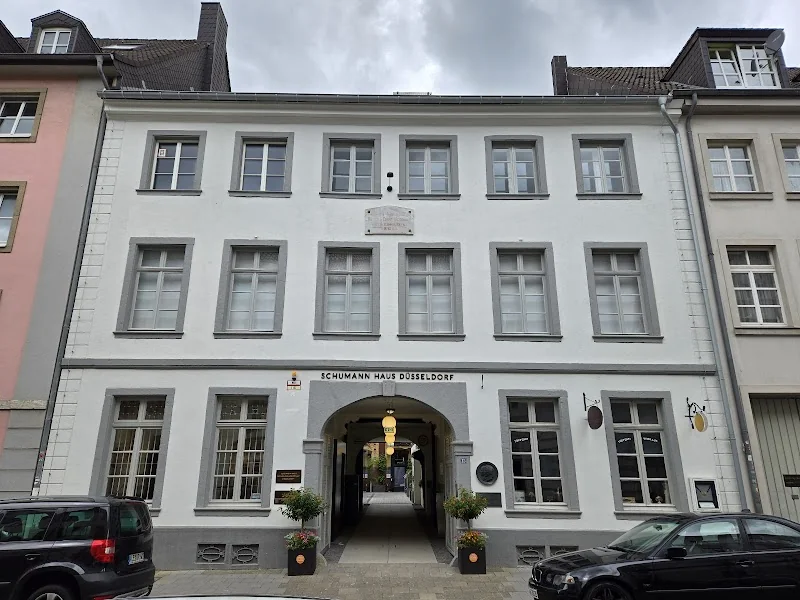
Bilker Str. 15, Düsseldorf-Stadtbezirk 1
Bilker Str. 15, 40213 Düsseldorf, Germany
Schumann-Haus Düsseldorf | Tickets & Tours
The Schumann-Haus Düsseldorf is much more than a classic sight. It is a historical memorial site, a modern music museum, and a house where music history directly connects with architecture, city history, and personal memory. At Bilker Straße 15, visitors encounter the only residence of the Schumann family that has been preserved in its historical substance. Clara and Robert Schumann lived here with their children since 1852, and this living environment is now made tangible in a carefully restored and contemporarily presented exhibition. The house has been restored in accordance with monument preservation guidelines, understood as exhibition piece number 1, and reopened as a museum. Therefore, those who visit the Schumann-Haus not only experience an exhibition but also a place where the atmosphere of the 19th century comes alive in eight themed rooms. For guests looking for a culturally rich destination in Düsseldorf, the Schumann-Haus is a particularly strong address because it combines authenticity, family history, musical memory, and practical visitor friendliness. ([duesseldorf.de](https://www.duesseldorf.de/schumannhaus))
History of the Schumann-Haus in Düsseldorf
The history of the Schumann-Haus begins with the Düsseldorf period of Clara and Robert Schumann, who lived with their children at Bilker Straße 15 from 1852. The official website describes the house as the only residence of the family preserved in its historical substance. This makes its cultural-historical value so extraordinary: it is not a reconstructed memorial image but an authentic place where real traces of living and life have been preserved. The house was therefore restored in accordance with monument preservation guidelines and converted into a museum so that visitors can trace the Düsseldorf life and work phase of the musician couple today. The building itself is treated in the official presentation as a first exhibition object because its substance, its rooms, and its history are already part of the storytelling. This creates a museum visit that does not take place in a neutral white cube but in a real town house of the 19th century. The fact that the museum was only opened in December 2023 underscores how current and carefully this historical heritage has been prepared for the present. ([duesseldorf.de](https://www.duesseldorf.de/schumannhaus))
The architectural details also make the history tangible. During the restoration, historical floorboards from around 1800, as well as old doors, stucco, and layers of paint that have been preserved since the construction period around 1795, came to light. The official reporting describes the building as a stroke of luck for restorers because essential parts of the house have hardly been changed for a long time. This architectural continuity creates a special impression of closeness to the Schumann era. Walking through the house, one experiences not only a music museum but also a time capsule of bourgeois living culture in Düsseldorf. At the same time, the building has been integrated into the larger cultural-historical concept of the Street of Romanticism and Revolution. This means that the Schumann story is not told in isolation but placed in a larger context of literature, music, and urban memory. For visitors, this means: The Schumann-Haus is a place where private family history, music history, and city history directly overlap. ([duesseldorf.de](https://www.duesseldorf.de/aktuelles/news/detailansicht/newsdetail/so-wird-das-schumann-haus-zu-einem-schumann-museum-umgebaut-1/))
Eight Themed Rooms and Exhibition in the Historical Residence
The heart of the museum is the eight themed rooms, where visitors can immerse themselves in the music culture of the 19th century. The official website emphasizes that here, especially the intense Düsseldorf life and work phase of Robert and Clara Schumann is at the center. This creates not a dry biography museum but a multifaceted tour where music, everyday life, family, and cultural environment merge. The house is designed to combine historical authenticity with modern mediation. This combination makes the Schumann-Haus interesting for different target groups: music lovers, cultural travelers, school classes, families, and those interested in local history each find their own access. The rooms not only provide information but also atmospheric density. From the official descriptions, it becomes clear that the exhibition relies on experience and narration: the building itself tells along, and the individual themed rooms open different perspectives on the Schumanns in Düsseldorf. This is exactly where the strength of this museum lies: it is small enough to feel intimate and rich enough to vividly unfold an entire phase of life. ([duesseldorf.de](https://www.duesseldorf.de/schumannhaus))
Particularly impressive is how strongly the historical substance has been integrated into the exhibition. The restored doors still show layers of paint from different times, and the historical floorboards and stucco reveal how carefully the house has been preserved. The restoration also made it clear that rooms have been changed over the decades and that behind later wall coverings lie further historical layers. Such findings give the museum a high credibility because they convey not only aesthetic but also material-historical depth. The official contributions even explain the earlier spatial structure, such as a wider central room that was referred to as a hall in older documents. This creates a picture of how bourgeois living functioned in the 19th century and how the use of the rooms changed. The facade with its Andesite hidden under the paint and the preserved historical staircase reinforce this impression. Thus, the Schumann-Haus itself becomes an exhibit that links architecture, interior, and memory. ([duesseldorf.de](https://www.duesseldorf.de/aktuelles/news/detailansicht/newsdetail/so-wird-das-schumann-haus-zu-einem-schumann-museum-umgebaut-1/))
Another sign of the quality of the presentation is the award of the exhibition design with the German Design Award 2025 in the category Excellent Architecture – Fair and Exhibition. This recognition shows that not only the historical substance but also the form of mediation has been implemented at a high level. The Schumann-Haus therefore does not rely solely on historical aura but on a contemporary understanding of museums that organizes content in a comprehensible, attractive, and spatially precise manner. In addition, current insights into the so-called treasure chamber of the house are included, where previously unknown letters, a friendship album, and a newly discovered portrait photograph of Clara Schumann have been displayed. Such presentations make it clear that the museum is not static but continuously develops its collection and narrative. Those looking for a place where originality, scholarly rigor, and modern exhibition design come together will find in the Schumann-Haus a convincing example of how a historical residence functions as a living music museum. ([duesseldorf.de](https://www.duesseldorf.de/medienportal/pressedienst-einzelansicht/pld/schumann-haus-feiert-german-design-award?utm_source=openai))
Opening Hours, Tickets, and Combination Ticket with the Heine Institute
For planning a visit, practical information is particularly helpful. According to the official website, the Schumann-Haus is open from Tuesday to Friday from 11 am to 5 pm, Saturday from 1 pm to 5 pm, and Sunday from 11 am to 5 pm. The regular admission is 4 euros, reduced 2 euros. Children and young people up to 18 years have free admission. Additionally, there is a happy hour from 4 pm with free admission, and on Sundays, admission is generally free. This makes the visit not only culturally appealing but also financially very accessible. However, visitors should note that there may be short waiting times during peak periods. Those who prefer a relaxed tour should plan their visit a bit earlier or outside of known peak times. The clear structure of the opening hours and the low-threshold pricing speak for a house that consciously aims to attract a wide audience. Combined with the strong content of the museum offer, this creates an attractive overall package for Düsseldorfers and guests from other cities. ([duesseldorf.de](https://www.duesseldorf.de/schumannhaus))
A particular strength is the combination ticket Schumann and Heine. It links the Schumann-Haus at Bilker Straße 15 with the Heinrich-Heine-Institut at Bilker Straße 12 to 14 and costs 6 euros for adults, reduced 3 euros. Here, too, children and young people up to 18 years have free admission. This offer is ideal for anyone who wants to spend a whole cultural morning or afternoon on the Street of Romanticism and Revolution. The connection between the two houses is meaningful in content because music, literature, and city history meet particularly closely at this location. The official website also provides contact details for museum visits and tours. Appointments can be arranged by phone or email, which is especially important for groups, families, and educational institutions. The museum is therefore available not only digitally but also personally and directly for booking and consultation. This fits well with a house that explicitly places closeness and mediation at the center. ([duesseldorf.de](https://www.duesseldorf.de/schumannhaus))
The tour offerings are also clearly structured. The website lists a trial tour, the format Welcome to the Schumanns, and a combined tour on the Street of Romanticism and Revolution, which connects the Schumann-Haus and Heinrich-Heine-Institut. The duration ranges from 30 minutes to 2 hours, and the prices are transparently displayed. For visitors, this means flexibility: those with little time can choose a compact insight, while those who want to dive deeper can book a more detailed format. This is particularly valuable for groups coming to Düsseldorf for a specific occasion. The tour dates can be requested by phone or email, making the house function not only as a museum place but also as an active mediation place. In connection with the free admissions on Sundays and during the happy hour, a very accessible visit model emerges that can be easily integrated into the everyday life of culture enthusiasts. ([duesseldorf.de](https://www.duesseldorf.de/schumannhaus))
Guided Tours, Family Days, and Lively Events
The Schumann-Haus is not a silent monument but a place with a regular program. In the current calendar view of the official website, a family Sunday on April 12, 2026, and a guided tour on April 23, 2026, appear, among others. This shows that the house is continuously used as a lively event venue and is not only designed for individual visits. This is particularly important for families because the mix of play, discovery, and history creates a good access point. According to the current announcement, the family Sunday is aimed at families with children aged six and older and playfully guides them through the rooms. In addition, there are changing guided tours, special formats, and recurring mediation offers. Therefore, those searching for Schumann-Haus Düsseldorf opening hours, Schumann-Haus Düsseldorf tours, or Schumann-Haus Düsseldorf family programs will find not only a one-time exhibition but a permanently maintained visitor offer in the official program. The house clearly positions itself as a cultural place that connects historical content with current participation and actively addresses different target groups. ([duesseldorf.de](https://www.duesseldorf.de/schumannhaus))
A particularly charming component of the program is the Sound Salon. For International Women’s Day, the Schumann-Haus invited in March 2025 to an acoustic discovery journey with historical recordings from the early days of sound recording. The event marked the beginning of a small series about Clara Schumann as a teacher, friend, and artist. Such formats show that the museum not only displays objects but also links sound, context, and biography. The admission was inexpensive, and participation was by registration. For a house that deals with music history, this is a convincing approach: visitors experience not only texts and rooms but also sounding perspectives on the 19th century and the role of female musicians in a male-dominated cultural landscape. The Sound Salon thus makes the Schumann-Haus a place where research, mediation, and sensory experience work particularly closely together. ([duesseldorf.de](https://www.duesseldorf.de/medienportal/pressedienst-einzelansicht/pld/klang-salon-im-schumann-haus-zum-internationalen-frauentag?utm_source=openai))
Special formats around the treasure chamber and the annual program also make the house attractive. At the beginning of 2026, new insights into the treasure chamber were announced, including previously unknown letters, a friendship album, and a newly discovered portrait photograph of Clara Schumann. Such presentations give the museum a constant relevance and show that the collection is continually re-examined and mediated. Additionally, the integration into larger city actions, such as the Winter Festival on the Street of Romanticism and Revolution, where the Schumann-Haus, together with the Heine Institute and Palais Wittgenstein, brings literature, music, and art to Bilker Straße, is noteworthy. Thus, the house is not only active internally but also part of a cultural network in the urban space. For guests, this means: a visit can be combined with an event, a special tour, or a larger cultural walk if desired. This mixture of a consistent museum experience and changing programs makes the Schumann-Haus particularly versatile. ([duesseldorf.de](https://www.duesseldorf.de/medienportal/pressedienst-einzelansicht/pld/neue-einblicke-in-die-schatzkammer-im-schumann-haus?utm_source=openai))
The house is also well-equipped for educational institutions. The official site lists a versatile musical mediation program for school classes and kindergarten groups. This makes it clear that the Schumann-Haus is not only intended for adults and specialist audiences but also creates its own access for children and young people. A historical music museum particularly benefits when it can be explained and experienced in age-appropriate formats. The combination of guided tours, workshops, and active participation opens up many possibilities here. For schools and kindergartens, this is particularly interesting because the visit can be integrated into lessons, project days, or cultural education programs. That younger visitors are explicitly addressed fits the open visitor structure of the house. Together with the family orientation, public tours, and special dates, a lively program emerges that goes far beyond a simple exhibition visit. ([duesseldorf.de](https://www.duesseldorf.de/schumannhaus))
Accessibility and Visitor Service
An important quality feature of the Schumann-Haus is its accessibility. According to the official statement, the barrier-free access to all museum areas was a fundamental requirement for the conversion into a museum. In the newly constructed rear extension, there is a passenger elevator that ensures barrier-free access to the museum areas. Additionally, a barrier-free WC has been installed in the basement, and measures such as threshold-free transitions and additional handrails have been implemented. This is particularly remarkable in a historical building and shows that monument protection and accessibility have been sensibly combined here. For visitors with mobility impairments, this is a strong argument, as the house attempts to connect its historical substance with modern usability. The fact that the measures were supported by a grant from the NRW Foundation further underscores the public relevance of the project. Accessibility is not just an addition here but part of the educational and architectural overall concept. ([duesseldorf.de](https://www.duesseldorf.de/medienportal/pressedienst-einzelansicht/pld/aufzug-im-schumann-haus-sorgt-fuer-barrierefreiheit))
The visitor service is also clearly organized. For museum visits and tours, the official website provides a phone number and an email address, allowing inquiries to be made directly and easily. This is particularly helpful for groups, school classes, private tours, and people who wish to plan their visit in advance. There is also a separate registration contact for events. This structure shows that the house does not rely solely on walk-in visitors but offers active advice and personal coordination. Additionally, it is noted that there may be waiting times during peak periods. This is communicated honestly and helps with planning. In practice, this means: those who want a relaxed visit should plan enough time and possibly contact in advance. The service of the house is thus consciously low-threshold but professional. This fits a museum that wants to combine historical depth with contemporary visitor orientation. ([duesseldorf.de](https://www.duesseldorf.de/schumannhaus))
For many guests, it is also important that the Schumann-Haus remains compact and manageable. The spatial proximity of the eight themed rooms, the clear structure of the opening hours, and the easy booking of tours make the visit planable and pleasant. Those visiting the house as part of a larger cultural program can easily incorporate it into a tour through Bilker Straße and the Heine area. This is what makes the location so attractive: it is historically significant but not overwhelming. Instead of monumental size, it offers a concentrated, intimate experience. Thus, it is well-suited for people who prefer to experience culture intensively rather than quickly. The Schumann-Haus remains a place where one can take their time but does not have to. This balance of accessibility, clarity, and historical atmosphere is a decisive advantage for different visitor groups. ([duesseldorf.de](https://www.duesseldorf.de/schumannhaus))
Why the Schumann-Haus is so Special for Düsseldorf
The Schumann-Haus is a cultural-historical key location for Düsseldorf. It tells not only of a famous musician family but also of the city as a place of musical development, bourgeois living culture, and historical memory. Through its integration into the Street of Romanticism and Revolution, the house becomes part of a larger cultural context that makes music and literature visible in immediate proximity. This gives the location a special depth. Those who visit the Schumann-Haus do not simply experience a single museum but a building block of urban identity. The location at Bilker Straße 15 makes this connection concrete, as history does not seem distant or abstract here but is anchored in today’s urban life. The house thus offers an ideal mix of central location, historical authenticity, and cultural radiance. For Düsseldorf, it is a place where the past is not concluded but remains present in the best sense. ([duesseldorf.de](https://www.duesseldorf.de/schumannhaus))
Additionally, there is the ambition to connect the historical residence with a contemporary museum language. The award of the exhibition design with the German Design Award 2025 shows that this ambition is also convincing in terms of design. The Schumann-Haus is therefore not only a place of remembrance but also an example of good museum design that presents historical spaces respectfully but not museum-dusty. This makes a significant difference for culturally interested guests: one does not enter a merely preserved house but a lively space with clear dramaturgy, high authenticity, and modern mediation. The combination of accessibility, family-friendly programs, guided tours, special events, and historical substance creates a visit that is both emotional and informative. Those looking for a cultural destination in Düsseldorf that is both intellectually interesting and atmospherically dense will find in the Schumann-Haus an address that convincingly fulfills this ambition. ([duesseldorf.de](https://www.duesseldorf.de/medienportal/pressedienst-einzelansicht/pld/schumann-haus-feiert-german-design-award?utm_source=openai))
The connection with the Heine Institute and the possibility of a combination ticket also show how well the Schumann-Haus can be integrated into a larger cultural day program. This allows music history, literary history, and urban experience to be connected in one place without the visit becoming arbitrary. The official website and current events make it clear that the house regularly creates new reasons to return. Therefore, it is worthwhile not only for first-time visitors but also for anyone wishing to experience a special tour, a current event format, or new finds from the collection. The Schumann-Haus is thus a museum with return value. It connects the fame of Clara and Robert Schumann with a clear, open, and modern visitor orientation. This is why it remains such an important house for Düsseldorf and a particularly rewarding address for guests. ([duesseldorf.de](https://www.duesseldorf.de/schumannhaus))
Sources:
Show moreShow less
Schumann-Haus Düsseldorf | Tickets & Tours
The Schumann-Haus Düsseldorf is much more than a classic sight. It is a historical memorial site, a modern music museum, and a house where music history directly connects with architecture, city history, and personal memory. At Bilker Straße 15, visitors encounter the only residence of the Schumann family that has been preserved in its historical substance. Clara and Robert Schumann lived here with their children since 1852, and this living environment is now made tangible in a carefully restored and contemporarily presented exhibition. The house has been restored in accordance with monument preservation guidelines, understood as exhibition piece number 1, and reopened as a museum. Therefore, those who visit the Schumann-Haus not only experience an exhibition but also a place where the atmosphere of the 19th century comes alive in eight themed rooms. For guests looking for a culturally rich destination in Düsseldorf, the Schumann-Haus is a particularly strong address because it combines authenticity, family history, musical memory, and practical visitor friendliness. ([duesseldorf.de](https://www.duesseldorf.de/schumannhaus))
History of the Schumann-Haus in Düsseldorf
The history of the Schumann-Haus begins with the Düsseldorf period of Clara and Robert Schumann, who lived with their children at Bilker Straße 15 from 1852. The official website describes the house as the only residence of the family preserved in its historical substance. This makes its cultural-historical value so extraordinary: it is not a reconstructed memorial image but an authentic place where real traces of living and life have been preserved. The house was therefore restored in accordance with monument preservation guidelines and converted into a museum so that visitors can trace the Düsseldorf life and work phase of the musician couple today. The building itself is treated in the official presentation as a first exhibition object because its substance, its rooms, and its history are already part of the storytelling. This creates a museum visit that does not take place in a neutral white cube but in a real town house of the 19th century. The fact that the museum was only opened in December 2023 underscores how current and carefully this historical heritage has been prepared for the present. ([duesseldorf.de](https://www.duesseldorf.de/schumannhaus))
The architectural details also make the history tangible. During the restoration, historical floorboards from around 1800, as well as old doors, stucco, and layers of paint that have been preserved since the construction period around 1795, came to light. The official reporting describes the building as a stroke of luck for restorers because essential parts of the house have hardly been changed for a long time. This architectural continuity creates a special impression of closeness to the Schumann era. Walking through the house, one experiences not only a music museum but also a time capsule of bourgeois living culture in Düsseldorf. At the same time, the building has been integrated into the larger cultural-historical concept of the Street of Romanticism and Revolution. This means that the Schumann story is not told in isolation but placed in a larger context of literature, music, and urban memory. For visitors, this means: The Schumann-Haus is a place where private family history, music history, and city history directly overlap. ([duesseldorf.de](https://www.duesseldorf.de/aktuelles/news/detailansicht/newsdetail/so-wird-das-schumann-haus-zu-einem-schumann-museum-umgebaut-1/))
Eight Themed Rooms and Exhibition in the Historical Residence
The heart of the museum is the eight themed rooms, where visitors can immerse themselves in the music culture of the 19th century. The official website emphasizes that here, especially the intense Düsseldorf life and work phase of Robert and Clara Schumann is at the center. This creates not a dry biography museum but a multifaceted tour where music, everyday life, family, and cultural environment merge. The house is designed to combine historical authenticity with modern mediation. This combination makes the Schumann-Haus interesting for different target groups: music lovers, cultural travelers, school classes, families, and those interested in local history each find their own access. The rooms not only provide information but also atmospheric density. From the official descriptions, it becomes clear that the exhibition relies on experience and narration: the building itself tells along, and the individual themed rooms open different perspectives on the Schumanns in Düsseldorf. This is exactly where the strength of this museum lies: it is small enough to feel intimate and rich enough to vividly unfold an entire phase of life. ([duesseldorf.de](https://www.duesseldorf.de/schumannhaus))
Particularly impressive is how strongly the historical substance has been integrated into the exhibition. The restored doors still show layers of paint from different times, and the historical floorboards and stucco reveal how carefully the house has been preserved. The restoration also made it clear that rooms have been changed over the decades and that behind later wall coverings lie further historical layers. Such findings give the museum a high credibility because they convey not only aesthetic but also material-historical depth. The official contributions even explain the earlier spatial structure, such as a wider central room that was referred to as a hall in older documents. This creates a picture of how bourgeois living functioned in the 19th century and how the use of the rooms changed. The facade with its Andesite hidden under the paint and the preserved historical staircase reinforce this impression. Thus, the Schumann-Haus itself becomes an exhibit that links architecture, interior, and memory. ([duesseldorf.de](https://www.duesseldorf.de/aktuelles/news/detailansicht/newsdetail/so-wird-das-schumann-haus-zu-einem-schumann-museum-umgebaut-1/))
Another sign of the quality of the presentation is the award of the exhibition design with the German Design Award 2025 in the category Excellent Architecture – Fair and Exhibition. This recognition shows that not only the historical substance but also the form of mediation has been implemented at a high level. The Schumann-Haus therefore does not rely solely on historical aura but on a contemporary understanding of museums that organizes content in a comprehensible, attractive, and spatially precise manner. In addition, current insights into the so-called treasure chamber of the house are included, where previously unknown letters, a friendship album, and a newly discovered portrait photograph of Clara Schumann have been displayed. Such presentations make it clear that the museum is not static but continuously develops its collection and narrative. Those looking for a place where originality, scholarly rigor, and modern exhibition design come together will find in the Schumann-Haus a convincing example of how a historical residence functions as a living music museum. ([duesseldorf.de](https://www.duesseldorf.de/medienportal/pressedienst-einzelansicht/pld/schumann-haus-feiert-german-design-award?utm_source=openai))
Opening Hours, Tickets, and Combination Ticket with the Heine Institute
For planning a visit, practical information is particularly helpful. According to the official website, the Schumann-Haus is open from Tuesday to Friday from 11 am to 5 pm, Saturday from 1 pm to 5 pm, and Sunday from 11 am to 5 pm. The regular admission is 4 euros, reduced 2 euros. Children and young people up to 18 years have free admission. Additionally, there is a happy hour from 4 pm with free admission, and on Sundays, admission is generally free. This makes the visit not only culturally appealing but also financially very accessible. However, visitors should note that there may be short waiting times during peak periods. Those who prefer a relaxed tour should plan their visit a bit earlier or outside of known peak times. The clear structure of the opening hours and the low-threshold pricing speak for a house that consciously aims to attract a wide audience. Combined with the strong content of the museum offer, this creates an attractive overall package for Düsseldorfers and guests from other cities. ([duesseldorf.de](https://www.duesseldorf.de/schumannhaus))
A particular strength is the combination ticket Schumann and Heine. It links the Schumann-Haus at Bilker Straße 15 with the Heinrich-Heine-Institut at Bilker Straße 12 to 14 and costs 6 euros for adults, reduced 3 euros. Here, too, children and young people up to 18 years have free admission. This offer is ideal for anyone who wants to spend a whole cultural morning or afternoon on the Street of Romanticism and Revolution. The connection between the two houses is meaningful in content because music, literature, and city history meet particularly closely at this location. The official website also provides contact details for museum visits and tours. Appointments can be arranged by phone or email, which is especially important for groups, families, and educational institutions. The museum is therefore available not only digitally but also personally and directly for booking and consultation. This fits well with a house that explicitly places closeness and mediation at the center. ([duesseldorf.de](https://www.duesseldorf.de/schumannhaus))
The tour offerings are also clearly structured. The website lists a trial tour, the format Welcome to the Schumanns, and a combined tour on the Street of Romanticism and Revolution, which connects the Schumann-Haus and Heinrich-Heine-Institut. The duration ranges from 30 minutes to 2 hours, and the prices are transparently displayed. For visitors, this means flexibility: those with little time can choose a compact insight, while those who want to dive deeper can book a more detailed format. This is particularly valuable for groups coming to Düsseldorf for a specific occasion. The tour dates can be requested by phone or email, making the house function not only as a museum place but also as an active mediation place. In connection with the free admissions on Sundays and during the happy hour, a very accessible visit model emerges that can be easily integrated into the everyday life of culture enthusiasts. ([duesseldorf.de](https://www.duesseldorf.de/schumannhaus))
Guided Tours, Family Days, and Lively Events
The Schumann-Haus is not a silent monument but a place with a regular program. In the current calendar view of the official website, a family Sunday on April 12, 2026, and a guided tour on April 23, 2026, appear, among others. This shows that the house is continuously used as a lively event venue and is not only designed for individual visits. This is particularly important for families because the mix of play, discovery, and history creates a good access point. According to the current announcement, the family Sunday is aimed at families with children aged six and older and playfully guides them through the rooms. In addition, there are changing guided tours, special formats, and recurring mediation offers. Therefore, those searching for Schumann-Haus Düsseldorf opening hours, Schumann-Haus Düsseldorf tours, or Schumann-Haus Düsseldorf family programs will find not only a one-time exhibition but a permanently maintained visitor offer in the official program. The house clearly positions itself as a cultural place that connects historical content with current participation and actively addresses different target groups. ([duesseldorf.de](https://www.duesseldorf.de/schumannhaus))
A particularly charming component of the program is the Sound Salon. For International Women’s Day, the Schumann-Haus invited in March 2025 to an acoustic discovery journey with historical recordings from the early days of sound recording. The event marked the beginning of a small series about Clara Schumann as a teacher, friend, and artist. Such formats show that the museum not only displays objects but also links sound, context, and biography. The admission was inexpensive, and participation was by registration. For a house that deals with music history, this is a convincing approach: visitors experience not only texts and rooms but also sounding perspectives on the 19th century and the role of female musicians in a male-dominated cultural landscape. The Sound Salon thus makes the Schumann-Haus a place where research, mediation, and sensory experience work particularly closely together. ([duesseldorf.de](https://www.duesseldorf.de/medienportal/pressedienst-einzelansicht/pld/klang-salon-im-schumann-haus-zum-internationalen-frauentag?utm_source=openai))
Special formats around the treasure chamber and the annual program also make the house attractive. At the beginning of 2026, new insights into the treasure chamber were announced, including previously unknown letters, a friendship album, and a newly discovered portrait photograph of Clara Schumann. Such presentations give the museum a constant relevance and show that the collection is continually re-examined and mediated. Additionally, the integration into larger city actions, such as the Winter Festival on the Street of Romanticism and Revolution, where the Schumann-Haus, together with the Heine Institute and Palais Wittgenstein, brings literature, music, and art to Bilker Straße, is noteworthy. Thus, the house is not only active internally but also part of a cultural network in the urban space. For guests, this means: a visit can be combined with an event, a special tour, or a larger cultural walk if desired. This mixture of a consistent museum experience and changing programs makes the Schumann-Haus particularly versatile. ([duesseldorf.de](https://www.duesseldorf.de/medienportal/pressedienst-einzelansicht/pld/neue-einblicke-in-die-schatzkammer-im-schumann-haus?utm_source=openai))
The house is also well-equipped for educational institutions. The official site lists a versatile musical mediation program for school classes and kindergarten groups. This makes it clear that the Schumann-Haus is not only intended for adults and specialist audiences but also creates its own access for children and young people. A historical music museum particularly benefits when it can be explained and experienced in age-appropriate formats. The combination of guided tours, workshops, and active participation opens up many possibilities here. For schools and kindergartens, this is particularly interesting because the visit can be integrated into lessons, project days, or cultural education programs. That younger visitors are explicitly addressed fits the open visitor structure of the house. Together with the family orientation, public tours, and special dates, a lively program emerges that goes far beyond a simple exhibition visit. ([duesseldorf.de](https://www.duesseldorf.de/schumannhaus))
Accessibility and Visitor Service
An important quality feature of the Schumann-Haus is its accessibility. According to the official statement, the barrier-free access to all museum areas was a fundamental requirement for the conversion into a museum. In the newly constructed rear extension, there is a passenger elevator that ensures barrier-free access to the museum areas. Additionally, a barrier-free WC has been installed in the basement, and measures such as threshold-free transitions and additional handrails have been implemented. This is particularly remarkable in a historical building and shows that monument protection and accessibility have been sensibly combined here. For visitors with mobility impairments, this is a strong argument, as the house attempts to connect its historical substance with modern usability. The fact that the measures were supported by a grant from the NRW Foundation further underscores the public relevance of the project. Accessibility is not just an addition here but part of the educational and architectural overall concept. ([duesseldorf.de](https://www.duesseldorf.de/medienportal/pressedienst-einzelansicht/pld/aufzug-im-schumann-haus-sorgt-fuer-barrierefreiheit))
The visitor service is also clearly organized. For museum visits and tours, the official website provides a phone number and an email address, allowing inquiries to be made directly and easily. This is particularly helpful for groups, school classes, private tours, and people who wish to plan their visit in advance. There is also a separate registration contact for events. This structure shows that the house does not rely solely on walk-in visitors but offers active advice and personal coordination. Additionally, it is noted that there may be waiting times during peak periods. This is communicated honestly and helps with planning. In practice, this means: those who want a relaxed visit should plan enough time and possibly contact in advance. The service of the house is thus consciously low-threshold but professional. This fits a museum that wants to combine historical depth with contemporary visitor orientation. ([duesseldorf.de](https://www.duesseldorf.de/schumannhaus))
For many guests, it is also important that the Schumann-Haus remains compact and manageable. The spatial proximity of the eight themed rooms, the clear structure of the opening hours, and the easy booking of tours make the visit planable and pleasant. Those visiting the house as part of a larger cultural program can easily incorporate it into a tour through Bilker Straße and the Heine area. This is what makes the location so attractive: it is historically significant but not overwhelming. Instead of monumental size, it offers a concentrated, intimate experience. Thus, it is well-suited for people who prefer to experience culture intensively rather than quickly. The Schumann-Haus remains a place where one can take their time but does not have to. This balance of accessibility, clarity, and historical atmosphere is a decisive advantage for different visitor groups. ([duesseldorf.de](https://www.duesseldorf.de/schumannhaus))
Why the Schumann-Haus is so Special for Düsseldorf
The Schumann-Haus is a cultural-historical key location for Düsseldorf. It tells not only of a famous musician family but also of the city as a place of musical development, bourgeois living culture, and historical memory. Through its integration into the Street of Romanticism and Revolution, the house becomes part of a larger cultural context that makes music and literature visible in immediate proximity. This gives the location a special depth. Those who visit the Schumann-Haus do not simply experience a single museum but a building block of urban identity. The location at Bilker Straße 15 makes this connection concrete, as history does not seem distant or abstract here but is anchored in today’s urban life. The house thus offers an ideal mix of central location, historical authenticity, and cultural radiance. For Düsseldorf, it is a place where the past is not concluded but remains present in the best sense. ([duesseldorf.de](https://www.duesseldorf.de/schumannhaus))
Additionally, there is the ambition to connect the historical residence with a contemporary museum language. The award of the exhibition design with the German Design Award 2025 shows that this ambition is also convincing in terms of design. The Schumann-Haus is therefore not only a place of remembrance but also an example of good museum design that presents historical spaces respectfully but not museum-dusty. This makes a significant difference for culturally interested guests: one does not enter a merely preserved house but a lively space with clear dramaturgy, high authenticity, and modern mediation. The combination of accessibility, family-friendly programs, guided tours, special events, and historical substance creates a visit that is both emotional and informative. Those looking for a cultural destination in Düsseldorf that is both intellectually interesting and atmospherically dense will find in the Schumann-Haus an address that convincingly fulfills this ambition. ([duesseldorf.de](https://www.duesseldorf.de/medienportal/pressedienst-einzelansicht/pld/schumann-haus-feiert-german-design-award?utm_source=openai))
The connection with the Heine Institute and the possibility of a combination ticket also show how well the Schumann-Haus can be integrated into a larger cultural day program. This allows music history, literary history, and urban experience to be connected in one place without the visit becoming arbitrary. The official website and current events make it clear that the house regularly creates new reasons to return. Therefore, it is worthwhile not only for first-time visitors but also for anyone wishing to experience a special tour, a current event format, or new finds from the collection. The Schumann-Haus is thus a museum with return value. It connects the fame of Clara and Robert Schumann with a clear, open, and modern visitor orientation. This is why it remains such an important house for Düsseldorf and a particularly rewarding address for guests. ([duesseldorf.de](https://www.duesseldorf.de/schumannhaus))
Sources:
Schumann-Haus Düsseldorf | Tickets & Tours
The Schumann-Haus Düsseldorf is much more than a classic sight. It is a historical memorial site, a modern music museum, and a house where music history directly connects with architecture, city history, and personal memory. At Bilker Straße 15, visitors encounter the only residence of the Schumann family that has been preserved in its historical substance. Clara and Robert Schumann lived here with their children since 1852, and this living environment is now made tangible in a carefully restored and contemporarily presented exhibition. The house has been restored in accordance with monument preservation guidelines, understood as exhibition piece number 1, and reopened as a museum. Therefore, those who visit the Schumann-Haus not only experience an exhibition but also a place where the atmosphere of the 19th century comes alive in eight themed rooms. For guests looking for a culturally rich destination in Düsseldorf, the Schumann-Haus is a particularly strong address because it combines authenticity, family history, musical memory, and practical visitor friendliness. ([duesseldorf.de](https://www.duesseldorf.de/schumannhaus))
History of the Schumann-Haus in Düsseldorf
The history of the Schumann-Haus begins with the Düsseldorf period of Clara and Robert Schumann, who lived with their children at Bilker Straße 15 from 1852. The official website describes the house as the only residence of the family preserved in its historical substance. This makes its cultural-historical value so extraordinary: it is not a reconstructed memorial image but an authentic place where real traces of living and life have been preserved. The house was therefore restored in accordance with monument preservation guidelines and converted into a museum so that visitors can trace the Düsseldorf life and work phase of the musician couple today. The building itself is treated in the official presentation as a first exhibition object because its substance, its rooms, and its history are already part of the storytelling. This creates a museum visit that does not take place in a neutral white cube but in a real town house of the 19th century. The fact that the museum was only opened in December 2023 underscores how current and carefully this historical heritage has been prepared for the present. ([duesseldorf.de](https://www.duesseldorf.de/schumannhaus))
The architectural details also make the history tangible. During the restoration, historical floorboards from around 1800, as well as old doors, stucco, and layers of paint that have been preserved since the construction period around 1795, came to light. The official reporting describes the building as a stroke of luck for restorers because essential parts of the house have hardly been changed for a long time. This architectural continuity creates a special impression of closeness to the Schumann era. Walking through the house, one experiences not only a music museum but also a time capsule of bourgeois living culture in Düsseldorf. At the same time, the building has been integrated into the larger cultural-historical concept of the Street of Romanticism and Revolution. This means that the Schumann story is not told in isolation but placed in a larger context of literature, music, and urban memory. For visitors, this means: The Schumann-Haus is a place where private family history, music history, and city history directly overlap. ([duesseldorf.de](https://www.duesseldorf.de/aktuelles/news/detailansicht/newsdetail/so-wird-das-schumann-haus-zu-einem-schumann-museum-umgebaut-1/))
Eight Themed Rooms and Exhibition in the Historical Residence
The heart of the museum is the eight themed rooms, where visitors can immerse themselves in the music culture of the 19th century. The official website emphasizes that here, especially the intense Düsseldorf life and work phase of Robert and Clara Schumann is at the center. This creates not a dry biography museum but a multifaceted tour where music, everyday life, family, and cultural environment merge. The house is designed to combine historical authenticity with modern mediation. This combination makes the Schumann-Haus interesting for different target groups: music lovers, cultural travelers, school classes, families, and those interested in local history each find their own access. The rooms not only provide information but also atmospheric density. From the official descriptions, it becomes clear that the exhibition relies on experience and narration: the building itself tells along, and the individual themed rooms open different perspectives on the Schumanns in Düsseldorf. This is exactly where the strength of this museum lies: it is small enough to feel intimate and rich enough to vividly unfold an entire phase of life. ([duesseldorf.de](https://www.duesseldorf.de/schumannhaus))
Particularly impressive is how strongly the historical substance has been integrated into the exhibition. The restored doors still show layers of paint from different times, and the historical floorboards and stucco reveal how carefully the house has been preserved. The restoration also made it clear that rooms have been changed over the decades and that behind later wall coverings lie further historical layers. Such findings give the museum a high credibility because they convey not only aesthetic but also material-historical depth. The official contributions even explain the earlier spatial structure, such as a wider central room that was referred to as a hall in older documents. This creates a picture of how bourgeois living functioned in the 19th century and how the use of the rooms changed. The facade with its Andesite hidden under the paint and the preserved historical staircase reinforce this impression. Thus, the Schumann-Haus itself becomes an exhibit that links architecture, interior, and memory. ([duesseldorf.de](https://www.duesseldorf.de/aktuelles/news/detailansicht/newsdetail/so-wird-das-schumann-haus-zu-einem-schumann-museum-umgebaut-1/))
Another sign of the quality of the presentation is the award of the exhibition design with the German Design Award 2025 in the category Excellent Architecture – Fair and Exhibition. This recognition shows that not only the historical substance but also the form of mediation has been implemented at a high level. The Schumann-Haus therefore does not rely solely on historical aura but on a contemporary understanding of museums that organizes content in a comprehensible, attractive, and spatially precise manner. In addition, current insights into the so-called treasure chamber of the house are included, where previously unknown letters, a friendship album, and a newly discovered portrait photograph of Clara Schumann have been displayed. Such presentations make it clear that the museum is not static but continuously develops its collection and narrative. Those looking for a place where originality, scholarly rigor, and modern exhibition design come together will find in the Schumann-Haus a convincing example of how a historical residence functions as a living music museum. ([duesseldorf.de](https://www.duesseldorf.de/medienportal/pressedienst-einzelansicht/pld/schumann-haus-feiert-german-design-award?utm_source=openai))
Opening Hours, Tickets, and Combination Ticket with the Heine Institute
For planning a visit, practical information is particularly helpful. According to the official website, the Schumann-Haus is open from Tuesday to Friday from 11 am to 5 pm, Saturday from 1 pm to 5 pm, and Sunday from 11 am to 5 pm. The regular admission is 4 euros, reduced 2 euros. Children and young people up to 18 years have free admission. Additionally, there is a happy hour from 4 pm with free admission, and on Sundays, admission is generally free. This makes the visit not only culturally appealing but also financially very accessible. However, visitors should note that there may be short waiting times during peak periods. Those who prefer a relaxed tour should plan their visit a bit earlier or outside of known peak times. The clear structure of the opening hours and the low-threshold pricing speak for a house that consciously aims to attract a wide audience. Combined with the strong content of the museum offer, this creates an attractive overall package for Düsseldorfers and guests from other cities. ([duesseldorf.de](https://www.duesseldorf.de/schumannhaus))
A particular strength is the combination ticket Schumann and Heine. It links the Schumann-Haus at Bilker Straße 15 with the Heinrich-Heine-Institut at Bilker Straße 12 to 14 and costs 6 euros for adults, reduced 3 euros. Here, too, children and young people up to 18 years have free admission. This offer is ideal for anyone who wants to spend a whole cultural morning or afternoon on the Street of Romanticism and Revolution. The connection between the two houses is meaningful in content because music, literature, and city history meet particularly closely at this location. The official website also provides contact details for museum visits and tours. Appointments can be arranged by phone or email, which is especially important for groups, families, and educational institutions. The museum is therefore available not only digitally but also personally and directly for booking and consultation. This fits well with a house that explicitly places closeness and mediation at the center. ([duesseldorf.de](https://www.duesseldorf.de/schumannhaus))
The tour offerings are also clearly structured. The website lists a trial tour, the format Welcome to the Schumanns, and a combined tour on the Street of Romanticism and Revolution, which connects the Schumann-Haus and Heinrich-Heine-Institut. The duration ranges from 30 minutes to 2 hours, and the prices are transparently displayed. For visitors, this means flexibility: those with little time can choose a compact insight, while those who want to dive deeper can book a more detailed format. This is particularly valuable for groups coming to Düsseldorf for a specific occasion. The tour dates can be requested by phone or email, making the house function not only as a museum place but also as an active mediation place. In connection with the free admissions on Sundays and during the happy hour, a very accessible visit model emerges that can be easily integrated into the everyday life of culture enthusiasts. ([duesseldorf.de](https://www.duesseldorf.de/schumannhaus))
Guided Tours, Family Days, and Lively Events
The Schumann-Haus is not a silent monument but a place with a regular program. In the current calendar view of the official website, a family Sunday on April 12, 2026, and a guided tour on April 23, 2026, appear, among others. This shows that the house is continuously used as a lively event venue and is not only designed for individual visits. This is particularly important for families because the mix of play, discovery, and history creates a good access point. According to the current announcement, the family Sunday is aimed at families with children aged six and older and playfully guides them through the rooms. In addition, there are changing guided tours, special formats, and recurring mediation offers. Therefore, those searching for Schumann-Haus Düsseldorf opening hours, Schumann-Haus Düsseldorf tours, or Schumann-Haus Düsseldorf family programs will find not only a one-time exhibition but a permanently maintained visitor offer in the official program. The house clearly positions itself as a cultural place that connects historical content with current participation and actively addresses different target groups. ([duesseldorf.de](https://www.duesseldorf.de/schumannhaus))
A particularly charming component of the program is the Sound Salon. For International Women’s Day, the Schumann-Haus invited in March 2025 to an acoustic discovery journey with historical recordings from the early days of sound recording. The event marked the beginning of a small series about Clara Schumann as a teacher, friend, and artist. Such formats show that the museum not only displays objects but also links sound, context, and biography. The admission was inexpensive, and participation was by registration. For a house that deals with music history, this is a convincing approach: visitors experience not only texts and rooms but also sounding perspectives on the 19th century and the role of female musicians in a male-dominated cultural landscape. The Sound Salon thus makes the Schumann-Haus a place where research, mediation, and sensory experience work particularly closely together. ([duesseldorf.de](https://www.duesseldorf.de/medienportal/pressedienst-einzelansicht/pld/klang-salon-im-schumann-haus-zum-internationalen-frauentag?utm_source=openai))
Special formats around the treasure chamber and the annual program also make the house attractive. At the beginning of 2026, new insights into the treasure chamber were announced, including previously unknown letters, a friendship album, and a newly discovered portrait photograph of Clara Schumann. Such presentations give the museum a constant relevance and show that the collection is continually re-examined and mediated. Additionally, the integration into larger city actions, such as the Winter Festival on the Street of Romanticism and Revolution, where the Schumann-Haus, together with the Heine Institute and Palais Wittgenstein, brings literature, music, and art to Bilker Straße, is noteworthy. Thus, the house is not only active internally but also part of a cultural network in the urban space. For guests, this means: a visit can be combined with an event, a special tour, or a larger cultural walk if desired. This mixture of a consistent museum experience and changing programs makes the Schumann-Haus particularly versatile. ([duesseldorf.de](https://www.duesseldorf.de/medienportal/pressedienst-einzelansicht/pld/neue-einblicke-in-die-schatzkammer-im-schumann-haus?utm_source=openai))
The house is also well-equipped for educational institutions. The official site lists a versatile musical mediation program for school classes and kindergarten groups. This makes it clear that the Schumann-Haus is not only intended for adults and specialist audiences but also creates its own access for children and young people. A historical music museum particularly benefits when it can be explained and experienced in age-appropriate formats. The combination of guided tours, workshops, and active participation opens up many possibilities here. For schools and kindergartens, this is particularly interesting because the visit can be integrated into lessons, project days, or cultural education programs. That younger visitors are explicitly addressed fits the open visitor structure of the house. Together with the family orientation, public tours, and special dates, a lively program emerges that goes far beyond a simple exhibition visit. ([duesseldorf.de](https://www.duesseldorf.de/schumannhaus))
Accessibility and Visitor Service
An important quality feature of the Schumann-Haus is its accessibility. According to the official statement, the barrier-free access to all museum areas was a fundamental requirement for the conversion into a museum. In the newly constructed rear extension, there is a passenger elevator that ensures barrier-free access to the museum areas. Additionally, a barrier-free WC has been installed in the basement, and measures such as threshold-free transitions and additional handrails have been implemented. This is particularly remarkable in a historical building and shows that monument protection and accessibility have been sensibly combined here. For visitors with mobility impairments, this is a strong argument, as the house attempts to connect its historical substance with modern usability. The fact that the measures were supported by a grant from the NRW Foundation further underscores the public relevance of the project. Accessibility is not just an addition here but part of the educational and architectural overall concept. ([duesseldorf.de](https://www.duesseldorf.de/medienportal/pressedienst-einzelansicht/pld/aufzug-im-schumann-haus-sorgt-fuer-barrierefreiheit))
The visitor service is also clearly organized. For museum visits and tours, the official website provides a phone number and an email address, allowing inquiries to be made directly and easily. This is particularly helpful for groups, school classes, private tours, and people who wish to plan their visit in advance. There is also a separate registration contact for events. This structure shows that the house does not rely solely on walk-in visitors but offers active advice and personal coordination. Additionally, it is noted that there may be waiting times during peak periods. This is communicated honestly and helps with planning. In practice, this means: those who want a relaxed visit should plan enough time and possibly contact in advance. The service of the house is thus consciously low-threshold but professional. This fits a museum that wants to combine historical depth with contemporary visitor orientation. ([duesseldorf.de](https://www.duesseldorf.de/schumannhaus))
For many guests, it is also important that the Schumann-Haus remains compact and manageable. The spatial proximity of the eight themed rooms, the clear structure of the opening hours, and the easy booking of tours make the visit planable and pleasant. Those visiting the house as part of a larger cultural program can easily incorporate it into a tour through Bilker Straße and the Heine area. This is what makes the location so attractive: it is historically significant but not overwhelming. Instead of monumental size, it offers a concentrated, intimate experience. Thus, it is well-suited for people who prefer to experience culture intensively rather than quickly. The Schumann-Haus remains a place where one can take their time but does not have to. This balance of accessibility, clarity, and historical atmosphere is a decisive advantage for different visitor groups. ([duesseldorf.de](https://www.duesseldorf.de/schumannhaus))
Why the Schumann-Haus is so Special for Düsseldorf
The Schumann-Haus is a cultural-historical key location for Düsseldorf. It tells not only of a famous musician family but also of the city as a place of musical development, bourgeois living culture, and historical memory. Through its integration into the Street of Romanticism and Revolution, the house becomes part of a larger cultural context that makes music and literature visible in immediate proximity. This gives the location a special depth. Those who visit the Schumann-Haus do not simply experience a single museum but a building block of urban identity. The location at Bilker Straße 15 makes this connection concrete, as history does not seem distant or abstract here but is anchored in today’s urban life. The house thus offers an ideal mix of central location, historical authenticity, and cultural radiance. For Düsseldorf, it is a place where the past is not concluded but remains present in the best sense. ([duesseldorf.de](https://www.duesseldorf.de/schumannhaus))
Additionally, there is the ambition to connect the historical residence with a contemporary museum language. The award of the exhibition design with the German Design Award 2025 shows that this ambition is also convincing in terms of design. The Schumann-Haus is therefore not only a place of remembrance but also an example of good museum design that presents historical spaces respectfully but not museum-dusty. This makes a significant difference for culturally interested guests: one does not enter a merely preserved house but a lively space with clear dramaturgy, high authenticity, and modern mediation. The combination of accessibility, family-friendly programs, guided tours, special events, and historical substance creates a visit that is both emotional and informative. Those looking for a cultural destination in Düsseldorf that is both intellectually interesting and atmospherically dense will find in the Schumann-Haus an address that convincingly fulfills this ambition. ([duesseldorf.de](https://www.duesseldorf.de/medienportal/pressedienst-einzelansicht/pld/schumann-haus-feiert-german-design-award?utm_source=openai))
The connection with the Heine Institute and the possibility of a combination ticket also show how well the Schumann-Haus can be integrated into a larger cultural day program. This allows music history, literary history, and urban experience to be connected in one place without the visit becoming arbitrary. The official website and current events make it clear that the house regularly creates new reasons to return. Therefore, it is worthwhile not only for first-time visitors but also for anyone wishing to experience a special tour, a current event format, or new finds from the collection. The Schumann-Haus is thus a museum with return value. It connects the fame of Clara and Robert Schumann with a clear, open, and modern visitor orientation. This is why it remains such an important house for Düsseldorf and a particularly rewarding address for guests. ([duesseldorf.de](https://www.duesseldorf.de/schumannhaus))
Sources:
Upcoming Events
No events found
Frequently Asked Questions
Reviews
Handan Bao
1. June 2025
⭐Raided the gift shop for emergency Sunday gift shopping. Small but unique selection. Bravo! (March 15, 2025) Now on the museum itself (March 23, 2025) ⭐️Interactive. The rooms are full of information panels built into cabinets for visitors to draw out and close. I see it as a good use of the novelty effect. ⭐️A place for ears as much as for eyes. My favorite installation is the juxtaposition of three interpretations of Schumann’s Sonata for violin and piano No. 2 in D minor. My vote goes to Christian Tetzlaff and Lars Vogt. Listened to each version for three times, lol. ⭐️The creaking broad panel wood floors could be a touch of historical authenticity? Just my good-faith guess.
Nils Paellmann
7. July 2024
Great small museum for fans of Robert and Clara Schumann, who lived here from 1854 to 1856. Robert Schumann was Generalmusikdirektor in Düsseldorf. One of the treasures of the exhibition are original program notices for concerts that Robert Schumann conducted with Clara at the piano. One of the works first performed here was the "Rhenish" symphony No. 3. You also learn about Schumann's friends who visited them in Düsseldorf, including Joseph Joachim, Johannes Brahms, and Franz Liszt, among others. And you can learn about their seven children who survived through adulthood.
Ichiro “Icchan2929” Shukuri
15. June 2025
Real Schumann house. Imagine Clara and Robert and Brahms were here.
Philip Banks
27. April 2025
Fabulous - what a brilliant place to explore the Schumann's years in Düsseldorf. It has won museum and design awards - everything beautifully curated and displayed including original handwritten music scores and letters - state of the art gallery. House immaculately restored. Staff so informative and a super guide. Thank you!
YS
28. November 2024
Lovely little place to visit for classical lovers.