Düsseldorf
Robert-Lehr-Ufer, 40474 Düsseldorf-Stadtbezirk 1, Germany
Robert-Lehr-Ufer | Parking & Access
The Robert-Lehr-Ufer in Düsseldorf is not a classic event venue with a ticket office and seating plan, but a prominent section of the Rhine riverbank in the Golzheim district, which frequently appears in search queries as a destination for access, parking, and maps. For this reason, clear orientation is worthwhile: The area is located directly on the Rhine, connects the surroundings of Cecilienallee with the Rheinpark Golzheim, and is very easy to locate via the Theodor-Heuss Bridge, the Rhine terrace, and several paths along the Rhine promenade. For visitors, the Robert-Lehr-Ufer is primarily a location with high everyday usability: Those who want to walk, jog, cycle, or attend appointments at the adjacent locations will find a well-developed, urban riverbank area with plenty of public space, a lot of activity, and several useful access points. The city describes the area not as a closed location, but as part of a vibrant section of the Rhine with park, transport, and recreational functions. ([duesseldorf.de](https://www.duesseldorf.de/stadtgruen/park/rheinpark-golzheim.html))
For the search intent behind terms like Robert-Lehr-Ufer Düsseldorf, Robert-Lehr-Ufer parking, Robert-Lehr-Ufer route, or Robert-Lehr-Ufer maps, this mix of address, orientation, and usage is crucial. The riverbank is directly connected to recreational paths, cycling routes, and event spaces in the northern part of the city center. At the same time, important points such as the Rheinpark Golzheim, the sports area under the Theodor-Heuss Bridge, a public toilet location, and individual event or wedding venues are in close proximity. Therefore, those searching for the Robert-Lehr-Ufer on the map are often looking not just for a street, but for a very specific access point to the Rhine with practical signposts. The following sections categorize location, parking, access, surroundings, addresses, and history in such a way that a helpful, clear, and truly usable information block emerges from the most common search queries. ([duesseldorf.de](https://www.duesseldorf.de/sportamt/multifunktionale-sportflaechen/theodor-heuss-bruecke-golzheim.html))
Where is the Robert-Lehr-Ufer located in Düsseldorf?
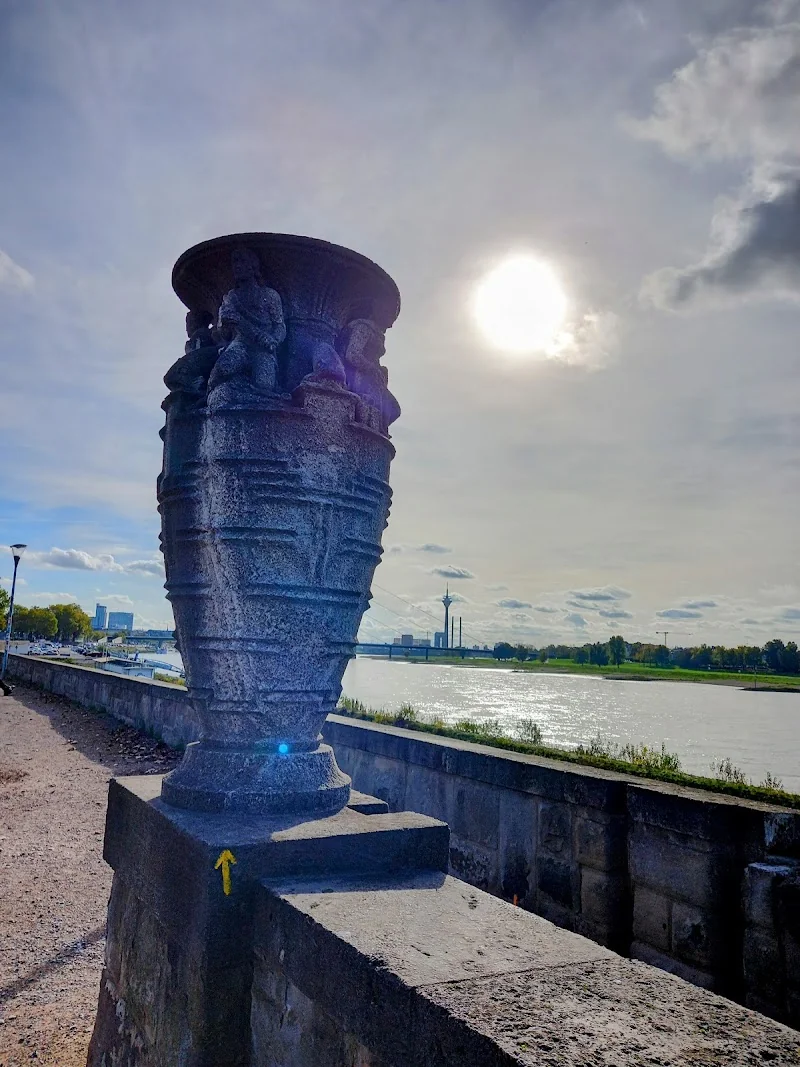
Geographically, the Robert-Lehr-Ufer belongs to Düsseldorf-Golzheim and runs along the Rhine in an area that the city administration clearly locates between Cecilienallee and Robert-Lehr-Ufer. The adjacent Rheinpark Golzheim is also officially located between Cecilienallee and Robert-Lehr-Ufer and covers a total area of 24.1 hectares. This direct neighborhood is important for orientation because the riverbank should not be viewed in isolation, but as part of a coherent Rhine area with green spaces, promenade, river wall, and access to the water. The city also mentions 19 hectares of grass areas for sports and recreation as well as a beautiful view of the Rhine and the city skyline. So, those searching for Robert-Lehr-Ufer maps or Robert-Lehr-Ufer 40474 Düsseldorf are essentially looking for a location at the western edge of the urban Rhine bend, where Golzheim, the riverbank, and park landscape intersect. ([duesseldorf.de](https://www.duesseldorf.de/stadtgruen/park/rheinpark-golzheim.html))
Particularly helpful for the map is the southern park access at the Robert-Lehr-Ufer or at the Rhine terrace. In a municipal press release about the Rheinpark-Golzheim walk, this access is explicitly mentioned as a meeting point. This shows how important the riverbank is not only as a street name but also as a landmark for the park. Those approaching the area often end up at a point where the riverbank, park, and gastronomy or event environment are very close together. This leads to frequent confusion between address, access, and the actual destination: Many users do not want the riverbank itself but rather a meeting point, a parking space, or access to the Rheinpark. Therefore, it is crucial for SEO to always consider Robert-Lehr-Ufer in conjunction with neighboring terms like Theodor-Heuss Bridge, Rheinpark Golzheim, and Rhine terrace, as these search terms best reflect real orientation at the location. ([duesseldorf.de](https://www.duesseldorf.de/medienportal/pressedienst-einzelansicht/pld/fuehrung-durch-den-rheinpark-golzheim))
From an urban and recreational perspective, the location is also remarkable. The Rheinpark Golzheim was designed in 1906 as Kaiser-Wilhelm-Park and has served multiple times as an exhibition space throughout its history, including during the GeSoLei 1926. The Robert-Lehr-Ufer forms a kind of edge between the open, park-like river landscape and the traffic and bridge situation at the Theodor-Heuss Bridge. This makes the place relevant for map and route searches: When entering the name, one does not expect a single sight but rather precise area and location information. The official city page about the Rheinpark provides the most important points of reference, as it shows that the riverbank lies in an area that combines recreation, history, mobility, and event use. ([duesseldorf.de](https://www.duesseldorf.de/medienportal/pressedienst-einzelansicht/pld/fuehrung-durch-den-rheinpark-golzheim))
Parking at Robert-Lehr-Ufer: free under the bridge and at events
Regarding parking, the Robert-Lehr-Ufer is a good example of how a location can have multiple parking logics at once. The city page for the multifunctional sports area at the Theodor-Heuss Bridge explicitly mentions available parking spaces for those arriving by car, but also points out that these may be subject to fees. The city's Rheinpark round provides even more specifics and mentions free parking under the Theodor-Heuss Bridge. For seekers, this means: The area is generally accessible by car, but the specific parking rules depend on which part of the riverbank or the adjacent Rheinpark one intends to visit. For example, someone planning a walk, a running route, or a visit to the sports area will find a different parking situation than someone heading to an event or a blocked event area. ([duesseldorf.de](https://www.duesseldorf.de/sportamt/multifunktionale-sportflaechen/theodor-heuss-bruecke-golzheim.html))
For event seekers, the reference to the parking lot at the Rhine terrace or Tonhalle is also important. In the event overviews of district 1, Robert-Lehr-Ufer 3 is explicitly mentioned as the parking lot Rhine terrace/Tonhalle, among other things in connection with events like the German Beach Tour. This shows that the Robert-Lehr-Ufer is not just a riverbank address but also part of the city's event logistics in certain situations. Therefore, those searching for Robert-Lehr-Ufer parking or Robert-Lehr-Ufer 3 Düsseldorf will encounter a real, city-documented parking reference. This is particularly relevant for larger events, as parking areas near the river can be quickly reorganized or temporarily used differently. The search intent here is clearly pragmatic: users want to know where they can find a sensible parking space during busier traffic. Official references from the event lists are valuable for this purpose. ([duesseldorf.de](https://www.duesseldorf.de/fileadmin/B01/bezirksvertretungen/BV01/Veranstaltungen_SB_1_2024.pdf?utm_source=openai))
It is also practical that the area at the Theodor-Heuss Bridge serves as a well-developed access point to the Rheinpark and the riverbank. Those arriving by car typically orient themselves via Cecilienallee, Theodor-Heuss Bridge, and Rhine terrace. The city route to the parking lot below the Rhine terrace is officially described in such a way that one first follows Cecilienallee and then turns onto Robert-Lehr-Ufer. This allows visitors to derive a simple pattern: The riverbank itself is not the destination in the sense of a single parking address, but rather the interplay of bridge, park zone, and event environment. Therefore, for an SEO page, it is sensible to always combine parking at Robert-Lehr-Ufer with the terms free, Rhine terrace, Theodor-Heuss Bridge, and event parking, as this combination accurately reflects the real search path of users. ([duesseldorf.de](https://www.duesseldorf.de/die-stadt-als-arbeitgeberin/tischreservierung-auf-einen-blick?utm_source=openai))
Access, Maps, and Route to Robert-Lehr-Ufer
The official public transport connection is clear and very useful for visitors: The city names the stop Theodor-Heuss-Brücke and lists the lines U78 and U79 as well as the bus lines 729, 756, 758, 834, 863, M2, and SB51. This means that the Robert-Lehr-Ufer is easily accessible not only for drivers but also for users of public transport. Those searching for Robert-Lehr-Ufer route or Robert-Lehr-Ufer maps receive a quick orientation framework: The target area is located in close proximity to a large stop and can be easily plotted on the city map via the bridge and the Rheinpark. This is particularly helpful for people who do not live in Düsseldorf or are visiting the area for the first time, as the location is less a classic address with a single house number and more a public corridor with several possible destinations. ([duesseldorf.de](https://www.duesseldorf.de/sportamt/multifunktionale-sportflaechen/theodor-heuss-bruecke-golzheim.html))
For cycling traffic, the location is even more clearly oriented towards the pathways along the Rhine. The city reports that with the new cycling and pedestrian ramp below the Oberkasseler Bridge, an additional cycling axis along the Rhine has been created, allowing cyclists to conveniently reach the Tonhalle riverbank and the Robert-Lehr-Ufer from the Rhine promenade. In another announcement, it is stated that the road surface at the Robert-Lehr-Ufer has been renewed over 400 meters to make cycling pleasant and continuous. This information shows why the Robert-Lehr-Ufer frequently appears in search queries about routes and maps: It is part of a coherent, well-developed Rhine route and not just a side street. This is particularly important for recreational traffic, as the city describes this axis as an attractive connection along the river. ([duesseldorf.de](https://www.duesseldorf.de/medienportal/pressedienst-einzelansicht/pld/robert-lehr-ufer-400-meter-neue-fahrbahndecke))
The current significance as a route section is further reinforced by the North-South cycling route 1. The city describes this cycling route as more than ten kilometers long and as a pioneering project for cycling infrastructure in Düsseldorf. South of the Theodor-Heuss Bridge, the route runs along the Robert-Lehr-Ufer, which has been connected to the cycling path along the Rhine promenade via the new cycling and pedestrian ramp. Additionally, the city points out that the axis along Düsseldorf's old town is used every year by more than a million recreational cyclists and commuters. This is central for the classification of the Robert-Lehr-Ufer, as it identifies the location as part of a heavily frequented mobility area. Therefore, those planning a route should not view the riverbank in isolation but rather as a connection between promenade, bridge, park, and city center. ([duesseldorf.de](https://www.duesseldorf.de/radverkehr/radleitrouten/radleitroute-1-nord-sued-west))
Rheinpark Golzheim and Rhine Terrace: Walks, Sports, and Rhine View
In immediate proximity to the Robert-Lehr-Ufer lies the Rheinpark Golzheim, and it is here that the special quality of the location becomes visible. The city describes the park as the first Düsseldorf park oriented towards the Rhine, with urban planning, historical, and garden artistic significance. It was designed in 1906 as Kaiser-Wilhelm-Park by Walter von Engelhardt and has often served as an exhibition site throughout its long history. Particularly important is the memory of the GeSoLei 1926, which is explicitly mentioned in the municipal press text. This means: Those walking along the Robert-Lehr-Ufer today are moving in a space that is not only scenically beautiful but also historically charged. The connection of the Rhine, park, and open riverbank gives the area a very unique, calm, yet simultaneously representative effect. ([duesseldorf.de](https://www.duesseldorf.de/medienportal/pressedienst-einzelansicht/pld/fuehrung-durch-den-rheinpark-golzheim))
The park is now a recreational area with a lot of openness: 24.1 hectares in total, of which 19 hectares are grass areas for sports and recreation, along with a beautiful view of the Rhine and the city skyline, a children's playground, and a dog run. The current character of the park is thus very well suited for walks, running routes, and relaxed stays by the water. At the same time, the city points out that the park suffered significant tree losses due to the storm Ela in 2014 and that the reconstruction is based on historical plans and planting lists, as the park has been under monument protection since 2001. This is important for content related to Robert-Lehr-Ufer, as the location is relevant not only infrastructurally but also in terms of garden monument preservation. Thus, a place emerges where leisure, monument protection, and river location come together in close proximity. ([duesseldorf.de](https://www.duesseldorf.de/stadtgruen/park/rheinpark-golzheim.html))
The area is also remarkably well equipped for sports use. Directly under the Theodor-Heuss Bridge, the city has opened the first multifunctional sports area. It is located immediately next to the Rheinpark Golzheim and offers basketball, floorball, roller skating, dancing, gymnastics, and soccer, and also includes a streetball court. According to city information, access is barrier-free. For seekers who view Robert-Lehr-Ufer not just as an address but as a recreational site, this is an important added value: Here, one can not only see the Rhine but also engage in active movement. The city's Rheinpark round complements this picture with a 3-kilometer circular route through the tree population of Cecilienallee and along the Robert-Lehr-Ufer back. The route is considered suitable for beginner runners, is partially illuminated, barrier-free, and utilizes asphalt and park paths. ([duesseldorf.de](https://www.duesseldorf.de/sportamt/multifunktionale-sportflaechen/theodor-heuss-bruecke-golzheim.html))
Robert-Lehr-Ufer 1, 3, and 21: Toilets, Parking, and MS RheinPoesie
The search queries around Robert-Lehr-Ufer 1, Robert-Lehr-Ufer 3, and Robert-Lehr-Ufer 21 show that many users are looking not only for the street name but also for specific house numbers. For Robert-Lehr-Ufer 1, the official city page for the toilet location list is particularly interesting: There is a modular facility with continuously open use listed. The same address also appears in the context of the multifunctional sports area at the Theodor-Heuss Bridge, whose address is Robert-Lehr-Ufer, 40474 Düsseldorf. This makes Robert-Lehr-Ufer 1 a clear practical reference point for visitors who are on the riverbank and need immediate understandable orientation. In such cases, the house number is less about a single building and more about a public location with city infrastructure. This makes the search phrase Robert-Lehr-Ufer 1 Düsseldorf maps so relevant. ([duesseldorf.de](https://www.duesseldorf.de/gebaeudemanagement/city-toilet-standorte))
Robert-Lehr-Ufer 3 is particularly important in the context of events. The district lists name this point as parking lot Rhine terrace/Tonhalle, among other things for events like the German Beach Tour. This shows that the location is planned for traffic management and event logistics during phases of high visitor numbers. For users searching for Robert-Lehr-Ufer 3 Düsseldorf or Robert-Lehr-Ufer 3 parking, this is a clear indication that the surroundings consist not only of promenade and park but also function as an organized parking area during major events. Such information is SEO-relevant as it directly reflects the real use of the location and avoids misunderstandings: Robert-Lehr-Ufer 3 is not just any arbitrary house number but a city-documented parking address in the event environment. ([duesseldorf.de](https://www.duesseldorf.de/fileadmin/B01/bezirksvertretungen/BV01/Veranstaltungen_SB_1_2024.pdf?utm_source=openai))
Robert-Lehr-Ufer 21, in turn, refers to the MS RheinPoesie in the Düsseldorf wedding calendar. The city describes civil weddings there in a maritime flair, names the location as suitable for larger groups but not barrier-free, and gives the wedding days as Wednesday to Friday mornings from January to November. This is important for the keyword landscape because here, a pure street name becomes a very concrete form of use. Those searching for Robert-Lehr-Ufer 21 Düsseldorf are likely looking for either the address, a special event location, or information about the wedding. For this reason, it makes sense to differentiate the house numbers in content: 1 stands for public infrastructure and proximity to the sports area, 3 for event parking, and 21 for an official wedding venue on the ship. Thus, a seemingly nonspecific riverbank address becomes a well-structured information space. ([traukalender.duesseldorf.de](https://traukalender.duesseldorf.de/de/MS-RheinPoesie-136.html))
Why is it called Robert-Lehr-Ufer? History and Namesake
The name Robert-Lehr-Ufer has a clear historical origin. According to the official final report on the review of Düsseldorf street and square names, the naming took place on June 3, 1957. It was done at the request of the Elders' Council and the Chief City Director in memory of the former Lord Mayor of Düsseldorf. The same document also describes that a Robert-Lehr memorial stone was planned in the immediate vicinity of the Rhine promenade. This is important for seekers because the street name is thus charged not only geographically but also culturally with memory. The Robert-Lehr-Ufer is therefore not a randomly chosen name but a deliberately set reference to the city's history and the municipal post-war identity of Düsseldorf. ([duesseldorf.de](https://www.duesseldorf.de/fileadmin/Amt41-203/stadtarchiv/aktuell/200123Abschlussbericht_Strassennamen.pdf))
Robert Lehr himself was a German politician and jurist. The city document names him as the Lord Mayor of Düsseldorf from 1924 to 1933, as the Oberpräsident of the Province of North Rhine, President of the North Rhine-Westphalia State Parliament, and Federal Minister of the Interior. The report also notes that Lehr entered the service of the city of Düsseldorf in 1913, worked for public order and economic reconstruction during World War I and in the following years, and later also participated in the state reconstruction in West Germany. For the current perception of the riverbank, this means: The name stands for local political history, for reconstruction after upheavals, and for a strong connection to the city of Düsseldorf itself. Therefore, those seeking information about Robert-Lehr-Ufer automatically come across a piece of political biography. ([duesseldorf.de](https://www.duesseldorf.de/fileadmin/Amt41-203/stadtarchiv/aktuell/200123Abschlussbericht_Strassennamen.pdf))
In today's cityscape, this historical dimension is particularly exciting because the name stands in a place that is also used modernly: for cycling, walks, leisure, public infrastructure, parking, and events. This is precisely where the strength of the location for content and SEO lies. The Robert-Lehr-Ufer connects the past and the present, history and everyday life, urban politics and Rhine mobility. Those searching for the location on a map receive a riverbank location; those searching for parking find bridge and event areas; those searching for history encounter Robert Lehr and the memory of Düsseldorf's municipal development. This multi-layeredness makes the address so search-strong and explains why terms like maps, route, parking, and 21 are so closely related to the riverbank. For visitors, this is ultimately an advantage: A place with so many functions is usually excellently developed and well signposted, even if it does not have a classic single use like a concert hall. ([duesseldorf.de](https://www.duesseldorf.de/fileadmin/Amt41-203/stadtarchiv/aktuell/200123Abschlussbericht_Strassennamen.pdf))
Sources:
- State Capital Düsseldorf - Theodor-Heuss-Brücke (Golzheim)
- State Capital Düsseldorf - Rheinpark Golzheim
- State Capital Düsseldorf - Robert-Lehr-Ufer: 400 meters of new road surface
- State Capital Düsseldorf - North-South Cycling Route 1
- State Capital Düsseldorf - Final Report on Street and Square Naming
- State Capital Düsseldorf - MS RheinPoesie
- State Capital Düsseldorf - City Toilet Locations
- State Capital Düsseldorf - Rheinpark Round
- State Capital Düsseldorf - Events in District 1 2024
Show moreShow less
Robert-Lehr-Ufer | Parking & Access
The Robert-Lehr-Ufer in Düsseldorf is not a classic event venue with a ticket office and seating plan, but a prominent section of the Rhine riverbank in the Golzheim district, which frequently appears in search queries as a destination for access, parking, and maps. For this reason, clear orientation is worthwhile: The area is located directly on the Rhine, connects the surroundings of Cecilienallee with the Rheinpark Golzheim, and is very easy to locate via the Theodor-Heuss Bridge, the Rhine terrace, and several paths along the Rhine promenade. For visitors, the Robert-Lehr-Ufer is primarily a location with high everyday usability: Those who want to walk, jog, cycle, or attend appointments at the adjacent locations will find a well-developed, urban riverbank area with plenty of public space, a lot of activity, and several useful access points. The city describes the area not as a closed location, but as part of a vibrant section of the Rhine with park, transport, and recreational functions. ([duesseldorf.de](https://www.duesseldorf.de/stadtgruen/park/rheinpark-golzheim.html))
For the search intent behind terms like Robert-Lehr-Ufer Düsseldorf, Robert-Lehr-Ufer parking, Robert-Lehr-Ufer route, or Robert-Lehr-Ufer maps, this mix of address, orientation, and usage is crucial. The riverbank is directly connected to recreational paths, cycling routes, and event spaces in the northern part of the city center. At the same time, important points such as the Rheinpark Golzheim, the sports area under the Theodor-Heuss Bridge, a public toilet location, and individual event or wedding venues are in close proximity. Therefore, those searching for the Robert-Lehr-Ufer on the map are often looking not just for a street, but for a very specific access point to the Rhine with practical signposts. The following sections categorize location, parking, access, surroundings, addresses, and history in such a way that a helpful, clear, and truly usable information block emerges from the most common search queries. ([duesseldorf.de](https://www.duesseldorf.de/sportamt/multifunktionale-sportflaechen/theodor-heuss-bruecke-golzheim.html))
Where is the Robert-Lehr-Ufer located in Düsseldorf?
Geographically, the Robert-Lehr-Ufer belongs to Düsseldorf-Golzheim and runs along the Rhine in an area that the city administration clearly locates between Cecilienallee and Robert-Lehr-Ufer. The adjacent Rheinpark Golzheim is also officially located between Cecilienallee and Robert-Lehr-Ufer and covers a total area of 24.1 hectares. This direct neighborhood is important for orientation because the riverbank should not be viewed in isolation, but as part of a coherent Rhine area with green spaces, promenade, river wall, and access to the water. The city also mentions 19 hectares of grass areas for sports and recreation as well as a beautiful view of the Rhine and the city skyline. So, those searching for Robert-Lehr-Ufer maps or Robert-Lehr-Ufer 40474 Düsseldorf are essentially looking for a location at the western edge of the urban Rhine bend, where Golzheim, the riverbank, and park landscape intersect. ([duesseldorf.de](https://www.duesseldorf.de/stadtgruen/park/rheinpark-golzheim.html))
Particularly helpful for the map is the southern park access at the Robert-Lehr-Ufer or at the Rhine terrace. In a municipal press release about the Rheinpark-Golzheim walk, this access is explicitly mentioned as a meeting point. This shows how important the riverbank is not only as a street name but also as a landmark for the park. Those approaching the area often end up at a point where the riverbank, park, and gastronomy or event environment are very close together. This leads to frequent confusion between address, access, and the actual destination: Many users do not want the riverbank itself but rather a meeting point, a parking space, or access to the Rheinpark. Therefore, it is crucial for SEO to always consider Robert-Lehr-Ufer in conjunction with neighboring terms like Theodor-Heuss Bridge, Rheinpark Golzheim, and Rhine terrace, as these search terms best reflect real orientation at the location. ([duesseldorf.de](https://www.duesseldorf.de/medienportal/pressedienst-einzelansicht/pld/fuehrung-durch-den-rheinpark-golzheim))
From an urban and recreational perspective, the location is also remarkable. The Rheinpark Golzheim was designed in 1906 as Kaiser-Wilhelm-Park and has served multiple times as an exhibition space throughout its history, including during the GeSoLei 1926. The Robert-Lehr-Ufer forms a kind of edge between the open, park-like river landscape and the traffic and bridge situation at the Theodor-Heuss Bridge. This makes the place relevant for map and route searches: When entering the name, one does not expect a single sight but rather precise area and location information. The official city page about the Rheinpark provides the most important points of reference, as it shows that the riverbank lies in an area that combines recreation, history, mobility, and event use. ([duesseldorf.de](https://www.duesseldorf.de/medienportal/pressedienst-einzelansicht/pld/fuehrung-durch-den-rheinpark-golzheim))
Parking at Robert-Lehr-Ufer: free under the bridge and at events
Regarding parking, the Robert-Lehr-Ufer is a good example of how a location can have multiple parking logics at once. The city page for the multifunctional sports area at the Theodor-Heuss Bridge explicitly mentions available parking spaces for those arriving by car, but also points out that these may be subject to fees. The city's Rheinpark round provides even more specifics and mentions free parking under the Theodor-Heuss Bridge. For seekers, this means: The area is generally accessible by car, but the specific parking rules depend on which part of the riverbank or the adjacent Rheinpark one intends to visit. For example, someone planning a walk, a running route, or a visit to the sports area will find a different parking situation than someone heading to an event or a blocked event area. ([duesseldorf.de](https://www.duesseldorf.de/sportamt/multifunktionale-sportflaechen/theodor-heuss-bruecke-golzheim.html))
For event seekers, the reference to the parking lot at the Rhine terrace or Tonhalle is also important. In the event overviews of district 1, Robert-Lehr-Ufer 3 is explicitly mentioned as the parking lot Rhine terrace/Tonhalle, among other things in connection with events like the German Beach Tour. This shows that the Robert-Lehr-Ufer is not just a riverbank address but also part of the city's event logistics in certain situations. Therefore, those searching for Robert-Lehr-Ufer parking or Robert-Lehr-Ufer 3 Düsseldorf will encounter a real, city-documented parking reference. This is particularly relevant for larger events, as parking areas near the river can be quickly reorganized or temporarily used differently. The search intent here is clearly pragmatic: users want to know where they can find a sensible parking space during busier traffic. Official references from the event lists are valuable for this purpose. ([duesseldorf.de](https://www.duesseldorf.de/fileadmin/B01/bezirksvertretungen/BV01/Veranstaltungen_SB_1_2024.pdf?utm_source=openai))
It is also practical that the area at the Theodor-Heuss Bridge serves as a well-developed access point to the Rheinpark and the riverbank. Those arriving by car typically orient themselves via Cecilienallee, Theodor-Heuss Bridge, and Rhine terrace. The city route to the parking lot below the Rhine terrace is officially described in such a way that one first follows Cecilienallee and then turns onto Robert-Lehr-Ufer. This allows visitors to derive a simple pattern: The riverbank itself is not the destination in the sense of a single parking address, but rather the interplay of bridge, park zone, and event environment. Therefore, for an SEO page, it is sensible to always combine parking at Robert-Lehr-Ufer with the terms free, Rhine terrace, Theodor-Heuss Bridge, and event parking, as this combination accurately reflects the real search path of users. ([duesseldorf.de](https://www.duesseldorf.de/die-stadt-als-arbeitgeberin/tischreservierung-auf-einen-blick?utm_source=openai))
Access, Maps, and Route to Robert-Lehr-Ufer
The official public transport connection is clear and very useful for visitors: The city names the stop Theodor-Heuss-Brücke and lists the lines U78 and U79 as well as the bus lines 729, 756, 758, 834, 863, M2, and SB51. This means that the Robert-Lehr-Ufer is easily accessible not only for drivers but also for users of public transport. Those searching for Robert-Lehr-Ufer route or Robert-Lehr-Ufer maps receive a quick orientation framework: The target area is located in close proximity to a large stop and can be easily plotted on the city map via the bridge and the Rheinpark. This is particularly helpful for people who do not live in Düsseldorf or are visiting the area for the first time, as the location is less a classic address with a single house number and more a public corridor with several possible destinations. ([duesseldorf.de](https://www.duesseldorf.de/sportamt/multifunktionale-sportflaechen/theodor-heuss-bruecke-golzheim.html))
For cycling traffic, the location is even more clearly oriented towards the pathways along the Rhine. The city reports that with the new cycling and pedestrian ramp below the Oberkasseler Bridge, an additional cycling axis along the Rhine has been created, allowing cyclists to conveniently reach the Tonhalle riverbank and the Robert-Lehr-Ufer from the Rhine promenade. In another announcement, it is stated that the road surface at the Robert-Lehr-Ufer has been renewed over 400 meters to make cycling pleasant and continuous. This information shows why the Robert-Lehr-Ufer frequently appears in search queries about routes and maps: It is part of a coherent, well-developed Rhine route and not just a side street. This is particularly important for recreational traffic, as the city describes this axis as an attractive connection along the river. ([duesseldorf.de](https://www.duesseldorf.de/medienportal/pressedienst-einzelansicht/pld/robert-lehr-ufer-400-meter-neue-fahrbahndecke))
The current significance as a route section is further reinforced by the North-South cycling route 1. The city describes this cycling route as more than ten kilometers long and as a pioneering project for cycling infrastructure in Düsseldorf. South of the Theodor-Heuss Bridge, the route runs along the Robert-Lehr-Ufer, which has been connected to the cycling path along the Rhine promenade via the new cycling and pedestrian ramp. Additionally, the city points out that the axis along Düsseldorf's old town is used every year by more than a million recreational cyclists and commuters. This is central for the classification of the Robert-Lehr-Ufer, as it identifies the location as part of a heavily frequented mobility area. Therefore, those planning a route should not view the riverbank in isolation but rather as a connection between promenade, bridge, park, and city center. ([duesseldorf.de](https://www.duesseldorf.de/radverkehr/radleitrouten/radleitroute-1-nord-sued-west))
Rheinpark Golzheim and Rhine Terrace: Walks, Sports, and Rhine View
In immediate proximity to the Robert-Lehr-Ufer lies the Rheinpark Golzheim, and it is here that the special quality of the location becomes visible. The city describes the park as the first Düsseldorf park oriented towards the Rhine, with urban planning, historical, and garden artistic significance. It was designed in 1906 as Kaiser-Wilhelm-Park by Walter von Engelhardt and has often served as an exhibition site throughout its long history. Particularly important is the memory of the GeSoLei 1926, which is explicitly mentioned in the municipal press text. This means: Those walking along the Robert-Lehr-Ufer today are moving in a space that is not only scenically beautiful but also historically charged. The connection of the Rhine, park, and open riverbank gives the area a very unique, calm, yet simultaneously representative effect. ([duesseldorf.de](https://www.duesseldorf.de/medienportal/pressedienst-einzelansicht/pld/fuehrung-durch-den-rheinpark-golzheim))
The park is now a recreational area with a lot of openness: 24.1 hectares in total, of which 19 hectares are grass areas for sports and recreation, along with a beautiful view of the Rhine and the city skyline, a children's playground, and a dog run. The current character of the park is thus very well suited for walks, running routes, and relaxed stays by the water. At the same time, the city points out that the park suffered significant tree losses due to the storm Ela in 2014 and that the reconstruction is based on historical plans and planting lists, as the park has been under monument protection since 2001. This is important for content related to Robert-Lehr-Ufer, as the location is relevant not only infrastructurally but also in terms of garden monument preservation. Thus, a place emerges where leisure, monument protection, and river location come together in close proximity. ([duesseldorf.de](https://www.duesseldorf.de/stadtgruen/park/rheinpark-golzheim.html))
The area is also remarkably well equipped for sports use. Directly under the Theodor-Heuss Bridge, the city has opened the first multifunctional sports area. It is located immediately next to the Rheinpark Golzheim and offers basketball, floorball, roller skating, dancing, gymnastics, and soccer, and also includes a streetball court. According to city information, access is barrier-free. For seekers who view Robert-Lehr-Ufer not just as an address but as a recreational site, this is an important added value: Here, one can not only see the Rhine but also engage in active movement. The city's Rheinpark round complements this picture with a 3-kilometer circular route through the tree population of Cecilienallee and along the Robert-Lehr-Ufer back. The route is considered suitable for beginner runners, is partially illuminated, barrier-free, and utilizes asphalt and park paths. ([duesseldorf.de](https://www.duesseldorf.de/sportamt/multifunktionale-sportflaechen/theodor-heuss-bruecke-golzheim.html))
Robert-Lehr-Ufer 1, 3, and 21: Toilets, Parking, and MS RheinPoesie
The search queries around Robert-Lehr-Ufer 1, Robert-Lehr-Ufer 3, and Robert-Lehr-Ufer 21 show that many users are looking not only for the street name but also for specific house numbers. For Robert-Lehr-Ufer 1, the official city page for the toilet location list is particularly interesting: There is a modular facility with continuously open use listed. The same address also appears in the context of the multifunctional sports area at the Theodor-Heuss Bridge, whose address is Robert-Lehr-Ufer, 40474 Düsseldorf. This makes Robert-Lehr-Ufer 1 a clear practical reference point for visitors who are on the riverbank and need immediate understandable orientation. In such cases, the house number is less about a single building and more about a public location with city infrastructure. This makes the search phrase Robert-Lehr-Ufer 1 Düsseldorf maps so relevant. ([duesseldorf.de](https://www.duesseldorf.de/gebaeudemanagement/city-toilet-standorte))
Robert-Lehr-Ufer 3 is particularly important in the context of events. The district lists name this point as parking lot Rhine terrace/Tonhalle, among other things for events like the German Beach Tour. This shows that the location is planned for traffic management and event logistics during phases of high visitor numbers. For users searching for Robert-Lehr-Ufer 3 Düsseldorf or Robert-Lehr-Ufer 3 parking, this is a clear indication that the surroundings consist not only of promenade and park but also function as an organized parking area during major events. Such information is SEO-relevant as it directly reflects the real use of the location and avoids misunderstandings: Robert-Lehr-Ufer 3 is not just any arbitrary house number but a city-documented parking address in the event environment. ([duesseldorf.de](https://www.duesseldorf.de/fileadmin/B01/bezirksvertretungen/BV01/Veranstaltungen_SB_1_2024.pdf?utm_source=openai))
Robert-Lehr-Ufer 21, in turn, refers to the MS RheinPoesie in the Düsseldorf wedding calendar. The city describes civil weddings there in a maritime flair, names the location as suitable for larger groups but not barrier-free, and gives the wedding days as Wednesday to Friday mornings from January to November. This is important for the keyword landscape because here, a pure street name becomes a very concrete form of use. Those searching for Robert-Lehr-Ufer 21 Düsseldorf are likely looking for either the address, a special event location, or information about the wedding. For this reason, it makes sense to differentiate the house numbers in content: 1 stands for public infrastructure and proximity to the sports area, 3 for event parking, and 21 for an official wedding venue on the ship. Thus, a seemingly nonspecific riverbank address becomes a well-structured information space. ([traukalender.duesseldorf.de](https://traukalender.duesseldorf.de/de/MS-RheinPoesie-136.html))
Why is it called Robert-Lehr-Ufer? History and Namesake
The name Robert-Lehr-Ufer has a clear historical origin. According to the official final report on the review of Düsseldorf street and square names, the naming took place on June 3, 1957. It was done at the request of the Elders' Council and the Chief City Director in memory of the former Lord Mayor of Düsseldorf. The same document also describes that a Robert-Lehr memorial stone was planned in the immediate vicinity of the Rhine promenade. This is important for seekers because the street name is thus charged not only geographically but also culturally with memory. The Robert-Lehr-Ufer is therefore not a randomly chosen name but a deliberately set reference to the city's history and the municipal post-war identity of Düsseldorf. ([duesseldorf.de](https://www.duesseldorf.de/fileadmin/Amt41-203/stadtarchiv/aktuell/200123Abschlussbericht_Strassennamen.pdf))
Robert Lehr himself was a German politician and jurist. The city document names him as the Lord Mayor of Düsseldorf from 1924 to 1933, as the Oberpräsident of the Province of North Rhine, President of the North Rhine-Westphalia State Parliament, and Federal Minister of the Interior. The report also notes that Lehr entered the service of the city of Düsseldorf in 1913, worked for public order and economic reconstruction during World War I and in the following years, and later also participated in the state reconstruction in West Germany. For the current perception of the riverbank, this means: The name stands for local political history, for reconstruction after upheavals, and for a strong connection to the city of Düsseldorf itself. Therefore, those seeking information about Robert-Lehr-Ufer automatically come across a piece of political biography. ([duesseldorf.de](https://www.duesseldorf.de/fileadmin/Amt41-203/stadtarchiv/aktuell/200123Abschlussbericht_Strassennamen.pdf))
In today's cityscape, this historical dimension is particularly exciting because the name stands in a place that is also used modernly: for cycling, walks, leisure, public infrastructure, parking, and events. This is precisely where the strength of the location for content and SEO lies. The Robert-Lehr-Ufer connects the past and the present, history and everyday life, urban politics and Rhine mobility. Those searching for the location on a map receive a riverbank location; those searching for parking find bridge and event areas; those searching for history encounter Robert Lehr and the memory of Düsseldorf's municipal development. This multi-layeredness makes the address so search-strong and explains why terms like maps, route, parking, and 21 are so closely related to the riverbank. For visitors, this is ultimately an advantage: A place with so many functions is usually excellently developed and well signposted, even if it does not have a classic single use like a concert hall. ([duesseldorf.de](https://www.duesseldorf.de/fileadmin/Amt41-203/stadtarchiv/aktuell/200123Abschlussbericht_Strassennamen.pdf))
Sources:
- State Capital Düsseldorf - Theodor-Heuss-Brücke (Golzheim)
- State Capital Düsseldorf - Rheinpark Golzheim
- State Capital Düsseldorf - Robert-Lehr-Ufer: 400 meters of new road surface
- State Capital Düsseldorf - North-South Cycling Route 1
- State Capital Düsseldorf - Final Report on Street and Square Naming
- State Capital Düsseldorf - MS RheinPoesie
- State Capital Düsseldorf - City Toilet Locations
- State Capital Düsseldorf - Rheinpark Round
- State Capital Düsseldorf - Events in District 1 2024
Robert-Lehr-Ufer | Parking & Access
The Robert-Lehr-Ufer in Düsseldorf is not a classic event venue with a ticket office and seating plan, but a prominent section of the Rhine riverbank in the Golzheim district, which frequently appears in search queries as a destination for access, parking, and maps. For this reason, clear orientation is worthwhile: The area is located directly on the Rhine, connects the surroundings of Cecilienallee with the Rheinpark Golzheim, and is very easy to locate via the Theodor-Heuss Bridge, the Rhine terrace, and several paths along the Rhine promenade. For visitors, the Robert-Lehr-Ufer is primarily a location with high everyday usability: Those who want to walk, jog, cycle, or attend appointments at the adjacent locations will find a well-developed, urban riverbank area with plenty of public space, a lot of activity, and several useful access points. The city describes the area not as a closed location, but as part of a vibrant section of the Rhine with park, transport, and recreational functions. ([duesseldorf.de](https://www.duesseldorf.de/stadtgruen/park/rheinpark-golzheim.html))
For the search intent behind terms like Robert-Lehr-Ufer Düsseldorf, Robert-Lehr-Ufer parking, Robert-Lehr-Ufer route, or Robert-Lehr-Ufer maps, this mix of address, orientation, and usage is crucial. The riverbank is directly connected to recreational paths, cycling routes, and event spaces in the northern part of the city center. At the same time, important points such as the Rheinpark Golzheim, the sports area under the Theodor-Heuss Bridge, a public toilet location, and individual event or wedding venues are in close proximity. Therefore, those searching for the Robert-Lehr-Ufer on the map are often looking not just for a street, but for a very specific access point to the Rhine with practical signposts. The following sections categorize location, parking, access, surroundings, addresses, and history in such a way that a helpful, clear, and truly usable information block emerges from the most common search queries. ([duesseldorf.de](https://www.duesseldorf.de/sportamt/multifunktionale-sportflaechen/theodor-heuss-bruecke-golzheim.html))
Where is the Robert-Lehr-Ufer located in Düsseldorf?
Geographically, the Robert-Lehr-Ufer belongs to Düsseldorf-Golzheim and runs along the Rhine in an area that the city administration clearly locates between Cecilienallee and Robert-Lehr-Ufer. The adjacent Rheinpark Golzheim is also officially located between Cecilienallee and Robert-Lehr-Ufer and covers a total area of 24.1 hectares. This direct neighborhood is important for orientation because the riverbank should not be viewed in isolation, but as part of a coherent Rhine area with green spaces, promenade, river wall, and access to the water. The city also mentions 19 hectares of grass areas for sports and recreation as well as a beautiful view of the Rhine and the city skyline. So, those searching for Robert-Lehr-Ufer maps or Robert-Lehr-Ufer 40474 Düsseldorf are essentially looking for a location at the western edge of the urban Rhine bend, where Golzheim, the riverbank, and park landscape intersect. ([duesseldorf.de](https://www.duesseldorf.de/stadtgruen/park/rheinpark-golzheim.html))
Particularly helpful for the map is the southern park access at the Robert-Lehr-Ufer or at the Rhine terrace. In a municipal press release about the Rheinpark-Golzheim walk, this access is explicitly mentioned as a meeting point. This shows how important the riverbank is not only as a street name but also as a landmark for the park. Those approaching the area often end up at a point where the riverbank, park, and gastronomy or event environment are very close together. This leads to frequent confusion between address, access, and the actual destination: Many users do not want the riverbank itself but rather a meeting point, a parking space, or access to the Rheinpark. Therefore, it is crucial for SEO to always consider Robert-Lehr-Ufer in conjunction with neighboring terms like Theodor-Heuss Bridge, Rheinpark Golzheim, and Rhine terrace, as these search terms best reflect real orientation at the location. ([duesseldorf.de](https://www.duesseldorf.de/medienportal/pressedienst-einzelansicht/pld/fuehrung-durch-den-rheinpark-golzheim))
From an urban and recreational perspective, the location is also remarkable. The Rheinpark Golzheim was designed in 1906 as Kaiser-Wilhelm-Park and has served multiple times as an exhibition space throughout its history, including during the GeSoLei 1926. The Robert-Lehr-Ufer forms a kind of edge between the open, park-like river landscape and the traffic and bridge situation at the Theodor-Heuss Bridge. This makes the place relevant for map and route searches: When entering the name, one does not expect a single sight but rather precise area and location information. The official city page about the Rheinpark provides the most important points of reference, as it shows that the riverbank lies in an area that combines recreation, history, mobility, and event use. ([duesseldorf.de](https://www.duesseldorf.de/medienportal/pressedienst-einzelansicht/pld/fuehrung-durch-den-rheinpark-golzheim))
Parking at Robert-Lehr-Ufer: free under the bridge and at events
Regarding parking, the Robert-Lehr-Ufer is a good example of how a location can have multiple parking logics at once. The city page for the multifunctional sports area at the Theodor-Heuss Bridge explicitly mentions available parking spaces for those arriving by car, but also points out that these may be subject to fees. The city's Rheinpark round provides even more specifics and mentions free parking under the Theodor-Heuss Bridge. For seekers, this means: The area is generally accessible by car, but the specific parking rules depend on which part of the riverbank or the adjacent Rheinpark one intends to visit. For example, someone planning a walk, a running route, or a visit to the sports area will find a different parking situation than someone heading to an event or a blocked event area. ([duesseldorf.de](https://www.duesseldorf.de/sportamt/multifunktionale-sportflaechen/theodor-heuss-bruecke-golzheim.html))
For event seekers, the reference to the parking lot at the Rhine terrace or Tonhalle is also important. In the event overviews of district 1, Robert-Lehr-Ufer 3 is explicitly mentioned as the parking lot Rhine terrace/Tonhalle, among other things in connection with events like the German Beach Tour. This shows that the Robert-Lehr-Ufer is not just a riverbank address but also part of the city's event logistics in certain situations. Therefore, those searching for Robert-Lehr-Ufer parking or Robert-Lehr-Ufer 3 Düsseldorf will encounter a real, city-documented parking reference. This is particularly relevant for larger events, as parking areas near the river can be quickly reorganized or temporarily used differently. The search intent here is clearly pragmatic: users want to know where they can find a sensible parking space during busier traffic. Official references from the event lists are valuable for this purpose. ([duesseldorf.de](https://www.duesseldorf.de/fileadmin/B01/bezirksvertretungen/BV01/Veranstaltungen_SB_1_2024.pdf?utm_source=openai))
It is also practical that the area at the Theodor-Heuss Bridge serves as a well-developed access point to the Rheinpark and the riverbank. Those arriving by car typically orient themselves via Cecilienallee, Theodor-Heuss Bridge, and Rhine terrace. The city route to the parking lot below the Rhine terrace is officially described in such a way that one first follows Cecilienallee and then turns onto Robert-Lehr-Ufer. This allows visitors to derive a simple pattern: The riverbank itself is not the destination in the sense of a single parking address, but rather the interplay of bridge, park zone, and event environment. Therefore, for an SEO page, it is sensible to always combine parking at Robert-Lehr-Ufer with the terms free, Rhine terrace, Theodor-Heuss Bridge, and event parking, as this combination accurately reflects the real search path of users. ([duesseldorf.de](https://www.duesseldorf.de/die-stadt-als-arbeitgeberin/tischreservierung-auf-einen-blick?utm_source=openai))
Access, Maps, and Route to Robert-Lehr-Ufer
The official public transport connection is clear and very useful for visitors: The city names the stop Theodor-Heuss-Brücke and lists the lines U78 and U79 as well as the bus lines 729, 756, 758, 834, 863, M2, and SB51. This means that the Robert-Lehr-Ufer is easily accessible not only for drivers but also for users of public transport. Those searching for Robert-Lehr-Ufer route or Robert-Lehr-Ufer maps receive a quick orientation framework: The target area is located in close proximity to a large stop and can be easily plotted on the city map via the bridge and the Rheinpark. This is particularly helpful for people who do not live in Düsseldorf or are visiting the area for the first time, as the location is less a classic address with a single house number and more a public corridor with several possible destinations. ([duesseldorf.de](https://www.duesseldorf.de/sportamt/multifunktionale-sportflaechen/theodor-heuss-bruecke-golzheim.html))
For cycling traffic, the location is even more clearly oriented towards the pathways along the Rhine. The city reports that with the new cycling and pedestrian ramp below the Oberkasseler Bridge, an additional cycling axis along the Rhine has been created, allowing cyclists to conveniently reach the Tonhalle riverbank and the Robert-Lehr-Ufer from the Rhine promenade. In another announcement, it is stated that the road surface at the Robert-Lehr-Ufer has been renewed over 400 meters to make cycling pleasant and continuous. This information shows why the Robert-Lehr-Ufer frequently appears in search queries about routes and maps: It is part of a coherent, well-developed Rhine route and not just a side street. This is particularly important for recreational traffic, as the city describes this axis as an attractive connection along the river. ([duesseldorf.de](https://www.duesseldorf.de/medienportal/pressedienst-einzelansicht/pld/robert-lehr-ufer-400-meter-neue-fahrbahndecke))
The current significance as a route section is further reinforced by the North-South cycling route 1. The city describes this cycling route as more than ten kilometers long and as a pioneering project for cycling infrastructure in Düsseldorf. South of the Theodor-Heuss Bridge, the route runs along the Robert-Lehr-Ufer, which has been connected to the cycling path along the Rhine promenade via the new cycling and pedestrian ramp. Additionally, the city points out that the axis along Düsseldorf's old town is used every year by more than a million recreational cyclists and commuters. This is central for the classification of the Robert-Lehr-Ufer, as it identifies the location as part of a heavily frequented mobility area. Therefore, those planning a route should not view the riverbank in isolation but rather as a connection between promenade, bridge, park, and city center. ([duesseldorf.de](https://www.duesseldorf.de/radverkehr/radleitrouten/radleitroute-1-nord-sued-west))
Rheinpark Golzheim and Rhine Terrace: Walks, Sports, and Rhine View
In immediate proximity to the Robert-Lehr-Ufer lies the Rheinpark Golzheim, and it is here that the special quality of the location becomes visible. The city describes the park as the first Düsseldorf park oriented towards the Rhine, with urban planning, historical, and garden artistic significance. It was designed in 1906 as Kaiser-Wilhelm-Park by Walter von Engelhardt and has often served as an exhibition site throughout its long history. Particularly important is the memory of the GeSoLei 1926, which is explicitly mentioned in the municipal press text. This means: Those walking along the Robert-Lehr-Ufer today are moving in a space that is not only scenically beautiful but also historically charged. The connection of the Rhine, park, and open riverbank gives the area a very unique, calm, yet simultaneously representative effect. ([duesseldorf.de](https://www.duesseldorf.de/medienportal/pressedienst-einzelansicht/pld/fuehrung-durch-den-rheinpark-golzheim))
The park is now a recreational area with a lot of openness: 24.1 hectares in total, of which 19 hectares are grass areas for sports and recreation, along with a beautiful view of the Rhine and the city skyline, a children's playground, and a dog run. The current character of the park is thus very well suited for walks, running routes, and relaxed stays by the water. At the same time, the city points out that the park suffered significant tree losses due to the storm Ela in 2014 and that the reconstruction is based on historical plans and planting lists, as the park has been under monument protection since 2001. This is important for content related to Robert-Lehr-Ufer, as the location is relevant not only infrastructurally but also in terms of garden monument preservation. Thus, a place emerges where leisure, monument protection, and river location come together in close proximity. ([duesseldorf.de](https://www.duesseldorf.de/stadtgruen/park/rheinpark-golzheim.html))
The area is also remarkably well equipped for sports use. Directly under the Theodor-Heuss Bridge, the city has opened the first multifunctional sports area. It is located immediately next to the Rheinpark Golzheim and offers basketball, floorball, roller skating, dancing, gymnastics, and soccer, and also includes a streetball court. According to city information, access is barrier-free. For seekers who view Robert-Lehr-Ufer not just as an address but as a recreational site, this is an important added value: Here, one can not only see the Rhine but also engage in active movement. The city's Rheinpark round complements this picture with a 3-kilometer circular route through the tree population of Cecilienallee and along the Robert-Lehr-Ufer back. The route is considered suitable for beginner runners, is partially illuminated, barrier-free, and utilizes asphalt and park paths. ([duesseldorf.de](https://www.duesseldorf.de/sportamt/multifunktionale-sportflaechen/theodor-heuss-bruecke-golzheim.html))
Robert-Lehr-Ufer 1, 3, and 21: Toilets, Parking, and MS RheinPoesie
The search queries around Robert-Lehr-Ufer 1, Robert-Lehr-Ufer 3, and Robert-Lehr-Ufer 21 show that many users are looking not only for the street name but also for specific house numbers. For Robert-Lehr-Ufer 1, the official city page for the toilet location list is particularly interesting: There is a modular facility with continuously open use listed. The same address also appears in the context of the multifunctional sports area at the Theodor-Heuss Bridge, whose address is Robert-Lehr-Ufer, 40474 Düsseldorf. This makes Robert-Lehr-Ufer 1 a clear practical reference point for visitors who are on the riverbank and need immediate understandable orientation. In such cases, the house number is less about a single building and more about a public location with city infrastructure. This makes the search phrase Robert-Lehr-Ufer 1 Düsseldorf maps so relevant. ([duesseldorf.de](https://www.duesseldorf.de/gebaeudemanagement/city-toilet-standorte))
Robert-Lehr-Ufer 3 is particularly important in the context of events. The district lists name this point as parking lot Rhine terrace/Tonhalle, among other things for events like the German Beach Tour. This shows that the location is planned for traffic management and event logistics during phases of high visitor numbers. For users searching for Robert-Lehr-Ufer 3 Düsseldorf or Robert-Lehr-Ufer 3 parking, this is a clear indication that the surroundings consist not only of promenade and park but also function as an organized parking area during major events. Such information is SEO-relevant as it directly reflects the real use of the location and avoids misunderstandings: Robert-Lehr-Ufer 3 is not just any arbitrary house number but a city-documented parking address in the event environment. ([duesseldorf.de](https://www.duesseldorf.de/fileadmin/B01/bezirksvertretungen/BV01/Veranstaltungen_SB_1_2024.pdf?utm_source=openai))
Robert-Lehr-Ufer 21, in turn, refers to the MS RheinPoesie in the Düsseldorf wedding calendar. The city describes civil weddings there in a maritime flair, names the location as suitable for larger groups but not barrier-free, and gives the wedding days as Wednesday to Friday mornings from January to November. This is important for the keyword landscape because here, a pure street name becomes a very concrete form of use. Those searching for Robert-Lehr-Ufer 21 Düsseldorf are likely looking for either the address, a special event location, or information about the wedding. For this reason, it makes sense to differentiate the house numbers in content: 1 stands for public infrastructure and proximity to the sports area, 3 for event parking, and 21 for an official wedding venue on the ship. Thus, a seemingly nonspecific riverbank address becomes a well-structured information space. ([traukalender.duesseldorf.de](https://traukalender.duesseldorf.de/de/MS-RheinPoesie-136.html))
Why is it called Robert-Lehr-Ufer? History and Namesake
The name Robert-Lehr-Ufer has a clear historical origin. According to the official final report on the review of Düsseldorf street and square names, the naming took place on June 3, 1957. It was done at the request of the Elders' Council and the Chief City Director in memory of the former Lord Mayor of Düsseldorf. The same document also describes that a Robert-Lehr memorial stone was planned in the immediate vicinity of the Rhine promenade. This is important for seekers because the street name is thus charged not only geographically but also culturally with memory. The Robert-Lehr-Ufer is therefore not a randomly chosen name but a deliberately set reference to the city's history and the municipal post-war identity of Düsseldorf. ([duesseldorf.de](https://www.duesseldorf.de/fileadmin/Amt41-203/stadtarchiv/aktuell/200123Abschlussbericht_Strassennamen.pdf))
Robert Lehr himself was a German politician and jurist. The city document names him as the Lord Mayor of Düsseldorf from 1924 to 1933, as the Oberpräsident of the Province of North Rhine, President of the North Rhine-Westphalia State Parliament, and Federal Minister of the Interior. The report also notes that Lehr entered the service of the city of Düsseldorf in 1913, worked for public order and economic reconstruction during World War I and in the following years, and later also participated in the state reconstruction in West Germany. For the current perception of the riverbank, this means: The name stands for local political history, for reconstruction after upheavals, and for a strong connection to the city of Düsseldorf itself. Therefore, those seeking information about Robert-Lehr-Ufer automatically come across a piece of political biography. ([duesseldorf.de](https://www.duesseldorf.de/fileadmin/Amt41-203/stadtarchiv/aktuell/200123Abschlussbericht_Strassennamen.pdf))
In today's cityscape, this historical dimension is particularly exciting because the name stands in a place that is also used modernly: for cycling, walks, leisure, public infrastructure, parking, and events. This is precisely where the strength of the location for content and SEO lies. The Robert-Lehr-Ufer connects the past and the present, history and everyday life, urban politics and Rhine mobility. Those searching for the location on a map receive a riverbank location; those searching for parking find bridge and event areas; those searching for history encounter Robert Lehr and the memory of Düsseldorf's municipal development. This multi-layeredness makes the address so search-strong and explains why terms like maps, route, parking, and 21 are so closely related to the riverbank. For visitors, this is ultimately an advantage: A place with so many functions is usually excellently developed and well signposted, even if it does not have a classic single use like a concert hall. ([duesseldorf.de](https://www.duesseldorf.de/fileadmin/Amt41-203/stadtarchiv/aktuell/200123Abschlussbericht_Strassennamen.pdf))
Sources:
- State Capital Düsseldorf - Theodor-Heuss-Brücke (Golzheim)
- State Capital Düsseldorf - Rheinpark Golzheim
- State Capital Düsseldorf - Robert-Lehr-Ufer: 400 meters of new road surface
- State Capital Düsseldorf - North-South Cycling Route 1
- State Capital Düsseldorf - Final Report on Street and Square Naming
- State Capital Düsseldorf - MS RheinPoesie
- State Capital Düsseldorf - City Toilet Locations
- State Capital Düsseldorf - Rheinpark Round
- State Capital Düsseldorf - Events in District 1 2024
Upcoming Events
No events found
Frequently Asked Questions
Reviews
No reviews found