Düsseldorf
Bilker Str. 7-9, 40213 Düsseldorf, Deutschland
Palais Wittgenstein | Concerts & Parking
Palais Wittgenstein is one of the most charming cultural addresses in Düsseldorf, as it combines a historic city palace and a vibrant event center in a compact space. The address Bilker Straße 7-9 in 40213 Düsseldorf stands for chamber music, readings, theater, and cultural encounters in a building that unites several institutions under one roof: the chamber music hall, the Düsseldorf Marionette Theater, the Institut Français Düsseldorf, and an Art Nouveau cafeteria. Thus, the Palais is not just a single hall, but a whole cultural location with a very unique atmosphere, suitable for both intense concert experiences and smaller formats that allow closeness between stage and audience. The municipal pages describe the place as a cultural center with historical flair, and it is precisely this mix that makes the location appealing: a representative building, a central location in Carlstadt, and a program that ranges from classical music to readings and special events. Therefore, those searching for Palais Wittgenstein Düsseldorf, for photos, for maps, for tickets, or for today's program will find a place that is more than just a concert address and has been firmly anchored in Düsseldorf's cultural life for decades. ([visitduesseldorf.de](https://www.visitduesseldorf.de/attraktionen/palais-wittgenstein-6b6373de97))
Concerts, Tickets, and the Program at Palais Wittgenstein
The most important search intention regarding Palais Wittgenstein is almost always: What concerts are taking place there, how do I get tickets, and what is happening today or in the upcoming season? The municipal cultural pages clearly show that the chamber music hall of Palais Wittgenstein is a fixed venue for classical music. Particularly significant is the series Sundays at 11, organized by the cultural office, which includes around 15 concerts at this location each year. Additionally, there are formats from the Heinrich Heine Institute in collaboration with the Tonhalle, such as the Symphonic Palais or chamber music trio and quartet evenings. The programs focus on classical ensembles, on musical dialogues between epochs and composers, and on a space where every detail remains audible. This is a central SEO point for all those searching for concerts, program, today, or concerts 2026: Palais Wittgenstein is not a large hall with mass operations, but a concentrated place for quality, intimacy, and musical nuance. The ticket logic also follows this character: Many events require a binding registration, often by email or phone, and for individual dates, an admission price of 12 euros, reduced to 6 euros, is mentioned. This appeals to visitors who are not just looking for any event but are consciously seeking small, sophisticated, and well-planned cultural appointments. ([duesseldorf.de](https://www.duesseldorf.de/kunst-und-kultur/die-duesseldorfer-kulturlandschaft/mekka-der-musik))
For content planning, it is also important that the program does not limit itself to a single genre. The official and municipal event pages repeatedly document readings, concert series, musically literary evenings, and special formats around Heine, Schumann, Brahms, and other classical names. This makes Palais Wittgenstein a location that can repeatedly appear in search queries for tickets, today, concerts, or program, even though the venue itself is not a classical event palace with a large evening box office. Instead, it operates like a cultivated, urban venue with clear program categories, pre-registration, and an audience that comes specifically for content, intimacy, and acoustics. For users searching for candlelight, chamber music, or intimate concert atmosphere, the Palais is thus a very fitting match, even if the specific dates always depend on the respective organizer. Those looking for a stylish evening in Düsseldorf will find here a place where program and space work closely together: not too large, not arbitrary, but clearly curated and mostly classical in nature. ([duesseldorf.de](https://www.duesseldorf.de/kunst-und-kultur/die-duesseldorfer-kulturlandschaft/mekka-der-musik))
Parking and Arrival at Palais Wittgenstein
In the search query Palais Wittgenstein parking, most visitors are not just looking for a random parking option, but for a reliable solution for a centrally located place in Düsseldorf's city center. The municipal travel information for the event location explicitly mentions Benrather Straße or Carlsplatz as important reference points for arriving by car. If coming via the B1 from the south or north, one should drive via the parallel streets to Bilker Straße, namely Poststraße or Hohe Straße, as well as via Benrather Straße to reach the event location directly. A parking garage on Benrather Straße or at Carlsplatz is also mentioned, which is open until 1 AM. This is particularly convenient for evening events, as Palais Wittgenstein is often used for concerts and readings that end late in the afternoon or evening. For those who prefer to arrive by public transport, there is also a clear route description: From the main train station, take the U-Bahn lines U70, U76, U78, and U79 to Heinrich-Heine-Allee, then walk via Graben- and Mittelstraße to Carlsplatz and further to Bilker Straße. The nearest tram stops are Benrather Straße and Poststraße. This combination of central location, short walking distance, and urban connection is crucial for visitors specifically searching for maps, directions, parking, or bilker str. 7-9. ([duesseldorf.de](https://www.duesseldorf.de/fileadmin/Amt13/presseanhang/180427_Symposium_Europa.pdf))
In practice, this means: Palais Wittgenstein can be easily integrated into a city stroll, a visit to the old town, or an evening around Carlsplatz and Carlstadt. The address is in an area where one can easily manage either by train and on foot or by car followed by a visit to the parking garage. Especially for smaller events with binding registration, it is advisable to plan the arrival early, as the venue itself does not have a large forecourt or an event parking deck in the classical sense. The official city information also recommends using the travel information service for current routes and schedules, which further facilitates the location search. Those searching for Palais Wittgenstein maps usually want exactly this mix of map, stop, parking garage, and walking path; and here the location of the building is an advantage, as the cultural center is located in the middle of the city while still providing a rather quiet, historical setting. For SEO, this means that parking is not just a peripheral topic, but one of the strongest user signals regarding this place. The location is ideal for visitors who want to arrive centrally but do not expect an anonymous large hall. ([duesseldorf.de](https://www.duesseldorf.de/fileadmin/Amt13/presseanhang/180427_Symposium_Europa.pdf))
Hall, Seating, and Special Rooms at Palais Wittgenstein
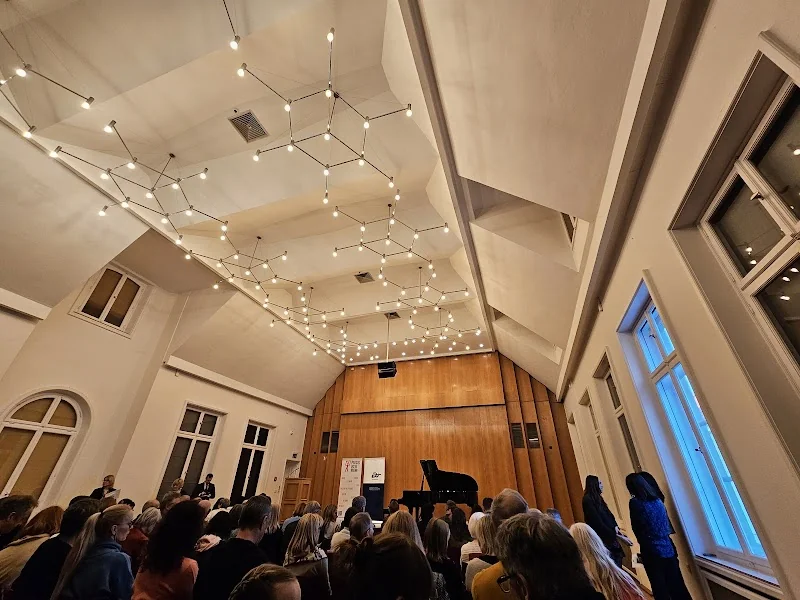
Those searching for Palais Wittgenstein hall, seating plan, or balcony usually think of a classic event space with good visibility and acoustics. In fact, the chamber music hall of Palais Wittgenstein is a comparatively intimate space, offering 234 seats according to the Kultur-am-Rhein description. This size is ideal for chamber music, as it reduces distance and makes musical nuances immediately perceptible. The hall is mentioned as a central component of the cultural center in the municipal description, and it is precisely this that gives it a special status in Düsseldorf's event calendar: not huge, but concentrated; not pompous, but attentive; not an anonymous multipurpose room, but a hall with a clear cultural identity. The closeness to the audience is one of the strongest advantages for organizers planning classical music, readings, or chamber-related formats. For visitors, this means that the question of the best seats is less influenced by gigantic tier logics than by the typical intimacy of a chamber music hall. This is why the venue works so well for small ensembles, trio evenings, string quartets, and literary-musical evenings. ([kulturamrhein.de](https://www.kulturamrhein.de/house_type/palais-wittgenstein/?utm_source=openai))
The building complex also includes the Düsseldorf Marionette Theater in the courtyard, which, according to the official tourism description, has just under 100 seats, creating an even smaller, almost velvety visitor situation. The theater is an important indication that Palais Wittgenstein is not just a single hall, but a house with multiple stages and cultural spaces. For search queries regarding photos or seating plans, this multifacetedness is relevant: the building shows current images on the official pages, and it becomes clear that different rooms have different sizes and atmospheres. Additionally, the Institut Français Düsseldorf offers language courses, official language certificates, lectures, workshops, and a media library in the Palais. This adds another cultural layer to the house. The Art Nouveau cafeteria, which is mentioned as a stylistic detail in tourist and culture-related portraits, completes the picture. From an SEO perspective, this multiple usage is a significant advantage, as search intentions for hall, balcony, photos, maps, or cultural center can all lead to the same place. The city's usage regulations also show that the hall can be rented for events upon request, provided they fit the character of the space; even the foyer, including the cafeteria, can be included in the usage. ([visitduesseldorf.de](https://www.visitduesseldorf.de/en/attractions/duesseldorfer-marionetten-theater-puppet-theatre-6a63eb871e))
History and Monument Preservation of Palais Wittgenstein
The historical depth of Palais Wittgenstein is one of the strongest reasons why the location is not only functional but also emotionally convincing. The municipal monument profile states that the noble palace was built in 1807 for Baron de Cylman; later it came into the possession of the Sayn-Wittgenstein family. Several renovations followed: in 1874, the front building was remodeled and the courtyard wings were expanded, with further changes occurring in 1879, 1893, 1894 with an expansion of the cellar, and in 1895 with the construction of a cross wing. In 1943, the building was destroyed by fire before restoration took place between 1974 and 1976, integrating an event hall. This journey from noble residence through destruction to cultural rebirth makes the place so narratively rich and so valuable for SEO texts. Because users searching for history, special features, or photos want not just to see a pretty building but also to understand why this place is regarded as a cultural gem today. The Palais is not an interchangeable event location but a monument with layers, renovations, and consciously restored dignity. ([duesseldorf.de](https://www.duesseldorf.de/denkmalschutz/qr-codes/denkmal-palais-wittgenstein))
Architectural details also contribute to its uniqueness. The façade of the front building is divided into seven axes, according to the monument text, the central entrance is emphasized by a beam with festoons, and the passage in the left axis features a neo-baroque wrought-iron gate, created by Paul Bogus in 1902 for the industrial and trade exhibition, where it received an award. The gate was reinstalled in a slightly altered form and is one of those elements that give the house its recognizable character. Inside, two open fireplaces are highlighted, while the rear courtyard wings feature terraces with balustrades. These details are not only interesting from a monument preservation perspective but also atmospherically important for visitors: upon entering the house, one quickly realizes that there is not just a functional shell standing here, but a historically charged place with visible traces of its past. In conjunction with the restoration of the 1970s and the current use as a cultural center, a coherent overall picture of history and present emerges. For a location page, this history is worth its weight in gold, as it explains why Palais Wittgenstein is not just an address for events but a piece of Düsseldorf's city and cultural history. ([duesseldorf.de](https://www.duesseldorf.de/denkmalschutz/qr-codes/denkmal-palais-wittgenstein))
Marionette Theater, Institut Français & Cultural Center
A central feature of Palais Wittgenstein is that the location brings together several cultural actors and thus functions almost like a small cultural quarter. The Düsseldorf Marionette Theater is located in the courtyard of the Palais and is described by the tourism site as a gem of Düsseldorf's theater landscape. What is special about it is the intimate seating capacity of just under 100 seats, which ensures that the audience experiences the figures very closely and the productions retain a special immediacy. The theater is not only aimed at children but explicitly also at adults, and it is known for its repertoire around Michael Ende's works, musical theater, fairy tales, and dramatic forms. For visitors looking for culture rather than just an evening program, this is a strong argument. At the same time, the Institut Français Düsseldorf brings another facet into the house: it is one of the oldest of its kind in Germany, offering language courses, official language certificates, lectures, workshops for children, and an extensive media library. This creates a location where theater, language, music, and education complement each other. This diversity is attractive to both search engines and users, as it unites the themes concerts, today, cultural center, and events in one house. ([visitduesseldorf.de](https://www.visitduesseldorf.de/en/attractions/duesseldorfer-marionetten-theater-puppet-theatre-6a63eb871e))
The municipal cultural landscape also clearly categorizes the place as an important music venue. The city's cultural page names the chamber music hall of Palais Wittgenstein alongside the Robert Schumann Hall as one of the relevant performance venues for classical concerts and points out that the cultural office offers 15 concerts annually in the Sundays at 11 series. It is clear: the Palais is not just a place for individual events but an established component of Düsseldorf's musical infrastructure. Therefore, those searching for Palais Wittgenstein concerts or Palais Wittgenstein today will find a house that is broadly positioned in content yet has a clear focus: high-quality, rather intimate cultural formats. The Institut Français, the marionette stage, and the chamber music hall together form an ensemble that is very accessible to visitors. One can combine a concert visit with a language course, a theater performance, or a city stroll, and therein lies the practical strength of the location. It is central, culturally dense, and at the same time clearly focused in content. For the description of an event location, this is a rarely favorable combination, as it offers both emotion and orientation. ([duesseldorf.de](https://www.duesseldorf.de/kunst-und-kultur/die-duesseldorfer-kulturlandschaft/mekka-der-musik))
Photos, Map View, and Visitor Planning on Bilker Straße
Many search queries related to Palais Wittgenstein revolve not only around content but also around orientation: photos, maps, bilker str. 7-9, or today are typical examples. Here, the official location pages help, as they provide current images of the building, a map view, and a clear contact structure. The city's service portal lists the address, phone number, and service hours, while the tourist location page presents the cultural center with an image, location, and brief description. For users, this means: those who want to get an impression before visiting will find a good sense of the building and its central location on the official pages. The location in Carlstadt, near the old town and Carlsplatz, also makes Palais Wittgenstein easy to integrate into a city stay. One is in the middle of Düsseldorf, yet in an environment shaped by historical architecture and cultural use. This mix is particularly interesting for visitors searching for photos or maps, as they do not just see an isolated event building but a piece of urban space with recognizable character. Orientation is therefore not difficult: Bilker Straße 7-9 is the central search address, and the official city map or the travel information service quickly leads to the destination. ([service.duesseldorf.de](https://service.duesseldorf.de/suche/-/egov-bis-detail/einrichtung/62520/show))
For visitor planning, it is also worthwhile to take a look at the service and usage logic of the house. The municipal service address states that the hours are Monday to Thursday from 9:00 AM to 2:00 PM and Friday from 9:00 AM to 12:00 PM and by appointment. This shows that Palais Wittgenstein is organized not only as an event venue but also as an administrative and cultural site. The usage regulations of the hall make it clear that events can be rented upon request, provided they are compatible with the character of the spaces; moreover, catering services are provided by contracted companies. For visitors, this means: the place is professionally structured, but not like a huge concert center, but like a historic house with clear rules and a suitable framework. Those searching for tickets or registration should therefore always keep the specific organizer in mind, as access often runs through reservation, pre-registration, or a limited ticket quota mechanism. This is typical for smaller cultural venues and fits a house with 234 seats in the chamber music hall. In summary, Palais Wittgenstein is both visually and organizationally well graspable: a historic palace with map, image, address, service windows, and a cultural program that attracts visitors consciously and not by chance. ([service.duesseldorf.de](https://service.duesseldorf.de/suche/-/egov-bis-detail/einrichtung/62520/show))
Sources:
- State Capital Düsseldorf - Historical Monument: Palais Wittgenstein
- City of Düsseldorf - Palais Wittgenstein Service Portal
- State Capital Düsseldorf - Mecca of Music
- Visit Düsseldorf - Palais Wittgenstein
- State Capital Düsseldorf - Symposium Europe PDF
- State Capital Düsseldorf - Usage Regulations Hall Palais Wittgenstein
- State Capital Düsseldorf - Trio Concert at Palais Wittgenstein
Mehr anzeigenWeniger anzeigen
Palais Wittgenstein | Concerts & Parking
Palais Wittgenstein is one of the most charming cultural addresses in Düsseldorf, as it combines a historic city palace and a vibrant event center in a compact space. The address Bilker Straße 7-9 in 40213 Düsseldorf stands for chamber music, readings, theater, and cultural encounters in a building that unites several institutions under one roof: the chamber music hall, the Düsseldorf Marionette Theater, the Institut Français Düsseldorf, and an Art Nouveau cafeteria. Thus, the Palais is not just a single hall, but a whole cultural location with a very unique atmosphere, suitable for both intense concert experiences and smaller formats that allow closeness between stage and audience. The municipal pages describe the place as a cultural center with historical flair, and it is precisely this mix that makes the location appealing: a representative building, a central location in Carlstadt, and a program that ranges from classical music to readings and special events. Therefore, those searching for Palais Wittgenstein Düsseldorf, for photos, for maps, for tickets, or for today's program will find a place that is more than just a concert address and has been firmly anchored in Düsseldorf's cultural life for decades. ([visitduesseldorf.de](https://www.visitduesseldorf.de/attraktionen/palais-wittgenstein-6b6373de97))
Concerts, Tickets, and the Program at Palais Wittgenstein
The most important search intention regarding Palais Wittgenstein is almost always: What concerts are taking place there, how do I get tickets, and what is happening today or in the upcoming season? The municipal cultural pages clearly show that the chamber music hall of Palais Wittgenstein is a fixed venue for classical music. Particularly significant is the series Sundays at 11, organized by the cultural office, which includes around 15 concerts at this location each year. Additionally, there are formats from the Heinrich Heine Institute in collaboration with the Tonhalle, such as the Symphonic Palais or chamber music trio and quartet evenings. The programs focus on classical ensembles, on musical dialogues between epochs and composers, and on a space where every detail remains audible. This is a central SEO point for all those searching for concerts, program, today, or concerts 2026: Palais Wittgenstein is not a large hall with mass operations, but a concentrated place for quality, intimacy, and musical nuance. The ticket logic also follows this character: Many events require a binding registration, often by email or phone, and for individual dates, an admission price of 12 euros, reduced to 6 euros, is mentioned. This appeals to visitors who are not just looking for any event but are consciously seeking small, sophisticated, and well-planned cultural appointments. ([duesseldorf.de](https://www.duesseldorf.de/kunst-und-kultur/die-duesseldorfer-kulturlandschaft/mekka-der-musik))
For content planning, it is also important that the program does not limit itself to a single genre. The official and municipal event pages repeatedly document readings, concert series, musically literary evenings, and special formats around Heine, Schumann, Brahms, and other classical names. This makes Palais Wittgenstein a location that can repeatedly appear in search queries for tickets, today, concerts, or program, even though the venue itself is not a classical event palace with a large evening box office. Instead, it operates like a cultivated, urban venue with clear program categories, pre-registration, and an audience that comes specifically for content, intimacy, and acoustics. For users searching for candlelight, chamber music, or intimate concert atmosphere, the Palais is thus a very fitting match, even if the specific dates always depend on the respective organizer. Those looking for a stylish evening in Düsseldorf will find here a place where program and space work closely together: not too large, not arbitrary, but clearly curated and mostly classical in nature. ([duesseldorf.de](https://www.duesseldorf.de/kunst-und-kultur/die-duesseldorfer-kulturlandschaft/mekka-der-musik))
Parking and Arrival at Palais Wittgenstein
In the search query Palais Wittgenstein parking, most visitors are not just looking for a random parking option, but for a reliable solution for a centrally located place in Düsseldorf's city center. The municipal travel information for the event location explicitly mentions Benrather Straße or Carlsplatz as important reference points for arriving by car. If coming via the B1 from the south or north, one should drive via the parallel streets to Bilker Straße, namely Poststraße or Hohe Straße, as well as via Benrather Straße to reach the event location directly. A parking garage on Benrather Straße or at Carlsplatz is also mentioned, which is open until 1 AM. This is particularly convenient for evening events, as Palais Wittgenstein is often used for concerts and readings that end late in the afternoon or evening. For those who prefer to arrive by public transport, there is also a clear route description: From the main train station, take the U-Bahn lines U70, U76, U78, and U79 to Heinrich-Heine-Allee, then walk via Graben- and Mittelstraße to Carlsplatz and further to Bilker Straße. The nearest tram stops are Benrather Straße and Poststraße. This combination of central location, short walking distance, and urban connection is crucial for visitors specifically searching for maps, directions, parking, or bilker str. 7-9. ([duesseldorf.de](https://www.duesseldorf.de/fileadmin/Amt13/presseanhang/180427_Symposium_Europa.pdf))
In practice, this means: Palais Wittgenstein can be easily integrated into a city stroll, a visit to the old town, or an evening around Carlsplatz and Carlstadt. The address is in an area where one can easily manage either by train and on foot or by car followed by a visit to the parking garage. Especially for smaller events with binding registration, it is advisable to plan the arrival early, as the venue itself does not have a large forecourt or an event parking deck in the classical sense. The official city information also recommends using the travel information service for current routes and schedules, which further facilitates the location search. Those searching for Palais Wittgenstein maps usually want exactly this mix of map, stop, parking garage, and walking path; and here the location of the building is an advantage, as the cultural center is located in the middle of the city while still providing a rather quiet, historical setting. For SEO, this means that parking is not just a peripheral topic, but one of the strongest user signals regarding this place. The location is ideal for visitors who want to arrive centrally but do not expect an anonymous large hall. ([duesseldorf.de](https://www.duesseldorf.de/fileadmin/Amt13/presseanhang/180427_Symposium_Europa.pdf))
Hall, Seating, and Special Rooms at Palais Wittgenstein
Those searching for Palais Wittgenstein hall, seating plan, or balcony usually think of a classic event space with good visibility and acoustics. In fact, the chamber music hall of Palais Wittgenstein is a comparatively intimate space, offering 234 seats according to the Kultur-am-Rhein description. This size is ideal for chamber music, as it reduces distance and makes musical nuances immediately perceptible. The hall is mentioned as a central component of the cultural center in the municipal description, and it is precisely this that gives it a special status in Düsseldorf's event calendar: not huge, but concentrated; not pompous, but attentive; not an anonymous multipurpose room, but a hall with a clear cultural identity. The closeness to the audience is one of the strongest advantages for organizers planning classical music, readings, or chamber-related formats. For visitors, this means that the question of the best seats is less influenced by gigantic tier logics than by the typical intimacy of a chamber music hall. This is why the venue works so well for small ensembles, trio evenings, string quartets, and literary-musical evenings. ([kulturamrhein.de](https://www.kulturamrhein.de/house_type/palais-wittgenstein/?utm_source=openai))
The building complex also includes the Düsseldorf Marionette Theater in the courtyard, which, according to the official tourism description, has just under 100 seats, creating an even smaller, almost velvety visitor situation. The theater is an important indication that Palais Wittgenstein is not just a single hall, but a house with multiple stages and cultural spaces. For search queries regarding photos or seating plans, this multifacetedness is relevant: the building shows current images on the official pages, and it becomes clear that different rooms have different sizes and atmospheres. Additionally, the Institut Français Düsseldorf offers language courses, official language certificates, lectures, workshops, and a media library in the Palais. This adds another cultural layer to the house. The Art Nouveau cafeteria, which is mentioned as a stylistic detail in tourist and culture-related portraits, completes the picture. From an SEO perspective, this multiple usage is a significant advantage, as search intentions for hall, balcony, photos, maps, or cultural center can all lead to the same place. The city's usage regulations also show that the hall can be rented for events upon request, provided they fit the character of the space; even the foyer, including the cafeteria, can be included in the usage. ([visitduesseldorf.de](https://www.visitduesseldorf.de/en/attractions/duesseldorfer-marionetten-theater-puppet-theatre-6a63eb871e))
History and Monument Preservation of Palais Wittgenstein
The historical depth of Palais Wittgenstein is one of the strongest reasons why the location is not only functional but also emotionally convincing. The municipal monument profile states that the noble palace was built in 1807 for Baron de Cylman; later it came into the possession of the Sayn-Wittgenstein family. Several renovations followed: in 1874, the front building was remodeled and the courtyard wings were expanded, with further changes occurring in 1879, 1893, 1894 with an expansion of the cellar, and in 1895 with the construction of a cross wing. In 1943, the building was destroyed by fire before restoration took place between 1974 and 1976, integrating an event hall. This journey from noble residence through destruction to cultural rebirth makes the place so narratively rich and so valuable for SEO texts. Because users searching for history, special features, or photos want not just to see a pretty building but also to understand why this place is regarded as a cultural gem today. The Palais is not an interchangeable event location but a monument with layers, renovations, and consciously restored dignity. ([duesseldorf.de](https://www.duesseldorf.de/denkmalschutz/qr-codes/denkmal-palais-wittgenstein))
Architectural details also contribute to its uniqueness. The façade of the front building is divided into seven axes, according to the monument text, the central entrance is emphasized by a beam with festoons, and the passage in the left axis features a neo-baroque wrought-iron gate, created by Paul Bogus in 1902 for the industrial and trade exhibition, where it received an award. The gate was reinstalled in a slightly altered form and is one of those elements that give the house its recognizable character. Inside, two open fireplaces are highlighted, while the rear courtyard wings feature terraces with balustrades. These details are not only interesting from a monument preservation perspective but also atmospherically important for visitors: upon entering the house, one quickly realizes that there is not just a functional shell standing here, but a historically charged place with visible traces of its past. In conjunction with the restoration of the 1970s and the current use as a cultural center, a coherent overall picture of history and present emerges. For a location page, this history is worth its weight in gold, as it explains why Palais Wittgenstein is not just an address for events but a piece of Düsseldorf's city and cultural history. ([duesseldorf.de](https://www.duesseldorf.de/denkmalschutz/qr-codes/denkmal-palais-wittgenstein))
Marionette Theater, Institut Français & Cultural Center
A central feature of Palais Wittgenstein is that the location brings together several cultural actors and thus functions almost like a small cultural quarter. The Düsseldorf Marionette Theater is located in the courtyard of the Palais and is described by the tourism site as a gem of Düsseldorf's theater landscape. What is special about it is the intimate seating capacity of just under 100 seats, which ensures that the audience experiences the figures very closely and the productions retain a special immediacy. The theater is not only aimed at children but explicitly also at adults, and it is known for its repertoire around Michael Ende's works, musical theater, fairy tales, and dramatic forms. For visitors looking for culture rather than just an evening program, this is a strong argument. At the same time, the Institut Français Düsseldorf brings another facet into the house: it is one of the oldest of its kind in Germany, offering language courses, official language certificates, lectures, workshops for children, and an extensive media library. This creates a location where theater, language, music, and education complement each other. This diversity is attractive to both search engines and users, as it unites the themes concerts, today, cultural center, and events in one house. ([visitduesseldorf.de](https://www.visitduesseldorf.de/en/attractions/duesseldorfer-marionetten-theater-puppet-theatre-6a63eb871e))
The municipal cultural landscape also clearly categorizes the place as an important music venue. The city's cultural page names the chamber music hall of Palais Wittgenstein alongside the Robert Schumann Hall as one of the relevant performance venues for classical concerts and points out that the cultural office offers 15 concerts annually in the Sundays at 11 series. It is clear: the Palais is not just a place for individual events but an established component of Düsseldorf's musical infrastructure. Therefore, those searching for Palais Wittgenstein concerts or Palais Wittgenstein today will find a house that is broadly positioned in content yet has a clear focus: high-quality, rather intimate cultural formats. The Institut Français, the marionette stage, and the chamber music hall together form an ensemble that is very accessible to visitors. One can combine a concert visit with a language course, a theater performance, or a city stroll, and therein lies the practical strength of the location. It is central, culturally dense, and at the same time clearly focused in content. For the description of an event location, this is a rarely favorable combination, as it offers both emotion and orientation. ([duesseldorf.de](https://www.duesseldorf.de/kunst-und-kultur/die-duesseldorfer-kulturlandschaft/mekka-der-musik))
Photos, Map View, and Visitor Planning on Bilker Straße
Many search queries related to Palais Wittgenstein revolve not only around content but also around orientation: photos, maps, bilker str. 7-9, or today are typical examples. Here, the official location pages help, as they provide current images of the building, a map view, and a clear contact structure. The city's service portal lists the address, phone number, and service hours, while the tourist location page presents the cultural center with an image, location, and brief description. For users, this means: those who want to get an impression before visiting will find a good sense of the building and its central location on the official pages. The location in Carlstadt, near the old town and Carlsplatz, also makes Palais Wittgenstein easy to integrate into a city stay. One is in the middle of Düsseldorf, yet in an environment shaped by historical architecture and cultural use. This mix is particularly interesting for visitors searching for photos or maps, as they do not just see an isolated event building but a piece of urban space with recognizable character. Orientation is therefore not difficult: Bilker Straße 7-9 is the central search address, and the official city map or the travel information service quickly leads to the destination. ([service.duesseldorf.de](https://service.duesseldorf.de/suche/-/egov-bis-detail/einrichtung/62520/show))
For visitor planning, it is also worthwhile to take a look at the service and usage logic of the house. The municipal service address states that the hours are Monday to Thursday from 9:00 AM to 2:00 PM and Friday from 9:00 AM to 12:00 PM and by appointment. This shows that Palais Wittgenstein is organized not only as an event venue but also as an administrative and cultural site. The usage regulations of the hall make it clear that events can be rented upon request, provided they are compatible with the character of the spaces; moreover, catering services are provided by contracted companies. For visitors, this means: the place is professionally structured, but not like a huge concert center, but like a historic house with clear rules and a suitable framework. Those searching for tickets or registration should therefore always keep the specific organizer in mind, as access often runs through reservation, pre-registration, or a limited ticket quota mechanism. This is typical for smaller cultural venues and fits a house with 234 seats in the chamber music hall. In summary, Palais Wittgenstein is both visually and organizationally well graspable: a historic palace with map, image, address, service windows, and a cultural program that attracts visitors consciously and not by chance. ([service.duesseldorf.de](https://service.duesseldorf.de/suche/-/egov-bis-detail/einrichtung/62520/show))
Sources:
- State Capital Düsseldorf - Historical Monument: Palais Wittgenstein
- City of Düsseldorf - Palais Wittgenstein Service Portal
- State Capital Düsseldorf - Mecca of Music
- Visit Düsseldorf - Palais Wittgenstein
- State Capital Düsseldorf - Symposium Europe PDF
- State Capital Düsseldorf - Usage Regulations Hall Palais Wittgenstein
- State Capital Düsseldorf - Trio Concert at Palais Wittgenstein
Palais Wittgenstein | Concerts & Parking
Palais Wittgenstein is one of the most charming cultural addresses in Düsseldorf, as it combines a historic city palace and a vibrant event center in a compact space. The address Bilker Straße 7-9 in 40213 Düsseldorf stands for chamber music, readings, theater, and cultural encounters in a building that unites several institutions under one roof: the chamber music hall, the Düsseldorf Marionette Theater, the Institut Français Düsseldorf, and an Art Nouveau cafeteria. Thus, the Palais is not just a single hall, but a whole cultural location with a very unique atmosphere, suitable for both intense concert experiences and smaller formats that allow closeness between stage and audience. The municipal pages describe the place as a cultural center with historical flair, and it is precisely this mix that makes the location appealing: a representative building, a central location in Carlstadt, and a program that ranges from classical music to readings and special events. Therefore, those searching for Palais Wittgenstein Düsseldorf, for photos, for maps, for tickets, or for today's program will find a place that is more than just a concert address and has been firmly anchored in Düsseldorf's cultural life for decades. ([visitduesseldorf.de](https://www.visitduesseldorf.de/attraktionen/palais-wittgenstein-6b6373de97))
Concerts, Tickets, and the Program at Palais Wittgenstein
The most important search intention regarding Palais Wittgenstein is almost always: What concerts are taking place there, how do I get tickets, and what is happening today or in the upcoming season? The municipal cultural pages clearly show that the chamber music hall of Palais Wittgenstein is a fixed venue for classical music. Particularly significant is the series Sundays at 11, organized by the cultural office, which includes around 15 concerts at this location each year. Additionally, there are formats from the Heinrich Heine Institute in collaboration with the Tonhalle, such as the Symphonic Palais or chamber music trio and quartet evenings. The programs focus on classical ensembles, on musical dialogues between epochs and composers, and on a space where every detail remains audible. This is a central SEO point for all those searching for concerts, program, today, or concerts 2026: Palais Wittgenstein is not a large hall with mass operations, but a concentrated place for quality, intimacy, and musical nuance. The ticket logic also follows this character: Many events require a binding registration, often by email or phone, and for individual dates, an admission price of 12 euros, reduced to 6 euros, is mentioned. This appeals to visitors who are not just looking for any event but are consciously seeking small, sophisticated, and well-planned cultural appointments. ([duesseldorf.de](https://www.duesseldorf.de/kunst-und-kultur/die-duesseldorfer-kulturlandschaft/mekka-der-musik))
For content planning, it is also important that the program does not limit itself to a single genre. The official and municipal event pages repeatedly document readings, concert series, musically literary evenings, and special formats around Heine, Schumann, Brahms, and other classical names. This makes Palais Wittgenstein a location that can repeatedly appear in search queries for tickets, today, concerts, or program, even though the venue itself is not a classical event palace with a large evening box office. Instead, it operates like a cultivated, urban venue with clear program categories, pre-registration, and an audience that comes specifically for content, intimacy, and acoustics. For users searching for candlelight, chamber music, or intimate concert atmosphere, the Palais is thus a very fitting match, even if the specific dates always depend on the respective organizer. Those looking for a stylish evening in Düsseldorf will find here a place where program and space work closely together: not too large, not arbitrary, but clearly curated and mostly classical in nature. ([duesseldorf.de](https://www.duesseldorf.de/kunst-und-kultur/die-duesseldorfer-kulturlandschaft/mekka-der-musik))
Parking and Arrival at Palais Wittgenstein
In the search query Palais Wittgenstein parking, most visitors are not just looking for a random parking option, but for a reliable solution for a centrally located place in Düsseldorf's city center. The municipal travel information for the event location explicitly mentions Benrather Straße or Carlsplatz as important reference points for arriving by car. If coming via the B1 from the south or north, one should drive via the parallel streets to Bilker Straße, namely Poststraße or Hohe Straße, as well as via Benrather Straße to reach the event location directly. A parking garage on Benrather Straße or at Carlsplatz is also mentioned, which is open until 1 AM. This is particularly convenient for evening events, as Palais Wittgenstein is often used for concerts and readings that end late in the afternoon or evening. For those who prefer to arrive by public transport, there is also a clear route description: From the main train station, take the U-Bahn lines U70, U76, U78, and U79 to Heinrich-Heine-Allee, then walk via Graben- and Mittelstraße to Carlsplatz and further to Bilker Straße. The nearest tram stops are Benrather Straße and Poststraße. This combination of central location, short walking distance, and urban connection is crucial for visitors specifically searching for maps, directions, parking, or bilker str. 7-9. ([duesseldorf.de](https://www.duesseldorf.de/fileadmin/Amt13/presseanhang/180427_Symposium_Europa.pdf))
In practice, this means: Palais Wittgenstein can be easily integrated into a city stroll, a visit to the old town, or an evening around Carlsplatz and Carlstadt. The address is in an area where one can easily manage either by train and on foot or by car followed by a visit to the parking garage. Especially for smaller events with binding registration, it is advisable to plan the arrival early, as the venue itself does not have a large forecourt or an event parking deck in the classical sense. The official city information also recommends using the travel information service for current routes and schedules, which further facilitates the location search. Those searching for Palais Wittgenstein maps usually want exactly this mix of map, stop, parking garage, and walking path; and here the location of the building is an advantage, as the cultural center is located in the middle of the city while still providing a rather quiet, historical setting. For SEO, this means that parking is not just a peripheral topic, but one of the strongest user signals regarding this place. The location is ideal for visitors who want to arrive centrally but do not expect an anonymous large hall. ([duesseldorf.de](https://www.duesseldorf.de/fileadmin/Amt13/presseanhang/180427_Symposium_Europa.pdf))
Hall, Seating, and Special Rooms at Palais Wittgenstein
Those searching for Palais Wittgenstein hall, seating plan, or balcony usually think of a classic event space with good visibility and acoustics. In fact, the chamber music hall of Palais Wittgenstein is a comparatively intimate space, offering 234 seats according to the Kultur-am-Rhein description. This size is ideal for chamber music, as it reduces distance and makes musical nuances immediately perceptible. The hall is mentioned as a central component of the cultural center in the municipal description, and it is precisely this that gives it a special status in Düsseldorf's event calendar: not huge, but concentrated; not pompous, but attentive; not an anonymous multipurpose room, but a hall with a clear cultural identity. The closeness to the audience is one of the strongest advantages for organizers planning classical music, readings, or chamber-related formats. For visitors, this means that the question of the best seats is less influenced by gigantic tier logics than by the typical intimacy of a chamber music hall. This is why the venue works so well for small ensembles, trio evenings, string quartets, and literary-musical evenings. ([kulturamrhein.de](https://www.kulturamrhein.de/house_type/palais-wittgenstein/?utm_source=openai))
The building complex also includes the Düsseldorf Marionette Theater in the courtyard, which, according to the official tourism description, has just under 100 seats, creating an even smaller, almost velvety visitor situation. The theater is an important indication that Palais Wittgenstein is not just a single hall, but a house with multiple stages and cultural spaces. For search queries regarding photos or seating plans, this multifacetedness is relevant: the building shows current images on the official pages, and it becomes clear that different rooms have different sizes and atmospheres. Additionally, the Institut Français Düsseldorf offers language courses, official language certificates, lectures, workshops, and a media library in the Palais. This adds another cultural layer to the house. The Art Nouveau cafeteria, which is mentioned as a stylistic detail in tourist and culture-related portraits, completes the picture. From an SEO perspective, this multiple usage is a significant advantage, as search intentions for hall, balcony, photos, maps, or cultural center can all lead to the same place. The city's usage regulations also show that the hall can be rented for events upon request, provided they fit the character of the space; even the foyer, including the cafeteria, can be included in the usage. ([visitduesseldorf.de](https://www.visitduesseldorf.de/en/attractions/duesseldorfer-marionetten-theater-puppet-theatre-6a63eb871e))
History and Monument Preservation of Palais Wittgenstein
The historical depth of Palais Wittgenstein is one of the strongest reasons why the location is not only functional but also emotionally convincing. The municipal monument profile states that the noble palace was built in 1807 for Baron de Cylman; later it came into the possession of the Sayn-Wittgenstein family. Several renovations followed: in 1874, the front building was remodeled and the courtyard wings were expanded, with further changes occurring in 1879, 1893, 1894 with an expansion of the cellar, and in 1895 with the construction of a cross wing. In 1943, the building was destroyed by fire before restoration took place between 1974 and 1976, integrating an event hall. This journey from noble residence through destruction to cultural rebirth makes the place so narratively rich and so valuable for SEO texts. Because users searching for history, special features, or photos want not just to see a pretty building but also to understand why this place is regarded as a cultural gem today. The Palais is not an interchangeable event location but a monument with layers, renovations, and consciously restored dignity. ([duesseldorf.de](https://www.duesseldorf.de/denkmalschutz/qr-codes/denkmal-palais-wittgenstein))
Architectural details also contribute to its uniqueness. The façade of the front building is divided into seven axes, according to the monument text, the central entrance is emphasized by a beam with festoons, and the passage in the left axis features a neo-baroque wrought-iron gate, created by Paul Bogus in 1902 for the industrial and trade exhibition, where it received an award. The gate was reinstalled in a slightly altered form and is one of those elements that give the house its recognizable character. Inside, two open fireplaces are highlighted, while the rear courtyard wings feature terraces with balustrades. These details are not only interesting from a monument preservation perspective but also atmospherically important for visitors: upon entering the house, one quickly realizes that there is not just a functional shell standing here, but a historically charged place with visible traces of its past. In conjunction with the restoration of the 1970s and the current use as a cultural center, a coherent overall picture of history and present emerges. For a location page, this history is worth its weight in gold, as it explains why Palais Wittgenstein is not just an address for events but a piece of Düsseldorf's city and cultural history. ([duesseldorf.de](https://www.duesseldorf.de/denkmalschutz/qr-codes/denkmal-palais-wittgenstein))
Marionette Theater, Institut Français & Cultural Center
A central feature of Palais Wittgenstein is that the location brings together several cultural actors and thus functions almost like a small cultural quarter. The Düsseldorf Marionette Theater is located in the courtyard of the Palais and is described by the tourism site as a gem of Düsseldorf's theater landscape. What is special about it is the intimate seating capacity of just under 100 seats, which ensures that the audience experiences the figures very closely and the productions retain a special immediacy. The theater is not only aimed at children but explicitly also at adults, and it is known for its repertoire around Michael Ende's works, musical theater, fairy tales, and dramatic forms. For visitors looking for culture rather than just an evening program, this is a strong argument. At the same time, the Institut Français Düsseldorf brings another facet into the house: it is one of the oldest of its kind in Germany, offering language courses, official language certificates, lectures, workshops for children, and an extensive media library. This creates a location where theater, language, music, and education complement each other. This diversity is attractive to both search engines and users, as it unites the themes concerts, today, cultural center, and events in one house. ([visitduesseldorf.de](https://www.visitduesseldorf.de/en/attractions/duesseldorfer-marionetten-theater-puppet-theatre-6a63eb871e))
The municipal cultural landscape also clearly categorizes the place as an important music venue. The city's cultural page names the chamber music hall of Palais Wittgenstein alongside the Robert Schumann Hall as one of the relevant performance venues for classical concerts and points out that the cultural office offers 15 concerts annually in the Sundays at 11 series. It is clear: the Palais is not just a place for individual events but an established component of Düsseldorf's musical infrastructure. Therefore, those searching for Palais Wittgenstein concerts or Palais Wittgenstein today will find a house that is broadly positioned in content yet has a clear focus: high-quality, rather intimate cultural formats. The Institut Français, the marionette stage, and the chamber music hall together form an ensemble that is very accessible to visitors. One can combine a concert visit with a language course, a theater performance, or a city stroll, and therein lies the practical strength of the location. It is central, culturally dense, and at the same time clearly focused in content. For the description of an event location, this is a rarely favorable combination, as it offers both emotion and orientation. ([duesseldorf.de](https://www.duesseldorf.de/kunst-und-kultur/die-duesseldorfer-kulturlandschaft/mekka-der-musik))
Photos, Map View, and Visitor Planning on Bilker Straße
Many search queries related to Palais Wittgenstein revolve not only around content but also around orientation: photos, maps, bilker str. 7-9, or today are typical examples. Here, the official location pages help, as they provide current images of the building, a map view, and a clear contact structure. The city's service portal lists the address, phone number, and service hours, while the tourist location page presents the cultural center with an image, location, and brief description. For users, this means: those who want to get an impression before visiting will find a good sense of the building and its central location on the official pages. The location in Carlstadt, near the old town and Carlsplatz, also makes Palais Wittgenstein easy to integrate into a city stay. One is in the middle of Düsseldorf, yet in an environment shaped by historical architecture and cultural use. This mix is particularly interesting for visitors searching for photos or maps, as they do not just see an isolated event building but a piece of urban space with recognizable character. Orientation is therefore not difficult: Bilker Straße 7-9 is the central search address, and the official city map or the travel information service quickly leads to the destination. ([service.duesseldorf.de](https://service.duesseldorf.de/suche/-/egov-bis-detail/einrichtung/62520/show))
For visitor planning, it is also worthwhile to take a look at the service and usage logic of the house. The municipal service address states that the hours are Monday to Thursday from 9:00 AM to 2:00 PM and Friday from 9:00 AM to 12:00 PM and by appointment. This shows that Palais Wittgenstein is organized not only as an event venue but also as an administrative and cultural site. The usage regulations of the hall make it clear that events can be rented upon request, provided they are compatible with the character of the spaces; moreover, catering services are provided by contracted companies. For visitors, this means: the place is professionally structured, but not like a huge concert center, but like a historic house with clear rules and a suitable framework. Those searching for tickets or registration should therefore always keep the specific organizer in mind, as access often runs through reservation, pre-registration, or a limited ticket quota mechanism. This is typical for smaller cultural venues and fits a house with 234 seats in the chamber music hall. In summary, Palais Wittgenstein is both visually and organizationally well graspable: a historic palace with map, image, address, service windows, and a cultural program that attracts visitors consciously and not by chance. ([service.duesseldorf.de](https://service.duesseldorf.de/suche/-/egov-bis-detail/einrichtung/62520/show))
Sources:
- State Capital Düsseldorf - Historical Monument: Palais Wittgenstein
- City of Düsseldorf - Palais Wittgenstein Service Portal
- State Capital Düsseldorf - Mecca of Music
- Visit Düsseldorf - Palais Wittgenstein
- State Capital Düsseldorf - Symposium Europe PDF
- State Capital Düsseldorf - Usage Regulations Hall Palais Wittgenstein
- State Capital Düsseldorf - Trio Concert at Palais Wittgenstein
Upcoming Events
No events found
Frequently Asked Questions
Reviews
Natalia Musiel
30. October 2025
We were here for an amazing Candlelight concert, I recommend this place to everyone, it was magical!
Sonia Ntoulelari
28. February 2026
It was an amazing experience!!! We are looking forward to the next time!
Aica
11. October 2021
Beautiful and elegant Marinette Theater. There is also a small cafe.
Der nette von nebenan
27. September 2024
Top
BB Poldy
19. April 2026
Candlelight Concert 18.4. What a pianist, wow... Oleksiy if you're reading this, thank you for this unforgettable journey with you and Mr. Einaudi's pieces. Hats off to you ❤️ A big shout-out to the incredibly friendly and helpful staff at the Palais Wittgenstein.