
Goltsteinstraße 21, Düsseldorf
Goltsteinstraße 21, 40211 Düsseldorf, Germany
Music Pavilion in the Hofgarten | Concerts & Directions
The Music Pavilion in the Hofgarten is much more than just a pretty spot on the map for Düsseldorf. It stands in the middle of a park that plays a special role in the city's history, and this combination of culture, green space, and central location makes it so interesting for visitors. The Hofgarten is considered Germany's oldest public park, established in 1769, and remains one of the most significant green spaces in the city center. It lies between Jägerhof, Malkasten, Heinrich-Heine-Allee, and Ehrenhof, forming a green bridge between historical and cultural sites. On nearly 28 hectares, meadows, water bodies, old trees, monuments, and playgrounds converge. The Music Pavilion integrates into this environment and is regularly used for open-air formats for this very reason. Those searching for the Music Pavilion in the Hofgarten Düsseldorf, Hofgarten concerts, or a pavilion in the Hofgarten will find a place that feels simultaneously calm, urban, and vibrant. The location is ideal for outdoor concerts, summer events, and special programs because you sit in the greenery yet are quickly in the city center. Thus, the place is not an isolated event space but part of a historical urban area that has served as a meeting point, walking area, and cultural backdrop for generations. ([visitduesseldorf.de](https://www.visitduesseldorf.de/en/attractions/hofgarten-2fd8a0832f?utm_source=openai))
Location and History of the Music Pavilion in the Hofgarten
To truly understand the Music Pavilion in the Hofgarten, one must look at the park itself. The Hofgarten is not just any city park but a place with an extraordinarily long history. The city of Düsseldorf describes it as a green island in the city center between the opera house, theater, and Goethe Museum. At the same time, the historical context indicates that the Hofgarten was established in the 18th century as a public walking area for the residents and is thus considered the seedbed of today's urban greenery. In the official city history, it is even referred to as the first people's park in Germany. This historical depth also shapes the perception of the Music Pavilion, as a stage in such an environment automatically gains a special effect. The park itself was co-designed by Maximilian Weyhe, whose influence on Düsseldorf's garden art is still visible today. The Hofgarten shows the transition from baroque garden geometry to a more natural English landscape form. This is precisely why it appears so open yet so orderly. Those who stroll there experience not just trees and paths but also a sequence of spaces: meadows, water bodies, the riding alley with its rows of trees, monuments like the Fairy Fountain or the Jröner Jong, and the transitions to Schloss Jägerhof and the Hofgärtnerhaus. The Music Pavilion is embedded in this structure and benefits from it, as it is simultaneously supported by greenery, history, and urban presence. For people looking for images of the Music Pavilion in the Hofgarten, this connection is particularly appealing: The pavilion does not stand alone but is in dialogue with old trees, historical axes, and a park that has been part of public life for more than two centuries. ([duesseldorf.de](https://www.duesseldorf.de/stadtgruen/historie/hofgarten-herrensitze))
The Hofgarten is also remarkably versatile in its current form. The city mentions 13 hectares of meadows, 3 hectares of water bodies, and an old tree population. Additionally, there are three playgrounds and a representative riding alley with four rows of trees, giving the park a clear structure. This explains why the Music Pavilion works so well: It stands in an environment designed for lingering rather than just passing through. Many guests associate a visit to the Music Pavilion with a longer walk through the park, a detour to Schloss Jägerhof, or a coffee around the neighboring cultural sites. The Hofgarten is not just a backdrop but a space of its own experience. Those attending a concert often experience the switch between the bustling city center and the quiet park atmosphere almost simultaneously. This is where the special charm of the location arises. For SEO, this point is important because search queries like pavilion in the hofgarten, music pavilion hofgarten, and music pavilion in the hofgarten düsseldorf all reflect the same need: People want to know where this place is located, how it is historically contextualized, and why it is so often used culturally. The answer is simple: The Music Pavilion sits in one of the city's most important green lungs, and this location makes it so valuable for outdoor events. ([duesseldorf.de](https://www.duesseldorf.de/stadtgruen/park/hofgarten))
Hofgarten Concerts and Other Open-Air Events
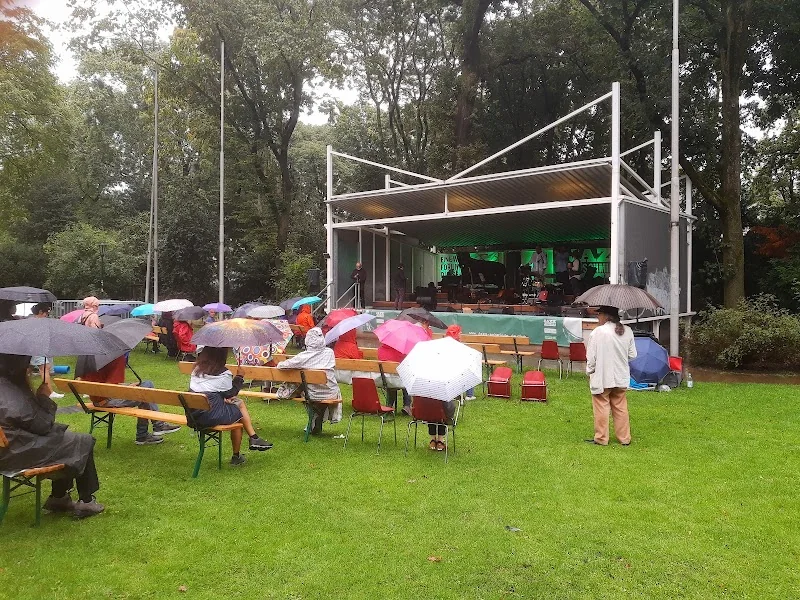
The most direct connection to the Music Pavilion is the Hofgarten concerts. In the official flyers, the series is described as a Sunday open-air format that extends over many weeks between May and September. Seventeen Sundays are mentioned, during which the Hofgarten becomes a concert venue at 11:00 AM. The concerts last one hour, are free, and take place at the Music Pavilion near Jägerhofallee. Some seating is available, emphasizing its character as an open, accessible cultural offering. The musical spectrum ranges from brass music to folk music, film music, pop, and classical. This covers exactly the mix that many people expect under open-air concerts Düsseldorf or music in the Hofgarten: diverse, intergenerational, and without entry barriers. An older official press release also notes that the Hofgarten concerts have been a fixed part of Düsseldorf's event calendar since 1964. This is remarkable because it shows that the Music Pavilion is not only used sporadically but is part of a long-standing cultural tradition. The concerts are thus not a coincidence but a well-established date in the city's summer program. For this reason, the Music Pavilion regularly appears in searches for programs, schedules, and event dates. Those searching for today, program, or schedule often mean not just a single concert but the entire logic of this series: Sundays, in the greenery, free, and with a changing repertoire. ([visitduesseldorf.de](https://www.visitduesseldorf.de/files/epaper/Hofgartenkonzerte/epaper/ausgabe.pdf))
Moreover, the Music Pavilion has shown in recent years that it is suitable for much more than a classic Sunday matinee. The city of Düsseldorf has utilized the site for the Europe Festival The Sound of Europe, which took place in the Hofgarten for the sixth consecutive year in 2026, turning the stage into an open-air venue for European sounds from 1 PM to 4 PM. The official site mentions a picnic area on the lawn in front of the Music Pavilion, bringing your own food and drinks, a children's program, and information booths nearby. Admission is free, and the event is organized by Europe Direct Düsseldorf together with partners. In 2025, the festival attracted around 4,500 visitors, impressively showcasing the significance of the location. Other formats include the CHANCE Festival 2024, which also took place at the Music Pavilion in the Hofgarten and the Theater Museum, connecting the site with German-French pop culture. Ukrainian programs have also been realized here, such as on August 24, 2024, Ukraine's Independence Day. For the search intent behind ukraine day music pavilion in the hofgarten, this is particularly important: The site stands not only for summer concerts but also for thematic cultural events with an international connection. This makes the Music Pavilion a flexible open-air stage that can accommodate both traditional concert series and contemporary festival formats. ([duesseldorf.de](https://www.duesseldorf.de/internationales/veranstaltungen/veranstaltungen-detailseite/newsdetail/the-sound-of-europe-2026))
Directions to the Music Pavilion in the Hofgarten
The directions to the Music Pavilion in the Hofgarten are pleasantly straightforward for a centrally located Düsseldorf event venue, especially when using public transport. The city of Düsseldorf lists several important stops in the immediate vicinity of the Hofgarten. These include Schadowstraße with the light rail lines U71, U72, U73, and U83, as well as tram lines 701, 705, and 706. Heinrich-Heine-Allee is also mentioned with a very dense schedule of various light rail lines, Schloss Jägerhof with tram 707, and bus lines 722, 752, and 754, as well as Jacobistraße with tram 707 and bus lines 752, 754, and SB55. Additionally, Pempelforter Straße is listed with U71, U72, U73, U83, tram 704, and bus lines 721, 722, and 737. For visitors asking for the quickest route to the actual event site, the official recommendation is clear: The access to the Music Pavilion in the Hofgarten is quickest via the Jacobistraße entrance. This information is particularly useful because many search queries not only inquire about the location itself but also about directions to the music pavilion or a specific route from the city center. Those arriving by train or subway can thus easily combine their visit with a walk through the Hofgarten. Especially for outdoor events, this is pleasant because you do not exit directly onto a main road but walk through the park paths into the atmosphere. This transition is what makes the charm of the location: The journey is urban, but the destination feels immediately more relaxed and greener. ([duesseldorf.de](https://www.duesseldorf.de/stadtgruen/park/hofgarten))
For visitors who do not arrive by car, orientation is also simple, as the Music Pavilion is repeatedly mentioned on many official event pages along with the same directions. This shows that accessibility is not a minor detail but part of the concept of the place. For example, those attending The Sound of Europe receive the hint about the Jacobistraße entrance directly from the city. At the Hofgarten concerts, the stops Schloss Jägerhof, Jacobistraße, Schadowstraße, and Pempelforter Straße are additionally mentioned, resulting in several possible routes. It is particularly practical that the stops are within walking distance, and the Hofgarten itself functions as a clear park. For guests traveling to Düsseldorf or combining a concert visit in the Hofgarten with a city walk, this is ideal. The location is close to the classic centers of the city center but not right in the traffic. This is one of the reasons why the Music Pavilion works so well as an open-air stage: It is quickly accessible but still surrounded by park space. So, for those searching for Music Pavilion Hofgarten, Pavilion in the Hofgarten, or Directions to the Music Pavilion, it is especially important to remember Jacobistraße. From there, the path is most direct, and from there, the character of the place is best revealed. ([duesseldorf.de](https://www.duesseldorf.de/internationales/europedirect/europe-in-the-city/the-sound-of-europe))
Parking at the Hofgarten in Düsseldorf
When parking at the Music Pavilion in the Hofgarten, an important principle applies: There is no dedicated parking lot. The official city site instead refers to parking garages nearby. This fits with a centrally located park in the city center, as the Hofgarten is very accessible but not designed as an auto event venue. Those arriving by car should therefore plan ahead and check the parking options in the area. Additionally, it is worth looking at the city's parking management, as the area around the Hofgarten belongs to tariff zone 1a. There, fees of 0.90 euros per 12 minutes apply on weekdays from 9 AM to 10 PM. This shows that the area around the Hofgarten is part of the inner-city parking zone with high occupancy. For practical visits, this means: If you want a relaxed arrival, public transport is usually the better option. However, if you still drive, you should allow time for parking search and orientation. Especially during events like The Sound of Europe or the Hofgarten concerts, when visitor interest is high, this is a realistic preparation. The proximity to central traffic axes is comfortable, but parking itself is naturally limited in an urban park environment. The advantage lies rather in the fact that the Hofgarten is already very central, and many destinations in the city center can subsequently be reached on foot. Thus, the Music Pavilion is a place that is best combined with a parking garage and a short walk for guests with a car. ([duesseldorf.de](https://www.duesseldorf.de/stadtgruen/park/hofgarten))
For the search intent behind parking hofgarten düsseldorf, it is also important that the area does not consist solely of parking spaces but of an urban-sensitive ensemble. The Hofgarten borders important cultural and city center areas, and therefore parking space is limited. The official mention of nearby parking garages is thus not a diversion but a factual description of reality. Those entering the Music Pavilion in the Hofgarten directly into the navigation system should therefore not only rely on the destination but also coordinate their arrival in advance. It is practical that the park area is still very central and easily accessible from many city center points. This is especially true for guests who are already around Schadowstraße, Heinrich-Heine-Allee, or Jägerhof. For visitors who want to take pictures of the stage, plan a festival afternoon, or want to go to the old town after a concert, the parking issue is therefore closely linked to the overall visit planning. The best advice remains: travel publicly, enjoy the walking path through the Hofgarten, and if driving is unavoidable, choose a nearby parking garage. This way, the parking issue becomes no stress factor but just a short organizational step before the actual experience. ([duesseldorf.de](https://www.duesseldorf.de/stadtgruen/park/hofgarten))
Images, Atmosphere, and Visitor Tips for the Music Pavilion
Those searching for images of the Music Pavilion in the Hofgarten are often looking for an impression of atmosphere. This is where the strength of this place lies: The pavilion is embedded in a park that works with old trees, meadows, water bodies, and monuments rather than closed building edges. As a result, photos of the Music Pavilion almost always appear generous, green, and summery. The official city description calls the Hofgarten a green island in the city center, and this formulation captures the visual impression very well. The surroundings provide strong motifs: the riding alley with its four rows of trees, open meadow areas, historical pathways, and the proximity to Schloss Jägerhof and Hofgärtnerhaus. Additionally, there are three playgrounds and the transition between quiet and lively park zones, making the place interesting for families as well. At events, another factor comes into play: the openness of the format. For the Hofgarten concerts, it is explicitly mentioned that some seating is available. At the festival The Sound of Europe, you are allowed to bring your own food and drinks, and the lawn in front of the Music Pavilion can be used as a picnic area. This creates a relaxed mix of concert, park day, and summer outing. Therefore, those wanting to take photos will find not just a stage but a whole staging of urban greenery. During the day, the place appears friendly and bright, while in the early evening, it feels softer and more atmospheric. For users searching for images of the music pavilion in the hofgarten, it is thus particularly important: There is not just one standardized motif here but many perspectives between stage, park, and cultural space. ([duesseldorf.de](https://www.duesseldorf.de/stadtgruen/park/hofgarten))
Visitor tips can be well derived from these facts without inventing anything. First, it is worth arriving early if you want a good spot in the greenery or a pleasant view of the stage, as the place attracts a significant audience during popular events. Second, the combination of concert and walk is sensible, as the Hofgarten as a park is already an experience in itself. Third, one should think of sun protection and water in warm weather, as the area is open and is also consciously used as a stay area during festivals. Fourth, the location is ideal for people who want to combine culture with a city stroll, as many other destinations are quickly reachable on foot from here. The atmosphere at the Music Pavilion is also shaped by the musical range: From brass and folk music to pop, classical, jazz, and international festival formats, the spectrum is broad. This changes the audience but not the fundamental character of the place. It remains an open, accessible, and historically charged space. This is exactly why search queries related to images, atmosphere, and special experiences fit so well with the Music Pavilion. Those who experience it are not just looking for a stage but a feeling: city in the greenery, culture without barriers, and a place where summer in Düsseldorf becomes visible. ([visitduesseldorf.de](https://www.visitduesseldorf.de/files/epaper/Hofgartenkonzerte/epaper/ausgabe.pdf))
Ukraine Day, The Sound of Europe, and Other Program Highlights
The Music Pavilion in the Hofgarten is not only associated with classic Hofgarten concerts but also with events of international and social significance. For the keyword combination ukraine day music pavilion in the hofgarten, a specific official Düsseldorf event is particularly relevant: On Saturday, August 24, 2024, Ukraine's Independence Day, a concert took place at the Music Pavilion in the Hofgarten starting at 2 PM. This is a concrete and well-documented reference for the topic and shows that the place is also used for thematic cultural events. Additionally, the Europe Festival The Sound of Europe has brought extra attention to the Music Pavilion in recent years. In 2025, the festival reportedly attracted around 4,500 guests, setting a visitor record, and in 2026, the Hofgarten was again transformed into an open-air stage for European music, discussion, and encounters from 1 PM to 4 PM. The official description mentions artists from Italy, the Netherlands, France, and Ukraine, as well as the opportunity to picnic on the lawn in front of the Music Pavilion. This makes the place a symbol of cultural openness and international perspective. For people searching for program, today, or event, this versatility is essential: The Music Pavilion is not a rigid hall but a flexible cultural venue that can accommodate various formats. This ranges from a Sunday concert to a Europe festival to thematic programs in the context of urban society, memory, and international cooperation. ([duesseldorf.de](https://www.duesseldorf.de/medienportal/pressedienst-einzelansicht/pld/der-preis-unserer-freiheit-jurij-andruchowytsch-stellte-neuen-essayband-im-kap1-vor?utm_source=openai))
The variety of events also explains why the Music Pavilion in Düsseldorf is searched so frequently. Those searching for music pavilion hofgarten innsbruck may refer to a different city but end up in Düsseldorf at a place that is extremely present in the local cultural calendar. Official sources show that the Music Pavilion is regularly used for free admission events, festivals with European connections, and concert series. The CHANCE Festival 2024 linked the Hofgarten with the Theater Museum and German-French pop culture. The Sound of Europe 2026 connected music with information booths, children's programs, and political communication around Europe. The Ukraine event on August 24, 2024, again demonstrated that the place can also serve as a stage for solidarity, memory, and international connectedness. This breadth is particularly valuable for SEO evaluation because it places search queries related to program, concert, Ukraine Day, and images in a real context. The Music Pavilion is thus neither just a nostalgic music stand nor merely a photo motif but an active event venue in the heart of the city. Those who visit it usually experience not only music but also the Hofgarten as a public stage for encounters, summer, and urban culture. This is what makes it a strong destination for seekers looking for a pavilion in the Hofgarten, a live venue, or special Düsseldorf open-air moments. ([duesseldorf.de](https://www.duesseldorf.de/internationales/veranstaltungen/veranstaltungen-detailseite/newsdetail/chance-festival-2024))
Sources:
- State Capital Düsseldorf - Hofgarten
- State Capital Düsseldorf - Hofgarten-Herrensitze and City Green History
- State Capital Düsseldorf - The Sound of Europe 2026
- State Capital Düsseldorf - Around 4,500 Guests at the Europe Festival The Sound of Europe
- Visit Düsseldorf - Hofgarten Concerts Flyer and Venues
- State Capital Düsseldorf - Ukraine Day at the Music Pavilion in the Hofgarten
Show moreShow less
Music Pavilion in the Hofgarten | Concerts & Directions
The Music Pavilion in the Hofgarten is much more than just a pretty spot on the map for Düsseldorf. It stands in the middle of a park that plays a special role in the city's history, and this combination of culture, green space, and central location makes it so interesting for visitors. The Hofgarten is considered Germany's oldest public park, established in 1769, and remains one of the most significant green spaces in the city center. It lies between Jägerhof, Malkasten, Heinrich-Heine-Allee, and Ehrenhof, forming a green bridge between historical and cultural sites. On nearly 28 hectares, meadows, water bodies, old trees, monuments, and playgrounds converge. The Music Pavilion integrates into this environment and is regularly used for open-air formats for this very reason. Those searching for the Music Pavilion in the Hofgarten Düsseldorf, Hofgarten concerts, or a pavilion in the Hofgarten will find a place that feels simultaneously calm, urban, and vibrant. The location is ideal for outdoor concerts, summer events, and special programs because you sit in the greenery yet are quickly in the city center. Thus, the place is not an isolated event space but part of a historical urban area that has served as a meeting point, walking area, and cultural backdrop for generations. ([visitduesseldorf.de](https://www.visitduesseldorf.de/en/attractions/hofgarten-2fd8a0832f?utm_source=openai))
Location and History of the Music Pavilion in the Hofgarten
To truly understand the Music Pavilion in the Hofgarten, one must look at the park itself. The Hofgarten is not just any city park but a place with an extraordinarily long history. The city of Düsseldorf describes it as a green island in the city center between the opera house, theater, and Goethe Museum. At the same time, the historical context indicates that the Hofgarten was established in the 18th century as a public walking area for the residents and is thus considered the seedbed of today's urban greenery. In the official city history, it is even referred to as the first people's park in Germany. This historical depth also shapes the perception of the Music Pavilion, as a stage in such an environment automatically gains a special effect. The park itself was co-designed by Maximilian Weyhe, whose influence on Düsseldorf's garden art is still visible today. The Hofgarten shows the transition from baroque garden geometry to a more natural English landscape form. This is precisely why it appears so open yet so orderly. Those who stroll there experience not just trees and paths but also a sequence of spaces: meadows, water bodies, the riding alley with its rows of trees, monuments like the Fairy Fountain or the Jröner Jong, and the transitions to Schloss Jägerhof and the Hofgärtnerhaus. The Music Pavilion is embedded in this structure and benefits from it, as it is simultaneously supported by greenery, history, and urban presence. For people looking for images of the Music Pavilion in the Hofgarten, this connection is particularly appealing: The pavilion does not stand alone but is in dialogue with old trees, historical axes, and a park that has been part of public life for more than two centuries. ([duesseldorf.de](https://www.duesseldorf.de/stadtgruen/historie/hofgarten-herrensitze))
The Hofgarten is also remarkably versatile in its current form. The city mentions 13 hectares of meadows, 3 hectares of water bodies, and an old tree population. Additionally, there are three playgrounds and a representative riding alley with four rows of trees, giving the park a clear structure. This explains why the Music Pavilion works so well: It stands in an environment designed for lingering rather than just passing through. Many guests associate a visit to the Music Pavilion with a longer walk through the park, a detour to Schloss Jägerhof, or a coffee around the neighboring cultural sites. The Hofgarten is not just a backdrop but a space of its own experience. Those attending a concert often experience the switch between the bustling city center and the quiet park atmosphere almost simultaneously. This is where the special charm of the location arises. For SEO, this point is important because search queries like pavilion in the hofgarten, music pavilion hofgarten, and music pavilion in the hofgarten düsseldorf all reflect the same need: People want to know where this place is located, how it is historically contextualized, and why it is so often used culturally. The answer is simple: The Music Pavilion sits in one of the city's most important green lungs, and this location makes it so valuable for outdoor events. ([duesseldorf.de](https://www.duesseldorf.de/stadtgruen/park/hofgarten))
Hofgarten Concerts and Other Open-Air Events
The most direct connection to the Music Pavilion is the Hofgarten concerts. In the official flyers, the series is described as a Sunday open-air format that extends over many weeks between May and September. Seventeen Sundays are mentioned, during which the Hofgarten becomes a concert venue at 11:00 AM. The concerts last one hour, are free, and take place at the Music Pavilion near Jägerhofallee. Some seating is available, emphasizing its character as an open, accessible cultural offering. The musical spectrum ranges from brass music to folk music, film music, pop, and classical. This covers exactly the mix that many people expect under open-air concerts Düsseldorf or music in the Hofgarten: diverse, intergenerational, and without entry barriers. An older official press release also notes that the Hofgarten concerts have been a fixed part of Düsseldorf's event calendar since 1964. This is remarkable because it shows that the Music Pavilion is not only used sporadically but is part of a long-standing cultural tradition. The concerts are thus not a coincidence but a well-established date in the city's summer program. For this reason, the Music Pavilion regularly appears in searches for programs, schedules, and event dates. Those searching for today, program, or schedule often mean not just a single concert but the entire logic of this series: Sundays, in the greenery, free, and with a changing repertoire. ([visitduesseldorf.de](https://www.visitduesseldorf.de/files/epaper/Hofgartenkonzerte/epaper/ausgabe.pdf))
Moreover, the Music Pavilion has shown in recent years that it is suitable for much more than a classic Sunday matinee. The city of Düsseldorf has utilized the site for the Europe Festival The Sound of Europe, which took place in the Hofgarten for the sixth consecutive year in 2026, turning the stage into an open-air venue for European sounds from 1 PM to 4 PM. The official site mentions a picnic area on the lawn in front of the Music Pavilion, bringing your own food and drinks, a children's program, and information booths nearby. Admission is free, and the event is organized by Europe Direct Düsseldorf together with partners. In 2025, the festival attracted around 4,500 visitors, impressively showcasing the significance of the location. Other formats include the CHANCE Festival 2024, which also took place at the Music Pavilion in the Hofgarten and the Theater Museum, connecting the site with German-French pop culture. Ukrainian programs have also been realized here, such as on August 24, 2024, Ukraine's Independence Day. For the search intent behind ukraine day music pavilion in the hofgarten, this is particularly important: The site stands not only for summer concerts but also for thematic cultural events with an international connection. This makes the Music Pavilion a flexible open-air stage that can accommodate both traditional concert series and contemporary festival formats. ([duesseldorf.de](https://www.duesseldorf.de/internationales/veranstaltungen/veranstaltungen-detailseite/newsdetail/the-sound-of-europe-2026))
Directions to the Music Pavilion in the Hofgarten
The directions to the Music Pavilion in the Hofgarten are pleasantly straightforward for a centrally located Düsseldorf event venue, especially when using public transport. The city of Düsseldorf lists several important stops in the immediate vicinity of the Hofgarten. These include Schadowstraße with the light rail lines U71, U72, U73, and U83, as well as tram lines 701, 705, and 706. Heinrich-Heine-Allee is also mentioned with a very dense schedule of various light rail lines, Schloss Jägerhof with tram 707, and bus lines 722, 752, and 754, as well as Jacobistraße with tram 707 and bus lines 752, 754, and SB55. Additionally, Pempelforter Straße is listed with U71, U72, U73, U83, tram 704, and bus lines 721, 722, and 737. For visitors asking for the quickest route to the actual event site, the official recommendation is clear: The access to the Music Pavilion in the Hofgarten is quickest via the Jacobistraße entrance. This information is particularly useful because many search queries not only inquire about the location itself but also about directions to the music pavilion or a specific route from the city center. Those arriving by train or subway can thus easily combine their visit with a walk through the Hofgarten. Especially for outdoor events, this is pleasant because you do not exit directly onto a main road but walk through the park paths into the atmosphere. This transition is what makes the charm of the location: The journey is urban, but the destination feels immediately more relaxed and greener. ([duesseldorf.de](https://www.duesseldorf.de/stadtgruen/park/hofgarten))
For visitors who do not arrive by car, orientation is also simple, as the Music Pavilion is repeatedly mentioned on many official event pages along with the same directions. This shows that accessibility is not a minor detail but part of the concept of the place. For example, those attending The Sound of Europe receive the hint about the Jacobistraße entrance directly from the city. At the Hofgarten concerts, the stops Schloss Jägerhof, Jacobistraße, Schadowstraße, and Pempelforter Straße are additionally mentioned, resulting in several possible routes. It is particularly practical that the stops are within walking distance, and the Hofgarten itself functions as a clear park. For guests traveling to Düsseldorf or combining a concert visit in the Hofgarten with a city walk, this is ideal. The location is close to the classic centers of the city center but not right in the traffic. This is one of the reasons why the Music Pavilion works so well as an open-air stage: It is quickly accessible but still surrounded by park space. So, for those searching for Music Pavilion Hofgarten, Pavilion in the Hofgarten, or Directions to the Music Pavilion, it is especially important to remember Jacobistraße. From there, the path is most direct, and from there, the character of the place is best revealed. ([duesseldorf.de](https://www.duesseldorf.de/internationales/europedirect/europe-in-the-city/the-sound-of-europe))
Parking at the Hofgarten in Düsseldorf
When parking at the Music Pavilion in the Hofgarten, an important principle applies: There is no dedicated parking lot. The official city site instead refers to parking garages nearby. This fits with a centrally located park in the city center, as the Hofgarten is very accessible but not designed as an auto event venue. Those arriving by car should therefore plan ahead and check the parking options in the area. Additionally, it is worth looking at the city's parking management, as the area around the Hofgarten belongs to tariff zone 1a. There, fees of 0.90 euros per 12 minutes apply on weekdays from 9 AM to 10 PM. This shows that the area around the Hofgarten is part of the inner-city parking zone with high occupancy. For practical visits, this means: If you want a relaxed arrival, public transport is usually the better option. However, if you still drive, you should allow time for parking search and orientation. Especially during events like The Sound of Europe or the Hofgarten concerts, when visitor interest is high, this is a realistic preparation. The proximity to central traffic axes is comfortable, but parking itself is naturally limited in an urban park environment. The advantage lies rather in the fact that the Hofgarten is already very central, and many destinations in the city center can subsequently be reached on foot. Thus, the Music Pavilion is a place that is best combined with a parking garage and a short walk for guests with a car. ([duesseldorf.de](https://www.duesseldorf.de/stadtgruen/park/hofgarten))
For the search intent behind parking hofgarten düsseldorf, it is also important that the area does not consist solely of parking spaces but of an urban-sensitive ensemble. The Hofgarten borders important cultural and city center areas, and therefore parking space is limited. The official mention of nearby parking garages is thus not a diversion but a factual description of reality. Those entering the Music Pavilion in the Hofgarten directly into the navigation system should therefore not only rely on the destination but also coordinate their arrival in advance. It is practical that the park area is still very central and easily accessible from many city center points. This is especially true for guests who are already around Schadowstraße, Heinrich-Heine-Allee, or Jägerhof. For visitors who want to take pictures of the stage, plan a festival afternoon, or want to go to the old town after a concert, the parking issue is therefore closely linked to the overall visit planning. The best advice remains: travel publicly, enjoy the walking path through the Hofgarten, and if driving is unavoidable, choose a nearby parking garage. This way, the parking issue becomes no stress factor but just a short organizational step before the actual experience. ([duesseldorf.de](https://www.duesseldorf.de/stadtgruen/park/hofgarten))
Images, Atmosphere, and Visitor Tips for the Music Pavilion
Those searching for images of the Music Pavilion in the Hofgarten are often looking for an impression of atmosphere. This is where the strength of this place lies: The pavilion is embedded in a park that works with old trees, meadows, water bodies, and monuments rather than closed building edges. As a result, photos of the Music Pavilion almost always appear generous, green, and summery. The official city description calls the Hofgarten a green island in the city center, and this formulation captures the visual impression very well. The surroundings provide strong motifs: the riding alley with its four rows of trees, open meadow areas, historical pathways, and the proximity to Schloss Jägerhof and Hofgärtnerhaus. Additionally, there are three playgrounds and the transition between quiet and lively park zones, making the place interesting for families as well. At events, another factor comes into play: the openness of the format. For the Hofgarten concerts, it is explicitly mentioned that some seating is available. At the festival The Sound of Europe, you are allowed to bring your own food and drinks, and the lawn in front of the Music Pavilion can be used as a picnic area. This creates a relaxed mix of concert, park day, and summer outing. Therefore, those wanting to take photos will find not just a stage but a whole staging of urban greenery. During the day, the place appears friendly and bright, while in the early evening, it feels softer and more atmospheric. For users searching for images of the music pavilion in the hofgarten, it is thus particularly important: There is not just one standardized motif here but many perspectives between stage, park, and cultural space. ([duesseldorf.de](https://www.duesseldorf.de/stadtgruen/park/hofgarten))
Visitor tips can be well derived from these facts without inventing anything. First, it is worth arriving early if you want a good spot in the greenery or a pleasant view of the stage, as the place attracts a significant audience during popular events. Second, the combination of concert and walk is sensible, as the Hofgarten as a park is already an experience in itself. Third, one should think of sun protection and water in warm weather, as the area is open and is also consciously used as a stay area during festivals. Fourth, the location is ideal for people who want to combine culture with a city stroll, as many other destinations are quickly reachable on foot from here. The atmosphere at the Music Pavilion is also shaped by the musical range: From brass and folk music to pop, classical, jazz, and international festival formats, the spectrum is broad. This changes the audience but not the fundamental character of the place. It remains an open, accessible, and historically charged space. This is exactly why search queries related to images, atmosphere, and special experiences fit so well with the Music Pavilion. Those who experience it are not just looking for a stage but a feeling: city in the greenery, culture without barriers, and a place where summer in Düsseldorf becomes visible. ([visitduesseldorf.de](https://www.visitduesseldorf.de/files/epaper/Hofgartenkonzerte/epaper/ausgabe.pdf))
Ukraine Day, The Sound of Europe, and Other Program Highlights
The Music Pavilion in the Hofgarten is not only associated with classic Hofgarten concerts but also with events of international and social significance. For the keyword combination ukraine day music pavilion in the hofgarten, a specific official Düsseldorf event is particularly relevant: On Saturday, August 24, 2024, Ukraine's Independence Day, a concert took place at the Music Pavilion in the Hofgarten starting at 2 PM. This is a concrete and well-documented reference for the topic and shows that the place is also used for thematic cultural events. Additionally, the Europe Festival The Sound of Europe has brought extra attention to the Music Pavilion in recent years. In 2025, the festival reportedly attracted around 4,500 guests, setting a visitor record, and in 2026, the Hofgarten was again transformed into an open-air stage for European music, discussion, and encounters from 1 PM to 4 PM. The official description mentions artists from Italy, the Netherlands, France, and Ukraine, as well as the opportunity to picnic on the lawn in front of the Music Pavilion. This makes the place a symbol of cultural openness and international perspective. For people searching for program, today, or event, this versatility is essential: The Music Pavilion is not a rigid hall but a flexible cultural venue that can accommodate various formats. This ranges from a Sunday concert to a Europe festival to thematic programs in the context of urban society, memory, and international cooperation. ([duesseldorf.de](https://www.duesseldorf.de/medienportal/pressedienst-einzelansicht/pld/der-preis-unserer-freiheit-jurij-andruchowytsch-stellte-neuen-essayband-im-kap1-vor?utm_source=openai))
The variety of events also explains why the Music Pavilion in Düsseldorf is searched so frequently. Those searching for music pavilion hofgarten innsbruck may refer to a different city but end up in Düsseldorf at a place that is extremely present in the local cultural calendar. Official sources show that the Music Pavilion is regularly used for free admission events, festivals with European connections, and concert series. The CHANCE Festival 2024 linked the Hofgarten with the Theater Museum and German-French pop culture. The Sound of Europe 2026 connected music with information booths, children's programs, and political communication around Europe. The Ukraine event on August 24, 2024, again demonstrated that the place can also serve as a stage for solidarity, memory, and international connectedness. This breadth is particularly valuable for SEO evaluation because it places search queries related to program, concert, Ukraine Day, and images in a real context. The Music Pavilion is thus neither just a nostalgic music stand nor merely a photo motif but an active event venue in the heart of the city. Those who visit it usually experience not only music but also the Hofgarten as a public stage for encounters, summer, and urban culture. This is what makes it a strong destination for seekers looking for a pavilion in the Hofgarten, a live venue, or special Düsseldorf open-air moments. ([duesseldorf.de](https://www.duesseldorf.de/internationales/veranstaltungen/veranstaltungen-detailseite/newsdetail/chance-festival-2024))
Sources:
- State Capital Düsseldorf - Hofgarten
- State Capital Düsseldorf - Hofgarten-Herrensitze and City Green History
- State Capital Düsseldorf - The Sound of Europe 2026
- State Capital Düsseldorf - Around 4,500 Guests at the Europe Festival The Sound of Europe
- Visit Düsseldorf - Hofgarten Concerts Flyer and Venues
- State Capital Düsseldorf - Ukraine Day at the Music Pavilion in the Hofgarten
Music Pavilion in the Hofgarten | Concerts & Directions
The Music Pavilion in the Hofgarten is much more than just a pretty spot on the map for Düsseldorf. It stands in the middle of a park that plays a special role in the city's history, and this combination of culture, green space, and central location makes it so interesting for visitors. The Hofgarten is considered Germany's oldest public park, established in 1769, and remains one of the most significant green spaces in the city center. It lies between Jägerhof, Malkasten, Heinrich-Heine-Allee, and Ehrenhof, forming a green bridge between historical and cultural sites. On nearly 28 hectares, meadows, water bodies, old trees, monuments, and playgrounds converge. The Music Pavilion integrates into this environment and is regularly used for open-air formats for this very reason. Those searching for the Music Pavilion in the Hofgarten Düsseldorf, Hofgarten concerts, or a pavilion in the Hofgarten will find a place that feels simultaneously calm, urban, and vibrant. The location is ideal for outdoor concerts, summer events, and special programs because you sit in the greenery yet are quickly in the city center. Thus, the place is not an isolated event space but part of a historical urban area that has served as a meeting point, walking area, and cultural backdrop for generations. ([visitduesseldorf.de](https://www.visitduesseldorf.de/en/attractions/hofgarten-2fd8a0832f?utm_source=openai))
Location and History of the Music Pavilion in the Hofgarten
To truly understand the Music Pavilion in the Hofgarten, one must look at the park itself. The Hofgarten is not just any city park but a place with an extraordinarily long history. The city of Düsseldorf describes it as a green island in the city center between the opera house, theater, and Goethe Museum. At the same time, the historical context indicates that the Hofgarten was established in the 18th century as a public walking area for the residents and is thus considered the seedbed of today's urban greenery. In the official city history, it is even referred to as the first people's park in Germany. This historical depth also shapes the perception of the Music Pavilion, as a stage in such an environment automatically gains a special effect. The park itself was co-designed by Maximilian Weyhe, whose influence on Düsseldorf's garden art is still visible today. The Hofgarten shows the transition from baroque garden geometry to a more natural English landscape form. This is precisely why it appears so open yet so orderly. Those who stroll there experience not just trees and paths but also a sequence of spaces: meadows, water bodies, the riding alley with its rows of trees, monuments like the Fairy Fountain or the Jröner Jong, and the transitions to Schloss Jägerhof and the Hofgärtnerhaus. The Music Pavilion is embedded in this structure and benefits from it, as it is simultaneously supported by greenery, history, and urban presence. For people looking for images of the Music Pavilion in the Hofgarten, this connection is particularly appealing: The pavilion does not stand alone but is in dialogue with old trees, historical axes, and a park that has been part of public life for more than two centuries. ([duesseldorf.de](https://www.duesseldorf.de/stadtgruen/historie/hofgarten-herrensitze))
The Hofgarten is also remarkably versatile in its current form. The city mentions 13 hectares of meadows, 3 hectares of water bodies, and an old tree population. Additionally, there are three playgrounds and a representative riding alley with four rows of trees, giving the park a clear structure. This explains why the Music Pavilion works so well: It stands in an environment designed for lingering rather than just passing through. Many guests associate a visit to the Music Pavilion with a longer walk through the park, a detour to Schloss Jägerhof, or a coffee around the neighboring cultural sites. The Hofgarten is not just a backdrop but a space of its own experience. Those attending a concert often experience the switch between the bustling city center and the quiet park atmosphere almost simultaneously. This is where the special charm of the location arises. For SEO, this point is important because search queries like pavilion in the hofgarten, music pavilion hofgarten, and music pavilion in the hofgarten düsseldorf all reflect the same need: People want to know where this place is located, how it is historically contextualized, and why it is so often used culturally. The answer is simple: The Music Pavilion sits in one of the city's most important green lungs, and this location makes it so valuable for outdoor events. ([duesseldorf.de](https://www.duesseldorf.de/stadtgruen/park/hofgarten))
Hofgarten Concerts and Other Open-Air Events
The most direct connection to the Music Pavilion is the Hofgarten concerts. In the official flyers, the series is described as a Sunday open-air format that extends over many weeks between May and September. Seventeen Sundays are mentioned, during which the Hofgarten becomes a concert venue at 11:00 AM. The concerts last one hour, are free, and take place at the Music Pavilion near Jägerhofallee. Some seating is available, emphasizing its character as an open, accessible cultural offering. The musical spectrum ranges from brass music to folk music, film music, pop, and classical. This covers exactly the mix that many people expect under open-air concerts Düsseldorf or music in the Hofgarten: diverse, intergenerational, and without entry barriers. An older official press release also notes that the Hofgarten concerts have been a fixed part of Düsseldorf's event calendar since 1964. This is remarkable because it shows that the Music Pavilion is not only used sporadically but is part of a long-standing cultural tradition. The concerts are thus not a coincidence but a well-established date in the city's summer program. For this reason, the Music Pavilion regularly appears in searches for programs, schedules, and event dates. Those searching for today, program, or schedule often mean not just a single concert but the entire logic of this series: Sundays, in the greenery, free, and with a changing repertoire. ([visitduesseldorf.de](https://www.visitduesseldorf.de/files/epaper/Hofgartenkonzerte/epaper/ausgabe.pdf))
Moreover, the Music Pavilion has shown in recent years that it is suitable for much more than a classic Sunday matinee. The city of Düsseldorf has utilized the site for the Europe Festival The Sound of Europe, which took place in the Hofgarten for the sixth consecutive year in 2026, turning the stage into an open-air venue for European sounds from 1 PM to 4 PM. The official site mentions a picnic area on the lawn in front of the Music Pavilion, bringing your own food and drinks, a children's program, and information booths nearby. Admission is free, and the event is organized by Europe Direct Düsseldorf together with partners. In 2025, the festival attracted around 4,500 visitors, impressively showcasing the significance of the location. Other formats include the CHANCE Festival 2024, which also took place at the Music Pavilion in the Hofgarten and the Theater Museum, connecting the site with German-French pop culture. Ukrainian programs have also been realized here, such as on August 24, 2024, Ukraine's Independence Day. For the search intent behind ukraine day music pavilion in the hofgarten, this is particularly important: The site stands not only for summer concerts but also for thematic cultural events with an international connection. This makes the Music Pavilion a flexible open-air stage that can accommodate both traditional concert series and contemporary festival formats. ([duesseldorf.de](https://www.duesseldorf.de/internationales/veranstaltungen/veranstaltungen-detailseite/newsdetail/the-sound-of-europe-2026))
Directions to the Music Pavilion in the Hofgarten
The directions to the Music Pavilion in the Hofgarten are pleasantly straightforward for a centrally located Düsseldorf event venue, especially when using public transport. The city of Düsseldorf lists several important stops in the immediate vicinity of the Hofgarten. These include Schadowstraße with the light rail lines U71, U72, U73, and U83, as well as tram lines 701, 705, and 706. Heinrich-Heine-Allee is also mentioned with a very dense schedule of various light rail lines, Schloss Jägerhof with tram 707, and bus lines 722, 752, and 754, as well as Jacobistraße with tram 707 and bus lines 752, 754, and SB55. Additionally, Pempelforter Straße is listed with U71, U72, U73, U83, tram 704, and bus lines 721, 722, and 737. For visitors asking for the quickest route to the actual event site, the official recommendation is clear: The access to the Music Pavilion in the Hofgarten is quickest via the Jacobistraße entrance. This information is particularly useful because many search queries not only inquire about the location itself but also about directions to the music pavilion or a specific route from the city center. Those arriving by train or subway can thus easily combine their visit with a walk through the Hofgarten. Especially for outdoor events, this is pleasant because you do not exit directly onto a main road but walk through the park paths into the atmosphere. This transition is what makes the charm of the location: The journey is urban, but the destination feels immediately more relaxed and greener. ([duesseldorf.de](https://www.duesseldorf.de/stadtgruen/park/hofgarten))
For visitors who do not arrive by car, orientation is also simple, as the Music Pavilion is repeatedly mentioned on many official event pages along with the same directions. This shows that accessibility is not a minor detail but part of the concept of the place. For example, those attending The Sound of Europe receive the hint about the Jacobistraße entrance directly from the city. At the Hofgarten concerts, the stops Schloss Jägerhof, Jacobistraße, Schadowstraße, and Pempelforter Straße are additionally mentioned, resulting in several possible routes. It is particularly practical that the stops are within walking distance, and the Hofgarten itself functions as a clear park. For guests traveling to Düsseldorf or combining a concert visit in the Hofgarten with a city walk, this is ideal. The location is close to the classic centers of the city center but not right in the traffic. This is one of the reasons why the Music Pavilion works so well as an open-air stage: It is quickly accessible but still surrounded by park space. So, for those searching for Music Pavilion Hofgarten, Pavilion in the Hofgarten, or Directions to the Music Pavilion, it is especially important to remember Jacobistraße. From there, the path is most direct, and from there, the character of the place is best revealed. ([duesseldorf.de](https://www.duesseldorf.de/internationales/europedirect/europe-in-the-city/the-sound-of-europe))
Parking at the Hofgarten in Düsseldorf
When parking at the Music Pavilion in the Hofgarten, an important principle applies: There is no dedicated parking lot. The official city site instead refers to parking garages nearby. This fits with a centrally located park in the city center, as the Hofgarten is very accessible but not designed as an auto event venue. Those arriving by car should therefore plan ahead and check the parking options in the area. Additionally, it is worth looking at the city's parking management, as the area around the Hofgarten belongs to tariff zone 1a. There, fees of 0.90 euros per 12 minutes apply on weekdays from 9 AM to 10 PM. This shows that the area around the Hofgarten is part of the inner-city parking zone with high occupancy. For practical visits, this means: If you want a relaxed arrival, public transport is usually the better option. However, if you still drive, you should allow time for parking search and orientation. Especially during events like The Sound of Europe or the Hofgarten concerts, when visitor interest is high, this is a realistic preparation. The proximity to central traffic axes is comfortable, but parking itself is naturally limited in an urban park environment. The advantage lies rather in the fact that the Hofgarten is already very central, and many destinations in the city center can subsequently be reached on foot. Thus, the Music Pavilion is a place that is best combined with a parking garage and a short walk for guests with a car. ([duesseldorf.de](https://www.duesseldorf.de/stadtgruen/park/hofgarten))
For the search intent behind parking hofgarten düsseldorf, it is also important that the area does not consist solely of parking spaces but of an urban-sensitive ensemble. The Hofgarten borders important cultural and city center areas, and therefore parking space is limited. The official mention of nearby parking garages is thus not a diversion but a factual description of reality. Those entering the Music Pavilion in the Hofgarten directly into the navigation system should therefore not only rely on the destination but also coordinate their arrival in advance. It is practical that the park area is still very central and easily accessible from many city center points. This is especially true for guests who are already around Schadowstraße, Heinrich-Heine-Allee, or Jägerhof. For visitors who want to take pictures of the stage, plan a festival afternoon, or want to go to the old town after a concert, the parking issue is therefore closely linked to the overall visit planning. The best advice remains: travel publicly, enjoy the walking path through the Hofgarten, and if driving is unavoidable, choose a nearby parking garage. This way, the parking issue becomes no stress factor but just a short organizational step before the actual experience. ([duesseldorf.de](https://www.duesseldorf.de/stadtgruen/park/hofgarten))
Images, Atmosphere, and Visitor Tips for the Music Pavilion
Those searching for images of the Music Pavilion in the Hofgarten are often looking for an impression of atmosphere. This is where the strength of this place lies: The pavilion is embedded in a park that works with old trees, meadows, water bodies, and monuments rather than closed building edges. As a result, photos of the Music Pavilion almost always appear generous, green, and summery. The official city description calls the Hofgarten a green island in the city center, and this formulation captures the visual impression very well. The surroundings provide strong motifs: the riding alley with its four rows of trees, open meadow areas, historical pathways, and the proximity to Schloss Jägerhof and Hofgärtnerhaus. Additionally, there are three playgrounds and the transition between quiet and lively park zones, making the place interesting for families as well. At events, another factor comes into play: the openness of the format. For the Hofgarten concerts, it is explicitly mentioned that some seating is available. At the festival The Sound of Europe, you are allowed to bring your own food and drinks, and the lawn in front of the Music Pavilion can be used as a picnic area. This creates a relaxed mix of concert, park day, and summer outing. Therefore, those wanting to take photos will find not just a stage but a whole staging of urban greenery. During the day, the place appears friendly and bright, while in the early evening, it feels softer and more atmospheric. For users searching for images of the music pavilion in the hofgarten, it is thus particularly important: There is not just one standardized motif here but many perspectives between stage, park, and cultural space. ([duesseldorf.de](https://www.duesseldorf.de/stadtgruen/park/hofgarten))
Visitor tips can be well derived from these facts without inventing anything. First, it is worth arriving early if you want a good spot in the greenery or a pleasant view of the stage, as the place attracts a significant audience during popular events. Second, the combination of concert and walk is sensible, as the Hofgarten as a park is already an experience in itself. Third, one should think of sun protection and water in warm weather, as the area is open and is also consciously used as a stay area during festivals. Fourth, the location is ideal for people who want to combine culture with a city stroll, as many other destinations are quickly reachable on foot from here. The atmosphere at the Music Pavilion is also shaped by the musical range: From brass and folk music to pop, classical, jazz, and international festival formats, the spectrum is broad. This changes the audience but not the fundamental character of the place. It remains an open, accessible, and historically charged space. This is exactly why search queries related to images, atmosphere, and special experiences fit so well with the Music Pavilion. Those who experience it are not just looking for a stage but a feeling: city in the greenery, culture without barriers, and a place where summer in Düsseldorf becomes visible. ([visitduesseldorf.de](https://www.visitduesseldorf.de/files/epaper/Hofgartenkonzerte/epaper/ausgabe.pdf))
Ukraine Day, The Sound of Europe, and Other Program Highlights
The Music Pavilion in the Hofgarten is not only associated with classic Hofgarten concerts but also with events of international and social significance. For the keyword combination ukraine day music pavilion in the hofgarten, a specific official Düsseldorf event is particularly relevant: On Saturday, August 24, 2024, Ukraine's Independence Day, a concert took place at the Music Pavilion in the Hofgarten starting at 2 PM. This is a concrete and well-documented reference for the topic and shows that the place is also used for thematic cultural events. Additionally, the Europe Festival The Sound of Europe has brought extra attention to the Music Pavilion in recent years. In 2025, the festival reportedly attracted around 4,500 guests, setting a visitor record, and in 2026, the Hofgarten was again transformed into an open-air stage for European music, discussion, and encounters from 1 PM to 4 PM. The official description mentions artists from Italy, the Netherlands, France, and Ukraine, as well as the opportunity to picnic on the lawn in front of the Music Pavilion. This makes the place a symbol of cultural openness and international perspective. For people searching for program, today, or event, this versatility is essential: The Music Pavilion is not a rigid hall but a flexible cultural venue that can accommodate various formats. This ranges from a Sunday concert to a Europe festival to thematic programs in the context of urban society, memory, and international cooperation. ([duesseldorf.de](https://www.duesseldorf.de/medienportal/pressedienst-einzelansicht/pld/der-preis-unserer-freiheit-jurij-andruchowytsch-stellte-neuen-essayband-im-kap1-vor?utm_source=openai))
The variety of events also explains why the Music Pavilion in Düsseldorf is searched so frequently. Those searching for music pavilion hofgarten innsbruck may refer to a different city but end up in Düsseldorf at a place that is extremely present in the local cultural calendar. Official sources show that the Music Pavilion is regularly used for free admission events, festivals with European connections, and concert series. The CHANCE Festival 2024 linked the Hofgarten with the Theater Museum and German-French pop culture. The Sound of Europe 2026 connected music with information booths, children's programs, and political communication around Europe. The Ukraine event on August 24, 2024, again demonstrated that the place can also serve as a stage for solidarity, memory, and international connectedness. This breadth is particularly valuable for SEO evaluation because it places search queries related to program, concert, Ukraine Day, and images in a real context. The Music Pavilion is thus neither just a nostalgic music stand nor merely a photo motif but an active event venue in the heart of the city. Those who visit it usually experience not only music but also the Hofgarten as a public stage for encounters, summer, and urban culture. This is what makes it a strong destination for seekers looking for a pavilion in the Hofgarten, a live venue, or special Düsseldorf open-air moments. ([duesseldorf.de](https://www.duesseldorf.de/internationales/veranstaltungen/veranstaltungen-detailseite/newsdetail/chance-festival-2024))
Sources:
- State Capital Düsseldorf - Hofgarten
- State Capital Düsseldorf - Hofgarten-Herrensitze and City Green History
- State Capital Düsseldorf - The Sound of Europe 2026
- State Capital Düsseldorf - Around 4,500 Guests at the Europe Festival The Sound of Europe
- Visit Düsseldorf - Hofgarten Concerts Flyer and Venues
- State Capital Düsseldorf - Ukraine Day at the Music Pavilion in the Hofgarten
Upcoming Events
No events found
Frequently Asked Questions
Reviews
Godokhan Schlemmer
11. August 2025
great when you bring your own chairs
Christine Hubert
12. August 2025
Every Sunday... a concert in the Hofgarten for music lovers. A delight in the shade under ancient trees. Thank you!
Ursula Müller-Jockel
14. May 2025
It was a beautiful early summer afternoon with well-attended concerts. However, it was very techno-heavy and not my taste.
Bernd Zyweck
24. August 2025
Beautiful location - but of course, compromises have to be made regarding the acoustics.
Chr. XYZ
26. August 2025
Located in the middle of the park - close to Goethe House, Wehrhahn and Kö.