
Düsseldorf
Grabbepl. 4, 40213 Düsseldorf, Deutschland
Art Association for the Rhineland & Westfalen | Annual Editions & Photos
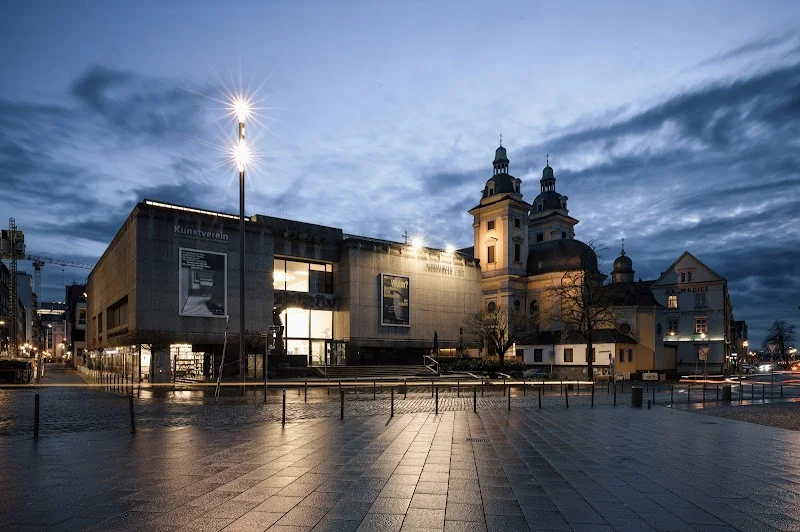
The Art Association for the Rhineland & Westfalen is one of the most traditional places for contemporary art in Düsseldorf and is closely connected to the cultural identity of the city. Since its founding in 1829, the institution has seen itself as a member-supported platform for the production, presentation, and mediation of contemporary art. Today, the Art Association operates as an independent venue for current international positions, site-specific works, and curatorial formats that do not settle for mere exhibitions but initiate new artistic processes. The location is particularly striking: since 1967, the Art Association has shared the building at Grabbeplatz with the Kunsthalle Düsseldorf, and the building designed by Konrad Beckmann exemplifies brutalism in Germany with its cubic form and visible concrete aesthetics. Therefore, those who come here experience not only art in the narrower sense but an institution where history, architecture, membership, and current programming interact closely. This very mix makes the Art Association relevant for visitors, collectors, art enthusiasts, and the Düsseldorf cultural audience alike. ([kunstverein-duesseldorf.de](https://kunstverein-duesseldorf.de/institution/))
Annual Editions and Membership in the Art Association
A central theme around the Art Association is the annual editions, and for good reason: for over 70 years, the Art Association has offered exclusive editions and unique pieces annually, aimed at members and often available only in limited numbers. The selection includes both younger and established artistic positions that have been shown in the Art Association's program or are connected to the institution and the city of Düsseldorf in special ways. The purchase is not only a collector's topic but part of the institutional self-understanding: the annual editions support both the future exhibition and event program as well as the participating artists. Remarkably, the solidarity model states that the proceeds from the sales are equally divided between the artists and the Art Association. This gives the annual editions a dual role as an art object and as a funding instrument. On the website, the works are presented each year in an accompanying brochure with texts by invited authors, further enhancing the character of the editions. ([kunstverein-duesseldorf.de](https://kunstverein-duesseldorf.de/jahresgaben/info/))
For interested parties, it is important to know that additional buyers are only allowed if they become members in the current calendar year. The purchasing process is conducted in writing via the inquiry button on the website, by email, or through forms available on-site, and for non-membership inquiries, a membership application can also be submitted directly. The membership itself is clearly tiered, such as individual, family, reduced, supporting, corporate, or premium membership, which allows the Art Association to address different supporter groups. The current selection of annual editions for 2025 shows how broad the spectrum is: on the official page, works by Koenraad Dedobbeleer, Alexandra Bircken, Mariam Inasvhili, Max Sandfort, Cecilia Bjartmar Hylta, and other positions can be found. So, anyone searching for art association düsseldorf annual editions is not only looking for prices or availability but for access to a vibrant network of art, membership, and support. ([kunstverein-duesseldorf.de](https://kunstverein-duesseldorf.de/jahresgaben/info/))
Photos, Exhibitions, and Visual Insights
The keyword around photos is also strong because the Art Association visually documents its exhibitions and projects in detail. The website shows installation views, image sequences, and photo credits for many exhibitions, allowing visitors to get a realistic sense of atmosphere, hanging, and spatial effect even before their visit. For example, on the page for the annual editions 2025, several installation views with photo credits can be seen, which is not only aesthetically helpful but also provides a good impression of the presentation style of the institution. Additionally, there is an extensive poster archive where previous projects can be traced through posters and visual identities. This is particularly relevant for search queries like art association for the rhineland and westfalen photos, as it provides access to a whole visual memory of the institution, not just individual images. Therefore, those exploring the place online see not just advertising but documented exhibitions, editions, and curatorial manuscripts. ([kunstverein-duesseldorf.de](https://kunstverein-duesseldorf.de/ausstellungen/jahresgaben-2025/))
The visual documentation is also an expression of the institution's substantive claim. The Art Association sees itself as a place for current international positions and for new productions developed specifically for the location. That is why photos and visual material here are more than mere decoration: they help to understand the spatial logic of the Art Association and make visible how strongly the works respond to the respective exhibition. Additionally, the publications page offers a large archive of books, catalogs, and artist publications, ranging from current titles to historical publications. This creates a corpus of images and printed materials that documents the exhibition history of the institution and is also useful for external communication. Therefore, anyone searching for reviews, photos, or program images will find not only individual impressions but a well-structured, professionally maintained material stock that sustainably shapes the perception of the Art Association on the official website. ([kunstverein-duesseldorf.de](https://kunstverein-duesseldorf.de/mitgliedschaft/))
Opening Hours, Admission, and On-Site Visits
For planning a visit, the opening hours are one of the most sought-after topics, and here the Art Association is very clear: it is open from Tuesday to Sunday and on public holidays from 11 am to 6 pm. Additionally, there is a special service evening, as the Düsseldorf public utilities allow free visits to the Art Association and the Kunsthalle every last Thursday of the month from 6 pm to 9 pm. The admission prices also remain comparatively accessible: adults pay 6 euros, reduced tickets are 3 euros, groups of ten or more pay 3 euros, children and young people up to 18 years have free admission, as do people with disabilities including an accompanying person, as well as members, ADKV members, and ICOM members. For search queries like art association düsseldorf opening hours or art association düsseldorf admission, these are the central key data that quickly and reliably answer the visit decision. ([kunstverein-duesseldorf.de](https://kunstverein-duesseldorf.de/ueber/kontakt-besuch/))
It is also important to note the current context: the official visit page points out that the originally planned renovation of the building has been postponed by three years and the intended move to a temporary venue will not take place for the time being. For visitors, this primarily means that the Art Association remains accessible at Grabbeplatz and that the visit should be oriented as usual according to the information on the website. Anyone coming spontaneously should still keep an eye on the opening hours, especially for special dates or short-term changes regarding events. The combination of clear times, free monthly appointments, and a comprehensible price structure makes the visit planable and low-threshold. This strengthens the location as a reliable destination for a cultural walk through Düsseldorf, as the Art Association is not only an address for professionals but also a well-accessible place for everyone who wants to experience contemporary art easily. ([kunstverein-duesseldorf.de](https://kunstverein-duesseldorf.de/ueber/kontakt-besuch/))
Directions, Parking, and Accessibility at Grabbeplatz
When it comes to directions, the public transport connection is particularly convenient. The official visitor information states that the nearest stop is Heinrich-Heine-Allee, accessible by several subway lines, including U70, U71, U72, U73, U74, U75, U76, U77, U78, U79, and U83. This makes the Art Association easily reachable for guests from the city center as well as for visitors coming from other districts or the surrounding area. Those arriving by car will find the nearest parking option in the underground garage under the Kunsthalle Düsseldorf; the entrance is located at Neustr./Mutter-Ey-Str. For search queries like art association düsseldorf directions or art association düsseldorf parking, these details are crucial as they make the way concrete right away. Additionally, the site points out that accessible parking spaces are located nearby at Grabbeplatz or on Ratinger Straße. For the journey, this means: the Art Association is centrally located, but the last stretch should still be planned, as the surroundings are designed with cobblestones. ([kunstverein-duesseldorf.de](https://kunstverein-duesseldorf.de/ueber/kontakt-besuch/))
There are also clear and honest indications regarding accessibility. The Art Association is not fully accessible in terms of construction, but access through the Kunsthalle is regulated: visitors enter through the main entrance and reception of the Kunsthalle, and the staff will assist if needed. People with wheelchairs or strollers can signal at a bell on the left at the entrance; they will then be guided to the elevator at the back, which leads to the exhibition rooms on the second floor. The exhibition areas themselves are at ground level. On-site, a wheelchair and folding stool can be borrowed, and there are additional benches in the exhibition area. The restroom on the second floor is also accessible with the support of the institution via a short, steep ramp. This transparent information is important because it realistically describes what is possible on-site without sugarcoating anything. For visitors with special needs, the Art Association is not perfect, but it is well-prepared and user-friendly in many respects. ([kunstverein-duesseldorf.de](https://kunstverein-duesseldorf.de/ueber/kontakt-besuch/))
History, Architecture, and Curatorial Significance
Historically, the Art Association is much more than just an exhibition space. It was founded in 1829 during a phase when Düsseldorf was culturally flourishing as an academy city; the first director was the painter Wilhelm von Schadow, who built the Art Association in exchange with artists, citizens, and the government in Berlin. In its own history, the institution emphasizes that until the 1960s, it was the only exhibition institution in the city alongside the art museum founded in 1919. This also explains the early claim to not only show contemporary art but also to include historical positions when necessary. Important milestones include exhibitions such as Masterpieces from the 15th to 20th Centuries from São Paulo, the World Exhibition of Photography, and a showcase of works by Aristide Maillol. Later, the Art Association made early marks with exhibitions by Peter Brüning, Jackson Pollock, Gerhard Richter, or Group 53. Particularly legendary was the DADA exhibition organized in 1958 together with Hanna Höch, Max Ernst, and Man Ray, which set important impulses in Düsseldorf. ([kunstverein-duesseldorf.de](https://kunstverein-duesseldorf.de/institution/))
The architecture of the current location is also closely linked to cultural history. Since 1967, the Art Association has been located in the building of the Kunsthalle at Grabbeplatz, a structure designed by Konrad Beckmann characterized by concrete and cubic features. The official representation describes the building as a prominent example of brutalist architecture. When a demolition was even discussed in the late 1990s, Düsseldorf artists and citizens successfully campaigned for the preservation of the building. This is important for the perception of the place because the Art Association works not only in a building but in a cultural monument that has become part of the debate itself. In connection with the Kunsthalle, the surrounding cultural institutions, and the historical role of the Art Association, a place emerges that connects local art history, international art, and the question of how to deal with urban space. For visitors, this is an additional attraction: the Art Association is not only exciting inside but also architecturally and historically charged. ([kunstverein-duesseldorf.de](https://kunstverein-duesseldorf.de/institution/))
Educational Program, Publications, and Scholarships
Another strong focus around the Art Association is the program itself, as the institution sees itself not only as an exhibition space but as a mediation and discourse space. The official membership page describes that the institution offers not only an exhibition program but also lectures, artist talks, film screenings, art trips, symposia, and publications. Additionally, new productions are supported that are specifically developed for the location. This makes the Art Association a platform where content, format, and encounter interact. For members, specific advantages are also added: free curatorial tours, invitations to current exhibitions, access to the members' program, and free admission to the Art Association, the Kunsthalle, and other art associations of the ADKV. Thus, membership is not only a formal support but a ticket to an active community of art enthusiasts. This is precisely why the keyword art association düsseldorf membership plays such an important role in SEO planning. ([kunstverein-duesseldorf.de](https://kunstverein-duesseldorf.de/mitgliedschaft/))
The funding structure is also noteworthy. In addition to the regular exhibition and mediation operations, there are scholarship programs such as the dHCS scholarship 2026/2027 and the travel scholarship 2026, which are documented in detail on the website. They show that the Art Association not only presents results but actively supports the creation of new works. The scholarship page lists the supported artists, and the jury is clearly identified, which underscores the transparency of the process. The publications page is also important for external perception, as it makes the Art Association visible as an art publisher and documentation site: there are current catalogs as well as older titles, including historical series and anniversary publications. Together, mediation, publications, and scholarships make it clear that the Art Association in Düsseldorf is more than just a showcase. It is a working place where research, production, publication, and audience are put into a productive relationship. For seekers, this is the actual uniqueness: here, contemporary art gains an institutional depth that goes far beyond mere exhibition. ([kunstverein-duesseldorf.de](https://kunstverein-duesseldorf.de/stipendien/dhcs-stipendium-2026-2027/?utm_source=openai))
Sources:
- Art Association for the Rhineland and Westfalen - Institution
- Art Association for the Rhineland and Westfalen - Contact and Visit
- Art Association for the Rhineland and Westfalen - Annual Editions
- Art Association for the Rhineland and Westfalen - Membership
- Art Association for the Rhineland and Westfalen - Publications
- Art Association for the Rhineland and Westfalen - Annual Editions 2025
Show moreShow less
Art Association for the Rhineland & Westfalen | Annual Editions & Photos
The Art Association for the Rhineland & Westfalen is one of the most traditional places for contemporary art in Düsseldorf and is closely connected to the cultural identity of the city. Since its founding in 1829, the institution has seen itself as a member-supported platform for the production, presentation, and mediation of contemporary art. Today, the Art Association operates as an independent venue for current international positions, site-specific works, and curatorial formats that do not settle for mere exhibitions but initiate new artistic processes. The location is particularly striking: since 1967, the Art Association has shared the building at Grabbeplatz with the Kunsthalle Düsseldorf, and the building designed by Konrad Beckmann exemplifies brutalism in Germany with its cubic form and visible concrete aesthetics. Therefore, those who come here experience not only art in the narrower sense but an institution where history, architecture, membership, and current programming interact closely. This very mix makes the Art Association relevant for visitors, collectors, art enthusiasts, and the Düsseldorf cultural audience alike. ([kunstverein-duesseldorf.de](https://kunstverein-duesseldorf.de/institution/))
Annual Editions and Membership in the Art Association
A central theme around the Art Association is the annual editions, and for good reason: for over 70 years, the Art Association has offered exclusive editions and unique pieces annually, aimed at members and often available only in limited numbers. The selection includes both younger and established artistic positions that have been shown in the Art Association's program or are connected to the institution and the city of Düsseldorf in special ways. The purchase is not only a collector's topic but part of the institutional self-understanding: the annual editions support both the future exhibition and event program as well as the participating artists. Remarkably, the solidarity model states that the proceeds from the sales are equally divided between the artists and the Art Association. This gives the annual editions a dual role as an art object and as a funding instrument. On the website, the works are presented each year in an accompanying brochure with texts by invited authors, further enhancing the character of the editions. ([kunstverein-duesseldorf.de](https://kunstverein-duesseldorf.de/jahresgaben/info/))
For interested parties, it is important to know that additional buyers are only allowed if they become members in the current calendar year. The purchasing process is conducted in writing via the inquiry button on the website, by email, or through forms available on-site, and for non-membership inquiries, a membership application can also be submitted directly. The membership itself is clearly tiered, such as individual, family, reduced, supporting, corporate, or premium membership, which allows the Art Association to address different supporter groups. The current selection of annual editions for 2025 shows how broad the spectrum is: on the official page, works by Koenraad Dedobbeleer, Alexandra Bircken, Mariam Inasvhili, Max Sandfort, Cecilia Bjartmar Hylta, and other positions can be found. So, anyone searching for art association düsseldorf annual editions is not only looking for prices or availability but for access to a vibrant network of art, membership, and support. ([kunstverein-duesseldorf.de](https://kunstverein-duesseldorf.de/jahresgaben/info/))
Photos, Exhibitions, and Visual Insights
The keyword around photos is also strong because the Art Association visually documents its exhibitions and projects in detail. The website shows installation views, image sequences, and photo credits for many exhibitions, allowing visitors to get a realistic sense of atmosphere, hanging, and spatial effect even before their visit. For example, on the page for the annual editions 2025, several installation views with photo credits can be seen, which is not only aesthetically helpful but also provides a good impression of the presentation style of the institution. Additionally, there is an extensive poster archive where previous projects can be traced through posters and visual identities. This is particularly relevant for search queries like art association for the rhineland and westfalen photos, as it provides access to a whole visual memory of the institution, not just individual images. Therefore, those exploring the place online see not just advertising but documented exhibitions, editions, and curatorial manuscripts. ([kunstverein-duesseldorf.de](https://kunstverein-duesseldorf.de/ausstellungen/jahresgaben-2025/))
The visual documentation is also an expression of the institution's substantive claim. The Art Association sees itself as a place for current international positions and for new productions developed specifically for the location. That is why photos and visual material here are more than mere decoration: they help to understand the spatial logic of the Art Association and make visible how strongly the works respond to the respective exhibition. Additionally, the publications page offers a large archive of books, catalogs, and artist publications, ranging from current titles to historical publications. This creates a corpus of images and printed materials that documents the exhibition history of the institution and is also useful for external communication. Therefore, anyone searching for reviews, photos, or program images will find not only individual impressions but a well-structured, professionally maintained material stock that sustainably shapes the perception of the Art Association on the official website. ([kunstverein-duesseldorf.de](https://kunstverein-duesseldorf.de/mitgliedschaft/))
Opening Hours, Admission, and On-Site Visits
For planning a visit, the opening hours are one of the most sought-after topics, and here the Art Association is very clear: it is open from Tuesday to Sunday and on public holidays from 11 am to 6 pm. Additionally, there is a special service evening, as the Düsseldorf public utilities allow free visits to the Art Association and the Kunsthalle every last Thursday of the month from 6 pm to 9 pm. The admission prices also remain comparatively accessible: adults pay 6 euros, reduced tickets are 3 euros, groups of ten or more pay 3 euros, children and young people up to 18 years have free admission, as do people with disabilities including an accompanying person, as well as members, ADKV members, and ICOM members. For search queries like art association düsseldorf opening hours or art association düsseldorf admission, these are the central key data that quickly and reliably answer the visit decision. ([kunstverein-duesseldorf.de](https://kunstverein-duesseldorf.de/ueber/kontakt-besuch/))
It is also important to note the current context: the official visit page points out that the originally planned renovation of the building has been postponed by three years and the intended move to a temporary venue will not take place for the time being. For visitors, this primarily means that the Art Association remains accessible at Grabbeplatz and that the visit should be oriented as usual according to the information on the website. Anyone coming spontaneously should still keep an eye on the opening hours, especially for special dates or short-term changes regarding events. The combination of clear times, free monthly appointments, and a comprehensible price structure makes the visit planable and low-threshold. This strengthens the location as a reliable destination for a cultural walk through Düsseldorf, as the Art Association is not only an address for professionals but also a well-accessible place for everyone who wants to experience contemporary art easily. ([kunstverein-duesseldorf.de](https://kunstverein-duesseldorf.de/ueber/kontakt-besuch/))
Directions, Parking, and Accessibility at Grabbeplatz
When it comes to directions, the public transport connection is particularly convenient. The official visitor information states that the nearest stop is Heinrich-Heine-Allee, accessible by several subway lines, including U70, U71, U72, U73, U74, U75, U76, U77, U78, U79, and U83. This makes the Art Association easily reachable for guests from the city center as well as for visitors coming from other districts or the surrounding area. Those arriving by car will find the nearest parking option in the underground garage under the Kunsthalle Düsseldorf; the entrance is located at Neustr./Mutter-Ey-Str. For search queries like art association düsseldorf directions or art association düsseldorf parking, these details are crucial as they make the way concrete right away. Additionally, the site points out that accessible parking spaces are located nearby at Grabbeplatz or on Ratinger Straße. For the journey, this means: the Art Association is centrally located, but the last stretch should still be planned, as the surroundings are designed with cobblestones. ([kunstverein-duesseldorf.de](https://kunstverein-duesseldorf.de/ueber/kontakt-besuch/))
There are also clear and honest indications regarding accessibility. The Art Association is not fully accessible in terms of construction, but access through the Kunsthalle is regulated: visitors enter through the main entrance and reception of the Kunsthalle, and the staff will assist if needed. People with wheelchairs or strollers can signal at a bell on the left at the entrance; they will then be guided to the elevator at the back, which leads to the exhibition rooms on the second floor. The exhibition areas themselves are at ground level. On-site, a wheelchair and folding stool can be borrowed, and there are additional benches in the exhibition area. The restroom on the second floor is also accessible with the support of the institution via a short, steep ramp. This transparent information is important because it realistically describes what is possible on-site without sugarcoating anything. For visitors with special needs, the Art Association is not perfect, but it is well-prepared and user-friendly in many respects. ([kunstverein-duesseldorf.de](https://kunstverein-duesseldorf.de/ueber/kontakt-besuch/))
History, Architecture, and Curatorial Significance
Historically, the Art Association is much more than just an exhibition space. It was founded in 1829 during a phase when Düsseldorf was culturally flourishing as an academy city; the first director was the painter Wilhelm von Schadow, who built the Art Association in exchange with artists, citizens, and the government in Berlin. In its own history, the institution emphasizes that until the 1960s, it was the only exhibition institution in the city alongside the art museum founded in 1919. This also explains the early claim to not only show contemporary art but also to include historical positions when necessary. Important milestones include exhibitions such as Masterpieces from the 15th to 20th Centuries from São Paulo, the World Exhibition of Photography, and a showcase of works by Aristide Maillol. Later, the Art Association made early marks with exhibitions by Peter Brüning, Jackson Pollock, Gerhard Richter, or Group 53. Particularly legendary was the DADA exhibition organized in 1958 together with Hanna Höch, Max Ernst, and Man Ray, which set important impulses in Düsseldorf. ([kunstverein-duesseldorf.de](https://kunstverein-duesseldorf.de/institution/))
The architecture of the current location is also closely linked to cultural history. Since 1967, the Art Association has been located in the building of the Kunsthalle at Grabbeplatz, a structure designed by Konrad Beckmann characterized by concrete and cubic features. The official representation describes the building as a prominent example of brutalist architecture. When a demolition was even discussed in the late 1990s, Düsseldorf artists and citizens successfully campaigned for the preservation of the building. This is important for the perception of the place because the Art Association works not only in a building but in a cultural monument that has become part of the debate itself. In connection with the Kunsthalle, the surrounding cultural institutions, and the historical role of the Art Association, a place emerges that connects local art history, international art, and the question of how to deal with urban space. For visitors, this is an additional attraction: the Art Association is not only exciting inside but also architecturally and historically charged. ([kunstverein-duesseldorf.de](https://kunstverein-duesseldorf.de/institution/))
Educational Program, Publications, and Scholarships
Another strong focus around the Art Association is the program itself, as the institution sees itself not only as an exhibition space but as a mediation and discourse space. The official membership page describes that the institution offers not only an exhibition program but also lectures, artist talks, film screenings, art trips, symposia, and publications. Additionally, new productions are supported that are specifically developed for the location. This makes the Art Association a platform where content, format, and encounter interact. For members, specific advantages are also added: free curatorial tours, invitations to current exhibitions, access to the members' program, and free admission to the Art Association, the Kunsthalle, and other art associations of the ADKV. Thus, membership is not only a formal support but a ticket to an active community of art enthusiasts. This is precisely why the keyword art association düsseldorf membership plays such an important role in SEO planning. ([kunstverein-duesseldorf.de](https://kunstverein-duesseldorf.de/mitgliedschaft/))
The funding structure is also noteworthy. In addition to the regular exhibition and mediation operations, there are scholarship programs such as the dHCS scholarship 2026/2027 and the travel scholarship 2026, which are documented in detail on the website. They show that the Art Association not only presents results but actively supports the creation of new works. The scholarship page lists the supported artists, and the jury is clearly identified, which underscores the transparency of the process. The publications page is also important for external perception, as it makes the Art Association visible as an art publisher and documentation site: there are current catalogs as well as older titles, including historical series and anniversary publications. Together, mediation, publications, and scholarships make it clear that the Art Association in Düsseldorf is more than just a showcase. It is a working place where research, production, publication, and audience are put into a productive relationship. For seekers, this is the actual uniqueness: here, contemporary art gains an institutional depth that goes far beyond mere exhibition. ([kunstverein-duesseldorf.de](https://kunstverein-duesseldorf.de/stipendien/dhcs-stipendium-2026-2027/?utm_source=openai))
Sources:
- Art Association for the Rhineland and Westfalen - Institution
- Art Association for the Rhineland and Westfalen - Contact and Visit
- Art Association for the Rhineland and Westfalen - Annual Editions
- Art Association for the Rhineland and Westfalen - Membership
- Art Association for the Rhineland and Westfalen - Publications
- Art Association for the Rhineland and Westfalen - Annual Editions 2025
Art Association for the Rhineland & Westfalen | Annual Editions & Photos
The Art Association for the Rhineland & Westfalen is one of the most traditional places for contemporary art in Düsseldorf and is closely connected to the cultural identity of the city. Since its founding in 1829, the institution has seen itself as a member-supported platform for the production, presentation, and mediation of contemporary art. Today, the Art Association operates as an independent venue for current international positions, site-specific works, and curatorial formats that do not settle for mere exhibitions but initiate new artistic processes. The location is particularly striking: since 1967, the Art Association has shared the building at Grabbeplatz with the Kunsthalle Düsseldorf, and the building designed by Konrad Beckmann exemplifies brutalism in Germany with its cubic form and visible concrete aesthetics. Therefore, those who come here experience not only art in the narrower sense but an institution where history, architecture, membership, and current programming interact closely. This very mix makes the Art Association relevant for visitors, collectors, art enthusiasts, and the Düsseldorf cultural audience alike. ([kunstverein-duesseldorf.de](https://kunstverein-duesseldorf.de/institution/))
Annual Editions and Membership in the Art Association
A central theme around the Art Association is the annual editions, and for good reason: for over 70 years, the Art Association has offered exclusive editions and unique pieces annually, aimed at members and often available only in limited numbers. The selection includes both younger and established artistic positions that have been shown in the Art Association's program or are connected to the institution and the city of Düsseldorf in special ways. The purchase is not only a collector's topic but part of the institutional self-understanding: the annual editions support both the future exhibition and event program as well as the participating artists. Remarkably, the solidarity model states that the proceeds from the sales are equally divided between the artists and the Art Association. This gives the annual editions a dual role as an art object and as a funding instrument. On the website, the works are presented each year in an accompanying brochure with texts by invited authors, further enhancing the character of the editions. ([kunstverein-duesseldorf.de](https://kunstverein-duesseldorf.de/jahresgaben/info/))
For interested parties, it is important to know that additional buyers are only allowed if they become members in the current calendar year. The purchasing process is conducted in writing via the inquiry button on the website, by email, or through forms available on-site, and for non-membership inquiries, a membership application can also be submitted directly. The membership itself is clearly tiered, such as individual, family, reduced, supporting, corporate, or premium membership, which allows the Art Association to address different supporter groups. The current selection of annual editions for 2025 shows how broad the spectrum is: on the official page, works by Koenraad Dedobbeleer, Alexandra Bircken, Mariam Inasvhili, Max Sandfort, Cecilia Bjartmar Hylta, and other positions can be found. So, anyone searching for art association düsseldorf annual editions is not only looking for prices or availability but for access to a vibrant network of art, membership, and support. ([kunstverein-duesseldorf.de](https://kunstverein-duesseldorf.de/jahresgaben/info/))
Photos, Exhibitions, and Visual Insights
The keyword around photos is also strong because the Art Association visually documents its exhibitions and projects in detail. The website shows installation views, image sequences, and photo credits for many exhibitions, allowing visitors to get a realistic sense of atmosphere, hanging, and spatial effect even before their visit. For example, on the page for the annual editions 2025, several installation views with photo credits can be seen, which is not only aesthetically helpful but also provides a good impression of the presentation style of the institution. Additionally, there is an extensive poster archive where previous projects can be traced through posters and visual identities. This is particularly relevant for search queries like art association for the rhineland and westfalen photos, as it provides access to a whole visual memory of the institution, not just individual images. Therefore, those exploring the place online see not just advertising but documented exhibitions, editions, and curatorial manuscripts. ([kunstverein-duesseldorf.de](https://kunstverein-duesseldorf.de/ausstellungen/jahresgaben-2025/))
The visual documentation is also an expression of the institution's substantive claim. The Art Association sees itself as a place for current international positions and for new productions developed specifically for the location. That is why photos and visual material here are more than mere decoration: they help to understand the spatial logic of the Art Association and make visible how strongly the works respond to the respective exhibition. Additionally, the publications page offers a large archive of books, catalogs, and artist publications, ranging from current titles to historical publications. This creates a corpus of images and printed materials that documents the exhibition history of the institution and is also useful for external communication. Therefore, anyone searching for reviews, photos, or program images will find not only individual impressions but a well-structured, professionally maintained material stock that sustainably shapes the perception of the Art Association on the official website. ([kunstverein-duesseldorf.de](https://kunstverein-duesseldorf.de/mitgliedschaft/))
Opening Hours, Admission, and On-Site Visits
For planning a visit, the opening hours are one of the most sought-after topics, and here the Art Association is very clear: it is open from Tuesday to Sunday and on public holidays from 11 am to 6 pm. Additionally, there is a special service evening, as the Düsseldorf public utilities allow free visits to the Art Association and the Kunsthalle every last Thursday of the month from 6 pm to 9 pm. The admission prices also remain comparatively accessible: adults pay 6 euros, reduced tickets are 3 euros, groups of ten or more pay 3 euros, children and young people up to 18 years have free admission, as do people with disabilities including an accompanying person, as well as members, ADKV members, and ICOM members. For search queries like art association düsseldorf opening hours or art association düsseldorf admission, these are the central key data that quickly and reliably answer the visit decision. ([kunstverein-duesseldorf.de](https://kunstverein-duesseldorf.de/ueber/kontakt-besuch/))
It is also important to note the current context: the official visit page points out that the originally planned renovation of the building has been postponed by three years and the intended move to a temporary venue will not take place for the time being. For visitors, this primarily means that the Art Association remains accessible at Grabbeplatz and that the visit should be oriented as usual according to the information on the website. Anyone coming spontaneously should still keep an eye on the opening hours, especially for special dates or short-term changes regarding events. The combination of clear times, free monthly appointments, and a comprehensible price structure makes the visit planable and low-threshold. This strengthens the location as a reliable destination for a cultural walk through Düsseldorf, as the Art Association is not only an address for professionals but also a well-accessible place for everyone who wants to experience contemporary art easily. ([kunstverein-duesseldorf.de](https://kunstverein-duesseldorf.de/ueber/kontakt-besuch/))
Directions, Parking, and Accessibility at Grabbeplatz
When it comes to directions, the public transport connection is particularly convenient. The official visitor information states that the nearest stop is Heinrich-Heine-Allee, accessible by several subway lines, including U70, U71, U72, U73, U74, U75, U76, U77, U78, U79, and U83. This makes the Art Association easily reachable for guests from the city center as well as for visitors coming from other districts or the surrounding area. Those arriving by car will find the nearest parking option in the underground garage under the Kunsthalle Düsseldorf; the entrance is located at Neustr./Mutter-Ey-Str. For search queries like art association düsseldorf directions or art association düsseldorf parking, these details are crucial as they make the way concrete right away. Additionally, the site points out that accessible parking spaces are located nearby at Grabbeplatz or on Ratinger Straße. For the journey, this means: the Art Association is centrally located, but the last stretch should still be planned, as the surroundings are designed with cobblestones. ([kunstverein-duesseldorf.de](https://kunstverein-duesseldorf.de/ueber/kontakt-besuch/))
There are also clear and honest indications regarding accessibility. The Art Association is not fully accessible in terms of construction, but access through the Kunsthalle is regulated: visitors enter through the main entrance and reception of the Kunsthalle, and the staff will assist if needed. People with wheelchairs or strollers can signal at a bell on the left at the entrance; they will then be guided to the elevator at the back, which leads to the exhibition rooms on the second floor. The exhibition areas themselves are at ground level. On-site, a wheelchair and folding stool can be borrowed, and there are additional benches in the exhibition area. The restroom on the second floor is also accessible with the support of the institution via a short, steep ramp. This transparent information is important because it realistically describes what is possible on-site without sugarcoating anything. For visitors with special needs, the Art Association is not perfect, but it is well-prepared and user-friendly in many respects. ([kunstverein-duesseldorf.de](https://kunstverein-duesseldorf.de/ueber/kontakt-besuch/))
History, Architecture, and Curatorial Significance
Historically, the Art Association is much more than just an exhibition space. It was founded in 1829 during a phase when Düsseldorf was culturally flourishing as an academy city; the first director was the painter Wilhelm von Schadow, who built the Art Association in exchange with artists, citizens, and the government in Berlin. In its own history, the institution emphasizes that until the 1960s, it was the only exhibition institution in the city alongside the art museum founded in 1919. This also explains the early claim to not only show contemporary art but also to include historical positions when necessary. Important milestones include exhibitions such as Masterpieces from the 15th to 20th Centuries from São Paulo, the World Exhibition of Photography, and a showcase of works by Aristide Maillol. Later, the Art Association made early marks with exhibitions by Peter Brüning, Jackson Pollock, Gerhard Richter, or Group 53. Particularly legendary was the DADA exhibition organized in 1958 together with Hanna Höch, Max Ernst, and Man Ray, which set important impulses in Düsseldorf. ([kunstverein-duesseldorf.de](https://kunstverein-duesseldorf.de/institution/))
The architecture of the current location is also closely linked to cultural history. Since 1967, the Art Association has been located in the building of the Kunsthalle at Grabbeplatz, a structure designed by Konrad Beckmann characterized by concrete and cubic features. The official representation describes the building as a prominent example of brutalist architecture. When a demolition was even discussed in the late 1990s, Düsseldorf artists and citizens successfully campaigned for the preservation of the building. This is important for the perception of the place because the Art Association works not only in a building but in a cultural monument that has become part of the debate itself. In connection with the Kunsthalle, the surrounding cultural institutions, and the historical role of the Art Association, a place emerges that connects local art history, international art, and the question of how to deal with urban space. For visitors, this is an additional attraction: the Art Association is not only exciting inside but also architecturally and historically charged. ([kunstverein-duesseldorf.de](https://kunstverein-duesseldorf.de/institution/))
Educational Program, Publications, and Scholarships
Another strong focus around the Art Association is the program itself, as the institution sees itself not only as an exhibition space but as a mediation and discourse space. The official membership page describes that the institution offers not only an exhibition program but also lectures, artist talks, film screenings, art trips, symposia, and publications. Additionally, new productions are supported that are specifically developed for the location. This makes the Art Association a platform where content, format, and encounter interact. For members, specific advantages are also added: free curatorial tours, invitations to current exhibitions, access to the members' program, and free admission to the Art Association, the Kunsthalle, and other art associations of the ADKV. Thus, membership is not only a formal support but a ticket to an active community of art enthusiasts. This is precisely why the keyword art association düsseldorf membership plays such an important role in SEO planning. ([kunstverein-duesseldorf.de](https://kunstverein-duesseldorf.de/mitgliedschaft/))
The funding structure is also noteworthy. In addition to the regular exhibition and mediation operations, there are scholarship programs such as the dHCS scholarship 2026/2027 and the travel scholarship 2026, which are documented in detail on the website. They show that the Art Association not only presents results but actively supports the creation of new works. The scholarship page lists the supported artists, and the jury is clearly identified, which underscores the transparency of the process. The publications page is also important for external perception, as it makes the Art Association visible as an art publisher and documentation site: there are current catalogs as well as older titles, including historical series and anniversary publications. Together, mediation, publications, and scholarships make it clear that the Art Association in Düsseldorf is more than just a showcase. It is a working place where research, production, publication, and audience are put into a productive relationship. For seekers, this is the actual uniqueness: here, contemporary art gains an institutional depth that goes far beyond mere exhibition. ([kunstverein-duesseldorf.de](https://kunstverein-duesseldorf.de/stipendien/dhcs-stipendium-2026-2027/?utm_source=openai))
Sources:
- Art Association for the Rhineland and Westfalen - Institution
- Art Association for the Rhineland and Westfalen - Contact and Visit
- Art Association for the Rhineland and Westfalen - Annual Editions
- Art Association for the Rhineland and Westfalen - Membership
- Art Association for the Rhineland and Westfalen - Publications
- Art Association for the Rhineland and Westfalen - Annual Editions 2025
Upcoming Events
No events found
Frequently Asked Questions
Reviews
Chia-chen Lehahn
28. April 2024
Visited this place during Night of the Museums. Small but has a few interesting and modern art/paintings.
Jay Green
14. April 2019
Such a strange place. Very strange. Got 2 stars because entry is free. All you can hear when you're in there is horror sounds like women screaming and oddly shaped faces on videos.
Monika S
29. November 2019
Exhibits in a modern building and showcases contemporary art from the region in interesting rotating exhibitions. Next to the building are four caryatids, female support figures in Greek style, created in 1881 from Rhenish sandstone. They represented the fine arts, including architecture, painting, poetry, and music, and adorned the gable of the predecessor building of the art hall that was destroyed in the war. My photo shows them on the side wall of the art association building.
Indrek
12. April 2025
It gets especially warm at this place when you engage with the works of Düsseldorf artists that are currently on display on 11.04.25. Then you have the chance to experience something you've long suspected and hoped to experience, then it's there, you'll find it, big loop, and I will miss you.
Thomas Krützmann
2. February 2020
We actually wanted to go to the Munch exhibition, but the line was too long. It didn't matter, because across at the art association, there's the absolutely worth-seeing 'Exhibition at the Expense of a Sad One' by young artists Hedda Schattanik and Roman Scszesny. Haven't seen such an inspiring and surprising installation in a long time. Anyone looking at Munch should also come here.