Ständehausstraße 1, Düsseldorf-Stadtbezirk 3
Ständehausstraße 1, 40217 Düsseldorf, Germany
Art Collection NRW | K21 & Tickets
The Art Collection North Rhine-Westphalia at the K21 location in Düsseldorf is a house that uniquely connects contemporary art, architecture, and urban space. Visitors to the location at Ständehausstraße 1 not only experience changing exhibitions but also a building with a remarkable history: the former Ständehaus at Kaiserteich, which is now used as a museum for international contemporary art. As part of the Art Collection NRW founded in 1961, K21 represents a clear curatorial claim, international perspectives, and a museum architecture that makes the tour itself an experience. Visitors will find a well-structured house with clear opening hours, a simple ticket model, barrier-free access, and a location that is easily reachable by both public transport and car. ([kunstsammlung.de](https://www.kunstsammlung.de/en/museum/concept?utm_source=openai))
K21 Düsseldorf: Collection, Exhibitions, and Contemporary Art
At K21, international contemporary art from the Art Collection North Rhine-Westphalia meets the impressive architecture of the former Ständehaus at Kaiserteich. The content of the house focuses on current developments in 21st-century art. In the individually designed exhibition spaces on the second and third floors, large-format, multimedia, and spatially expansive works are displayed, opening global perspectives and making the diversity of contemporary forms of expression visible. Among the positions highlighted in the official presentation are Kader Attia, Cao Fei, Isa Genzken, Henrike Naumann, Isaac Julien, Raqs Media Collective, Bunny Rogers, Dayanita Singh, Hito Steyerl, and Ai Weiwei. Thus, K21 is not a static collection house but a place where the present can be continuously reinterpreted, and where the audience can discover different artistic attitudes, media, and themes time and again. ([kunstsammlung.de](https://www.kunstsammlung.de/en/museum/K21))
Particularly exciting is the curatorial structure of the house. A dedicated area is reserved for the K21 Global Art Award, which is awarded annually in collaboration with the friends of the art collection and includes the purchase of a work for the museum. This way, the collection grows not only in content but also geographically and generationally. On the first floor, there is also the archive of Dorothee and Konrad Fischer, from which artistic positions or thematic lines are regularly shown. This combination of collection, archive, and current selection gives K21 a special depth: the house not only shows works but also contexts, networks, and historical connections of the Düsseldorf and international art scene. Therefore, anyone looking for an art collection in Düsseldorf will find a place that goes far beyond a classic museum scheme and makes current artistic debates visible. ([kunstsammlung.de](https://www.kunstsammlung.de/en/museum/K21))
Opening Hours, Tickets, and Admission Prices of the Art Collection NRW
The opening hours of the Art Collection NRW at K21 are clearly regulated for planning your visit. The museum is open from Tuesday to Sunday and on public holidays from 11 AM to 6 PM. On the first Wednesday of each month, the opening hours are extended until 10 PM; the house is closed on Mondays. Additionally, it is closed on December 24th, 25th, and 31st. There are separate offers and bookable times for groups and schools, which can also be available before regular opening hours starting at 10 AM. This transparency is particularly practical for a museum visit with a fixed daily schedule, as the tour can be easily combined with a walk at Kaiserteich, an appointment in the city center, or a follow-up visit in Düsseldorf. ([kunstsammlung.de](https://www.kunstsammlung.de/en/visit/))
In terms of the ticket model, K21 focuses on clear prices and flexible use. There are no timed tickets; regular admission tickets are valid for one year from the date of purchase and entitle a one-time visit. The combination ticket for K20 and K21 costs 20 euros. For K21, the prices are 8 euros for the collection, 14 euros for the collection and exhibition, with reduced prices of 6 and 12 euros respectively. Students and trainees over 18 pay 5 euros. Children and teenagers up to and including 17 years have free admission. Digital and printed tickets are accepted. This structure is particularly helpful for anyone who wants to plan spontaneously or with greater time flexibility, as a ticket is not fixed to a specific time slot. ([kunstsammlung.de](https://www.kunstsammlung.de/en/visit/))
Directions and Parking at Ständehausstraße 1
The journey to the Art Collection NRW at K21 is straightforward and well connected to public transport. The official stop is called Graf-Adolf-Platz. Lines 706, 708, 709, U71, U72, U73, and U83 go there. Those wishing to switch between K20 and K21 can also do so by subway: the connection between Heinrich-Heine-Allee and Graf-Adolf-Platz takes about two minutes, and the walking distance is around 15 to 20 minutes. This makes K21 very suitable for a museum visit without a car, especially if the day continues in the city center, Friedrichstadt, or around Kaiserteich. The transport connection is particularly convenient for guests from outside, as the museum can be reached with few transfers and the path from public transport to the entrance remains short. ([kunstsammlung.de](https://www.kunstsammlung.de/en/visit/))
The directions for arriving by car are also clearly described. For K21, the Art Collection recommends heading towards Friedrichstadt and mentions parking options at the Friedrichstraße, Herzogstraße, Kirchplatz, and GAP 15 parking garages. There are stopping and unloading options for coaches and groups in the immediate vicinity, and bus parking spaces are located at the Tonhallen banks. For those planning a barrier-free journey, designated disabled parking spaces are available directly on the K21 property to the right of the building; access is via Wasserstraße. This combination of parking garage options, bus connections, and separate disabled parking spaces makes the location usable for both individual visits and organized group trips. This is an important practical advantage, especially for a house in the middle of Düsseldorf. ([kunstsammlung.de](https://www.kunstsammlung.de/en/visit/))
Architecture and History of the Ständehaus at Kaiserteich
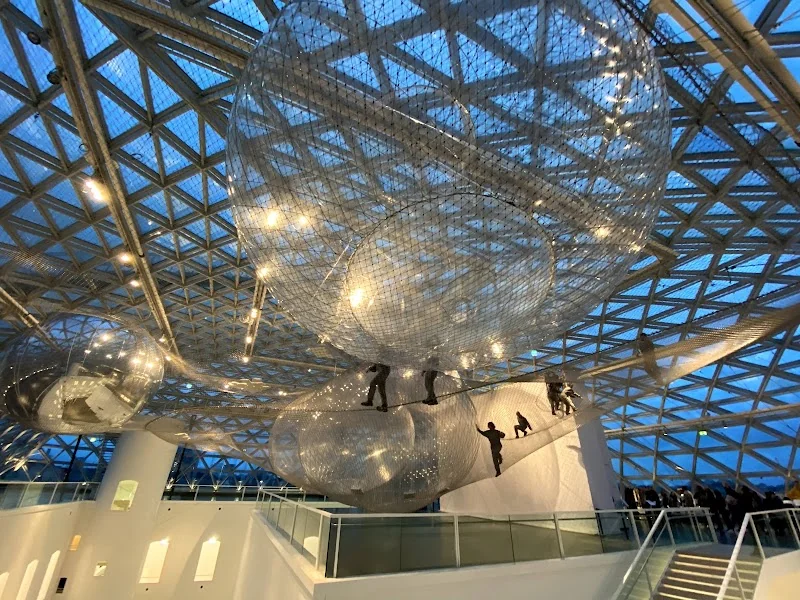
The current K21 possesses an architectural quality that goes far beyond a purely museum function. The former Ständehaus at Kaiserteich was the seat of the North Rhine-Westphalian state parliament until 1988 and was opened in spring 2002 as the second pillar of the art collection for modern and contemporary art. Four building wings with surrounding arcades enclose a central public square, the generous piazza of the house. The renovation of the representative historicist building from 1876 to 1880 by the Munich office Kiessler + Partner created a modern museum building, whose glass dome roof shapes the structure of the house and simultaneously spans the upper level. Together with the flexible exhibition areas in the basement and the upper gallery spaces, a spatial dramaturgy emerges that closely intertwines architecture and art. ([kunstsammlung.de](https://www.kunstsammlung.de/en/museum/K21))
Content-wise and historically, K21 is part of a larger museum concept. The Art Collection North Rhine-Westphalia was founded in 1961 and arose from an important Paul Klee acquisition by the state in 1960. From this origin, an internationally significant collection developed over decades, which today includes classical modernism, post-war modernism, and contemporary art. With K20 and K21, the institution operates two locations that set different focuses: K20 at Grabbeplatz for classical modernism and art after 1945, K21 at Kaiserteich for international contemporary art. This dual museum approach is particularly attractive for visitors, as it opens two different perspectives on art history and also offers the opportunity to spread the day with a combination ticket across both houses. ([kunstsammlung.de](https://www.kunstsammlung.de/en/museum/concept?utm_source=openai))
Accessibility, Service, Shop, Café, and WLAN
For a comfortable visit, K21 offers several practical services. The house is fundamentally barrier-free, and visitors with limited mobility can borrow wheelchairs free of charge on-site. Additionally, folding chairs are available that can be used as walking aids. Those with an official disability ID receive preferential entry in waiting situations. This is also helpful for families or groups with special needs, as the museum visit can be planned much more relaxed. The Art Collection also explicitly points out that K21 is overall accessible and that disabled parking spaces are available directly on the property. This creates a service package that not only relies on architectural openness but also significantly facilitates the real stay on-site. ([kunstsammlung.de](https://www.kunstsammlung.de/en/visit/))
Moreover, visitor comfort includes WLAN, cloakrooms, lockers, and supplementary infrastructure. In the public areas of K21, there is free internet access via the K21 public network, which is available, among other places, on the piazza and in Salon21. Coats, larger bags, and bulky items should be left at the cloakroom or in the lockers; both are free of charge. Photography for private purposes is generally allowed in the exhibition galleries, provided there are no special restrictions for individual works or special exhibitions. Eating and drinking are not permitted in the exhibition halls. The offer is complemented by a museum shop, café, and restaurant, as well as visitor service at the phone number +49 (0)211 8381-204 and the email address service@kunstsammlung.de. All of this makes K21 a museum that functions well not only culturally but also organizationally. ([kunstsammlung.de](https://www.kunstsammlung.de/en/visit/))
Visitor Tips for Your Tour Through K21
Those who want to experience the Art Collection NRW at K21 in a relaxed manner benefit from some useful details. The tickets are valid for one year, allowing for flexible planning of the visit. Particularly attractive is the first Wednesday of the month: then K21 is open until 10 PM, and admission is free from 6 PM. This can be a good time for an after-work visit or an evening of art in a calm atmosphere. Furthermore, the Art Collection refers to a wide educational and mediation offer that is also aimed at groups, schools, and daycare centers. Especially for families or organized visits, early registration is worthwhile, as some offers can also be available before regular opening hours with prior registration. This allows the museum visit to be better adapted to different daily routines. ([kunstsammlung.de](https://www.kunstsammlung.de/en/visit/))
Another tip concerns the content structure of the house. K21 is not a museum that one quickly runs through; the architecture invites you to linger, and the collection is curated in such a way that individual rooms or works receive time and attention. Those who want to examine contemporary art in detail should plan enough time for the second and third floors and also take a look at the archive on the first floor. The piazza and the dome roof are also part of the experience, as they provide a spatial openness that is often missed in classic museum buildings. Thus, the Art Collection Düsseldorf becomes a place where collection, history, present, and architecture come together, making it worthwhile for both targeted art enthusiasts and spontaneous visitors. ([kunstsammlung.de](https://www.kunstsammlung.de/en/museum/K21))
Sources:
Show moreShow less
Art Collection NRW | K21 & Tickets
The Art Collection North Rhine-Westphalia at the K21 location in Düsseldorf is a house that uniquely connects contemporary art, architecture, and urban space. Visitors to the location at Ständehausstraße 1 not only experience changing exhibitions but also a building with a remarkable history: the former Ständehaus at Kaiserteich, which is now used as a museum for international contemporary art. As part of the Art Collection NRW founded in 1961, K21 represents a clear curatorial claim, international perspectives, and a museum architecture that makes the tour itself an experience. Visitors will find a well-structured house with clear opening hours, a simple ticket model, barrier-free access, and a location that is easily reachable by both public transport and car. ([kunstsammlung.de](https://www.kunstsammlung.de/en/museum/concept?utm_source=openai))
K21 Düsseldorf: Collection, Exhibitions, and Contemporary Art
At K21, international contemporary art from the Art Collection North Rhine-Westphalia meets the impressive architecture of the former Ständehaus at Kaiserteich. The content of the house focuses on current developments in 21st-century art. In the individually designed exhibition spaces on the second and third floors, large-format, multimedia, and spatially expansive works are displayed, opening global perspectives and making the diversity of contemporary forms of expression visible. Among the positions highlighted in the official presentation are Kader Attia, Cao Fei, Isa Genzken, Henrike Naumann, Isaac Julien, Raqs Media Collective, Bunny Rogers, Dayanita Singh, Hito Steyerl, and Ai Weiwei. Thus, K21 is not a static collection house but a place where the present can be continuously reinterpreted, and where the audience can discover different artistic attitudes, media, and themes time and again. ([kunstsammlung.de](https://www.kunstsammlung.de/en/museum/K21))
Particularly exciting is the curatorial structure of the house. A dedicated area is reserved for the K21 Global Art Award, which is awarded annually in collaboration with the friends of the art collection and includes the purchase of a work for the museum. This way, the collection grows not only in content but also geographically and generationally. On the first floor, there is also the archive of Dorothee and Konrad Fischer, from which artistic positions or thematic lines are regularly shown. This combination of collection, archive, and current selection gives K21 a special depth: the house not only shows works but also contexts, networks, and historical connections of the Düsseldorf and international art scene. Therefore, anyone looking for an art collection in Düsseldorf will find a place that goes far beyond a classic museum scheme and makes current artistic debates visible. ([kunstsammlung.de](https://www.kunstsammlung.de/en/museum/K21))
Opening Hours, Tickets, and Admission Prices of the Art Collection NRW
The opening hours of the Art Collection NRW at K21 are clearly regulated for planning your visit. The museum is open from Tuesday to Sunday and on public holidays from 11 AM to 6 PM. On the first Wednesday of each month, the opening hours are extended until 10 PM; the house is closed on Mondays. Additionally, it is closed on December 24th, 25th, and 31st. There are separate offers and bookable times for groups and schools, which can also be available before regular opening hours starting at 10 AM. This transparency is particularly practical for a museum visit with a fixed daily schedule, as the tour can be easily combined with a walk at Kaiserteich, an appointment in the city center, or a follow-up visit in Düsseldorf. ([kunstsammlung.de](https://www.kunstsammlung.de/en/visit/))
In terms of the ticket model, K21 focuses on clear prices and flexible use. There are no timed tickets; regular admission tickets are valid for one year from the date of purchase and entitle a one-time visit. The combination ticket for K20 and K21 costs 20 euros. For K21, the prices are 8 euros for the collection, 14 euros for the collection and exhibition, with reduced prices of 6 and 12 euros respectively. Students and trainees over 18 pay 5 euros. Children and teenagers up to and including 17 years have free admission. Digital and printed tickets are accepted. This structure is particularly helpful for anyone who wants to plan spontaneously or with greater time flexibility, as a ticket is not fixed to a specific time slot. ([kunstsammlung.de](https://www.kunstsammlung.de/en/visit/))
Directions and Parking at Ständehausstraße 1
The journey to the Art Collection NRW at K21 is straightforward and well connected to public transport. The official stop is called Graf-Adolf-Platz. Lines 706, 708, 709, U71, U72, U73, and U83 go there. Those wishing to switch between K20 and K21 can also do so by subway: the connection between Heinrich-Heine-Allee and Graf-Adolf-Platz takes about two minutes, and the walking distance is around 15 to 20 minutes. This makes K21 very suitable for a museum visit without a car, especially if the day continues in the city center, Friedrichstadt, or around Kaiserteich. The transport connection is particularly convenient for guests from outside, as the museum can be reached with few transfers and the path from public transport to the entrance remains short. ([kunstsammlung.de](https://www.kunstsammlung.de/en/visit/))
The directions for arriving by car are also clearly described. For K21, the Art Collection recommends heading towards Friedrichstadt and mentions parking options at the Friedrichstraße, Herzogstraße, Kirchplatz, and GAP 15 parking garages. There are stopping and unloading options for coaches and groups in the immediate vicinity, and bus parking spaces are located at the Tonhallen banks. For those planning a barrier-free journey, designated disabled parking spaces are available directly on the K21 property to the right of the building; access is via Wasserstraße. This combination of parking garage options, bus connections, and separate disabled parking spaces makes the location usable for both individual visits and organized group trips. This is an important practical advantage, especially for a house in the middle of Düsseldorf. ([kunstsammlung.de](https://www.kunstsammlung.de/en/visit/))
Architecture and History of the Ständehaus at Kaiserteich
The current K21 possesses an architectural quality that goes far beyond a purely museum function. The former Ständehaus at Kaiserteich was the seat of the North Rhine-Westphalian state parliament until 1988 and was opened in spring 2002 as the second pillar of the art collection for modern and contemporary art. Four building wings with surrounding arcades enclose a central public square, the generous piazza of the house. The renovation of the representative historicist building from 1876 to 1880 by the Munich office Kiessler + Partner created a modern museum building, whose glass dome roof shapes the structure of the house and simultaneously spans the upper level. Together with the flexible exhibition areas in the basement and the upper gallery spaces, a spatial dramaturgy emerges that closely intertwines architecture and art. ([kunstsammlung.de](https://www.kunstsammlung.de/en/museum/K21))
Content-wise and historically, K21 is part of a larger museum concept. The Art Collection North Rhine-Westphalia was founded in 1961 and arose from an important Paul Klee acquisition by the state in 1960. From this origin, an internationally significant collection developed over decades, which today includes classical modernism, post-war modernism, and contemporary art. With K20 and K21, the institution operates two locations that set different focuses: K20 at Grabbeplatz for classical modernism and art after 1945, K21 at Kaiserteich for international contemporary art. This dual museum approach is particularly attractive for visitors, as it opens two different perspectives on art history and also offers the opportunity to spread the day with a combination ticket across both houses. ([kunstsammlung.de](https://www.kunstsammlung.de/en/museum/concept?utm_source=openai))
Accessibility, Service, Shop, Café, and WLAN
For a comfortable visit, K21 offers several practical services. The house is fundamentally barrier-free, and visitors with limited mobility can borrow wheelchairs free of charge on-site. Additionally, folding chairs are available that can be used as walking aids. Those with an official disability ID receive preferential entry in waiting situations. This is also helpful for families or groups with special needs, as the museum visit can be planned much more relaxed. The Art Collection also explicitly points out that K21 is overall accessible and that disabled parking spaces are available directly on the property. This creates a service package that not only relies on architectural openness but also significantly facilitates the real stay on-site. ([kunstsammlung.de](https://www.kunstsammlung.de/en/visit/))
Moreover, visitor comfort includes WLAN, cloakrooms, lockers, and supplementary infrastructure. In the public areas of K21, there is free internet access via the K21 public network, which is available, among other places, on the piazza and in Salon21. Coats, larger bags, and bulky items should be left at the cloakroom or in the lockers; both are free of charge. Photography for private purposes is generally allowed in the exhibition galleries, provided there are no special restrictions for individual works or special exhibitions. Eating and drinking are not permitted in the exhibition halls. The offer is complemented by a museum shop, café, and restaurant, as well as visitor service at the phone number +49 (0)211 8381-204 and the email address service@kunstsammlung.de. All of this makes K21 a museum that functions well not only culturally but also organizationally. ([kunstsammlung.de](https://www.kunstsammlung.de/en/visit/))
Visitor Tips for Your Tour Through K21
Those who want to experience the Art Collection NRW at K21 in a relaxed manner benefit from some useful details. The tickets are valid for one year, allowing for flexible planning of the visit. Particularly attractive is the first Wednesday of the month: then K21 is open until 10 PM, and admission is free from 6 PM. This can be a good time for an after-work visit or an evening of art in a calm atmosphere. Furthermore, the Art Collection refers to a wide educational and mediation offer that is also aimed at groups, schools, and daycare centers. Especially for families or organized visits, early registration is worthwhile, as some offers can also be available before regular opening hours with prior registration. This allows the museum visit to be better adapted to different daily routines. ([kunstsammlung.de](https://www.kunstsammlung.de/en/visit/))
Another tip concerns the content structure of the house. K21 is not a museum that one quickly runs through; the architecture invites you to linger, and the collection is curated in such a way that individual rooms or works receive time and attention. Those who want to examine contemporary art in detail should plan enough time for the second and third floors and also take a look at the archive on the first floor. The piazza and the dome roof are also part of the experience, as they provide a spatial openness that is often missed in classic museum buildings. Thus, the Art Collection Düsseldorf becomes a place where collection, history, present, and architecture come together, making it worthwhile for both targeted art enthusiasts and spontaneous visitors. ([kunstsammlung.de](https://www.kunstsammlung.de/en/museum/K21))
Sources:
Art Collection NRW | K21 & Tickets
The Art Collection North Rhine-Westphalia at the K21 location in Düsseldorf is a house that uniquely connects contemporary art, architecture, and urban space. Visitors to the location at Ständehausstraße 1 not only experience changing exhibitions but also a building with a remarkable history: the former Ständehaus at Kaiserteich, which is now used as a museum for international contemporary art. As part of the Art Collection NRW founded in 1961, K21 represents a clear curatorial claim, international perspectives, and a museum architecture that makes the tour itself an experience. Visitors will find a well-structured house with clear opening hours, a simple ticket model, barrier-free access, and a location that is easily reachable by both public transport and car. ([kunstsammlung.de](https://www.kunstsammlung.de/en/museum/concept?utm_source=openai))
K21 Düsseldorf: Collection, Exhibitions, and Contemporary Art
At K21, international contemporary art from the Art Collection North Rhine-Westphalia meets the impressive architecture of the former Ständehaus at Kaiserteich. The content of the house focuses on current developments in 21st-century art. In the individually designed exhibition spaces on the second and third floors, large-format, multimedia, and spatially expansive works are displayed, opening global perspectives and making the diversity of contemporary forms of expression visible. Among the positions highlighted in the official presentation are Kader Attia, Cao Fei, Isa Genzken, Henrike Naumann, Isaac Julien, Raqs Media Collective, Bunny Rogers, Dayanita Singh, Hito Steyerl, and Ai Weiwei. Thus, K21 is not a static collection house but a place where the present can be continuously reinterpreted, and where the audience can discover different artistic attitudes, media, and themes time and again. ([kunstsammlung.de](https://www.kunstsammlung.de/en/museum/K21))
Particularly exciting is the curatorial structure of the house. A dedicated area is reserved for the K21 Global Art Award, which is awarded annually in collaboration with the friends of the art collection and includes the purchase of a work for the museum. This way, the collection grows not only in content but also geographically and generationally. On the first floor, there is also the archive of Dorothee and Konrad Fischer, from which artistic positions or thematic lines are regularly shown. This combination of collection, archive, and current selection gives K21 a special depth: the house not only shows works but also contexts, networks, and historical connections of the Düsseldorf and international art scene. Therefore, anyone looking for an art collection in Düsseldorf will find a place that goes far beyond a classic museum scheme and makes current artistic debates visible. ([kunstsammlung.de](https://www.kunstsammlung.de/en/museum/K21))
Opening Hours, Tickets, and Admission Prices of the Art Collection NRW
The opening hours of the Art Collection NRW at K21 are clearly regulated for planning your visit. The museum is open from Tuesday to Sunday and on public holidays from 11 AM to 6 PM. On the first Wednesday of each month, the opening hours are extended until 10 PM; the house is closed on Mondays. Additionally, it is closed on December 24th, 25th, and 31st. There are separate offers and bookable times for groups and schools, which can also be available before regular opening hours starting at 10 AM. This transparency is particularly practical for a museum visit with a fixed daily schedule, as the tour can be easily combined with a walk at Kaiserteich, an appointment in the city center, or a follow-up visit in Düsseldorf. ([kunstsammlung.de](https://www.kunstsammlung.de/en/visit/))
In terms of the ticket model, K21 focuses on clear prices and flexible use. There are no timed tickets; regular admission tickets are valid for one year from the date of purchase and entitle a one-time visit. The combination ticket for K20 and K21 costs 20 euros. For K21, the prices are 8 euros for the collection, 14 euros for the collection and exhibition, with reduced prices of 6 and 12 euros respectively. Students and trainees over 18 pay 5 euros. Children and teenagers up to and including 17 years have free admission. Digital and printed tickets are accepted. This structure is particularly helpful for anyone who wants to plan spontaneously or with greater time flexibility, as a ticket is not fixed to a specific time slot. ([kunstsammlung.de](https://www.kunstsammlung.de/en/visit/))
Directions and Parking at Ständehausstraße 1
The journey to the Art Collection NRW at K21 is straightforward and well connected to public transport. The official stop is called Graf-Adolf-Platz. Lines 706, 708, 709, U71, U72, U73, and U83 go there. Those wishing to switch between K20 and K21 can also do so by subway: the connection between Heinrich-Heine-Allee and Graf-Adolf-Platz takes about two minutes, and the walking distance is around 15 to 20 minutes. This makes K21 very suitable for a museum visit without a car, especially if the day continues in the city center, Friedrichstadt, or around Kaiserteich. The transport connection is particularly convenient for guests from outside, as the museum can be reached with few transfers and the path from public transport to the entrance remains short. ([kunstsammlung.de](https://www.kunstsammlung.de/en/visit/))
The directions for arriving by car are also clearly described. For K21, the Art Collection recommends heading towards Friedrichstadt and mentions parking options at the Friedrichstraße, Herzogstraße, Kirchplatz, and GAP 15 parking garages. There are stopping and unloading options for coaches and groups in the immediate vicinity, and bus parking spaces are located at the Tonhallen banks. For those planning a barrier-free journey, designated disabled parking spaces are available directly on the K21 property to the right of the building; access is via Wasserstraße. This combination of parking garage options, bus connections, and separate disabled parking spaces makes the location usable for both individual visits and organized group trips. This is an important practical advantage, especially for a house in the middle of Düsseldorf. ([kunstsammlung.de](https://www.kunstsammlung.de/en/visit/))
Architecture and History of the Ständehaus at Kaiserteich
The current K21 possesses an architectural quality that goes far beyond a purely museum function. The former Ständehaus at Kaiserteich was the seat of the North Rhine-Westphalian state parliament until 1988 and was opened in spring 2002 as the second pillar of the art collection for modern and contemporary art. Four building wings with surrounding arcades enclose a central public square, the generous piazza of the house. The renovation of the representative historicist building from 1876 to 1880 by the Munich office Kiessler + Partner created a modern museum building, whose glass dome roof shapes the structure of the house and simultaneously spans the upper level. Together with the flexible exhibition areas in the basement and the upper gallery spaces, a spatial dramaturgy emerges that closely intertwines architecture and art. ([kunstsammlung.de](https://www.kunstsammlung.de/en/museum/K21))
Content-wise and historically, K21 is part of a larger museum concept. The Art Collection North Rhine-Westphalia was founded in 1961 and arose from an important Paul Klee acquisition by the state in 1960. From this origin, an internationally significant collection developed over decades, which today includes classical modernism, post-war modernism, and contemporary art. With K20 and K21, the institution operates two locations that set different focuses: K20 at Grabbeplatz for classical modernism and art after 1945, K21 at Kaiserteich for international contemporary art. This dual museum approach is particularly attractive for visitors, as it opens two different perspectives on art history and also offers the opportunity to spread the day with a combination ticket across both houses. ([kunstsammlung.de](https://www.kunstsammlung.de/en/museum/concept?utm_source=openai))
Accessibility, Service, Shop, Café, and WLAN
For a comfortable visit, K21 offers several practical services. The house is fundamentally barrier-free, and visitors with limited mobility can borrow wheelchairs free of charge on-site. Additionally, folding chairs are available that can be used as walking aids. Those with an official disability ID receive preferential entry in waiting situations. This is also helpful for families or groups with special needs, as the museum visit can be planned much more relaxed. The Art Collection also explicitly points out that K21 is overall accessible and that disabled parking spaces are available directly on the property. This creates a service package that not only relies on architectural openness but also significantly facilitates the real stay on-site. ([kunstsammlung.de](https://www.kunstsammlung.de/en/visit/))
Moreover, visitor comfort includes WLAN, cloakrooms, lockers, and supplementary infrastructure. In the public areas of K21, there is free internet access via the K21 public network, which is available, among other places, on the piazza and in Salon21. Coats, larger bags, and bulky items should be left at the cloakroom or in the lockers; both are free of charge. Photography for private purposes is generally allowed in the exhibition galleries, provided there are no special restrictions for individual works or special exhibitions. Eating and drinking are not permitted in the exhibition halls. The offer is complemented by a museum shop, café, and restaurant, as well as visitor service at the phone number +49 (0)211 8381-204 and the email address service@kunstsammlung.de. All of this makes K21 a museum that functions well not only culturally but also organizationally. ([kunstsammlung.de](https://www.kunstsammlung.de/en/visit/))
Visitor Tips for Your Tour Through K21
Those who want to experience the Art Collection NRW at K21 in a relaxed manner benefit from some useful details. The tickets are valid for one year, allowing for flexible planning of the visit. Particularly attractive is the first Wednesday of the month: then K21 is open until 10 PM, and admission is free from 6 PM. This can be a good time for an after-work visit or an evening of art in a calm atmosphere. Furthermore, the Art Collection refers to a wide educational and mediation offer that is also aimed at groups, schools, and daycare centers. Especially for families or organized visits, early registration is worthwhile, as some offers can also be available before regular opening hours with prior registration. This allows the museum visit to be better adapted to different daily routines. ([kunstsammlung.de](https://www.kunstsammlung.de/en/visit/))
Another tip concerns the content structure of the house. K21 is not a museum that one quickly runs through; the architecture invites you to linger, and the collection is curated in such a way that individual rooms or works receive time and attention. Those who want to examine contemporary art in detail should plan enough time for the second and third floors and also take a look at the archive on the first floor. The piazza and the dome roof are also part of the experience, as they provide a spatial openness that is often missed in classic museum buildings. Thus, the Art Collection Düsseldorf becomes a place where collection, history, present, and architecture come together, making it worthwhile for both targeted art enthusiasts and spontaneous visitors. ([kunstsammlung.de](https://www.kunstsammlung.de/en/museum/K21))
Sources:
Upcoming Events
No events found
Frequently Asked Questions
Reviews
Barbara SC
22. February 2026
Stunning museum! Everything from the surrounding park to the building itself feels considered and impressive. Inside, it leans into that classic white cube gallery aesthetic, but the architecture gives it real character. Most rooms are dedicated to a single artist, which I really liked, it gives the work space to breathe. A few rooms feature multiple artists, but it’s all curated in a way that makes sense. It was especially great to see some of Ai Weiwei’s work in person. The 4th floor is a perfect reset spot, particularly on a sunny day. You get a great view over the city, and it’s a nice place to relax. Only downside: the café/restaurant is pretty pricey, around €9 for a bottle of water, which feels a bit steep.
Yumi is happy!
6. December 2025
Went to Kunstsammlung in early November with no expectations, but the autumn scenery blending with the sunset sky turned out to be absolutely breathtaking. 🤩 The museum itself was wonderful, too. As someone new to modern art, it was truly exciting to explore each piece and imagine the artist’s thoughts and intentions behind it. 🫶🏻
Darina M
1. February 2026
I liked the place a lot: the exhibitions and especially the architectural style. What was concerning is the fact that the hall guards were not friendly and I felt uncomfortable by walking from one hall to another one. It felt like I am did something wrong even though I didn’t do. Because of that I have mixed feelings.
Hyan Lee
20. January 2026
Beautiful museum located in a nice park. -1 floor always has some interesting temporary exhibition. Great collection in general. Love to visit once a while for new stuff.
Joey
15. February 2026
This was an extremely uncomfortable and disappointing experience. From the moment we entered the museum, we — two Black men — were constantly followed and closely watched by security. Every single room we went into, security appeared and stayed near us without any clear reason. This did not feel like general security measures, but like targeted surveillance. Other visitors were able to move freely, while we were repeatedly monitored. It made it impossible to enjoy the museum in a relaxed way. It is very hard not to conclude that this treatment was based on our skin color. This is deeply upsetting, especially in a cultural institution that should promote openness, inclusion, and understanding. A museum should be a welcoming and safe space for everyone. Unfortunately, this was not our experience. Until there is a serious change in how visitors are treated, I cannot recommend this museum.