Grabbepl. 4, Düsseldorf-Stadtbezirk 1
Grabbepl. 4, 40213 Düsseldorf, Germany
Kunsthalle Düsseldorf | Exhibition & Opening Hours
The Kunsthalle Düsseldorf at Grabbeplatz is much more than a classic exhibition house. It is a prominent cultural venue in the city center of Düsseldorf, where contemporary art, mediation, discourse, and encounters are closely intertwined. Visitors to the Kunsthalle do not experience a static collection with a fixed route, but a house in constant change: changing exhibitions, discussions, tours, family offerings, and events shape its profile. The building itself is part of this experience. With its brutal, clearly readable architecture, large interior spaces, and presence in the urban fabric, the Kunsthalle acts like a structure that not only houses art but also stages it. At the same time, it is a place that many visitors associate with neighboring institutions such as the Kunstverein, the Salon des Amateurs, or the Walther König bookstore. This very mix makes the Kunsthalle Düsseldorf so exciting: it is an exhibition house, meeting point, urban location, and cultural address in one. Currently, the house is in a phase of transition because the originally planned renovation for 2026 has been postponed by three years to January 2029. As a result, the Kunsthalle remains visible and usable while its program is being restructured in the short term. ([kunsthalle-duesseldorf.de](https://www.kunsthalle-duesseldorf.de/informationen/?utm_source=openai))
Current Exhibitions, Program, and the Moment of Transition
Those looking for the current exhibition at the Kunsthalle Düsseldorf should primarily keep an eye on the official calendar and information page. The reason is simple: the house is in an unusual phase between ongoing programming and a postponed renovation process. The city of Düsseldorf initially planned the start of comprehensive renovations for summer 2026 but decided on January 28, 2026, to postpone the measure by three years. For the Kunsthalle, this did not mean stagnation but a necessary realignment of planning. The team announced that they would restructure the program in the short term and keep future work visible at various locations in Düsseldorf. For visitors, this means: there is no definitive, completed status, but a lively transitional situation in which current exhibitions, special formats, and mediation offerings continue to be developed. This openness fits the profile of the house, which has been working with artistic, musical, and discursive formats for years. ([kunsthalle-duesseldorf.de](https://www.kunsthalle-duesseldorf.de/en/exhibitions/sanierung_verschoben/?utm_source=openai))
A good example of this programmatic openness is the exhibition IM KINOSAAL, in which the Kunsthalle Düsseldorf focused on its audiovisual neighborhood history. The focus was on developments since 2000 as well as on the environment of the Düsseldorf Art Academy and the Salon des Amateurs, which opened in the building in 2004. Such projects show that the Kunsthalle not only occupies exhibition spaces but also continually reflects on its own history, its neighborhoods, and its cultural networks. This includes discussions, performances, concerts, and screenings, as well as classic exhibition openings. The Kunsthalle Düsseldorf is thus a place where contemporary art is not presented in isolation but merges with urban history, music, and institutional memory. Therefore, those searching under terms like current exhibition, program, queer modernity, or scents often end up here at a house that emphasizes thematic diversity, temporary settings, and unusual perspectives. Not every search query refers to a fixed permanent exhibition; more important is the current curatorial theme. That is why the program of the Kunsthalle is particularly exciting for visitors who want to understand contexts, not just see images. ([kunsthalle-duesseldorf.de](https://www.kunsthalle-duesseldorf.de/ausstellungen/im_kinosaal/?utm_source=openai))
Opening Hours, Admission, and Family Day
The opening hours of the Kunsthalle Düsseldorf are clearly and visitor-friendly regulated. According to the official information page, the house is open from Tuesday to Sunday and on public holidays from 11 AM to 6 PM. This is convenient for anyone wanting to combine their visit with a city tour, a museum visit, or a café stop in the old town. Particularly attractive are the regular Fridays for the wallet and for families: on the second Sunday of the month, the Kunsthalle invites, together with the Düsseldorf public utilities, to Family Day, where admission and program are free. Additionally, on the last Thursday of the month, there is Long Thursday, also with free admission from 6 PM to 9 PM. These formats make the visit particularly accessible and show that the Kunsthalle is open not only to die-hard art fans but also consciously to the curious, families, and spontaneous guests. The current information also indicates that online tickets are possible and that a reservation is usually not required. ([kunsthalle-duesseldorf.de](https://www.kunsthalle-duesseldorf.de/informationen/?utm_source=openai))
For children and teenagers, the Kunsthalle Düsseldorf is also well equipped. The education page explicitly describes a varied program for children, teenagers, and families. This includes family tours, creative parts in the studio, multi-day holiday workshops, and the Düsseldorf Children's Museum Night. Another digital offering is KuKi, a joint mediation project by KIT and Kunsthalle Düsseldorf, which digitally prepares art, craft ideas, and information for families. Particularly important for the search terms admission and children is also the pricing structure: children and teenagers up to 18 years have free admission, as do severely disabled people including companions. This makes the visit family-friendly and lowers the entry barrier for young target groups. Therefore, anyone searching for Kunsthalle Düsseldorf children, Family Day, or admission will find no complicated exceptions here but a relatively transparent and open visiting model. It is also practical that the Kunsthalle regularly communicates special program days, making a visit with a tour or family activity easy to plan. ([kunsthalle-duesseldorf.de](https://www.kunsthalle-duesseldorf.de/informationen/?utm_source=openai))
Directions, Parking, and Address at Grabbeplatz
The address of the Kunsthalle Düsseldorf is easy to remember: Grabbeplatz 4, 40213 Düsseldorf. For public transport, the Kunsthalle recommends the subway station Heinrich-Heine-Allee; among others, the lines U70, U71, U72, U73, U74, U75, U76, U77, U78, U79, and U83 stop there. From there, the house is easily reachable on foot, but the Kunsthalle points out that there is no guidance system in the old town area. Therefore, those coming for the first time should check the way in advance. For drivers, there is an underground garage under the Kunsthalle with an entrance via Neustraße or Mutter-Ey-Straße. Additionally, disabled parking spaces are designated nearby at Grabbeplatz or Ratinger Straße. This combination of central location, public transport connection, and parking garage makes the Kunsthalle particularly conveniently accessible for an urban audience. ([kunsthalle-duesseldorf.de](https://www.kunsthalle-duesseldorf.de/informationen/?utm_source=openai))
The location at Grabbeplatz also creates a certain complexity of orientation, as there are other well-known addresses in the immediate vicinity. This is relevant for the keyword search K20: the K20 of the North Rhine-Westphalia Art Collection is located at Grabbeplatz 5, directly next to the Kunsthalle Düsseldorf. Therefore, those searching for Kunsthalle Düsseldorf K20 often mean the immediate neighborhood, not the same institution. Although both houses are very close to each other, they are organizationally separate. For visitors, this is an advantage because Grabbeplatz thus becomes a real art cluster in the old town. One can easily switch between different cultural venues and connect several institutions in one day. This is particularly practical for day visitors or tourists: first the Kunsthalle, then K20, followed by a stroll through the old town or a detour to gastronomy and bookstores in the same area. This dense cultural neighborhood is one of the reasons why the location is in high demand. ([kunstsammlung.de](https://www.kunstsammlung.de/en/contact?utm_source=openai))
Architecture, Spaces, and Special Neighborhood
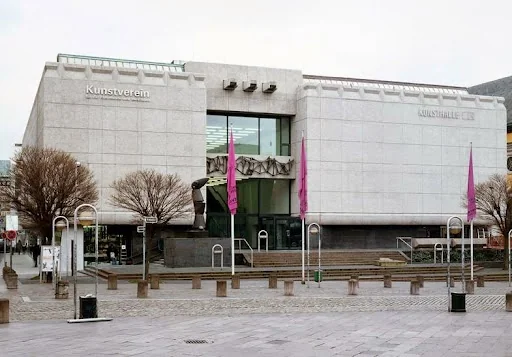
Architecturally, the Kunsthalle Düsseldorf is one of the most striking cultural buildings in the city. For the new building, architects Beckmann and Brockes used prefabricated concrete elements that still shape the characteristic facade today. As a result, the building is considered one of the early examples of Brutalism in Germany. This architectural language is not just a historical detail but shapes the visitor experience to this day. The Kunsthalle is not a neutral white cube but a structure with strong materiality, clear presence, and visible history. Inside, the house has three large exhibition spaces and two foyers, as well as a total of around 1,000 square meters of exhibition space. For a house of this kind, this is a considerable size that allows for both large installations and focused presentations. Especially in contemporary art, sound projects, and site-specific works, this spatial openness is a decisive advantage. ([kunsthalle-duesseldorf.de](https://www.kunsthalle-duesseldorf.de/informationen/ueber-uns/?utm_source=openai))
Part of the special identity of the Kunsthalle is also its neighborhood in the building. Next to the Kunstverein for the Rhineland and Westphalia, there are the Düsseldorf cabaret Kom(m)ödchen, the Walther König bookstore, and the artist club Salon des Amateurs. This makes the place not just a museum but a dense cultural ecosystem. Those coming here encounter art production, book culture, nightlife, and audience work in one house. The Salon des Amateurs is known for its highly curated music program and has shaped the Düsseldorf electronic scene for years. This very mix of exhibition, debate, club culture, and book trade makes the Kunsthalle so distinctive. It is a place where the boundaries between high culture, subculture, and everyday life are consciously kept open. The planned renovation should also be understood in this context: it aims to improve energy efficiency, increase accessibility, and make the spaces more flexible. The Kunsthalle thus remains a historically significant building but also develops a contemporary usage concept for the future. ([kunsthalle-duesseldorf.de](https://www.kunsthalle-duesseldorf.de/informationen/ueber-uns/?utm_source=openai))
Children, Families, Accessibility, and Inclusive Offers
The Kunsthalle Düsseldorf addresses families not only through special event days but also through its mediation understanding. The education page describes a wide range of offerings for children, teenagers, and families, including family tours, creative workshops, holiday programs, and digital content via KuKi. Particularly attractive is that Family Day on the second Sunday of the month makes admission and program free. This creates a format that makes art experienceable for different age groups together. The Kunsthalle does not only think of children in primary school age but of entire family constellations and low-threshold access. Special formats like the Children's Museum Night and public program points around current exhibitions also show that mediation is not seen as a marginal topic here but as a central part of the house. Therefore, anyone searching for kunsthalle düsseldorf children or Family Day will find not just a date but a regular educational concept. ([kunsthalle-duesseldorf.de](https://www.kunsthalle-duesseldorf.de/kunstvermittlung/?utm_source=openai))
Regarding accessibility, the picture is more nuanced. The Kunsthalle describes itself as a cultural institution for all but openly points out that the building is not fully accessible due to its structural conditions. At the same time, there are concrete aids: the ground floor is accessible via a ramp, further floors can be reached via a freight elevator, a disabled toilet is located on the second floor, and a wheelchair is available for loan. Parking spaces for people with disabilities are also available in the immediate vicinity. This open communication is important as it allows visitors to have realistic expectations. The announced renovation should significantly improve accessibility, but until then, the house works with pragmatic solutions and clear indications. This is particularly relevant for families with strollers, older visitors, or people with mobility restrictions. Those who inform themselves before the visit can plan their stay much more pleasantly. ([duesseldorf.de](https://www.duesseldorf.de/b-info/grabbeplatz-4?utm_source=openai))
Team, Jobs, and Contact
Organizationally, the Kunsthalle Düsseldorf is also transparently structured. The official team page mentions Alicia Holthausen as Interim Artistic Director, Ariane Berger as Managing Director, and Claudia Paulus as Head of Visitor Service, among others. Additional responsibilities include organization, curation, project management, as well as press and communication. This openness is important for a cultural institution as it signals approachability and clarity. For visitors, the visitor service is particularly relevant when it comes to practical questions about tickets, barrier-free access, or group inquiries. Additionally, the imprint provides the central phone number and the official email address of the Kunsthalle. Therefore, anyone with specific questions will find not only a building but also clearly named responsibilities and contact paths. ([kunsthalle-duesseldorf.de](https://www.kunsthalle-duesseldorf.de/en/information/team/?utm_source=openai))
For the search term jobs, a closer look at the job offerings page is worthwhile. There, internships for students related to art and culture are primarily offered. Currently, the internship positions are filled until mid-October 2026; applications for later periods are planned from February 2026. This shows that the Kunsthalle also functions as a training and learning place. For young people from the fields of art history, cultural management, mediation, or communication, this can be an interesting entry point. At the same time, the page makes it clear that the institution works in a structured manner and communicates application processes transparently. Therefore, anyone who wants not only to see art but also to work in an art house will find concrete information instead of vague phrases. Together with the team information, this creates a picture of a professionally managed house that takes visitor orientation and organizational clarity seriously. ([kunsthalle-duesseldorf.de](https://www.kunsthalle-duesseldorf.de/informationen/stellenangebote/?utm_source=openai))
Sources:
- Kunsthalle Düsseldorf - Information ([kunsthalle-duesseldorf.de](https://www.kunsthalle-duesseldorf.de/informationen/?utm_source=openai))
- Kunsthalle Düsseldorf - About Us ([kunsthalle-duesseldorf.de](https://www.kunsthalle-duesseldorf.de/informationen/ueber-uns/?utm_source=openai))
- Kunsthalle Düsseldorf - Team ([kunsthalle-duesseldorf.de](https://www.kunsthalle-duesseldorf.de/en/information/team/?utm_source=openai))
- Kunsthalle Düsseldorf - Job Offers ([kunsthalle-duesseldorf.de](https://www.kunsthalle-duesseldorf.de/informationen/stellenangebote/?utm_source=openai))
- Kunsthalle Düsseldorf - Accessibility and Grabbeplatz 4 ([duesseldorf.de](https://www.duesseldorf.de/b-info/grabbeplatz-4?utm_source=openai))
- Kunsthalle Düsseldorf - Renovation Postponed ([kunsthalle-duesseldorf.de](https://www.kunsthalle-duesseldorf.de/en/exhibitions/sanierung_verschoben/?utm_source=openai))
- Kunsthalle Düsseldorf - Education and Family Offers ([kunsthalle-duesseldorf.de](https://www.kunsthalle-duesseldorf.de/kunstvermittlung/?utm_source=openai))
- Kunsthalle Düsseldorf - Calendar and Current Programs ([kunsthalle-duesseldorf.de](https://www.kunsthalle-duesseldorf.de/kalender/?utm_source=openai))
Show moreShow less
Kunsthalle Düsseldorf | Exhibition & Opening Hours
The Kunsthalle Düsseldorf at Grabbeplatz is much more than a classic exhibition house. It is a prominent cultural venue in the city center of Düsseldorf, where contemporary art, mediation, discourse, and encounters are closely intertwined. Visitors to the Kunsthalle do not experience a static collection with a fixed route, but a house in constant change: changing exhibitions, discussions, tours, family offerings, and events shape its profile. The building itself is part of this experience. With its brutal, clearly readable architecture, large interior spaces, and presence in the urban fabric, the Kunsthalle acts like a structure that not only houses art but also stages it. At the same time, it is a place that many visitors associate with neighboring institutions such as the Kunstverein, the Salon des Amateurs, or the Walther König bookstore. This very mix makes the Kunsthalle Düsseldorf so exciting: it is an exhibition house, meeting point, urban location, and cultural address in one. Currently, the house is in a phase of transition because the originally planned renovation for 2026 has been postponed by three years to January 2029. As a result, the Kunsthalle remains visible and usable while its program is being restructured in the short term. ([kunsthalle-duesseldorf.de](https://www.kunsthalle-duesseldorf.de/informationen/?utm_source=openai))
Current Exhibitions, Program, and the Moment of Transition
Those looking for the current exhibition at the Kunsthalle Düsseldorf should primarily keep an eye on the official calendar and information page. The reason is simple: the house is in an unusual phase between ongoing programming and a postponed renovation process. The city of Düsseldorf initially planned the start of comprehensive renovations for summer 2026 but decided on January 28, 2026, to postpone the measure by three years. For the Kunsthalle, this did not mean stagnation but a necessary realignment of planning. The team announced that they would restructure the program in the short term and keep future work visible at various locations in Düsseldorf. For visitors, this means: there is no definitive, completed status, but a lively transitional situation in which current exhibitions, special formats, and mediation offerings continue to be developed. This openness fits the profile of the house, which has been working with artistic, musical, and discursive formats for years. ([kunsthalle-duesseldorf.de](https://www.kunsthalle-duesseldorf.de/en/exhibitions/sanierung_verschoben/?utm_source=openai))
A good example of this programmatic openness is the exhibition IM KINOSAAL, in which the Kunsthalle Düsseldorf focused on its audiovisual neighborhood history. The focus was on developments since 2000 as well as on the environment of the Düsseldorf Art Academy and the Salon des Amateurs, which opened in the building in 2004. Such projects show that the Kunsthalle not only occupies exhibition spaces but also continually reflects on its own history, its neighborhoods, and its cultural networks. This includes discussions, performances, concerts, and screenings, as well as classic exhibition openings. The Kunsthalle Düsseldorf is thus a place where contemporary art is not presented in isolation but merges with urban history, music, and institutional memory. Therefore, those searching under terms like current exhibition, program, queer modernity, or scents often end up here at a house that emphasizes thematic diversity, temporary settings, and unusual perspectives. Not every search query refers to a fixed permanent exhibition; more important is the current curatorial theme. That is why the program of the Kunsthalle is particularly exciting for visitors who want to understand contexts, not just see images. ([kunsthalle-duesseldorf.de](https://www.kunsthalle-duesseldorf.de/ausstellungen/im_kinosaal/?utm_source=openai))
Opening Hours, Admission, and Family Day
The opening hours of the Kunsthalle Düsseldorf are clearly and visitor-friendly regulated. According to the official information page, the house is open from Tuesday to Sunday and on public holidays from 11 AM to 6 PM. This is convenient for anyone wanting to combine their visit with a city tour, a museum visit, or a café stop in the old town. Particularly attractive are the regular Fridays for the wallet and for families: on the second Sunday of the month, the Kunsthalle invites, together with the Düsseldorf public utilities, to Family Day, where admission and program are free. Additionally, on the last Thursday of the month, there is Long Thursday, also with free admission from 6 PM to 9 PM. These formats make the visit particularly accessible and show that the Kunsthalle is open not only to die-hard art fans but also consciously to the curious, families, and spontaneous guests. The current information also indicates that online tickets are possible and that a reservation is usually not required. ([kunsthalle-duesseldorf.de](https://www.kunsthalle-duesseldorf.de/informationen/?utm_source=openai))
For children and teenagers, the Kunsthalle Düsseldorf is also well equipped. The education page explicitly describes a varied program for children, teenagers, and families. This includes family tours, creative parts in the studio, multi-day holiday workshops, and the Düsseldorf Children's Museum Night. Another digital offering is KuKi, a joint mediation project by KIT and Kunsthalle Düsseldorf, which digitally prepares art, craft ideas, and information for families. Particularly important for the search terms admission and children is also the pricing structure: children and teenagers up to 18 years have free admission, as do severely disabled people including companions. This makes the visit family-friendly and lowers the entry barrier for young target groups. Therefore, anyone searching for Kunsthalle Düsseldorf children, Family Day, or admission will find no complicated exceptions here but a relatively transparent and open visiting model. It is also practical that the Kunsthalle regularly communicates special program days, making a visit with a tour or family activity easy to plan. ([kunsthalle-duesseldorf.de](https://www.kunsthalle-duesseldorf.de/informationen/?utm_source=openai))
Directions, Parking, and Address at Grabbeplatz
The address of the Kunsthalle Düsseldorf is easy to remember: Grabbeplatz 4, 40213 Düsseldorf. For public transport, the Kunsthalle recommends the subway station Heinrich-Heine-Allee; among others, the lines U70, U71, U72, U73, U74, U75, U76, U77, U78, U79, and U83 stop there. From there, the house is easily reachable on foot, but the Kunsthalle points out that there is no guidance system in the old town area. Therefore, those coming for the first time should check the way in advance. For drivers, there is an underground garage under the Kunsthalle with an entrance via Neustraße or Mutter-Ey-Straße. Additionally, disabled parking spaces are designated nearby at Grabbeplatz or Ratinger Straße. This combination of central location, public transport connection, and parking garage makes the Kunsthalle particularly conveniently accessible for an urban audience. ([kunsthalle-duesseldorf.de](https://www.kunsthalle-duesseldorf.de/informationen/?utm_source=openai))
The location at Grabbeplatz also creates a certain complexity of orientation, as there are other well-known addresses in the immediate vicinity. This is relevant for the keyword search K20: the K20 of the North Rhine-Westphalia Art Collection is located at Grabbeplatz 5, directly next to the Kunsthalle Düsseldorf. Therefore, those searching for Kunsthalle Düsseldorf K20 often mean the immediate neighborhood, not the same institution. Although both houses are very close to each other, they are organizationally separate. For visitors, this is an advantage because Grabbeplatz thus becomes a real art cluster in the old town. One can easily switch between different cultural venues and connect several institutions in one day. This is particularly practical for day visitors or tourists: first the Kunsthalle, then K20, followed by a stroll through the old town or a detour to gastronomy and bookstores in the same area. This dense cultural neighborhood is one of the reasons why the location is in high demand. ([kunstsammlung.de](https://www.kunstsammlung.de/en/contact?utm_source=openai))
Architecture, Spaces, and Special Neighborhood
Architecturally, the Kunsthalle Düsseldorf is one of the most striking cultural buildings in the city. For the new building, architects Beckmann and Brockes used prefabricated concrete elements that still shape the characteristic facade today. As a result, the building is considered one of the early examples of Brutalism in Germany. This architectural language is not just a historical detail but shapes the visitor experience to this day. The Kunsthalle is not a neutral white cube but a structure with strong materiality, clear presence, and visible history. Inside, the house has three large exhibition spaces and two foyers, as well as a total of around 1,000 square meters of exhibition space. For a house of this kind, this is a considerable size that allows for both large installations and focused presentations. Especially in contemporary art, sound projects, and site-specific works, this spatial openness is a decisive advantage. ([kunsthalle-duesseldorf.de](https://www.kunsthalle-duesseldorf.de/informationen/ueber-uns/?utm_source=openai))
Part of the special identity of the Kunsthalle is also its neighborhood in the building. Next to the Kunstverein for the Rhineland and Westphalia, there are the Düsseldorf cabaret Kom(m)ödchen, the Walther König bookstore, and the artist club Salon des Amateurs. This makes the place not just a museum but a dense cultural ecosystem. Those coming here encounter art production, book culture, nightlife, and audience work in one house. The Salon des Amateurs is known for its highly curated music program and has shaped the Düsseldorf electronic scene for years. This very mix of exhibition, debate, club culture, and book trade makes the Kunsthalle so distinctive. It is a place where the boundaries between high culture, subculture, and everyday life are consciously kept open. The planned renovation should also be understood in this context: it aims to improve energy efficiency, increase accessibility, and make the spaces more flexible. The Kunsthalle thus remains a historically significant building but also develops a contemporary usage concept for the future. ([kunsthalle-duesseldorf.de](https://www.kunsthalle-duesseldorf.de/informationen/ueber-uns/?utm_source=openai))
Children, Families, Accessibility, and Inclusive Offers
The Kunsthalle Düsseldorf addresses families not only through special event days but also through its mediation understanding. The education page describes a wide range of offerings for children, teenagers, and families, including family tours, creative workshops, holiday programs, and digital content via KuKi. Particularly attractive is that Family Day on the second Sunday of the month makes admission and program free. This creates a format that makes art experienceable for different age groups together. The Kunsthalle does not only think of children in primary school age but of entire family constellations and low-threshold access. Special formats like the Children's Museum Night and public program points around current exhibitions also show that mediation is not seen as a marginal topic here but as a central part of the house. Therefore, anyone searching for kunsthalle düsseldorf children or Family Day will find not just a date but a regular educational concept. ([kunsthalle-duesseldorf.de](https://www.kunsthalle-duesseldorf.de/kunstvermittlung/?utm_source=openai))
Regarding accessibility, the picture is more nuanced. The Kunsthalle describes itself as a cultural institution for all but openly points out that the building is not fully accessible due to its structural conditions. At the same time, there are concrete aids: the ground floor is accessible via a ramp, further floors can be reached via a freight elevator, a disabled toilet is located on the second floor, and a wheelchair is available for loan. Parking spaces for people with disabilities are also available in the immediate vicinity. This open communication is important as it allows visitors to have realistic expectations. The announced renovation should significantly improve accessibility, but until then, the house works with pragmatic solutions and clear indications. This is particularly relevant for families with strollers, older visitors, or people with mobility restrictions. Those who inform themselves before the visit can plan their stay much more pleasantly. ([duesseldorf.de](https://www.duesseldorf.de/b-info/grabbeplatz-4?utm_source=openai))
Team, Jobs, and Contact
Organizationally, the Kunsthalle Düsseldorf is also transparently structured. The official team page mentions Alicia Holthausen as Interim Artistic Director, Ariane Berger as Managing Director, and Claudia Paulus as Head of Visitor Service, among others. Additional responsibilities include organization, curation, project management, as well as press and communication. This openness is important for a cultural institution as it signals approachability and clarity. For visitors, the visitor service is particularly relevant when it comes to practical questions about tickets, barrier-free access, or group inquiries. Additionally, the imprint provides the central phone number and the official email address of the Kunsthalle. Therefore, anyone with specific questions will find not only a building but also clearly named responsibilities and contact paths. ([kunsthalle-duesseldorf.de](https://www.kunsthalle-duesseldorf.de/en/information/team/?utm_source=openai))
For the search term jobs, a closer look at the job offerings page is worthwhile. There, internships for students related to art and culture are primarily offered. Currently, the internship positions are filled until mid-October 2026; applications for later periods are planned from February 2026. This shows that the Kunsthalle also functions as a training and learning place. For young people from the fields of art history, cultural management, mediation, or communication, this can be an interesting entry point. At the same time, the page makes it clear that the institution works in a structured manner and communicates application processes transparently. Therefore, anyone who wants not only to see art but also to work in an art house will find concrete information instead of vague phrases. Together with the team information, this creates a picture of a professionally managed house that takes visitor orientation and organizational clarity seriously. ([kunsthalle-duesseldorf.de](https://www.kunsthalle-duesseldorf.de/informationen/stellenangebote/?utm_source=openai))
Sources:
- Kunsthalle Düsseldorf - Information ([kunsthalle-duesseldorf.de](https://www.kunsthalle-duesseldorf.de/informationen/?utm_source=openai))
- Kunsthalle Düsseldorf - About Us ([kunsthalle-duesseldorf.de](https://www.kunsthalle-duesseldorf.de/informationen/ueber-uns/?utm_source=openai))
- Kunsthalle Düsseldorf - Team ([kunsthalle-duesseldorf.de](https://www.kunsthalle-duesseldorf.de/en/information/team/?utm_source=openai))
- Kunsthalle Düsseldorf - Job Offers ([kunsthalle-duesseldorf.de](https://www.kunsthalle-duesseldorf.de/informationen/stellenangebote/?utm_source=openai))
- Kunsthalle Düsseldorf - Accessibility and Grabbeplatz 4 ([duesseldorf.de](https://www.duesseldorf.de/b-info/grabbeplatz-4?utm_source=openai))
- Kunsthalle Düsseldorf - Renovation Postponed ([kunsthalle-duesseldorf.de](https://www.kunsthalle-duesseldorf.de/en/exhibitions/sanierung_verschoben/?utm_source=openai))
- Kunsthalle Düsseldorf - Education and Family Offers ([kunsthalle-duesseldorf.de](https://www.kunsthalle-duesseldorf.de/kunstvermittlung/?utm_source=openai))
- Kunsthalle Düsseldorf - Calendar and Current Programs ([kunsthalle-duesseldorf.de](https://www.kunsthalle-duesseldorf.de/kalender/?utm_source=openai))
Kunsthalle Düsseldorf | Exhibition & Opening Hours
The Kunsthalle Düsseldorf at Grabbeplatz is much more than a classic exhibition house. It is a prominent cultural venue in the city center of Düsseldorf, where contemporary art, mediation, discourse, and encounters are closely intertwined. Visitors to the Kunsthalle do not experience a static collection with a fixed route, but a house in constant change: changing exhibitions, discussions, tours, family offerings, and events shape its profile. The building itself is part of this experience. With its brutal, clearly readable architecture, large interior spaces, and presence in the urban fabric, the Kunsthalle acts like a structure that not only houses art but also stages it. At the same time, it is a place that many visitors associate with neighboring institutions such as the Kunstverein, the Salon des Amateurs, or the Walther König bookstore. This very mix makes the Kunsthalle Düsseldorf so exciting: it is an exhibition house, meeting point, urban location, and cultural address in one. Currently, the house is in a phase of transition because the originally planned renovation for 2026 has been postponed by three years to January 2029. As a result, the Kunsthalle remains visible and usable while its program is being restructured in the short term. ([kunsthalle-duesseldorf.de](https://www.kunsthalle-duesseldorf.de/informationen/?utm_source=openai))
Current Exhibitions, Program, and the Moment of Transition
Those looking for the current exhibition at the Kunsthalle Düsseldorf should primarily keep an eye on the official calendar and information page. The reason is simple: the house is in an unusual phase between ongoing programming and a postponed renovation process. The city of Düsseldorf initially planned the start of comprehensive renovations for summer 2026 but decided on January 28, 2026, to postpone the measure by three years. For the Kunsthalle, this did not mean stagnation but a necessary realignment of planning. The team announced that they would restructure the program in the short term and keep future work visible at various locations in Düsseldorf. For visitors, this means: there is no definitive, completed status, but a lively transitional situation in which current exhibitions, special formats, and mediation offerings continue to be developed. This openness fits the profile of the house, which has been working with artistic, musical, and discursive formats for years. ([kunsthalle-duesseldorf.de](https://www.kunsthalle-duesseldorf.de/en/exhibitions/sanierung_verschoben/?utm_source=openai))
A good example of this programmatic openness is the exhibition IM KINOSAAL, in which the Kunsthalle Düsseldorf focused on its audiovisual neighborhood history. The focus was on developments since 2000 as well as on the environment of the Düsseldorf Art Academy and the Salon des Amateurs, which opened in the building in 2004. Such projects show that the Kunsthalle not only occupies exhibition spaces but also continually reflects on its own history, its neighborhoods, and its cultural networks. This includes discussions, performances, concerts, and screenings, as well as classic exhibition openings. The Kunsthalle Düsseldorf is thus a place where contemporary art is not presented in isolation but merges with urban history, music, and institutional memory. Therefore, those searching under terms like current exhibition, program, queer modernity, or scents often end up here at a house that emphasizes thematic diversity, temporary settings, and unusual perspectives. Not every search query refers to a fixed permanent exhibition; more important is the current curatorial theme. That is why the program of the Kunsthalle is particularly exciting for visitors who want to understand contexts, not just see images. ([kunsthalle-duesseldorf.de](https://www.kunsthalle-duesseldorf.de/ausstellungen/im_kinosaal/?utm_source=openai))
Opening Hours, Admission, and Family Day
The opening hours of the Kunsthalle Düsseldorf are clearly and visitor-friendly regulated. According to the official information page, the house is open from Tuesday to Sunday and on public holidays from 11 AM to 6 PM. This is convenient for anyone wanting to combine their visit with a city tour, a museum visit, or a café stop in the old town. Particularly attractive are the regular Fridays for the wallet and for families: on the second Sunday of the month, the Kunsthalle invites, together with the Düsseldorf public utilities, to Family Day, where admission and program are free. Additionally, on the last Thursday of the month, there is Long Thursday, also with free admission from 6 PM to 9 PM. These formats make the visit particularly accessible and show that the Kunsthalle is open not only to die-hard art fans but also consciously to the curious, families, and spontaneous guests. The current information also indicates that online tickets are possible and that a reservation is usually not required. ([kunsthalle-duesseldorf.de](https://www.kunsthalle-duesseldorf.de/informationen/?utm_source=openai))
For children and teenagers, the Kunsthalle Düsseldorf is also well equipped. The education page explicitly describes a varied program for children, teenagers, and families. This includes family tours, creative parts in the studio, multi-day holiday workshops, and the Düsseldorf Children's Museum Night. Another digital offering is KuKi, a joint mediation project by KIT and Kunsthalle Düsseldorf, which digitally prepares art, craft ideas, and information for families. Particularly important for the search terms admission and children is also the pricing structure: children and teenagers up to 18 years have free admission, as do severely disabled people including companions. This makes the visit family-friendly and lowers the entry barrier for young target groups. Therefore, anyone searching for Kunsthalle Düsseldorf children, Family Day, or admission will find no complicated exceptions here but a relatively transparent and open visiting model. It is also practical that the Kunsthalle regularly communicates special program days, making a visit with a tour or family activity easy to plan. ([kunsthalle-duesseldorf.de](https://www.kunsthalle-duesseldorf.de/informationen/?utm_source=openai))
Directions, Parking, and Address at Grabbeplatz
The address of the Kunsthalle Düsseldorf is easy to remember: Grabbeplatz 4, 40213 Düsseldorf. For public transport, the Kunsthalle recommends the subway station Heinrich-Heine-Allee; among others, the lines U70, U71, U72, U73, U74, U75, U76, U77, U78, U79, and U83 stop there. From there, the house is easily reachable on foot, but the Kunsthalle points out that there is no guidance system in the old town area. Therefore, those coming for the first time should check the way in advance. For drivers, there is an underground garage under the Kunsthalle with an entrance via Neustraße or Mutter-Ey-Straße. Additionally, disabled parking spaces are designated nearby at Grabbeplatz or Ratinger Straße. This combination of central location, public transport connection, and parking garage makes the Kunsthalle particularly conveniently accessible for an urban audience. ([kunsthalle-duesseldorf.de](https://www.kunsthalle-duesseldorf.de/informationen/?utm_source=openai))
The location at Grabbeplatz also creates a certain complexity of orientation, as there are other well-known addresses in the immediate vicinity. This is relevant for the keyword search K20: the K20 of the North Rhine-Westphalia Art Collection is located at Grabbeplatz 5, directly next to the Kunsthalle Düsseldorf. Therefore, those searching for Kunsthalle Düsseldorf K20 often mean the immediate neighborhood, not the same institution. Although both houses are very close to each other, they are organizationally separate. For visitors, this is an advantage because Grabbeplatz thus becomes a real art cluster in the old town. One can easily switch between different cultural venues and connect several institutions in one day. This is particularly practical for day visitors or tourists: first the Kunsthalle, then K20, followed by a stroll through the old town or a detour to gastronomy and bookstores in the same area. This dense cultural neighborhood is one of the reasons why the location is in high demand. ([kunstsammlung.de](https://www.kunstsammlung.de/en/contact?utm_source=openai))
Architecture, Spaces, and Special Neighborhood
Architecturally, the Kunsthalle Düsseldorf is one of the most striking cultural buildings in the city. For the new building, architects Beckmann and Brockes used prefabricated concrete elements that still shape the characteristic facade today. As a result, the building is considered one of the early examples of Brutalism in Germany. This architectural language is not just a historical detail but shapes the visitor experience to this day. The Kunsthalle is not a neutral white cube but a structure with strong materiality, clear presence, and visible history. Inside, the house has three large exhibition spaces and two foyers, as well as a total of around 1,000 square meters of exhibition space. For a house of this kind, this is a considerable size that allows for both large installations and focused presentations. Especially in contemporary art, sound projects, and site-specific works, this spatial openness is a decisive advantage. ([kunsthalle-duesseldorf.de](https://www.kunsthalle-duesseldorf.de/informationen/ueber-uns/?utm_source=openai))
Part of the special identity of the Kunsthalle is also its neighborhood in the building. Next to the Kunstverein for the Rhineland and Westphalia, there are the Düsseldorf cabaret Kom(m)ödchen, the Walther König bookstore, and the artist club Salon des Amateurs. This makes the place not just a museum but a dense cultural ecosystem. Those coming here encounter art production, book culture, nightlife, and audience work in one house. The Salon des Amateurs is known for its highly curated music program and has shaped the Düsseldorf electronic scene for years. This very mix of exhibition, debate, club culture, and book trade makes the Kunsthalle so distinctive. It is a place where the boundaries between high culture, subculture, and everyday life are consciously kept open. The planned renovation should also be understood in this context: it aims to improve energy efficiency, increase accessibility, and make the spaces more flexible. The Kunsthalle thus remains a historically significant building but also develops a contemporary usage concept for the future. ([kunsthalle-duesseldorf.de](https://www.kunsthalle-duesseldorf.de/informationen/ueber-uns/?utm_source=openai))
Children, Families, Accessibility, and Inclusive Offers
The Kunsthalle Düsseldorf addresses families not only through special event days but also through its mediation understanding. The education page describes a wide range of offerings for children, teenagers, and families, including family tours, creative workshops, holiday programs, and digital content via KuKi. Particularly attractive is that Family Day on the second Sunday of the month makes admission and program free. This creates a format that makes art experienceable for different age groups together. The Kunsthalle does not only think of children in primary school age but of entire family constellations and low-threshold access. Special formats like the Children's Museum Night and public program points around current exhibitions also show that mediation is not seen as a marginal topic here but as a central part of the house. Therefore, anyone searching for kunsthalle düsseldorf children or Family Day will find not just a date but a regular educational concept. ([kunsthalle-duesseldorf.de](https://www.kunsthalle-duesseldorf.de/kunstvermittlung/?utm_source=openai))
Regarding accessibility, the picture is more nuanced. The Kunsthalle describes itself as a cultural institution for all but openly points out that the building is not fully accessible due to its structural conditions. At the same time, there are concrete aids: the ground floor is accessible via a ramp, further floors can be reached via a freight elevator, a disabled toilet is located on the second floor, and a wheelchair is available for loan. Parking spaces for people with disabilities are also available in the immediate vicinity. This open communication is important as it allows visitors to have realistic expectations. The announced renovation should significantly improve accessibility, but until then, the house works with pragmatic solutions and clear indications. This is particularly relevant for families with strollers, older visitors, or people with mobility restrictions. Those who inform themselves before the visit can plan their stay much more pleasantly. ([duesseldorf.de](https://www.duesseldorf.de/b-info/grabbeplatz-4?utm_source=openai))
Team, Jobs, and Contact
Organizationally, the Kunsthalle Düsseldorf is also transparently structured. The official team page mentions Alicia Holthausen as Interim Artistic Director, Ariane Berger as Managing Director, and Claudia Paulus as Head of Visitor Service, among others. Additional responsibilities include organization, curation, project management, as well as press and communication. This openness is important for a cultural institution as it signals approachability and clarity. For visitors, the visitor service is particularly relevant when it comes to practical questions about tickets, barrier-free access, or group inquiries. Additionally, the imprint provides the central phone number and the official email address of the Kunsthalle. Therefore, anyone with specific questions will find not only a building but also clearly named responsibilities and contact paths. ([kunsthalle-duesseldorf.de](https://www.kunsthalle-duesseldorf.de/en/information/team/?utm_source=openai))
For the search term jobs, a closer look at the job offerings page is worthwhile. There, internships for students related to art and culture are primarily offered. Currently, the internship positions are filled until mid-October 2026; applications for later periods are planned from February 2026. This shows that the Kunsthalle also functions as a training and learning place. For young people from the fields of art history, cultural management, mediation, or communication, this can be an interesting entry point. At the same time, the page makes it clear that the institution works in a structured manner and communicates application processes transparently. Therefore, anyone who wants not only to see art but also to work in an art house will find concrete information instead of vague phrases. Together with the team information, this creates a picture of a professionally managed house that takes visitor orientation and organizational clarity seriously. ([kunsthalle-duesseldorf.de](https://www.kunsthalle-duesseldorf.de/informationen/stellenangebote/?utm_source=openai))
Sources:
- Kunsthalle Düsseldorf - Information ([kunsthalle-duesseldorf.de](https://www.kunsthalle-duesseldorf.de/informationen/?utm_source=openai))
- Kunsthalle Düsseldorf - About Us ([kunsthalle-duesseldorf.de](https://www.kunsthalle-duesseldorf.de/informationen/ueber-uns/?utm_source=openai))
- Kunsthalle Düsseldorf - Team ([kunsthalle-duesseldorf.de](https://www.kunsthalle-duesseldorf.de/en/information/team/?utm_source=openai))
- Kunsthalle Düsseldorf - Job Offers ([kunsthalle-duesseldorf.de](https://www.kunsthalle-duesseldorf.de/informationen/stellenangebote/?utm_source=openai))
- Kunsthalle Düsseldorf - Accessibility and Grabbeplatz 4 ([duesseldorf.de](https://www.duesseldorf.de/b-info/grabbeplatz-4?utm_source=openai))
- Kunsthalle Düsseldorf - Renovation Postponed ([kunsthalle-duesseldorf.de](https://www.kunsthalle-duesseldorf.de/en/exhibitions/sanierung_verschoben/?utm_source=openai))
- Kunsthalle Düsseldorf - Education and Family Offers ([kunsthalle-duesseldorf.de](https://www.kunsthalle-duesseldorf.de/kunstvermittlung/?utm_source=openai))
- Kunsthalle Düsseldorf - Calendar and Current Programs ([kunsthalle-duesseldorf.de](https://www.kunsthalle-duesseldorf.de/kalender/?utm_source=openai))
Upcoming Events
No events found
Frequently Asked Questions
Reviews
Juan Zhao
12. December 2025
Nothing to see. Spent 10 min. If this is "how we envision our future of the city", then it’s a lack of imagination and creativity. My balcony looks much greener than this.
Elena Trajkovska
10. June 2025
Interesting place. It has its unique vibe. The best thing you can do there is create a collage.
Ірина Фесенко
31. July 2025
I really enjoyed my visit to Kunsthalle Düsseldorf. The exhibitions were thought-provoking and the space itself is very impressive. A great place for contemporary art lovers! ❤️❤️❤️❤️❤️❤️❤️
Yuan
29. December 2025
An outstanding museum. A thoughtfully curated collection spanning modern and contemporary art, presented in an inspiring space. One of Düsseldorf’s cultural highlights.
Seimen Burum
31. March 2023
The museum was built in 1967 in a sober brutalist architectural style using lots of prefab concrete. The building houses the Kunsthalle and the Kunstverein for NRW. The exhibitions are from contemporary artists with sometimes challenging art for the visitors. Some may like that, others not, but just immerse yourself in art.