
Düsseldorf
Königsallee, 40 Düsseldorf, Deutschland
Königsallee | Shopping & Parking in Düsseldorf
The Königsallee is one of the most famous addresses in Düsseldorf and is much more than just a shopping street. Those who visit the Kö experience a boulevard that uniquely combines luxury, city history, architecture, water, greenery, and urban life. This is precisely why so many people search for Königsallee Düsseldorf, for the route, for maps, for shops, and for parking. The charm of the Kö lies not only in the big names but also in its distinctive cityscape: the Kö-Graben, the elegant bridges, the historic facades, and the mix of strolling and shopping. The official city describes the Königsallee as one of the flagships of the city and a true tourist destination with special architectural features. At the same time, it is a boulevard where high-quality shops, restaurants, hotels, and cultural highlights seamlessly come together. Since 1994, the Königsallee has been listed as a historic monument, further emphasizing its special status. To understand the Kö, one should consider both its history and its current function as a shopping and experience mile. ([duesseldorf.de](https://www.duesseldorf.de/int/tourism/discover/koe))
This page organizes the Königsallee for visitors, shopping enthusiasts, and anyone looking for practical information. The focus is on the most important shops and shopping centers, access by train, bus, and car, the parking situation, historical development, as well as the notable buildings and landmarks along the boulevard. Especially for a street that consolidates so many addresses and search intentions, a clear classification helps: The Kö is a cohesive urban space with well-known anchors such as Kö-Bogen, Breuninger, Sevens, Kö-Galerie, and Kaufhof at the Kö. Those searching with a house number or a shop name will find the most important connections here. The result is a compact yet well-founded overview of one of the most defining streets in Germany. ([visitduesseldorf.de](https://www.visitduesseldorf.de/attraktionen/breuninger-5433b2e41d))
Shops on the Königsallee: Luxury, Passages, and Shopping Centers
The Königsallee is famous for its high density of brands, boutiques, and shopping addresses. The official tourism information describes the street as one of the major shopping addresses in Europe, where international luxury brands such as Prada, Gucci, Hermès, Chanel, Dior, and Louis Vuitton line up. This very mix makes the Kö so attractive for many visitors: It’s not just about shopping, but about a shopping experience with boulevard character. Between elegant flagship stores, jewelers, perfumeries, and street cafés, an environment is created that is suitable for both a quick window shopping stroll and a longer shopping day. Additionally, the Kö does not function like a single shopping center but like an urban ribbon of brand houses, passages, and larger complexes. This gives the street its special dynamism and explains why search queries for shops on the Königsallee are so often associated with specific house numbers, malls, or brand names. ([visitduesseldorf.de](https://www.visitduesseldorf.de/en/attractions/koenigsallee-7a3c732904))
Particularly important are the large shopping anchors directly on the Kö. Breuninger at Kö-Bogen is the Düsseldorf flagship of the company and spans five floors, with the shoe department in the basement being particularly spacious according to the official description. Sevens accommodates 35 exclusive stores, 11 restaurants, and 2 bars and considers itself a premium shopping center with a broad mix of fashion, beauty, lifestyle, art, and technology. The Kö-Galerie connects the Königsallee with Grünstraße and focuses on a multi-story passage with high-quality brands. Kaufhof at the Kö is one of the most traditional establishments on the boulevard; the Art Nouveau building has been used for retail since 1909. Additionally, the SETAREH Gallery at Königsallee 27 + 31 plays a role for art enthusiasts, as it specializes in contemporary art. This very range makes the Kö interesting: luxury, tradition, passage, gallery, and gastronomy come together in a compact space. ([visitduesseldorf.de](https://www.visitduesseldorf.de/attraktionen/breuninger-5433b2e41d))
Access, Route, and Maps to the Königsallee
Those searching for Königsallee Düsseldorf route or Königsallee Düsseldorf maps primarily need a good spatial orientation. The Königsallee stretches just over a kilometer from north to south, from Hofgarten to Friedrichstadt. This is important because the Kö is not a single square but a longer boulevard with different sections, crossings, and points of interest. To the north are the transition to Hofgarten and the area around Kö-Bogen, further south are passages, malls, hotels, and commercial buildings, until the street runs out towards Friedrichstadt. The official city information also refers to planning offers such as city maps, arrival, and city orientation. For visitors, this is helpful because the Königsallee is best understood as a cohesive axis that can be approached from several sides depending on the destination. Especially for navigation searches, it is worthwhile to read the Kö not just as a street name but as an orientation system with clear landmarks. ([duesseldorf.de](https://www.duesseldorf.de/int/tourism/discover/koe))
The Königsallee is very well accessible by public transport. A central point is the Steinstraße/Königsallee stop, which sevens explicitly names as a connection for subway, tram, and bus. Among others, the subway lines U70, U74, U75, U76, U77, U78, and U79 run there; additionally, tram lines 701, 705, and 706 as well as bus lines 780, 782, 785, 805, 817, and SB50 are listed. Also important is the Hop-On-Hop-Off stop Kö-Brücke Königsallee/Steinstraße, which is useful for the tourist entry into the boulevard. Those heading to the Kö-Bogen or Sevens side find a good mix of walking, public transport, and direct orientation. For visitors from the city center, the proximity to Heinrich-Heine-Allee and Corneliusplatz is also relevant, as access to the eastern side of the Königsallee is easily accessible from there. This makes the question of route and maps not just a pure navigation aid but a practical visiting strategy. ([sevens.de](https://sevens.de/parken))
Parking at the Königsallee: Parking Garages and Parking Guidance System
The parking situation at the Königsallee is a central topic for many visitors, and the city of Düsseldorf offers a comparatively good orientation network for this. Directly at the Kö, there are several large addresses with their own parking facilities. This is particularly clear at sevens: The parking garage is located directly at the center and offers a total of 294 parking spaces. Breuninger at Kö-Bogen also mentions parking options at the house. Those arriving by car also benefit from the Düsseldorf parking guidance system, which leads to free parking spaces with dynamic and static signs. According to the city, around 11,000 parking spaces in parking lots, garages, and underground garages are connected to the system. For a heavily frequented shopping street like the Königsallee, this is a decisive advantage because search traffic is reduced and arrival is clearly managed. The practical consequence: Those arriving purposefully can plan parking in the Kö area into their visit instead of searching for a long time. ([sevens.de](https://sevens.de/parken))
Additionally, the Kö is also interesting in the context of modern inner-city mobility. The city of Düsseldorf has established new parking zones for e-scooters and other small vehicles along the Königsallee; free parking is no longer allowed everywhere but is bound to six designated areas. This shows that the Königsallee is treated not only as a classic shopping mile but also as a sensitive public space with clearly regulated mobility. For visitors, this means practically: Those arriving by car should best use the large parking garages and the parking guidance system; those traveling with scooters or sharing options should observe the parking rules on-site. Overall, the Kö is very well accessible but also highly organized. Especially during peak times, the combination of public transport, parking garage, and walking is worthwhile. Those who want to arrive relaxed should plan their arrival in advance and orient themselves to the major anchor points such as Sevens, Breuninger, or Kö-Galerie. ([duesseldorf.de](https://www.duesseldorf.de/aktuelles/news/detailansicht/newsdetail/neue-regeln-schraenken-e-scooter-parken-auf-der-koe-ein-1?utm_source=openai))
History of the Königsallee: From City Moat to Boulevard of Splendor
The present-day Königsallee is the result of a long urban development change. After the demolition of the fortifications in 1801, Düsseldorf could develop anew. From 1802, architect Caspar Anton Huschberger and landscape gardener Maximilian Friedrich Weyhe transformed the former eastern defense zone into the area that would later become the Königsallee. This development is important because it does not make the Kö appear as a random shopping street but as a consciously designed urban space. Weyhe also worked on the Hofgarten, which connects as the green lung of the city with the boulevard. This alone created an ensemble of park, water, promenade, and urban representation that still shapes Düsseldorf today. The Kö was thus from the very beginning more than a traffic axis: it was part of a larger vision for the city. This historical depth distinguishes it from many purely shopping miles. ([duesseldorf.de](https://www.duesseldorf.de/int/duesseldorf-from-fishing-village-to-metropolis))
The further rise began around 1840 when wealthy citizens built their houses there, and the then-chestnut avenue increasingly became the center of urban life. The street received its current name in 1851 as a gesture towards the Prussian King Friedrich Wilhelm IV. The well-known tradition includes the story that he was allegedly pelted with horse manure on the then-chestnut avenue. Regardless of the anecdotal character of this tale, the naming remains an important part of the Kö's identity to this day. The historical layers are also reflected in the cityscape: restored houses, decorative details, and a layout that has been listed as a historic monument since 1994. Thus, the Königsallee connects the past and present in a particularly visible way. Today, those strolling along the boulevard are moving along a street that has been reinterpreted repeatedly for over two centuries without losing its character as an elegant city address. ([duesseldorf.de](https://www.duesseldorf.de/int/tourism/discover/koe))
Kö-Graben, Kö-Bogen, and Architecture on the Boulevard
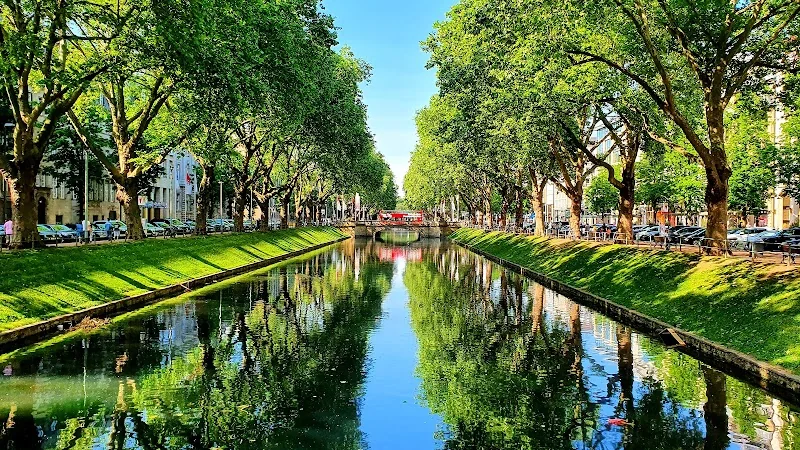
A significant part of the fascination of the Königsallee lies in its landscape and architectural concept. The official city describes the boulevard as an urban space just over a kilometer long with a 580-meter-long city moat, through which water from the Düssel flows. This Kö-Graben is not only decorative but shapes the entire atmosphere of the boulevard. Along the banks, there are about 120 chestnut trees, complemented by further plane trees and sycamores, which make the walk surprisingly calm even on busy days. Additionally, there are several bridges over which one can cross to the east and west sides of the Kö. The special furnishings are also noteworthy: lamps, bollards, clocks, phone booths, and kiosks were specially designed for the Kö. This creates an overall picture that consciously sets itself apart from a purely functional shopping street. The Kö is thus not only a place to buy but also a place to look, walk, and linger. ([duesseldorf.de](https://www.duesseldorf.de/int/tourism/discover/koe))
At the northern end, the Kö-Bogen complements the historic cityscape with a striking new building. New York architect Daniel Libeskind designed a building ensemble there with convex and concave curved facades. Glass and travertine characterize the exterior view, along with green, diagonally cut niches. The official description emphasizes that the Kö-Bogen has been an exclusive part of Düsseldorf's shopping scene since its opening in autumn 2013 and houses brands such as Breuninger, Tesla, and Apple. At the same time, it strengthens the connection to the Hofgarten and makes the northern tip of the Kö a particularly strong architectural point. Those who want to experience urban development while shopping on the Königsallee will find one of the most exciting spots on the entire boulevard here. The Kö thus has a dual effect: on one hand, historically and landscape-shaped, on the other hand, modern and architecturally self-confident. This tension is one of the reasons why the street is so often photographed, visited, and explained in city tours. ([visitduesseldorf.de](https://www.visitduesseldorf.de/attraktionen/koe-bogen-372efd7d65))
Important Addresses on the Königsallee: Orientation and House Numbers
Many search queries about the Königsallee are purely navigational searches for house numbers, and this is precisely why specific anchor points help with orientation. The most famous is Königsallee 2, where the Kö-Bogen and Breuninger are located. The Kö-Bogen is officially described as an architectural ensemble at the upper end of the Königsallee, while Breuninger sits there as an important Düsseldorf flagship of the fashion retailer. Further south is SETAREH GALLERY at Königsallee 27 + 31, a gallery for contemporary art with more than 25 supported artists. Also easily memorable is Königsallee 56, the address of sevens with 35 stores, 11 restaurants, and 2 bars. And at Königsallee 60E is the Kö-Galerie, a multi-story passage that connects the Königsallee with Grünstraße. These addresses are valuable for visitors because they divide the large street into clearly identifiable targets. Those searching for a specific shop or house number can quickly orient themselves at these points. ([visitduesseldorf.de](https://www.visitduesseldorf.de/attraktionen/koe-bogen-372efd7d65))
These house numbers are also important for the overall impression of the Königsallee because they make different uses visible. Königsallee 1-9 stands with Kaufhof at the Kö for a traditional department store that has been offering exclusive goods in the Art Nouveau building since 1909. The addresses around 2, 27 + 31, 56, and 60E, on the other hand, show the modern mix of luxury retail, art, gastronomy, and passage. Additionally, the street features some of the most exclusive hotels in the city on its so-called quiet side, including the Steigenberger Parkhotel, Breidenbacher Hof, and Kö59 Hotel. This makes the Kö relevant not only during the day but also in the evening and for overnight guests. So, those searching for Königsallee Düsseldorf 2, 27, 30, 14, 19, or 71 are moving within a street system that consists of well-known anchor points, hotel addresses, passages, and brand houses. This is exactly what makes the Königsallee so searchable: it is a single street and at the same time an entire district of orientation points, shopping experiences, and urban details. ([visitduesseldorf.de](https://www.visitduesseldorf.de/attraktionen/kaufhof-an-der-koe-a39693669c))
Sources:
- State Capital Düsseldorf – Königsallee ([duesseldorf.de](https://www.duesseldorf.de/int/tourism/discover/koe))
- Visit Düsseldorf – Königsallee ([visitduesseldorf.de](https://www.visitduesseldorf.de/en/attractions/koenigsallee-7a3c732904))
- State Capital Düsseldorf – Düsseldorf from fishing village to metropolis ([duesseldorf.de](https://www.duesseldorf.de/int/duesseldorf-from-fishing-village-to-metropolis))
- Visit Düsseldorf – Kö-Bogen ([visitduesseldorf.de](https://www.visitduesseldorf.de/attraktionen/koe-bogen-372efd7d65))
- Visit Düsseldorf – Breuninger ([visitduesseldorf.de](https://www.visitduesseldorf.de/attraktionen/breuninger-5433b2e41d))
- sevens Düsseldorf – Access & Parking ([sevens.de](https://sevens.de/parken))
- Visit Düsseldorf – Kö-Galerie ([visitduesseldorf.de](https://www.visitduesseldorf.de/en/attractions/koe-galerie-b7d5ecad9f))
- Visit Düsseldorf – Kaufhof at the Kö ([visitduesseldorf.de](https://www.visitduesseldorf.de/attraktionen/kaufhof-an-der-koe-a39693669c))
- Visit Düsseldorf – SETAREH ([visitduesseldorf.de](https://www.visitduesseldorf.de/attraktionen/setareh-e5e852460a))
Show moreShow less
Königsallee | Shopping & Parking in Düsseldorf
The Königsallee is one of the most famous addresses in Düsseldorf and is much more than just a shopping street. Those who visit the Kö experience a boulevard that uniquely combines luxury, city history, architecture, water, greenery, and urban life. This is precisely why so many people search for Königsallee Düsseldorf, for the route, for maps, for shops, and for parking. The charm of the Kö lies not only in the big names but also in its distinctive cityscape: the Kö-Graben, the elegant bridges, the historic facades, and the mix of strolling and shopping. The official city describes the Königsallee as one of the flagships of the city and a true tourist destination with special architectural features. At the same time, it is a boulevard where high-quality shops, restaurants, hotels, and cultural highlights seamlessly come together. Since 1994, the Königsallee has been listed as a historic monument, further emphasizing its special status. To understand the Kö, one should consider both its history and its current function as a shopping and experience mile. ([duesseldorf.de](https://www.duesseldorf.de/int/tourism/discover/koe))
This page organizes the Königsallee for visitors, shopping enthusiasts, and anyone looking for practical information. The focus is on the most important shops and shopping centers, access by train, bus, and car, the parking situation, historical development, as well as the notable buildings and landmarks along the boulevard. Especially for a street that consolidates so many addresses and search intentions, a clear classification helps: The Kö is a cohesive urban space with well-known anchors such as Kö-Bogen, Breuninger, Sevens, Kö-Galerie, and Kaufhof at the Kö. Those searching with a house number or a shop name will find the most important connections here. The result is a compact yet well-founded overview of one of the most defining streets in Germany. ([visitduesseldorf.de](https://www.visitduesseldorf.de/attraktionen/breuninger-5433b2e41d))
Shops on the Königsallee: Luxury, Passages, and Shopping Centers
The Königsallee is famous for its high density of brands, boutiques, and shopping addresses. The official tourism information describes the street as one of the major shopping addresses in Europe, where international luxury brands such as Prada, Gucci, Hermès, Chanel, Dior, and Louis Vuitton line up. This very mix makes the Kö so attractive for many visitors: It’s not just about shopping, but about a shopping experience with boulevard character. Between elegant flagship stores, jewelers, perfumeries, and street cafés, an environment is created that is suitable for both a quick window shopping stroll and a longer shopping day. Additionally, the Kö does not function like a single shopping center but like an urban ribbon of brand houses, passages, and larger complexes. This gives the street its special dynamism and explains why search queries for shops on the Königsallee are so often associated with specific house numbers, malls, or brand names. ([visitduesseldorf.de](https://www.visitduesseldorf.de/en/attractions/koenigsallee-7a3c732904))
Particularly important are the large shopping anchors directly on the Kö. Breuninger at Kö-Bogen is the Düsseldorf flagship of the company and spans five floors, with the shoe department in the basement being particularly spacious according to the official description. Sevens accommodates 35 exclusive stores, 11 restaurants, and 2 bars and considers itself a premium shopping center with a broad mix of fashion, beauty, lifestyle, art, and technology. The Kö-Galerie connects the Königsallee with Grünstraße and focuses on a multi-story passage with high-quality brands. Kaufhof at the Kö is one of the most traditional establishments on the boulevard; the Art Nouveau building has been used for retail since 1909. Additionally, the SETAREH Gallery at Königsallee 27 + 31 plays a role for art enthusiasts, as it specializes in contemporary art. This very range makes the Kö interesting: luxury, tradition, passage, gallery, and gastronomy come together in a compact space. ([visitduesseldorf.de](https://www.visitduesseldorf.de/attraktionen/breuninger-5433b2e41d))
Access, Route, and Maps to the Königsallee
Those searching for Königsallee Düsseldorf route or Königsallee Düsseldorf maps primarily need a good spatial orientation. The Königsallee stretches just over a kilometer from north to south, from Hofgarten to Friedrichstadt. This is important because the Kö is not a single square but a longer boulevard with different sections, crossings, and points of interest. To the north are the transition to Hofgarten and the area around Kö-Bogen, further south are passages, malls, hotels, and commercial buildings, until the street runs out towards Friedrichstadt. The official city information also refers to planning offers such as city maps, arrival, and city orientation. For visitors, this is helpful because the Königsallee is best understood as a cohesive axis that can be approached from several sides depending on the destination. Especially for navigation searches, it is worthwhile to read the Kö not just as a street name but as an orientation system with clear landmarks. ([duesseldorf.de](https://www.duesseldorf.de/int/tourism/discover/koe))
The Königsallee is very well accessible by public transport. A central point is the Steinstraße/Königsallee stop, which sevens explicitly names as a connection for subway, tram, and bus. Among others, the subway lines U70, U74, U75, U76, U77, U78, and U79 run there; additionally, tram lines 701, 705, and 706 as well as bus lines 780, 782, 785, 805, 817, and SB50 are listed. Also important is the Hop-On-Hop-Off stop Kö-Brücke Königsallee/Steinstraße, which is useful for the tourist entry into the boulevard. Those heading to the Kö-Bogen or Sevens side find a good mix of walking, public transport, and direct orientation. For visitors from the city center, the proximity to Heinrich-Heine-Allee and Corneliusplatz is also relevant, as access to the eastern side of the Königsallee is easily accessible from there. This makes the question of route and maps not just a pure navigation aid but a practical visiting strategy. ([sevens.de](https://sevens.de/parken))
Parking at the Königsallee: Parking Garages and Parking Guidance System
The parking situation at the Königsallee is a central topic for many visitors, and the city of Düsseldorf offers a comparatively good orientation network for this. Directly at the Kö, there are several large addresses with their own parking facilities. This is particularly clear at sevens: The parking garage is located directly at the center and offers a total of 294 parking spaces. Breuninger at Kö-Bogen also mentions parking options at the house. Those arriving by car also benefit from the Düsseldorf parking guidance system, which leads to free parking spaces with dynamic and static signs. According to the city, around 11,000 parking spaces in parking lots, garages, and underground garages are connected to the system. For a heavily frequented shopping street like the Königsallee, this is a decisive advantage because search traffic is reduced and arrival is clearly managed. The practical consequence: Those arriving purposefully can plan parking in the Kö area into their visit instead of searching for a long time. ([sevens.de](https://sevens.de/parken))
Additionally, the Kö is also interesting in the context of modern inner-city mobility. The city of Düsseldorf has established new parking zones for e-scooters and other small vehicles along the Königsallee; free parking is no longer allowed everywhere but is bound to six designated areas. This shows that the Königsallee is treated not only as a classic shopping mile but also as a sensitive public space with clearly regulated mobility. For visitors, this means practically: Those arriving by car should best use the large parking garages and the parking guidance system; those traveling with scooters or sharing options should observe the parking rules on-site. Overall, the Kö is very well accessible but also highly organized. Especially during peak times, the combination of public transport, parking garage, and walking is worthwhile. Those who want to arrive relaxed should plan their arrival in advance and orient themselves to the major anchor points such as Sevens, Breuninger, or Kö-Galerie. ([duesseldorf.de](https://www.duesseldorf.de/aktuelles/news/detailansicht/newsdetail/neue-regeln-schraenken-e-scooter-parken-auf-der-koe-ein-1?utm_source=openai))
History of the Königsallee: From City Moat to Boulevard of Splendor
The present-day Königsallee is the result of a long urban development change. After the demolition of the fortifications in 1801, Düsseldorf could develop anew. From 1802, architect Caspar Anton Huschberger and landscape gardener Maximilian Friedrich Weyhe transformed the former eastern defense zone into the area that would later become the Königsallee. This development is important because it does not make the Kö appear as a random shopping street but as a consciously designed urban space. Weyhe also worked on the Hofgarten, which connects as the green lung of the city with the boulevard. This alone created an ensemble of park, water, promenade, and urban representation that still shapes Düsseldorf today. The Kö was thus from the very beginning more than a traffic axis: it was part of a larger vision for the city. This historical depth distinguishes it from many purely shopping miles. ([duesseldorf.de](https://www.duesseldorf.de/int/duesseldorf-from-fishing-village-to-metropolis))
The further rise began around 1840 when wealthy citizens built their houses there, and the then-chestnut avenue increasingly became the center of urban life. The street received its current name in 1851 as a gesture towards the Prussian King Friedrich Wilhelm IV. The well-known tradition includes the story that he was allegedly pelted with horse manure on the then-chestnut avenue. Regardless of the anecdotal character of this tale, the naming remains an important part of the Kö's identity to this day. The historical layers are also reflected in the cityscape: restored houses, decorative details, and a layout that has been listed as a historic monument since 1994. Thus, the Königsallee connects the past and present in a particularly visible way. Today, those strolling along the boulevard are moving along a street that has been reinterpreted repeatedly for over two centuries without losing its character as an elegant city address. ([duesseldorf.de](https://www.duesseldorf.de/int/tourism/discover/koe))
Kö-Graben, Kö-Bogen, and Architecture on the Boulevard
A significant part of the fascination of the Königsallee lies in its landscape and architectural concept. The official city describes the boulevard as an urban space just over a kilometer long with a 580-meter-long city moat, through which water from the Düssel flows. This Kö-Graben is not only decorative but shapes the entire atmosphere of the boulevard. Along the banks, there are about 120 chestnut trees, complemented by further plane trees and sycamores, which make the walk surprisingly calm even on busy days. Additionally, there are several bridges over which one can cross to the east and west sides of the Kö. The special furnishings are also noteworthy: lamps, bollards, clocks, phone booths, and kiosks were specially designed for the Kö. This creates an overall picture that consciously sets itself apart from a purely functional shopping street. The Kö is thus not only a place to buy but also a place to look, walk, and linger. ([duesseldorf.de](https://www.duesseldorf.de/int/tourism/discover/koe))
At the northern end, the Kö-Bogen complements the historic cityscape with a striking new building. New York architect Daniel Libeskind designed a building ensemble there with convex and concave curved facades. Glass and travertine characterize the exterior view, along with green, diagonally cut niches. The official description emphasizes that the Kö-Bogen has been an exclusive part of Düsseldorf's shopping scene since its opening in autumn 2013 and houses brands such as Breuninger, Tesla, and Apple. At the same time, it strengthens the connection to the Hofgarten and makes the northern tip of the Kö a particularly strong architectural point. Those who want to experience urban development while shopping on the Königsallee will find one of the most exciting spots on the entire boulevard here. The Kö thus has a dual effect: on one hand, historically and landscape-shaped, on the other hand, modern and architecturally self-confident. This tension is one of the reasons why the street is so often photographed, visited, and explained in city tours. ([visitduesseldorf.de](https://www.visitduesseldorf.de/attraktionen/koe-bogen-372efd7d65))
Important Addresses on the Königsallee: Orientation and House Numbers
Many search queries about the Königsallee are purely navigational searches for house numbers, and this is precisely why specific anchor points help with orientation. The most famous is Königsallee 2, where the Kö-Bogen and Breuninger are located. The Kö-Bogen is officially described as an architectural ensemble at the upper end of the Königsallee, while Breuninger sits there as an important Düsseldorf flagship of the fashion retailer. Further south is SETAREH GALLERY at Königsallee 27 + 31, a gallery for contemporary art with more than 25 supported artists. Also easily memorable is Königsallee 56, the address of sevens with 35 stores, 11 restaurants, and 2 bars. And at Königsallee 60E is the Kö-Galerie, a multi-story passage that connects the Königsallee with Grünstraße. These addresses are valuable for visitors because they divide the large street into clearly identifiable targets. Those searching for a specific shop or house number can quickly orient themselves at these points. ([visitduesseldorf.de](https://www.visitduesseldorf.de/attraktionen/koe-bogen-372efd7d65))
These house numbers are also important for the overall impression of the Königsallee because they make different uses visible. Königsallee 1-9 stands with Kaufhof at the Kö for a traditional department store that has been offering exclusive goods in the Art Nouveau building since 1909. The addresses around 2, 27 + 31, 56, and 60E, on the other hand, show the modern mix of luxury retail, art, gastronomy, and passage. Additionally, the street features some of the most exclusive hotels in the city on its so-called quiet side, including the Steigenberger Parkhotel, Breidenbacher Hof, and Kö59 Hotel. This makes the Kö relevant not only during the day but also in the evening and for overnight guests. So, those searching for Königsallee Düsseldorf 2, 27, 30, 14, 19, or 71 are moving within a street system that consists of well-known anchor points, hotel addresses, passages, and brand houses. This is exactly what makes the Königsallee so searchable: it is a single street and at the same time an entire district of orientation points, shopping experiences, and urban details. ([visitduesseldorf.de](https://www.visitduesseldorf.de/attraktionen/kaufhof-an-der-koe-a39693669c))
Sources:
- State Capital Düsseldorf – Königsallee ([duesseldorf.de](https://www.duesseldorf.de/int/tourism/discover/koe))
- Visit Düsseldorf – Königsallee ([visitduesseldorf.de](https://www.visitduesseldorf.de/en/attractions/koenigsallee-7a3c732904))
- State Capital Düsseldorf – Düsseldorf from fishing village to metropolis ([duesseldorf.de](https://www.duesseldorf.de/int/duesseldorf-from-fishing-village-to-metropolis))
- Visit Düsseldorf – Kö-Bogen ([visitduesseldorf.de](https://www.visitduesseldorf.de/attraktionen/koe-bogen-372efd7d65))
- Visit Düsseldorf – Breuninger ([visitduesseldorf.de](https://www.visitduesseldorf.de/attraktionen/breuninger-5433b2e41d))
- sevens Düsseldorf – Access & Parking ([sevens.de](https://sevens.de/parken))
- Visit Düsseldorf – Kö-Galerie ([visitduesseldorf.de](https://www.visitduesseldorf.de/en/attractions/koe-galerie-b7d5ecad9f))
- Visit Düsseldorf – Kaufhof at the Kö ([visitduesseldorf.de](https://www.visitduesseldorf.de/attraktionen/kaufhof-an-der-koe-a39693669c))
- Visit Düsseldorf – SETAREH ([visitduesseldorf.de](https://www.visitduesseldorf.de/attraktionen/setareh-e5e852460a))
Königsallee | Shopping & Parking in Düsseldorf
The Königsallee is one of the most famous addresses in Düsseldorf and is much more than just a shopping street. Those who visit the Kö experience a boulevard that uniquely combines luxury, city history, architecture, water, greenery, and urban life. This is precisely why so many people search for Königsallee Düsseldorf, for the route, for maps, for shops, and for parking. The charm of the Kö lies not only in the big names but also in its distinctive cityscape: the Kö-Graben, the elegant bridges, the historic facades, and the mix of strolling and shopping. The official city describes the Königsallee as one of the flagships of the city and a true tourist destination with special architectural features. At the same time, it is a boulevard where high-quality shops, restaurants, hotels, and cultural highlights seamlessly come together. Since 1994, the Königsallee has been listed as a historic monument, further emphasizing its special status. To understand the Kö, one should consider both its history and its current function as a shopping and experience mile. ([duesseldorf.de](https://www.duesseldorf.de/int/tourism/discover/koe))
This page organizes the Königsallee for visitors, shopping enthusiasts, and anyone looking for practical information. The focus is on the most important shops and shopping centers, access by train, bus, and car, the parking situation, historical development, as well as the notable buildings and landmarks along the boulevard. Especially for a street that consolidates so many addresses and search intentions, a clear classification helps: The Kö is a cohesive urban space with well-known anchors such as Kö-Bogen, Breuninger, Sevens, Kö-Galerie, and Kaufhof at the Kö. Those searching with a house number or a shop name will find the most important connections here. The result is a compact yet well-founded overview of one of the most defining streets in Germany. ([visitduesseldorf.de](https://www.visitduesseldorf.de/attraktionen/breuninger-5433b2e41d))
Shops on the Königsallee: Luxury, Passages, and Shopping Centers
The Königsallee is famous for its high density of brands, boutiques, and shopping addresses. The official tourism information describes the street as one of the major shopping addresses in Europe, where international luxury brands such as Prada, Gucci, Hermès, Chanel, Dior, and Louis Vuitton line up. This very mix makes the Kö so attractive for many visitors: It’s not just about shopping, but about a shopping experience with boulevard character. Between elegant flagship stores, jewelers, perfumeries, and street cafés, an environment is created that is suitable for both a quick window shopping stroll and a longer shopping day. Additionally, the Kö does not function like a single shopping center but like an urban ribbon of brand houses, passages, and larger complexes. This gives the street its special dynamism and explains why search queries for shops on the Königsallee are so often associated with specific house numbers, malls, or brand names. ([visitduesseldorf.de](https://www.visitduesseldorf.de/en/attractions/koenigsallee-7a3c732904))
Particularly important are the large shopping anchors directly on the Kö. Breuninger at Kö-Bogen is the Düsseldorf flagship of the company and spans five floors, with the shoe department in the basement being particularly spacious according to the official description. Sevens accommodates 35 exclusive stores, 11 restaurants, and 2 bars and considers itself a premium shopping center with a broad mix of fashion, beauty, lifestyle, art, and technology. The Kö-Galerie connects the Königsallee with Grünstraße and focuses on a multi-story passage with high-quality brands. Kaufhof at the Kö is one of the most traditional establishments on the boulevard; the Art Nouveau building has been used for retail since 1909. Additionally, the SETAREH Gallery at Königsallee 27 + 31 plays a role for art enthusiasts, as it specializes in contemporary art. This very range makes the Kö interesting: luxury, tradition, passage, gallery, and gastronomy come together in a compact space. ([visitduesseldorf.de](https://www.visitduesseldorf.de/attraktionen/breuninger-5433b2e41d))
Access, Route, and Maps to the Königsallee
Those searching for Königsallee Düsseldorf route or Königsallee Düsseldorf maps primarily need a good spatial orientation. The Königsallee stretches just over a kilometer from north to south, from Hofgarten to Friedrichstadt. This is important because the Kö is not a single square but a longer boulevard with different sections, crossings, and points of interest. To the north are the transition to Hofgarten and the area around Kö-Bogen, further south are passages, malls, hotels, and commercial buildings, until the street runs out towards Friedrichstadt. The official city information also refers to planning offers such as city maps, arrival, and city orientation. For visitors, this is helpful because the Königsallee is best understood as a cohesive axis that can be approached from several sides depending on the destination. Especially for navigation searches, it is worthwhile to read the Kö not just as a street name but as an orientation system with clear landmarks. ([duesseldorf.de](https://www.duesseldorf.de/int/tourism/discover/koe))
The Königsallee is very well accessible by public transport. A central point is the Steinstraße/Königsallee stop, which sevens explicitly names as a connection for subway, tram, and bus. Among others, the subway lines U70, U74, U75, U76, U77, U78, and U79 run there; additionally, tram lines 701, 705, and 706 as well as bus lines 780, 782, 785, 805, 817, and SB50 are listed. Also important is the Hop-On-Hop-Off stop Kö-Brücke Königsallee/Steinstraße, which is useful for the tourist entry into the boulevard. Those heading to the Kö-Bogen or Sevens side find a good mix of walking, public transport, and direct orientation. For visitors from the city center, the proximity to Heinrich-Heine-Allee and Corneliusplatz is also relevant, as access to the eastern side of the Königsallee is easily accessible from there. This makes the question of route and maps not just a pure navigation aid but a practical visiting strategy. ([sevens.de](https://sevens.de/parken))
Parking at the Königsallee: Parking Garages and Parking Guidance System
The parking situation at the Königsallee is a central topic for many visitors, and the city of Düsseldorf offers a comparatively good orientation network for this. Directly at the Kö, there are several large addresses with their own parking facilities. This is particularly clear at sevens: The parking garage is located directly at the center and offers a total of 294 parking spaces. Breuninger at Kö-Bogen also mentions parking options at the house. Those arriving by car also benefit from the Düsseldorf parking guidance system, which leads to free parking spaces with dynamic and static signs. According to the city, around 11,000 parking spaces in parking lots, garages, and underground garages are connected to the system. For a heavily frequented shopping street like the Königsallee, this is a decisive advantage because search traffic is reduced and arrival is clearly managed. The practical consequence: Those arriving purposefully can plan parking in the Kö area into their visit instead of searching for a long time. ([sevens.de](https://sevens.de/parken))
Additionally, the Kö is also interesting in the context of modern inner-city mobility. The city of Düsseldorf has established new parking zones for e-scooters and other small vehicles along the Königsallee; free parking is no longer allowed everywhere but is bound to six designated areas. This shows that the Königsallee is treated not only as a classic shopping mile but also as a sensitive public space with clearly regulated mobility. For visitors, this means practically: Those arriving by car should best use the large parking garages and the parking guidance system; those traveling with scooters or sharing options should observe the parking rules on-site. Overall, the Kö is very well accessible but also highly organized. Especially during peak times, the combination of public transport, parking garage, and walking is worthwhile. Those who want to arrive relaxed should plan their arrival in advance and orient themselves to the major anchor points such as Sevens, Breuninger, or Kö-Galerie. ([duesseldorf.de](https://www.duesseldorf.de/aktuelles/news/detailansicht/newsdetail/neue-regeln-schraenken-e-scooter-parken-auf-der-koe-ein-1?utm_source=openai))
History of the Königsallee: From City Moat to Boulevard of Splendor
The present-day Königsallee is the result of a long urban development change. After the demolition of the fortifications in 1801, Düsseldorf could develop anew. From 1802, architect Caspar Anton Huschberger and landscape gardener Maximilian Friedrich Weyhe transformed the former eastern defense zone into the area that would later become the Königsallee. This development is important because it does not make the Kö appear as a random shopping street but as a consciously designed urban space. Weyhe also worked on the Hofgarten, which connects as the green lung of the city with the boulevard. This alone created an ensemble of park, water, promenade, and urban representation that still shapes Düsseldorf today. The Kö was thus from the very beginning more than a traffic axis: it was part of a larger vision for the city. This historical depth distinguishes it from many purely shopping miles. ([duesseldorf.de](https://www.duesseldorf.de/int/duesseldorf-from-fishing-village-to-metropolis))
The further rise began around 1840 when wealthy citizens built their houses there, and the then-chestnut avenue increasingly became the center of urban life. The street received its current name in 1851 as a gesture towards the Prussian King Friedrich Wilhelm IV. The well-known tradition includes the story that he was allegedly pelted with horse manure on the then-chestnut avenue. Regardless of the anecdotal character of this tale, the naming remains an important part of the Kö's identity to this day. The historical layers are also reflected in the cityscape: restored houses, decorative details, and a layout that has been listed as a historic monument since 1994. Thus, the Königsallee connects the past and present in a particularly visible way. Today, those strolling along the boulevard are moving along a street that has been reinterpreted repeatedly for over two centuries without losing its character as an elegant city address. ([duesseldorf.de](https://www.duesseldorf.de/int/tourism/discover/koe))
Kö-Graben, Kö-Bogen, and Architecture on the Boulevard
A significant part of the fascination of the Königsallee lies in its landscape and architectural concept. The official city describes the boulevard as an urban space just over a kilometer long with a 580-meter-long city moat, through which water from the Düssel flows. This Kö-Graben is not only decorative but shapes the entire atmosphere of the boulevard. Along the banks, there are about 120 chestnut trees, complemented by further plane trees and sycamores, which make the walk surprisingly calm even on busy days. Additionally, there are several bridges over which one can cross to the east and west sides of the Kö. The special furnishings are also noteworthy: lamps, bollards, clocks, phone booths, and kiosks were specially designed for the Kö. This creates an overall picture that consciously sets itself apart from a purely functional shopping street. The Kö is thus not only a place to buy but also a place to look, walk, and linger. ([duesseldorf.de](https://www.duesseldorf.de/int/tourism/discover/koe))
At the northern end, the Kö-Bogen complements the historic cityscape with a striking new building. New York architect Daniel Libeskind designed a building ensemble there with convex and concave curved facades. Glass and travertine characterize the exterior view, along with green, diagonally cut niches. The official description emphasizes that the Kö-Bogen has been an exclusive part of Düsseldorf's shopping scene since its opening in autumn 2013 and houses brands such as Breuninger, Tesla, and Apple. At the same time, it strengthens the connection to the Hofgarten and makes the northern tip of the Kö a particularly strong architectural point. Those who want to experience urban development while shopping on the Königsallee will find one of the most exciting spots on the entire boulevard here. The Kö thus has a dual effect: on one hand, historically and landscape-shaped, on the other hand, modern and architecturally self-confident. This tension is one of the reasons why the street is so often photographed, visited, and explained in city tours. ([visitduesseldorf.de](https://www.visitduesseldorf.de/attraktionen/koe-bogen-372efd7d65))
Important Addresses on the Königsallee: Orientation and House Numbers
Many search queries about the Königsallee are purely navigational searches for house numbers, and this is precisely why specific anchor points help with orientation. The most famous is Königsallee 2, where the Kö-Bogen and Breuninger are located. The Kö-Bogen is officially described as an architectural ensemble at the upper end of the Königsallee, while Breuninger sits there as an important Düsseldorf flagship of the fashion retailer. Further south is SETAREH GALLERY at Königsallee 27 + 31, a gallery for contemporary art with more than 25 supported artists. Also easily memorable is Königsallee 56, the address of sevens with 35 stores, 11 restaurants, and 2 bars. And at Königsallee 60E is the Kö-Galerie, a multi-story passage that connects the Königsallee with Grünstraße. These addresses are valuable for visitors because they divide the large street into clearly identifiable targets. Those searching for a specific shop or house number can quickly orient themselves at these points. ([visitduesseldorf.de](https://www.visitduesseldorf.de/attraktionen/koe-bogen-372efd7d65))
These house numbers are also important for the overall impression of the Königsallee because they make different uses visible. Königsallee 1-9 stands with Kaufhof at the Kö for a traditional department store that has been offering exclusive goods in the Art Nouveau building since 1909. The addresses around 2, 27 + 31, 56, and 60E, on the other hand, show the modern mix of luxury retail, art, gastronomy, and passage. Additionally, the street features some of the most exclusive hotels in the city on its so-called quiet side, including the Steigenberger Parkhotel, Breidenbacher Hof, and Kö59 Hotel. This makes the Kö relevant not only during the day but also in the evening and for overnight guests. So, those searching for Königsallee Düsseldorf 2, 27, 30, 14, 19, or 71 are moving within a street system that consists of well-known anchor points, hotel addresses, passages, and brand houses. This is exactly what makes the Königsallee so searchable: it is a single street and at the same time an entire district of orientation points, shopping experiences, and urban details. ([visitduesseldorf.de](https://www.visitduesseldorf.de/attraktionen/kaufhof-an-der-koe-a39693669c))
Sources:
- State Capital Düsseldorf – Königsallee ([duesseldorf.de](https://www.duesseldorf.de/int/tourism/discover/koe))
- Visit Düsseldorf – Königsallee ([visitduesseldorf.de](https://www.visitduesseldorf.de/en/attractions/koenigsallee-7a3c732904))
- State Capital Düsseldorf – Düsseldorf from fishing village to metropolis ([duesseldorf.de](https://www.duesseldorf.de/int/duesseldorf-from-fishing-village-to-metropolis))
- Visit Düsseldorf – Kö-Bogen ([visitduesseldorf.de](https://www.visitduesseldorf.de/attraktionen/koe-bogen-372efd7d65))
- Visit Düsseldorf – Breuninger ([visitduesseldorf.de](https://www.visitduesseldorf.de/attraktionen/breuninger-5433b2e41d))
- sevens Düsseldorf – Access & Parking ([sevens.de](https://sevens.de/parken))
- Visit Düsseldorf – Kö-Galerie ([visitduesseldorf.de](https://www.visitduesseldorf.de/en/attractions/koe-galerie-b7d5ecad9f))
- Visit Düsseldorf – Kaufhof at the Kö ([visitduesseldorf.de](https://www.visitduesseldorf.de/attraktionen/kaufhof-an-der-koe-a39693669c))
- Visit Düsseldorf – SETAREH ([visitduesseldorf.de](https://www.visitduesseldorf.de/attraktionen/setareh-e5e852460a))
Frequently Asked Questions
Reviews
No reviews found