
Düsseldorf
Johannes-Rau-Platz, 40213 Düsseldorf, Germany
Johannes-Rau-Platz | Directions, Parking & Events
The Johannes-Rau-Platz in Düsseldorf is not a classic place with fixed opening hours like a museum or a hall, but a public square by the Rhine, notable for its location, political and urban surroundings, as well as its use during major city and cultural events. Those searching for this square often mean the area at the Düsseldorf Rhine waterfront in 40213 Düsseldorf, near the Rhine promenade, the old town, and the government district. The square is located in the vicinity of Villa Horion or the House of Parliamentary History and forms a visible transition between water, city, and political center. This very mix makes the place so interesting: it serves as a stage, promenade, meeting point, and orientation point at the same time. For visitors, it is therefore not just a point on the map, but a place with atmosphere, history, and recognizability. ([visitduesseldorf.de](https://www.visitduesseldorf.de/en/sights/rhine-embankment-promenade/))
Location, Maps, and Route to Johannes-Rau-Platz
The Johannes-Rau-Platz is part of the distinctive section of the Rhine between the old town and the river and is part of the popular Rhine promenade, which, according to the official Visit Düsseldorf information, was designed between 1990 and 1997 based on plans by architect Niklaus Fritschi. This promenade connects city life and Rhine views in a special way and, with its length of about 1.5 kilometers, is one of the most defining open spaces in the city center. Therefore, for orientation, not only the name of the square is important, but also the surroundings: Rhine promenade, Untere Rheinwerft, Horionplatz, House of Parliamentary History, and the government district help with map searches. Those looking for maps or routes should always understand the square in connection with this waterfront area, as it is spatially embedded in a dense network of footpaths, event points, and urban connections. ([visitduesseldorf.de](https://www.visitduesseldorf.de/en/sights/rhine-embankment-promenade/))
The official tourism site of Visit Düsseldorf refers to general routes to the city center via city maps, park-and-ride, and the well-connected city. For the Johannes-Rau-Platz itself, there is no isolated island location, but a connection to the urban fabric around the old town and the Rhine. This is precisely why search terms like route, maps, or directions work so well: many visitors are not only looking for the square but also for the best way to reach it in the context of an event or a walk. Practically, this means that the square is best planned as a destination within the Rhine waterfront system and not as a secluded single address. This is especially important on event days when the paths along the river are heavily frequented and the square transforms into a larger event area. ([visitduesseldorf.de](https://www.visitduesseldorf.de/en/getting-here/by-car/))
Events at Johannes-Rau-Platz: Japan Day, Stage, and City Events
When the Johannes-Rau-Platz appears in search queries, it is often in connection with Japan Day Düsseldorf/NRW. The official Visit Düsseldorf page describes the square as an event location and names it as the site of the pop culture stage during Japan Day. There, visitors can find Japanese cuisine such as ramen and karaage bowls, as well as stalls with cosplay items and official Japan Day merchandise. A program featuring anime, games, music, cosplay contests, karaoke competitions, and live performances has been announced for 2025 on the pop culture stage. This clearly shows: the square is not a quiet background but an active part of one of Düsseldorf's largest public events, attracting people from the entire region. ([visitduesseldorf.de](https://www.visitduesseldorf.de/en/attractions/johannes-rau-platz-japan-tag-4648744ece))
Even beyond Japan Day, the place plays an important role in the public life of the city. The Blue Light Mile of the Bundeswehr took place at the Rhine waterfront at Johannes-Rau-Platz in 2024 and 2025, bringing together the regulatory office, fire department, Bundeswehr, police, and other organizations. Emergency vehicles, technology, information offerings, and a children's program were the focus there. The official review by the regulatory office shows that the square is well-suited for such formats because it offers sufficient visibility, waterfront location, and space for a larger public. Additionally, an inclusive torch relay for the Special Olympics NRW has been announced at Johannes-Rau-Platz. This makes it clear that the square is used not only for festivals but also for symbolic, urban, and community events. Those searching for events at Johannes-Rau-Platz are often looking for a very real mix of culture, public relations, and urban life. ([duesseldorf.de](https://www.duesseldorf.de/ordnungsamt/osd/aktuell-vor-ort))
Moreover, the Johannes-Rau-Platz repeatedly appears as part of larger Rhine and city center areas, for example, in security and event planning around the old town, the Rhine waterfront, and the state parliament. The official Japan Day plan shows the square as a Japanese pop culture zone, stall and stage area, consciously placing it within a network of Burgplatz, Rhine promenade, state parliament, and other festival points. This embedding explains why search queries like events, program, stage, or Japan Day fit so well with the square: Johannes-Rau-Platz is a hub within a much larger event landscape along the Rhine. ([visitduesseldorf.de](https://www.visitduesseldorf.de/files/epaper/japan-tag/?utm_source=openai))
Parking, Public Transport, and Practical Tips for Visiting
Those arriving by car should not expect a dedicated visitor parking area at Johannes-Rau-Platz but should use the downtown solutions of Düsseldorf. Visit Düsseldorf generally refers to park-and-ride options and numerous parking garages in the city center. As concrete examples, the official Christmas market page mentions the underground garage at the Rhine waterfront, the parking garage on Schadowstraße, and Carlsplatz. For heavily frequented days, the city also recommends checking occupancy in advance and, if necessary, opting for P+R. This is particularly sensible for Johannes-Rau-Platz, as events along the Rhine and in the old town can quickly congest traffic. Therefore, those who want to arrive relaxed should plan better with a central parking garage or P+R instead of searching for a free parking space directly at the square. ([visitduesseldorf.de](https://www.visitduesseldorf.de/erleben/veranstaltungen/weihnachten-in-duesseldorf/weihnachten-test))
Public transport is particularly convenient for this location, as Johannes-Rau-Platz is part of a very well-connected urban area. The official tourism pages recommend arriving by bus and train for city center visits and checking the city map. For large Rhine events, the Japan Day plan also names stops such as Landtag/Kniebrücke and points out transfer and walking routes within the event area. Additionally, the city of Düsseldorf explicitly lists Johannes-Rau-Platz in its e-scooter maps, showing its good integration into the mobile city infrastructure. For many visitors, this is crucial: one can visit the square very well as part of a larger tour instead of just targeting it as a single address. ([visitduesseldorf.de](https://www.visitduesseldorf.de/en/getting-here/by-car/))
Johannes Rau, Villa Horion, and the History of the Square
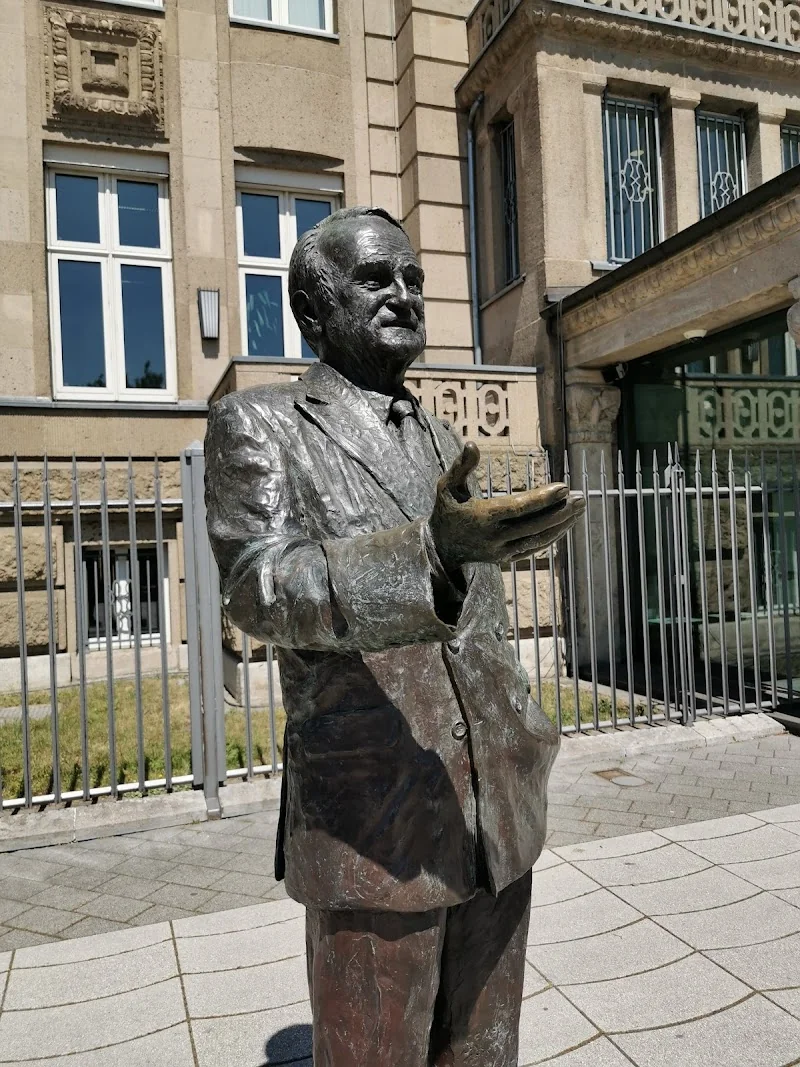
The name Johannes-Rau-Platz is closely linked to the political history of North Rhine-Westphalia. The Düsseldorf city chronicle documents that on May 10, 2007, the square in front of Villa Horion was named Johannes-Rau-Platz, and a statue of Johannes Rau was unveiled there. Johannes Rau was a former Federal President and previously the Minister-President of North Rhine-Westphalia. The official art database of the city of Düsseldorf adds that the bronze sculpture of Johannes Rau is located in front of the former State Chancellery, Villa Horion. This explains why the square is not only a geographical but also a cultural memory place. It refers to a significant political figure and to Düsseldorf's role as the state capital. ([duesseldorf.de](https://www.duesseldorf.de/stadtarchiv/stadtgeschichte/chronik/2007))
The immediate surroundings reinforce this character. The urban planning describes the area south of Haroldstraße as part of the North Rhine-Westphalian government district and classifies Johannes-Rau-Platz as a boundary of the eastern area. At the same time, the integration into the Green Ring around the old town and Carlstadt is emphasized, and to the west, Johannes-Rau-Platz connects to the Rhine promenade. Thus, the square stands at an intersection of politics, green space, and urban space. This location explains why the place has such a pronounced effect: here, administration, promenade, waterfront, and city center meet. For visitors, this is an advantage, as one does not have to experience the square in isolation but as part of a coherent urban landscape with a clear historical and spatial identity. ([duesseldorf.de](https://www.duesseldorf.de/stadtplanungsamt/projektuebersicht/qualitaetssichernde-verfahren/wettbewerb-suedlich-haroldstrasse))
Rhine Promenade, Waterfront Atmosphere, and the Role of the Square Today
The Rhine promenade itself is one of the most important arguments for a visit to Johannes-Rau-Platz. Visit Düsseldorf describes it as a particularly popular promenade between the old town and the Rhine, which was created after the redesign, also thanks to the Rhine waterfront tunnel. The site emphasizes the spaciousness, the evening atmosphere, the restaurants at the casemates, and the high-quality strolling experience along the water. For Johannes-Rau-Platz, this means: it is not just a square, but part of an urban walking path where Rhine views, urban life, and event usage overlap. Those arriving there experience Düsseldorf not as a backdrop but as a vibrant, open urban space with a lot of people and a strong connection to the river. ([visitduesseldorf.de](https://www.visitduesseldorf.de/en/sights/rhine-embankment-promenade/))
The square also plays a very practical and functional role in today's urban life. The city of Düsseldorf mentions a skate park at Johannes-Rau-Platz, and the review by the regulatory office shows that the Rhine waterfront here is regularly used for events, safety information, and public presentations. This is a good example of how flexible this place is: a space for walking and staying during the day, a stage, information area, or meeting point during major events. This versatility makes it so relevant in local searches. When asking about opening hours, people are often actually looking for access, usability, and the right time for a visit. For Johannes-Rau-Platz, the answer is therefore simple: it is a public square that is freely accessible in normal city life and is organized or used differently during events. ([duesseldorf.de](https://www.duesseldorf.de/medienportal/pressedienst-einzelansicht/pld/freiluft-sportanlagen-wieder-geoeffnet))
Orientation on Site, Surroundings, and What Makes Johannes-Rau-Platz Special
For orientation on site, looking at the prominent neighbors helps. The House of Parliamentary History in Villa Horion is located directly at Johannes-Rau-Platz and offers historical reference points for all those interested in the political development of North Rhine-Westphalia. At the same time, the square is embedded in the vicinity of Burgplatz, the state parliament, and Untere Rheinwerft, in a part of Düsseldorf shaped by the river and large public events. Finding the square is relatively easy if one knows the topography of the city center: it is best to move along the Rhine waterfront and always think of the square together with the promenade, the government district, and the event areas. ([visitduesseldorf.de](https://www.visitduesseldorf.de/attraktionen/haus-der-parlamentsgeschichte-702125c811?utm_source=openai))
This is also where the SEO core for this location lies: most search queries do not revolve around a single building but around practical questions like route, maps, parking, and events. Johannes-Rau-Platz is an ideal search term for this because it has real usage occasions: Japan Day, Blue Light Mile, torch relay, public actions along the Rhine, and the walking path along the promenade. At the same time, the place remains one with political and historical depth due to its naming after Johannes Rau and its proximity to Villa Horion. Therefore, those visiting it receive more than just an address. They get a place where Düsseldorf shows its representative, cultural, and open side. This is why Johannes-Rau-Platz is equally interesting for visitors, city planners, and event fans. ([duesseldorf.de](https://www.duesseldorf.de/stadtarchiv/stadtgeschichte/chronik/2007))
Sources:
- Visit Düsseldorf - Johannes-Rau-Platz - Japan Day
- Visit Düsseldorf - Japan Day 2025 - Pop Culture Stage
- State Capital Düsseldorf - City Chronicle 2007
- Visit Düsseldorf - Rhine Embankment Promenade
- State Capital Düsseldorf - South of Haroldstraße
- State Capital Düsseldorf - OSD Current on Site
- Visit Düsseldorf - Getting to Düsseldorf
- Visit Düsseldorf - House of Parliamentary History
Show moreShow less
Johannes-Rau-Platz | Directions, Parking & Events
The Johannes-Rau-Platz in Düsseldorf is not a classic place with fixed opening hours like a museum or a hall, but a public square by the Rhine, notable for its location, political and urban surroundings, as well as its use during major city and cultural events. Those searching for this square often mean the area at the Düsseldorf Rhine waterfront in 40213 Düsseldorf, near the Rhine promenade, the old town, and the government district. The square is located in the vicinity of Villa Horion or the House of Parliamentary History and forms a visible transition between water, city, and political center. This very mix makes the place so interesting: it serves as a stage, promenade, meeting point, and orientation point at the same time. For visitors, it is therefore not just a point on the map, but a place with atmosphere, history, and recognizability. ([visitduesseldorf.de](https://www.visitduesseldorf.de/en/sights/rhine-embankment-promenade/))
Location, Maps, and Route to Johannes-Rau-Platz
The Johannes-Rau-Platz is part of the distinctive section of the Rhine between the old town and the river and is part of the popular Rhine promenade, which, according to the official Visit Düsseldorf information, was designed between 1990 and 1997 based on plans by architect Niklaus Fritschi. This promenade connects city life and Rhine views in a special way and, with its length of about 1.5 kilometers, is one of the most defining open spaces in the city center. Therefore, for orientation, not only the name of the square is important, but also the surroundings: Rhine promenade, Untere Rheinwerft, Horionplatz, House of Parliamentary History, and the government district help with map searches. Those looking for maps or routes should always understand the square in connection with this waterfront area, as it is spatially embedded in a dense network of footpaths, event points, and urban connections. ([visitduesseldorf.de](https://www.visitduesseldorf.de/en/sights/rhine-embankment-promenade/))
The official tourism site of Visit Düsseldorf refers to general routes to the city center via city maps, park-and-ride, and the well-connected city. For the Johannes-Rau-Platz itself, there is no isolated island location, but a connection to the urban fabric around the old town and the Rhine. This is precisely why search terms like route, maps, or directions work so well: many visitors are not only looking for the square but also for the best way to reach it in the context of an event or a walk. Practically, this means that the square is best planned as a destination within the Rhine waterfront system and not as a secluded single address. This is especially important on event days when the paths along the river are heavily frequented and the square transforms into a larger event area. ([visitduesseldorf.de](https://www.visitduesseldorf.de/en/getting-here/by-car/))
Events at Johannes-Rau-Platz: Japan Day, Stage, and City Events
When the Johannes-Rau-Platz appears in search queries, it is often in connection with Japan Day Düsseldorf/NRW. The official Visit Düsseldorf page describes the square as an event location and names it as the site of the pop culture stage during Japan Day. There, visitors can find Japanese cuisine such as ramen and karaage bowls, as well as stalls with cosplay items and official Japan Day merchandise. A program featuring anime, games, music, cosplay contests, karaoke competitions, and live performances has been announced for 2025 on the pop culture stage. This clearly shows: the square is not a quiet background but an active part of one of Düsseldorf's largest public events, attracting people from the entire region. ([visitduesseldorf.de](https://www.visitduesseldorf.de/en/attractions/johannes-rau-platz-japan-tag-4648744ece))
Even beyond Japan Day, the place plays an important role in the public life of the city. The Blue Light Mile of the Bundeswehr took place at the Rhine waterfront at Johannes-Rau-Platz in 2024 and 2025, bringing together the regulatory office, fire department, Bundeswehr, police, and other organizations. Emergency vehicles, technology, information offerings, and a children's program were the focus there. The official review by the regulatory office shows that the square is well-suited for such formats because it offers sufficient visibility, waterfront location, and space for a larger public. Additionally, an inclusive torch relay for the Special Olympics NRW has been announced at Johannes-Rau-Platz. This makes it clear that the square is used not only for festivals but also for symbolic, urban, and community events. Those searching for events at Johannes-Rau-Platz are often looking for a very real mix of culture, public relations, and urban life. ([duesseldorf.de](https://www.duesseldorf.de/ordnungsamt/osd/aktuell-vor-ort))
Moreover, the Johannes-Rau-Platz repeatedly appears as part of larger Rhine and city center areas, for example, in security and event planning around the old town, the Rhine waterfront, and the state parliament. The official Japan Day plan shows the square as a Japanese pop culture zone, stall and stage area, consciously placing it within a network of Burgplatz, Rhine promenade, state parliament, and other festival points. This embedding explains why search queries like events, program, stage, or Japan Day fit so well with the square: Johannes-Rau-Platz is a hub within a much larger event landscape along the Rhine. ([visitduesseldorf.de](https://www.visitduesseldorf.de/files/epaper/japan-tag/?utm_source=openai))
Parking, Public Transport, and Practical Tips for Visiting
Those arriving by car should not expect a dedicated visitor parking area at Johannes-Rau-Platz but should use the downtown solutions of Düsseldorf. Visit Düsseldorf generally refers to park-and-ride options and numerous parking garages in the city center. As concrete examples, the official Christmas market page mentions the underground garage at the Rhine waterfront, the parking garage on Schadowstraße, and Carlsplatz. For heavily frequented days, the city also recommends checking occupancy in advance and, if necessary, opting for P+R. This is particularly sensible for Johannes-Rau-Platz, as events along the Rhine and in the old town can quickly congest traffic. Therefore, those who want to arrive relaxed should plan better with a central parking garage or P+R instead of searching for a free parking space directly at the square. ([visitduesseldorf.de](https://www.visitduesseldorf.de/erleben/veranstaltungen/weihnachten-in-duesseldorf/weihnachten-test))
Public transport is particularly convenient for this location, as Johannes-Rau-Platz is part of a very well-connected urban area. The official tourism pages recommend arriving by bus and train for city center visits and checking the city map. For large Rhine events, the Japan Day plan also names stops such as Landtag/Kniebrücke and points out transfer and walking routes within the event area. Additionally, the city of Düsseldorf explicitly lists Johannes-Rau-Platz in its e-scooter maps, showing its good integration into the mobile city infrastructure. For many visitors, this is crucial: one can visit the square very well as part of a larger tour instead of just targeting it as a single address. ([visitduesseldorf.de](https://www.visitduesseldorf.de/en/getting-here/by-car/))
Johannes Rau, Villa Horion, and the History of the Square
The name Johannes-Rau-Platz is closely linked to the political history of North Rhine-Westphalia. The Düsseldorf city chronicle documents that on May 10, 2007, the square in front of Villa Horion was named Johannes-Rau-Platz, and a statue of Johannes Rau was unveiled there. Johannes Rau was a former Federal President and previously the Minister-President of North Rhine-Westphalia. The official art database of the city of Düsseldorf adds that the bronze sculpture of Johannes Rau is located in front of the former State Chancellery, Villa Horion. This explains why the square is not only a geographical but also a cultural memory place. It refers to a significant political figure and to Düsseldorf's role as the state capital. ([duesseldorf.de](https://www.duesseldorf.de/stadtarchiv/stadtgeschichte/chronik/2007))
The immediate surroundings reinforce this character. The urban planning describes the area south of Haroldstraße as part of the North Rhine-Westphalian government district and classifies Johannes-Rau-Platz as a boundary of the eastern area. At the same time, the integration into the Green Ring around the old town and Carlstadt is emphasized, and to the west, Johannes-Rau-Platz connects to the Rhine promenade. Thus, the square stands at an intersection of politics, green space, and urban space. This location explains why the place has such a pronounced effect: here, administration, promenade, waterfront, and city center meet. For visitors, this is an advantage, as one does not have to experience the square in isolation but as part of a coherent urban landscape with a clear historical and spatial identity. ([duesseldorf.de](https://www.duesseldorf.de/stadtplanungsamt/projektuebersicht/qualitaetssichernde-verfahren/wettbewerb-suedlich-haroldstrasse))
Rhine Promenade, Waterfront Atmosphere, and the Role of the Square Today
The Rhine promenade itself is one of the most important arguments for a visit to Johannes-Rau-Platz. Visit Düsseldorf describes it as a particularly popular promenade between the old town and the Rhine, which was created after the redesign, also thanks to the Rhine waterfront tunnel. The site emphasizes the spaciousness, the evening atmosphere, the restaurants at the casemates, and the high-quality strolling experience along the water. For Johannes-Rau-Platz, this means: it is not just a square, but part of an urban walking path where Rhine views, urban life, and event usage overlap. Those arriving there experience Düsseldorf not as a backdrop but as a vibrant, open urban space with a lot of people and a strong connection to the river. ([visitduesseldorf.de](https://www.visitduesseldorf.de/en/sights/rhine-embankment-promenade/))
The square also plays a very practical and functional role in today's urban life. The city of Düsseldorf mentions a skate park at Johannes-Rau-Platz, and the review by the regulatory office shows that the Rhine waterfront here is regularly used for events, safety information, and public presentations. This is a good example of how flexible this place is: a space for walking and staying during the day, a stage, information area, or meeting point during major events. This versatility makes it so relevant in local searches. When asking about opening hours, people are often actually looking for access, usability, and the right time for a visit. For Johannes-Rau-Platz, the answer is therefore simple: it is a public square that is freely accessible in normal city life and is organized or used differently during events. ([duesseldorf.de](https://www.duesseldorf.de/medienportal/pressedienst-einzelansicht/pld/freiluft-sportanlagen-wieder-geoeffnet))
Orientation on Site, Surroundings, and What Makes Johannes-Rau-Platz Special
For orientation on site, looking at the prominent neighbors helps. The House of Parliamentary History in Villa Horion is located directly at Johannes-Rau-Platz and offers historical reference points for all those interested in the political development of North Rhine-Westphalia. At the same time, the square is embedded in the vicinity of Burgplatz, the state parliament, and Untere Rheinwerft, in a part of Düsseldorf shaped by the river and large public events. Finding the square is relatively easy if one knows the topography of the city center: it is best to move along the Rhine waterfront and always think of the square together with the promenade, the government district, and the event areas. ([visitduesseldorf.de](https://www.visitduesseldorf.de/attraktionen/haus-der-parlamentsgeschichte-702125c811?utm_source=openai))
This is also where the SEO core for this location lies: most search queries do not revolve around a single building but around practical questions like route, maps, parking, and events. Johannes-Rau-Platz is an ideal search term for this because it has real usage occasions: Japan Day, Blue Light Mile, torch relay, public actions along the Rhine, and the walking path along the promenade. At the same time, the place remains one with political and historical depth due to its naming after Johannes Rau and its proximity to Villa Horion. Therefore, those visiting it receive more than just an address. They get a place where Düsseldorf shows its representative, cultural, and open side. This is why Johannes-Rau-Platz is equally interesting for visitors, city planners, and event fans. ([duesseldorf.de](https://www.duesseldorf.de/stadtarchiv/stadtgeschichte/chronik/2007))
Sources:
- Visit Düsseldorf - Johannes-Rau-Platz - Japan Day
- Visit Düsseldorf - Japan Day 2025 - Pop Culture Stage
- State Capital Düsseldorf - City Chronicle 2007
- Visit Düsseldorf - Rhine Embankment Promenade
- State Capital Düsseldorf - South of Haroldstraße
- State Capital Düsseldorf - OSD Current on Site
- Visit Düsseldorf - Getting to Düsseldorf
- Visit Düsseldorf - House of Parliamentary History
Johannes-Rau-Platz | Directions, Parking & Events
The Johannes-Rau-Platz in Düsseldorf is not a classic place with fixed opening hours like a museum or a hall, but a public square by the Rhine, notable for its location, political and urban surroundings, as well as its use during major city and cultural events. Those searching for this square often mean the area at the Düsseldorf Rhine waterfront in 40213 Düsseldorf, near the Rhine promenade, the old town, and the government district. The square is located in the vicinity of Villa Horion or the House of Parliamentary History and forms a visible transition between water, city, and political center. This very mix makes the place so interesting: it serves as a stage, promenade, meeting point, and orientation point at the same time. For visitors, it is therefore not just a point on the map, but a place with atmosphere, history, and recognizability. ([visitduesseldorf.de](https://www.visitduesseldorf.de/en/sights/rhine-embankment-promenade/))
Location, Maps, and Route to Johannes-Rau-Platz
The Johannes-Rau-Platz is part of the distinctive section of the Rhine between the old town and the river and is part of the popular Rhine promenade, which, according to the official Visit Düsseldorf information, was designed between 1990 and 1997 based on plans by architect Niklaus Fritschi. This promenade connects city life and Rhine views in a special way and, with its length of about 1.5 kilometers, is one of the most defining open spaces in the city center. Therefore, for orientation, not only the name of the square is important, but also the surroundings: Rhine promenade, Untere Rheinwerft, Horionplatz, House of Parliamentary History, and the government district help with map searches. Those looking for maps or routes should always understand the square in connection with this waterfront area, as it is spatially embedded in a dense network of footpaths, event points, and urban connections. ([visitduesseldorf.de](https://www.visitduesseldorf.de/en/sights/rhine-embankment-promenade/))
The official tourism site of Visit Düsseldorf refers to general routes to the city center via city maps, park-and-ride, and the well-connected city. For the Johannes-Rau-Platz itself, there is no isolated island location, but a connection to the urban fabric around the old town and the Rhine. This is precisely why search terms like route, maps, or directions work so well: many visitors are not only looking for the square but also for the best way to reach it in the context of an event or a walk. Practically, this means that the square is best planned as a destination within the Rhine waterfront system and not as a secluded single address. This is especially important on event days when the paths along the river are heavily frequented and the square transforms into a larger event area. ([visitduesseldorf.de](https://www.visitduesseldorf.de/en/getting-here/by-car/))
Events at Johannes-Rau-Platz: Japan Day, Stage, and City Events
When the Johannes-Rau-Platz appears in search queries, it is often in connection with Japan Day Düsseldorf/NRW. The official Visit Düsseldorf page describes the square as an event location and names it as the site of the pop culture stage during Japan Day. There, visitors can find Japanese cuisine such as ramen and karaage bowls, as well as stalls with cosplay items and official Japan Day merchandise. A program featuring anime, games, music, cosplay contests, karaoke competitions, and live performances has been announced for 2025 on the pop culture stage. This clearly shows: the square is not a quiet background but an active part of one of Düsseldorf's largest public events, attracting people from the entire region. ([visitduesseldorf.de](https://www.visitduesseldorf.de/en/attractions/johannes-rau-platz-japan-tag-4648744ece))
Even beyond Japan Day, the place plays an important role in the public life of the city. The Blue Light Mile of the Bundeswehr took place at the Rhine waterfront at Johannes-Rau-Platz in 2024 and 2025, bringing together the regulatory office, fire department, Bundeswehr, police, and other organizations. Emergency vehicles, technology, information offerings, and a children's program were the focus there. The official review by the regulatory office shows that the square is well-suited for such formats because it offers sufficient visibility, waterfront location, and space for a larger public. Additionally, an inclusive torch relay for the Special Olympics NRW has been announced at Johannes-Rau-Platz. This makes it clear that the square is used not only for festivals but also for symbolic, urban, and community events. Those searching for events at Johannes-Rau-Platz are often looking for a very real mix of culture, public relations, and urban life. ([duesseldorf.de](https://www.duesseldorf.de/ordnungsamt/osd/aktuell-vor-ort))
Moreover, the Johannes-Rau-Platz repeatedly appears as part of larger Rhine and city center areas, for example, in security and event planning around the old town, the Rhine waterfront, and the state parliament. The official Japan Day plan shows the square as a Japanese pop culture zone, stall and stage area, consciously placing it within a network of Burgplatz, Rhine promenade, state parliament, and other festival points. This embedding explains why search queries like events, program, stage, or Japan Day fit so well with the square: Johannes-Rau-Platz is a hub within a much larger event landscape along the Rhine. ([visitduesseldorf.de](https://www.visitduesseldorf.de/files/epaper/japan-tag/?utm_source=openai))
Parking, Public Transport, and Practical Tips for Visiting
Those arriving by car should not expect a dedicated visitor parking area at Johannes-Rau-Platz but should use the downtown solutions of Düsseldorf. Visit Düsseldorf generally refers to park-and-ride options and numerous parking garages in the city center. As concrete examples, the official Christmas market page mentions the underground garage at the Rhine waterfront, the parking garage on Schadowstraße, and Carlsplatz. For heavily frequented days, the city also recommends checking occupancy in advance and, if necessary, opting for P+R. This is particularly sensible for Johannes-Rau-Platz, as events along the Rhine and in the old town can quickly congest traffic. Therefore, those who want to arrive relaxed should plan better with a central parking garage or P+R instead of searching for a free parking space directly at the square. ([visitduesseldorf.de](https://www.visitduesseldorf.de/erleben/veranstaltungen/weihnachten-in-duesseldorf/weihnachten-test))
Public transport is particularly convenient for this location, as Johannes-Rau-Platz is part of a very well-connected urban area. The official tourism pages recommend arriving by bus and train for city center visits and checking the city map. For large Rhine events, the Japan Day plan also names stops such as Landtag/Kniebrücke and points out transfer and walking routes within the event area. Additionally, the city of Düsseldorf explicitly lists Johannes-Rau-Platz in its e-scooter maps, showing its good integration into the mobile city infrastructure. For many visitors, this is crucial: one can visit the square very well as part of a larger tour instead of just targeting it as a single address. ([visitduesseldorf.de](https://www.visitduesseldorf.de/en/getting-here/by-car/))
Johannes Rau, Villa Horion, and the History of the Square
The name Johannes-Rau-Platz is closely linked to the political history of North Rhine-Westphalia. The Düsseldorf city chronicle documents that on May 10, 2007, the square in front of Villa Horion was named Johannes-Rau-Platz, and a statue of Johannes Rau was unveiled there. Johannes Rau was a former Federal President and previously the Minister-President of North Rhine-Westphalia. The official art database of the city of Düsseldorf adds that the bronze sculpture of Johannes Rau is located in front of the former State Chancellery, Villa Horion. This explains why the square is not only a geographical but also a cultural memory place. It refers to a significant political figure and to Düsseldorf's role as the state capital. ([duesseldorf.de](https://www.duesseldorf.de/stadtarchiv/stadtgeschichte/chronik/2007))
The immediate surroundings reinforce this character. The urban planning describes the area south of Haroldstraße as part of the North Rhine-Westphalian government district and classifies Johannes-Rau-Platz as a boundary of the eastern area. At the same time, the integration into the Green Ring around the old town and Carlstadt is emphasized, and to the west, Johannes-Rau-Platz connects to the Rhine promenade. Thus, the square stands at an intersection of politics, green space, and urban space. This location explains why the place has such a pronounced effect: here, administration, promenade, waterfront, and city center meet. For visitors, this is an advantage, as one does not have to experience the square in isolation but as part of a coherent urban landscape with a clear historical and spatial identity. ([duesseldorf.de](https://www.duesseldorf.de/stadtplanungsamt/projektuebersicht/qualitaetssichernde-verfahren/wettbewerb-suedlich-haroldstrasse))
Rhine Promenade, Waterfront Atmosphere, and the Role of the Square Today
The Rhine promenade itself is one of the most important arguments for a visit to Johannes-Rau-Platz. Visit Düsseldorf describes it as a particularly popular promenade between the old town and the Rhine, which was created after the redesign, also thanks to the Rhine waterfront tunnel. The site emphasizes the spaciousness, the evening atmosphere, the restaurants at the casemates, and the high-quality strolling experience along the water. For Johannes-Rau-Platz, this means: it is not just a square, but part of an urban walking path where Rhine views, urban life, and event usage overlap. Those arriving there experience Düsseldorf not as a backdrop but as a vibrant, open urban space with a lot of people and a strong connection to the river. ([visitduesseldorf.de](https://www.visitduesseldorf.de/en/sights/rhine-embankment-promenade/))
The square also plays a very practical and functional role in today's urban life. The city of Düsseldorf mentions a skate park at Johannes-Rau-Platz, and the review by the regulatory office shows that the Rhine waterfront here is regularly used for events, safety information, and public presentations. This is a good example of how flexible this place is: a space for walking and staying during the day, a stage, information area, or meeting point during major events. This versatility makes it so relevant in local searches. When asking about opening hours, people are often actually looking for access, usability, and the right time for a visit. For Johannes-Rau-Platz, the answer is therefore simple: it is a public square that is freely accessible in normal city life and is organized or used differently during events. ([duesseldorf.de](https://www.duesseldorf.de/medienportal/pressedienst-einzelansicht/pld/freiluft-sportanlagen-wieder-geoeffnet))
Orientation on Site, Surroundings, and What Makes Johannes-Rau-Platz Special
For orientation on site, looking at the prominent neighbors helps. The House of Parliamentary History in Villa Horion is located directly at Johannes-Rau-Platz and offers historical reference points for all those interested in the political development of North Rhine-Westphalia. At the same time, the square is embedded in the vicinity of Burgplatz, the state parliament, and Untere Rheinwerft, in a part of Düsseldorf shaped by the river and large public events. Finding the square is relatively easy if one knows the topography of the city center: it is best to move along the Rhine waterfront and always think of the square together with the promenade, the government district, and the event areas. ([visitduesseldorf.de](https://www.visitduesseldorf.de/attraktionen/haus-der-parlamentsgeschichte-702125c811?utm_source=openai))
This is also where the SEO core for this location lies: most search queries do not revolve around a single building but around practical questions like route, maps, parking, and events. Johannes-Rau-Platz is an ideal search term for this because it has real usage occasions: Japan Day, Blue Light Mile, torch relay, public actions along the Rhine, and the walking path along the promenade. At the same time, the place remains one with political and historical depth due to its naming after Johannes Rau and its proximity to Villa Horion. Therefore, those visiting it receive more than just an address. They get a place where Düsseldorf shows its representative, cultural, and open side. This is why Johannes-Rau-Platz is equally interesting for visitors, city planners, and event fans. ([duesseldorf.de](https://www.duesseldorf.de/stadtarchiv/stadtgeschichte/chronik/2007))
Sources:
- Visit Düsseldorf - Johannes-Rau-Platz - Japan Day
- Visit Düsseldorf - Japan Day 2025 - Pop Culture Stage
- State Capital Düsseldorf - City Chronicle 2007
- Visit Düsseldorf - Rhine Embankment Promenade
- State Capital Düsseldorf - South of Haroldstraße
- State Capital Düsseldorf - OSD Current on Site
- Visit Düsseldorf - Getting to Düsseldorf
- Visit Düsseldorf - House of Parliamentary History
Upcoming Events
No events found
Frequently Asked Questions
Reviews
No reviews found