
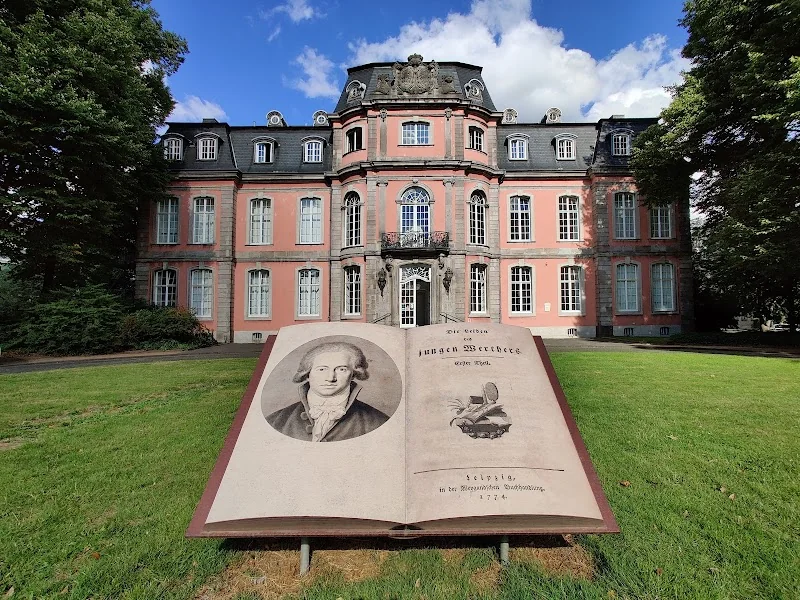
Jacobistraße 2, Düsseldorf
Jacobistraße 2, 40211 Düsseldorf, Germany
Goethe Museum Düsseldorf | Opening Hours & Tickets
The Goethe Museum Düsseldorf is much more than a classic literature museum: it combines exhibition, archive, research library, art collection, and event venue under one roof. The institution is one of the three major Goethe archive and research sites and preserves, based on the collection of Anton Kippenberg, the largest private Goethe collection in the world with around 50,000 objects. Visitors experience not only originals from Goethe's life and work but also the cultural context of his time, from manuscripts to books to art and utilitarian objects. Since 1987, the museum has been housed in the historic Schloss Jägerhof on the edge of the Hofgarten; the foundation and the city of Düsseldorf jointly secure the location and its cultural work. This creates a place where education, research, and a publicly accessible museum interact in a particularly harmonious way. Those looking for opening hours, tickets, directions, children's offerings, or current events will find here a compact yet deep introduction to the house and its many facets. ([goethe-museum.de](https://www.goethe-museum.de/en/about-us/the-goethe-museum-duesseldorf?utm_source=openai))
Opening Hours, Tickets, and Admission
For planning a visit, the opening hours are particularly important, as the Goethe Museum Düsseldorf operates with clear but visitor-friendly time slots. The museum is open Tuesday to Friday and Sunday from 11:00 AM to 5:00 PM, and on Saturdays, the visiting day starts at 1:00 PM and also runs until 5:00 PM. This makes the house suitable for a short cultural walk in the afternoon as well as for a quieter weekend visit. The admission price remains deliberately low-threshold: the regular entry fee is 4.00 euros, reduced 2.00 euros. Additionally, there is a Happy Hour from 4 PM with free admission; on Sundays, admission is also free. So, those who are flexible can start their visit particularly easily on a Sunday or in the late afternoon. This combination of regular tickets, discounts, and free time slots makes the museum attractive for individual visitors, families, school classes, and anyone who wants to experience literature and cultural history spontaneously. Especially in a place that works with originals and research, the fair price is a strong signal: the Goethe legacy should not be exclusive but open and as widely accessible as possible. ([goethe-museum.de](https://www.goethe-museum.de/en/opening-times?utm_source=openai))
Directions, Parking, and Address
The Goethe Museum Düsseldorf is located very centrally at Jacobistraße 2, 40211 Düsseldorf, thus in immediate proximity to the Hofgarten and in an area that can be easily combined with a city walk. For arrival by public transport, the museum lists several direct options: From the main train station, tram lines 707 towards Unterrath stop at Schloss Jägerhof and 704 towards Derendorf stop at Adlerstraße. The museum can be reached by subway via lines U71, U72, U73, and U83; the appropriate stops are Schadowstraße or Pempelforter Straße. This selection is practical because it allows flexibility depending on the starting point in the city area and does not rely on a single line. This connection is particularly simple for guests from outside who arrive at the main train station. Those who plan their arrival in advance can thus connect the museum visit stress-free with other stops in the center, such as the Hofgarten, the surrounding cultural sites, or a stay in the city center. ([goethe-museum.de](https://www.goethe-museum.de/de/anfahrt?utm_source=openai))
The house is also accessible by car, but due to its city center location, a conscious search for parking is recommended. On the official directions page, the museum lists parking options at Malkasten parking lot and Kaufhof parking garage. Thus, there are at least two concrete options nearby without having to search long for a parking space. Those arriving by car should plan the city center routes early and pay attention to the respective access routes, as the museum is located in a historically grown area with narrow streets. However, this location is also an advantage: Schloss Jägerhof stands at the eastern edge of the Hofgarten and connects culture, green space, and urban infrastructure with short distances. Those who prefer to walk or bike also benefit from the central location. Thus, the visit becomes not only a museum stop but a cultural moment that can be well integrated into the day right in the middle of Düsseldorf. ([goethe-museum.de](https://www.goethe-museum.de/de/anfahrt?utm_source=openai))
Events, Exhibitions, and Goethe's Fairy Tales
The Goethe Museum Düsseldorf is not a quiet archive behind closed doors but a lively place for changing events and thematic exhibitions. The official event calendar shows that the house works with special exhibitions, discussions, readings, musical formats, and collaborations. This mix is particularly important for the positioning of the museum, as it makes clear that Goethe is not only documented here but is continually read, staged, and related to the present. Those looking for events will therefore find not just dates but a curated cultural program that connects literature, music, and scientific perspectives. The spectrum ranges from Goethe discussions to literary-musical evenings to exhibition projects with external partners. Particularly interesting is that the calendar also includes open formats and project-related exhibitions that address current questions and thus create new incentives for visits. This keeps the museum exciting for repeat visits because the thematic focus changes repeatedly. ([goethe-museum.de](https://www.goethe-museum.de/de/veranstaltung/veranstaltungskalender?utm_source=openai))
Content-wise, these programs often connect to themes that are particularly relevant in the Goethe cosmos: fairy tales, nature, music, classic reception, or the connection of text and image. The keyword fairy tales shows how the museum makes literary materials readable today. Goethe's own fairy tale world and the question of how stories of the wonderful are told in the present appear repeatedly in special exhibitions and discussion formats. This creates a bridge between historical collection and current cultural debate. The museum explicitly sees itself as a modern place of knowledge and communication that not only preserves but also conveys and recontextualizes. So, those looking for exhibitions, programs, or thematic events will find in the Goethe Museum not just a mere sequence of dates but a lively space of ideas. The connection of classic literature, contemporary art, and public communication makes the house one of the most interesting cultural addresses in Düsseldorf. ([goethe-museum.de](https://www.goethe-museum.de/en/about-us/the-goethe-museum-duesseldorf?utm_source=openai))
Children, App, and Digital Discovery Tour
The Goethe Museum Düsseldorf also offers surprisingly many access points for families and young visitors. On the children's page, the museum describes that there is much to discover in Schloss Jägerhof: Goethe's house in miniature, experiments with prisms, locks of hair, treasure hunts, and digital rallies. For preschool children and younger groups, there are specific formats with guided tours, museum rallies, as well as crafting and drawing activities. The age orientation is particularly important: some offerings are suitable from 5 years old and designed for a maximum of 15 children, keeping the groups manageable and pedagogically well manageable. The house is thus not only a destination for literarily interested adults but also for kindergartens, families, and school groups seeking an initial access to Goethe, color theory, and museum work. That the museum does not rely solely on text transmission but works with playful and exploratory formats is a strong signal for contemporary cultural education. Thus, a historical collection becomes a place where children can actively think along, experiment, and make their own discoveries. ([goethe-museum.de](https://www.goethe-museum.de/de/bildung/kinder?utm_source=openai))
This offering is complemented by the museum app, which serves as a multimedia companion through the exhibition and was even awarded the German Design Award 2020 in the category Excellent Communication Design App. The app offers free text, audio, and video material on selected collection highlights and can be used in the museum via beacons as soon as one enters the exhibition rooms. For this, GPS and Bluetooth settings should be activated so that the content is automatically provided on-site. This digital offering is not only practical but also fits well with a museum that connects scientific interests, literary education, and modern forms of communication. Those who wish for more background knowledge during a tour receive additional layers for viewing the collection. Especially for guests who prefer to explore independently rather than follow a guided tour, the app is a real added value. The Goethe Museum thus shows that classical cultural education and digital accompaniment do not exclude each other but can meaningfully complement each other. ([goethe-museum.de](https://www.goethe-museum.de/de/museum/app?utm_source=openai))
Collection, History, and Management
The history of the Goethe Museum Düsseldorf is closely linked to the collection of the publisher Anton Kippenberg. The institution was founded in 1953 by two heirs of Kippenberg, the museum complex was opened in 1956, and since 1987 the house has been located in Schloss Jägerhof. The building itself is also part of the historical narrative: it was built according to plans from 1748, completed in 1772, later restored after destruction, and today provides an appropriate setting for the collection with its location at the Hofgarten. The museum presents there the permanent exhibition Goethe and His Time, in which original manuscripts, books, paintings, drawings, busts, and crafts come together. Additionally, the house describes its holdings with coins, medals, glasses from the spa towns visited by Goethe, porcelain with Weimar views, city and landscape paintings, as well as portraits and busts from Goethe's environment. This spectrum shows that not only a single poet is honored here but a whole culture and intellectual world is to be made visible. The collection thus serves not merely for veneration but for a historically grounded engagement with Goethe and his time. ([goethe-museum.de](https://www.goethe-museum.de/en/about-us/the-goethe-museum-duesseldorf?utm_source=openai))
Also part of the house's profile is research. The research library is a specialized scientific library on Goethe and his time and comprises around 25,000 volumes that can be used publicly as a reference collection. In addition, there is the collection of manuscripts, music materials, and other holdings that collectively explain the character of the house as an archive and research site. The museum thus sees itself not only as an exhibition venue but as an active center for knowledge, communication, and scientific work. The management is also clearly named: PD Dr. Boris Roman Gibhardt is listed as director; Dr. Heike Spies serves as deputy director and curator, and Dr. Barbara Steingießer is responsible for exhibitions and event management. This structure is relevant for visitors because it shows that behind the exhibitions is a professionally strong team that interlinks collection, communication, and program. So, those looking for management, director, or staff will find in the Goethe Museum not only names but an institutional profile that consistently brings together research and the public. ([goethe-museum.de](https://www.goethe-museum.de/en/collection/library?utm_source=openai))
Sources:
- Goethe Museum Düsseldorf - Homepage
- Goethe Museum Düsseldorf - Opening Hours
- Goethe Museum Düsseldorf - Prices
- Goethe Museum Düsseldorf - Directions
- Goethe Museum Düsseldorf - Children
- Goethe Museum Düsseldorf - Event Calendar
- Goethe Museum Düsseldorf - Staff according to function
- Goethe Museum Düsseldorf - About us
Show moreShow less
Goethe Museum Düsseldorf | Opening Hours & Tickets
The Goethe Museum Düsseldorf is much more than a classic literature museum: it combines exhibition, archive, research library, art collection, and event venue under one roof. The institution is one of the three major Goethe archive and research sites and preserves, based on the collection of Anton Kippenberg, the largest private Goethe collection in the world with around 50,000 objects. Visitors experience not only originals from Goethe's life and work but also the cultural context of his time, from manuscripts to books to art and utilitarian objects. Since 1987, the museum has been housed in the historic Schloss Jägerhof on the edge of the Hofgarten; the foundation and the city of Düsseldorf jointly secure the location and its cultural work. This creates a place where education, research, and a publicly accessible museum interact in a particularly harmonious way. Those looking for opening hours, tickets, directions, children's offerings, or current events will find here a compact yet deep introduction to the house and its many facets. ([goethe-museum.de](https://www.goethe-museum.de/en/about-us/the-goethe-museum-duesseldorf?utm_source=openai))
Opening Hours, Tickets, and Admission
For planning a visit, the opening hours are particularly important, as the Goethe Museum Düsseldorf operates with clear but visitor-friendly time slots. The museum is open Tuesday to Friday and Sunday from 11:00 AM to 5:00 PM, and on Saturdays, the visiting day starts at 1:00 PM and also runs until 5:00 PM. This makes the house suitable for a short cultural walk in the afternoon as well as for a quieter weekend visit. The admission price remains deliberately low-threshold: the regular entry fee is 4.00 euros, reduced 2.00 euros. Additionally, there is a Happy Hour from 4 PM with free admission; on Sundays, admission is also free. So, those who are flexible can start their visit particularly easily on a Sunday or in the late afternoon. This combination of regular tickets, discounts, and free time slots makes the museum attractive for individual visitors, families, school classes, and anyone who wants to experience literature and cultural history spontaneously. Especially in a place that works with originals and research, the fair price is a strong signal: the Goethe legacy should not be exclusive but open and as widely accessible as possible. ([goethe-museum.de](https://www.goethe-museum.de/en/opening-times?utm_source=openai))
Directions, Parking, and Address
The Goethe Museum Düsseldorf is located very centrally at Jacobistraße 2, 40211 Düsseldorf, thus in immediate proximity to the Hofgarten and in an area that can be easily combined with a city walk. For arrival by public transport, the museum lists several direct options: From the main train station, tram lines 707 towards Unterrath stop at Schloss Jägerhof and 704 towards Derendorf stop at Adlerstraße. The museum can be reached by subway via lines U71, U72, U73, and U83; the appropriate stops are Schadowstraße or Pempelforter Straße. This selection is practical because it allows flexibility depending on the starting point in the city area and does not rely on a single line. This connection is particularly simple for guests from outside who arrive at the main train station. Those who plan their arrival in advance can thus connect the museum visit stress-free with other stops in the center, such as the Hofgarten, the surrounding cultural sites, or a stay in the city center. ([goethe-museum.de](https://www.goethe-museum.de/de/anfahrt?utm_source=openai))
The house is also accessible by car, but due to its city center location, a conscious search for parking is recommended. On the official directions page, the museum lists parking options at Malkasten parking lot and Kaufhof parking garage. Thus, there are at least two concrete options nearby without having to search long for a parking space. Those arriving by car should plan the city center routes early and pay attention to the respective access routes, as the museum is located in a historically grown area with narrow streets. However, this location is also an advantage: Schloss Jägerhof stands at the eastern edge of the Hofgarten and connects culture, green space, and urban infrastructure with short distances. Those who prefer to walk or bike also benefit from the central location. Thus, the visit becomes not only a museum stop but a cultural moment that can be well integrated into the day right in the middle of Düsseldorf. ([goethe-museum.de](https://www.goethe-museum.de/de/anfahrt?utm_source=openai))
Events, Exhibitions, and Goethe's Fairy Tales
The Goethe Museum Düsseldorf is not a quiet archive behind closed doors but a lively place for changing events and thematic exhibitions. The official event calendar shows that the house works with special exhibitions, discussions, readings, musical formats, and collaborations. This mix is particularly important for the positioning of the museum, as it makes clear that Goethe is not only documented here but is continually read, staged, and related to the present. Those looking for events will therefore find not just dates but a curated cultural program that connects literature, music, and scientific perspectives. The spectrum ranges from Goethe discussions to literary-musical evenings to exhibition projects with external partners. Particularly interesting is that the calendar also includes open formats and project-related exhibitions that address current questions and thus create new incentives for visits. This keeps the museum exciting for repeat visits because the thematic focus changes repeatedly. ([goethe-museum.de](https://www.goethe-museum.de/de/veranstaltung/veranstaltungskalender?utm_source=openai))
Content-wise, these programs often connect to themes that are particularly relevant in the Goethe cosmos: fairy tales, nature, music, classic reception, or the connection of text and image. The keyword fairy tales shows how the museum makes literary materials readable today. Goethe's own fairy tale world and the question of how stories of the wonderful are told in the present appear repeatedly in special exhibitions and discussion formats. This creates a bridge between historical collection and current cultural debate. The museum explicitly sees itself as a modern place of knowledge and communication that not only preserves but also conveys and recontextualizes. So, those looking for exhibitions, programs, or thematic events will find in the Goethe Museum not just a mere sequence of dates but a lively space of ideas. The connection of classic literature, contemporary art, and public communication makes the house one of the most interesting cultural addresses in Düsseldorf. ([goethe-museum.de](https://www.goethe-museum.de/en/about-us/the-goethe-museum-duesseldorf?utm_source=openai))
Children, App, and Digital Discovery Tour
The Goethe Museum Düsseldorf also offers surprisingly many access points for families and young visitors. On the children's page, the museum describes that there is much to discover in Schloss Jägerhof: Goethe's house in miniature, experiments with prisms, locks of hair, treasure hunts, and digital rallies. For preschool children and younger groups, there are specific formats with guided tours, museum rallies, as well as crafting and drawing activities. The age orientation is particularly important: some offerings are suitable from 5 years old and designed for a maximum of 15 children, keeping the groups manageable and pedagogically well manageable. The house is thus not only a destination for literarily interested adults but also for kindergartens, families, and school groups seeking an initial access to Goethe, color theory, and museum work. That the museum does not rely solely on text transmission but works with playful and exploratory formats is a strong signal for contemporary cultural education. Thus, a historical collection becomes a place where children can actively think along, experiment, and make their own discoveries. ([goethe-museum.de](https://www.goethe-museum.de/de/bildung/kinder?utm_source=openai))
This offering is complemented by the museum app, which serves as a multimedia companion through the exhibition and was even awarded the German Design Award 2020 in the category Excellent Communication Design App. The app offers free text, audio, and video material on selected collection highlights and can be used in the museum via beacons as soon as one enters the exhibition rooms. For this, GPS and Bluetooth settings should be activated so that the content is automatically provided on-site. This digital offering is not only practical but also fits well with a museum that connects scientific interests, literary education, and modern forms of communication. Those who wish for more background knowledge during a tour receive additional layers for viewing the collection. Especially for guests who prefer to explore independently rather than follow a guided tour, the app is a real added value. The Goethe Museum thus shows that classical cultural education and digital accompaniment do not exclude each other but can meaningfully complement each other. ([goethe-museum.de](https://www.goethe-museum.de/de/museum/app?utm_source=openai))
Collection, History, and Management
The history of the Goethe Museum Düsseldorf is closely linked to the collection of the publisher Anton Kippenberg. The institution was founded in 1953 by two heirs of Kippenberg, the museum complex was opened in 1956, and since 1987 the house has been located in Schloss Jägerhof. The building itself is also part of the historical narrative: it was built according to plans from 1748, completed in 1772, later restored after destruction, and today provides an appropriate setting for the collection with its location at the Hofgarten. The museum presents there the permanent exhibition Goethe and His Time, in which original manuscripts, books, paintings, drawings, busts, and crafts come together. Additionally, the house describes its holdings with coins, medals, glasses from the spa towns visited by Goethe, porcelain with Weimar views, city and landscape paintings, as well as portraits and busts from Goethe's environment. This spectrum shows that not only a single poet is honored here but a whole culture and intellectual world is to be made visible. The collection thus serves not merely for veneration but for a historically grounded engagement with Goethe and his time. ([goethe-museum.de](https://www.goethe-museum.de/en/about-us/the-goethe-museum-duesseldorf?utm_source=openai))
Also part of the house's profile is research. The research library is a specialized scientific library on Goethe and his time and comprises around 25,000 volumes that can be used publicly as a reference collection. In addition, there is the collection of manuscripts, music materials, and other holdings that collectively explain the character of the house as an archive and research site. The museum thus sees itself not only as an exhibition venue but as an active center for knowledge, communication, and scientific work. The management is also clearly named: PD Dr. Boris Roman Gibhardt is listed as director; Dr. Heike Spies serves as deputy director and curator, and Dr. Barbara Steingießer is responsible for exhibitions and event management. This structure is relevant for visitors because it shows that behind the exhibitions is a professionally strong team that interlinks collection, communication, and program. So, those looking for management, director, or staff will find in the Goethe Museum not only names but an institutional profile that consistently brings together research and the public. ([goethe-museum.de](https://www.goethe-museum.de/en/collection/library?utm_source=openai))
Sources:
- Goethe Museum Düsseldorf - Homepage
- Goethe Museum Düsseldorf - Opening Hours
- Goethe Museum Düsseldorf - Prices
- Goethe Museum Düsseldorf - Directions
- Goethe Museum Düsseldorf - Children
- Goethe Museum Düsseldorf - Event Calendar
- Goethe Museum Düsseldorf - Staff according to function
- Goethe Museum Düsseldorf - About us
Goethe Museum Düsseldorf | Opening Hours & Tickets
The Goethe Museum Düsseldorf is much more than a classic literature museum: it combines exhibition, archive, research library, art collection, and event venue under one roof. The institution is one of the three major Goethe archive and research sites and preserves, based on the collection of Anton Kippenberg, the largest private Goethe collection in the world with around 50,000 objects. Visitors experience not only originals from Goethe's life and work but also the cultural context of his time, from manuscripts to books to art and utilitarian objects. Since 1987, the museum has been housed in the historic Schloss Jägerhof on the edge of the Hofgarten; the foundation and the city of Düsseldorf jointly secure the location and its cultural work. This creates a place where education, research, and a publicly accessible museum interact in a particularly harmonious way. Those looking for opening hours, tickets, directions, children's offerings, or current events will find here a compact yet deep introduction to the house and its many facets. ([goethe-museum.de](https://www.goethe-museum.de/en/about-us/the-goethe-museum-duesseldorf?utm_source=openai))
Opening Hours, Tickets, and Admission
For planning a visit, the opening hours are particularly important, as the Goethe Museum Düsseldorf operates with clear but visitor-friendly time slots. The museum is open Tuesday to Friday and Sunday from 11:00 AM to 5:00 PM, and on Saturdays, the visiting day starts at 1:00 PM and also runs until 5:00 PM. This makes the house suitable for a short cultural walk in the afternoon as well as for a quieter weekend visit. The admission price remains deliberately low-threshold: the regular entry fee is 4.00 euros, reduced 2.00 euros. Additionally, there is a Happy Hour from 4 PM with free admission; on Sundays, admission is also free. So, those who are flexible can start their visit particularly easily on a Sunday or in the late afternoon. This combination of regular tickets, discounts, and free time slots makes the museum attractive for individual visitors, families, school classes, and anyone who wants to experience literature and cultural history spontaneously. Especially in a place that works with originals and research, the fair price is a strong signal: the Goethe legacy should not be exclusive but open and as widely accessible as possible. ([goethe-museum.de](https://www.goethe-museum.de/en/opening-times?utm_source=openai))
Directions, Parking, and Address
The Goethe Museum Düsseldorf is located very centrally at Jacobistraße 2, 40211 Düsseldorf, thus in immediate proximity to the Hofgarten and in an area that can be easily combined with a city walk. For arrival by public transport, the museum lists several direct options: From the main train station, tram lines 707 towards Unterrath stop at Schloss Jägerhof and 704 towards Derendorf stop at Adlerstraße. The museum can be reached by subway via lines U71, U72, U73, and U83; the appropriate stops are Schadowstraße or Pempelforter Straße. This selection is practical because it allows flexibility depending on the starting point in the city area and does not rely on a single line. This connection is particularly simple for guests from outside who arrive at the main train station. Those who plan their arrival in advance can thus connect the museum visit stress-free with other stops in the center, such as the Hofgarten, the surrounding cultural sites, or a stay in the city center. ([goethe-museum.de](https://www.goethe-museum.de/de/anfahrt?utm_source=openai))
The house is also accessible by car, but due to its city center location, a conscious search for parking is recommended. On the official directions page, the museum lists parking options at Malkasten parking lot and Kaufhof parking garage. Thus, there are at least two concrete options nearby without having to search long for a parking space. Those arriving by car should plan the city center routes early and pay attention to the respective access routes, as the museum is located in a historically grown area with narrow streets. However, this location is also an advantage: Schloss Jägerhof stands at the eastern edge of the Hofgarten and connects culture, green space, and urban infrastructure with short distances. Those who prefer to walk or bike also benefit from the central location. Thus, the visit becomes not only a museum stop but a cultural moment that can be well integrated into the day right in the middle of Düsseldorf. ([goethe-museum.de](https://www.goethe-museum.de/de/anfahrt?utm_source=openai))
Events, Exhibitions, and Goethe's Fairy Tales
The Goethe Museum Düsseldorf is not a quiet archive behind closed doors but a lively place for changing events and thematic exhibitions. The official event calendar shows that the house works with special exhibitions, discussions, readings, musical formats, and collaborations. This mix is particularly important for the positioning of the museum, as it makes clear that Goethe is not only documented here but is continually read, staged, and related to the present. Those looking for events will therefore find not just dates but a curated cultural program that connects literature, music, and scientific perspectives. The spectrum ranges from Goethe discussions to literary-musical evenings to exhibition projects with external partners. Particularly interesting is that the calendar also includes open formats and project-related exhibitions that address current questions and thus create new incentives for visits. This keeps the museum exciting for repeat visits because the thematic focus changes repeatedly. ([goethe-museum.de](https://www.goethe-museum.de/de/veranstaltung/veranstaltungskalender?utm_source=openai))
Content-wise, these programs often connect to themes that are particularly relevant in the Goethe cosmos: fairy tales, nature, music, classic reception, or the connection of text and image. The keyword fairy tales shows how the museum makes literary materials readable today. Goethe's own fairy tale world and the question of how stories of the wonderful are told in the present appear repeatedly in special exhibitions and discussion formats. This creates a bridge between historical collection and current cultural debate. The museum explicitly sees itself as a modern place of knowledge and communication that not only preserves but also conveys and recontextualizes. So, those looking for exhibitions, programs, or thematic events will find in the Goethe Museum not just a mere sequence of dates but a lively space of ideas. The connection of classic literature, contemporary art, and public communication makes the house one of the most interesting cultural addresses in Düsseldorf. ([goethe-museum.de](https://www.goethe-museum.de/en/about-us/the-goethe-museum-duesseldorf?utm_source=openai))
Children, App, and Digital Discovery Tour
The Goethe Museum Düsseldorf also offers surprisingly many access points for families and young visitors. On the children's page, the museum describes that there is much to discover in Schloss Jägerhof: Goethe's house in miniature, experiments with prisms, locks of hair, treasure hunts, and digital rallies. For preschool children and younger groups, there are specific formats with guided tours, museum rallies, as well as crafting and drawing activities. The age orientation is particularly important: some offerings are suitable from 5 years old and designed for a maximum of 15 children, keeping the groups manageable and pedagogically well manageable. The house is thus not only a destination for literarily interested adults but also for kindergartens, families, and school groups seeking an initial access to Goethe, color theory, and museum work. That the museum does not rely solely on text transmission but works with playful and exploratory formats is a strong signal for contemporary cultural education. Thus, a historical collection becomes a place where children can actively think along, experiment, and make their own discoveries. ([goethe-museum.de](https://www.goethe-museum.de/de/bildung/kinder?utm_source=openai))
This offering is complemented by the museum app, which serves as a multimedia companion through the exhibition and was even awarded the German Design Award 2020 in the category Excellent Communication Design App. The app offers free text, audio, and video material on selected collection highlights and can be used in the museum via beacons as soon as one enters the exhibition rooms. For this, GPS and Bluetooth settings should be activated so that the content is automatically provided on-site. This digital offering is not only practical but also fits well with a museum that connects scientific interests, literary education, and modern forms of communication. Those who wish for more background knowledge during a tour receive additional layers for viewing the collection. Especially for guests who prefer to explore independently rather than follow a guided tour, the app is a real added value. The Goethe Museum thus shows that classical cultural education and digital accompaniment do not exclude each other but can meaningfully complement each other. ([goethe-museum.de](https://www.goethe-museum.de/de/museum/app?utm_source=openai))
Collection, History, and Management
The history of the Goethe Museum Düsseldorf is closely linked to the collection of the publisher Anton Kippenberg. The institution was founded in 1953 by two heirs of Kippenberg, the museum complex was opened in 1956, and since 1987 the house has been located in Schloss Jägerhof. The building itself is also part of the historical narrative: it was built according to plans from 1748, completed in 1772, later restored after destruction, and today provides an appropriate setting for the collection with its location at the Hofgarten. The museum presents there the permanent exhibition Goethe and His Time, in which original manuscripts, books, paintings, drawings, busts, and crafts come together. Additionally, the house describes its holdings with coins, medals, glasses from the spa towns visited by Goethe, porcelain with Weimar views, city and landscape paintings, as well as portraits and busts from Goethe's environment. This spectrum shows that not only a single poet is honored here but a whole culture and intellectual world is to be made visible. The collection thus serves not merely for veneration but for a historically grounded engagement with Goethe and his time. ([goethe-museum.de](https://www.goethe-museum.de/en/about-us/the-goethe-museum-duesseldorf?utm_source=openai))
Also part of the house's profile is research. The research library is a specialized scientific library on Goethe and his time and comprises around 25,000 volumes that can be used publicly as a reference collection. In addition, there is the collection of manuscripts, music materials, and other holdings that collectively explain the character of the house as an archive and research site. The museum thus sees itself not only as an exhibition venue but as an active center for knowledge, communication, and scientific work. The management is also clearly named: PD Dr. Boris Roman Gibhardt is listed as director; Dr. Heike Spies serves as deputy director and curator, and Dr. Barbara Steingießer is responsible for exhibitions and event management. This structure is relevant for visitors because it shows that behind the exhibitions is a professionally strong team that interlinks collection, communication, and program. So, those looking for management, director, or staff will find in the Goethe Museum not only names but an institutional profile that consistently brings together research and the public. ([goethe-museum.de](https://www.goethe-museum.de/en/collection/library?utm_source=openai))
Sources:
- Goethe Museum Düsseldorf - Homepage
- Goethe Museum Düsseldorf - Opening Hours
- Goethe Museum Düsseldorf - Prices
- Goethe Museum Düsseldorf - Directions
- Goethe Museum Düsseldorf - Children
- Goethe Museum Düsseldorf - Event Calendar
- Goethe Museum Düsseldorf - Staff according to function
- Goethe Museum Düsseldorf - About us
Upcoming Events
No events found
Frequently Asked Questions
Reviews
Handan Bao
29. August 2025
Plenty to read on the wall and in the glass display cases. Very little opportunity for hands-on interaction. Will bore young kids out of their mind, so bring only brainy book-wormy folks. Elegant building, graceful staircase, varying floor patterns. My fav is the light and colour exhibition on the ground floor. Worth the 4 euro entrance fee? My answer is yes.
Engr. Great Emeka
2. July 2025
I was truly impressed by the blend of art, history, and science. One of the highlights was a fascinating exhibit on polarization optics titled "Der Teil und das Ganze", which cleverly uses light and filters to reveal a hidden image of Goethe—an interactive and thought-provoking piece! The rooms were beautifully arranged with classic busts, original documents, and striking sculptures like the Medusa head. The peaceful atmosphere and well-lit space made it a pleasant and enriching experience. Highly recommend it for both art and science lovers.
Frédéric Borgognon
13. October 2024
Goethe Museum is opened every day from 11am to 5pm (except Saturday late opening at 1pm). The Museum is in an old beautiful house. Unfortunately, except some descriptions in English, the museum is completely in German. Except that nice artworks.
Rosemary Tom
29. October 2025
I really enjoyed my visit as it offers a deeper look into Goethe’s life and his many niche interests beyond literature. The exhibits are well-curated and informative, making it a rewarding experience for anyone curious about the man behind the classics.
Melissa Prostrollo
22. February 2020
Nice museum in a historic mansion. It was only 4 Euro each and was a great place to step in from the rain and see something for a while, even if you're not very aware of Goethe, as I was not. Lots of interesting historical information, very cool architectural details and a whole collection of porcelain and other antiques on the top floor. When you first step inside, it looks like it may be sparse, but there is plenty to see and it is a great value for the money.