
Düsseldorf
Alte Glashütte, 40625 Düsseldorf, Deutschland
Glassworks Tower | Gerresheim & Glassmaker Quarter
The Glassworks Tower is one of the most visible symbols of the former Gerresheim Glassworks and thus much more than just a single building in the east of Düsseldorf. Today, those who come to the Glassmaker Quarter experience a place where industrial culture, urban development, and memory intertwine directly. The site is located in the district of Gerresheim, which has been significantly shaped by glass production for many decades and still possesses a unique identity through historical buildings, new neighborhood developments, and the well-known industrial path. The glass tower symbolically represents change: from a factory site, it has become an urban development project with heritage protection, residential areas, green spaces, and public paths. This very mix makes the place so exciting for visitors who are not only looking for a photo motif but also want to understand the history of an entire district. The following presentation connects the most important search topics related to Glassworks Tower, Gerresheim, access, parking, and the development of the Glassmaker Quarter based on available public information. ([duesseldorf.de](https://www.duesseldorf.de/stadtplanungsamt/projektuebersicht/bebauungsplaene/glasmacherviertel?utm_source=openai))
History of the Gerresheim Glassworks
The history of the Glassworks Tower begins with the Gerresheim Glassworks, which Ferdinand Heye founded in 1864 in Gerresheim. From an industrial project, it developed into a defining economic location for the entire eastern part of Düsseldorf within a few decades. Early on, the operation benefited from its proximity to the train station and good transport options for raw materials and finished glass products. Local historical sources describe that as early as 1865, numerous employees were engaged in production and large quantities of bottles were manufactured. At the same time, the operation became a magnet for workers from various regions of Europe, which permanently changed Gerresheim. The district gained not only jobs from the glassworks but also new settlements, social facilities, and its own industrial culture. The name of the glassworks, often simply referred to as the “Hött,” therefore stands in Gerresheim to this day for more than just a factory. It refers to growth, technical modernization, labor history, and a time when glass production determined the rhythm of the district. ([duesseldorf.de](https://www.duesseldorf.de/stadtarchiv/stadtgeschichte/zeitleiste/zeitleiste-06-1850-bis-1880/1864?utm_source=openai))
The subsequent transformation is also an essential part of the site's history. In 2005, the Gerresheim Glassworks was closed after nearly 150 years of operation. The city of Düsseldorf states that a new industrial use at this location no longer seemed sensible given the changing requirements and the surrounding residential areas. Instead, the idea of an urban neighborhood with different forms of housing, commerce, services, and an integrated retail location emerged. It is precisely here that the Glassworks Tower becomes a memory anchor: It shows that the site has not simply disappeared but has transitioned into a new phase. The historical substance has not been fully preserved, but it remains visible. Today, the site can be read as a transition between industrial history and modern urban development. For those searching for Glassworks Tower Düsseldorf or Glassworks Tower Gerresheim, this is important: It does not refer to an isolated observation tower but to a monument in a former factory area that consciously carries its past into the present. ([duesseldorf.de](https://www.duesseldorf.de/stadtplanungsamt/projektuebersicht/bebauungsplaene/glasmacherviertel?utm_source=openai))
The Glass Tower, the Gerrix Tower, and the Monuments in the Ensemble
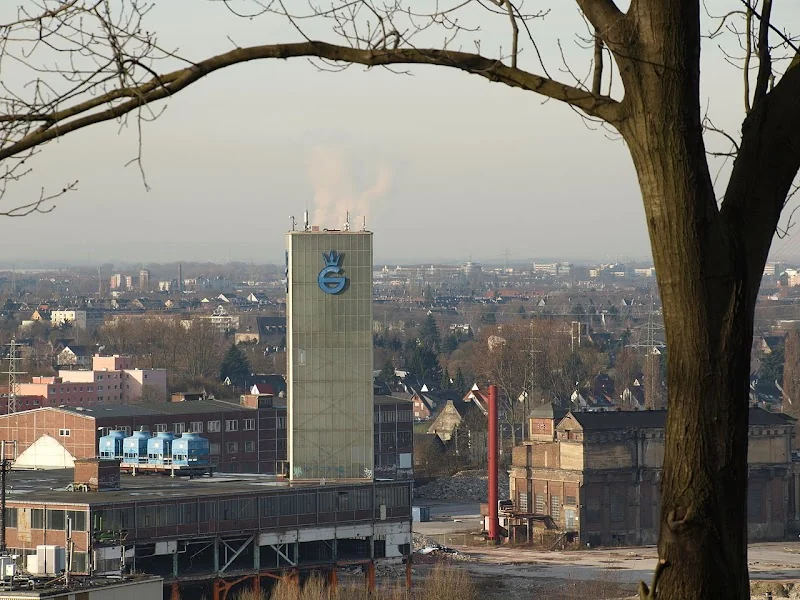
The distinctive tower of the complex is described in sources as the Glass Tower and also as the Gerrix Tower. According to the Rhineland Industrial Culture, it was built in 1966 based on designs from the factory's own construction office and bears the trademark of the glassworks with the crowned G. This combination of functional industrial architecture and clear symbolism makes the building so striking. The tower represents not only a single building but also the self-representation of a company that has long shaped the cityscape of Gerresheim. The historical classification also shows how strongly technical progress, brand identity, and architectural ambition came together on the site. For today's visitors, the tower is therefore primarily a reading signal: Those who see it immediately understand that a large industrial operation once stood here. The site does not appear museum-like and closed off but is embedded in a development that has remained visible to this day. This makes the Glass Tower an important landmark in the Glassmaker Quarter and one of the few remaining high signs of the old glassworks. ([rheinische-industriekultur.com](https://www.rheinische-industriekultur.com/seiten/objekte/orte/duesseldorf/objekte/gerresheim_glashuette_intern.html?utm_source=openai))
The preserved ensemble also includes the electrical central station, the boiler house, and the Heyebad, according to the city's planning documents. These buildings are explicitly mentioned as monuments that will remain as a reminder of the glassworks. The center of the new neighborhood is the Düsselpark, which integrates the listed buildings. This creates no break between past and future but a consciously designed connection. This is a crucial hint for people searching for special details around Glassworks Tower Gerresheim or Glass Tower Gerresheim: The place can be read not only from a single tower but from a whole mosaic of industrial architecture, open spaces, and new buildings. This also contributes to the site's appeal. Visitors immediately sense that something should be preserved here because the history of the site cannot be told in a display case but in the space itself. For this reason, the tower is often perceived as a landmark of the former factory site. ([duesseldorf.de](https://www.duesseldorf.de/stadtplanungsamt/projektuebersicht/bebauungsplaene/glasmacherviertel?utm_source=openai))
Access to the Glassworks Tower by S-Bahn, U73, and Bus
Access to the Glassworks Tower is relatively easy because the Glassmaker Quarter is closely connected to the Düsseldorf-Gerresheim S-Bahn station. The city planning mentions the S-Bahn connection with lines S8 and S28, as well as the terminus of the U73 and various bus lines for the area. The site is located in the east of Düsseldorf in district 7 and is bordered to the south by the railway line Düsseldorf-Wuppertal-Mettmann. This location explains why the site was so attractive even during the industrialization phase: The historical train station area was a logistical advantage for glass production and is today an advantage for all those who wish to travel without a car. Those who want to visit the Glassworks Tower thus find a good mix of public transport and short distances in the neighborhood. The official tourist presentation of the industrial path also emphasizes that the historical station Gerresheim is a central starting point and that without it, the industrial settlement in this form would hardly have been possible. For orientation, this means: The station is not just a stop but also a piece of local history. ([duesseldorf.de](https://www.duesseldorf.de/stadtplanungsamt/projektuebersicht/bebauungsplaene/glasmacherviertel?utm_source=openai))
It is also practical that the area does not function as a secluded site but as part of the Gerresheim district. The official neighborhood description refers to good connections to the center of Gerresheim and to the Heyestraße South area with shopping and gastronomy. For visitors, this is pleasant because a walk to the Glassworks Tower can be combined with a stroll through the surroundings. Those arriving by public transport do not move in an isolated industrial area but in a developed district with urban infrastructure. This is an important difference from many other industrial monuments. The Glassworks Tower benefits from the fact that the station, street, and neighborhood work together. This makes the site suitable both for a targeted photo stop and as a starting point for a longer walk through the glass history of Gerresheim. The combination of S-Bahn, U-Bahn, bus, and footpaths makes access uncomplicated for both locals and guests. ([duesseldorf.de](https://www.duesseldorf.de/stadtplanungsamt/projektuebersicht/bebauungsplaene/glasmacherviertel?utm_source=openai))
Parking at the Glassmaker Quarter and at the Gerresheim S-Bahn Station
Those arriving by car will find a park-and-ride offer at the Gerresheim S-Bahn station on the former Glassmaker site. The city of Düsseldorf has set up around 160 parking spaces there and has additionally equipped the area with public lighting. Bicycle parking options have also been announced. This makes the area attractive not only for commuters but also for visitors who want to comfortably reach the Glassworks Tower and its surroundings. The location is particularly important because the offer is located directly near the station, making the transition between car, bicycle, and train easier. Therefore, those searching for parking in the Glassmaker Quarter or parking at the Glassworks Tower will essentially land on this official P+R solution. This is a practical advantage because one does not have to park in dense inner-city traffic but can use an orderly and well-connected area. The city explicitly describes the offer as free parking with an environmentally friendly commuting option. ([duesseldorf.de](https://www.duesseldorf.de/medienportal/pressedienst-einzelansicht/pld/gerresheim-kostenlos-parken-und-umweltfreundlich-pendeln?utm_source=openai))
The location of the neighborhood is also well prepared for driving. The city's planning documents mention connections in the direction of A46 via Rampenstraße and Glashüttenstraße to the south and via Torfbruchstraße to the north. Additionally, there is future and existing integration into the road network around Gerresheim South. For visitors, this means that the Glassworks Tower is accessible not only by train but also from other parts of Düsseldorf and the surrounding area. However, it remains important that the site consciously opts for a mix of motorized traffic, public transport, and footpaths. This fits the current use of the area as an urban neighborhood. Therefore, those visiting the tower experience no classic excursion destination with huge parking areas but a developed urban environment. This aligns well with the current developments in the Glassmaker Quarter and makes access flexible. For those seeking information in advance about access and parking, these official hints are the most reliable points of reference. ([duesseldorf.de](https://www.duesseldorf.de/stadtplanungsamt/projektuebersicht/bebauungsplaene/glasmacherviertel?utm_source=openai))
Industrial Path Düsseldorf-Gerresheim: Walk through Glass History
The Industrial Path Düsseldorf-Gerresheim is the best complement to a visit to the Glassworks Tower. The official tourism site describes it as a nearly four-kilometer-long circular route with 21 stations where Düsseldorf's industrial history becomes vividly experienceable. The route can be walked independently or experienced as part of a guided tour. This is particularly helpful for all those who do not only want to see a single place but want to understand the connection between the glassworks, train station, workers' settlements, and other industrial buildings. The path makes clear how strongly industrial production has influenced urban development. In Gerresheim, this can be read very concretely: glass production, transport connections, housing construction, and social infrastructure have been closely related here for a long time. For those searching for industrial path Düsseldorf Gerresheim or Glassworks Tower Düsseldorf, this route is the logical red thread. It leads right through the historical environment of the tower and creates an access that goes beyond mere architectural observation. ([visitduesseldorf.de](https://www.visitduesseldorf.de/dus/der-industriepfad-duesseldorf-gerresheim?utm_source=openai))
The official description of the industrial path names several special stations that make the circular route particularly attractive. This includes the formerly largest glassworks in the world, the oldest train station in West Germany, and the last of the formerly 40 brick ring kilns in Düsseldorf. Such points show that Gerresheim is not only locally interesting but has a firm place in the industrial culture of the region. For visitors, this means: An excursion to the Glassworks Tower can easily turn into a whole discovery tour. Those who take their time understand not only the tower itself but also the social and technical frameworks that have shaped the place. Additionally, the tourist site refers to practical information such as accessibility, city maps, public toilets, and tourist information. This makes the path practical and accessible. It is not intended as a specialized excursion for experts but as an understandable, easily accessible walk for all age groups. This is precisely where its strength lies. ([visitduesseldorf.de](https://www.visitduesseldorf.de/dus/der-industriepfad-duesseldorf-gerresheim?utm_source=openai))
Glassmaker Quarter Today: Change, Living, and Urban Development
Today, the former factory site is part of the Glassmaker Quarter, an urban development project in the east of Düsseldorf. The city describes the planning area as covering around 32 hectares and as an urban neighborhood with different types of housing, commercial and service offerings, as well as an integrated retail location. At the center is the Düsselpark, which incorporates the listed buildings and thus connects the historical substance with new uses. This is crucial for the perception of the Glassworks Tower: The tower does not stand in a backdrop of pure past but in a vibrant development space. As a result, it remains visible and simultaneously acquires a new function as an identity-forming symbol of the neighborhood. The location of the area is also clearly defined: to the west by the piped northern Düssel, to the north by the street Nach den Mauresköthen, to the east by the Heyestraße, and to the south by the railway line with the Düsseldorf-Gerresheim S-Bahn station. This clear framing helps to classify the site in urban planning. ([duesseldorf.de](https://www.duesseldorf.de/stadtplanungsamt/projektuebersicht/bebauungsplaene/glasmacherviertel?utm_source=openai))
The larger context is Gerresheim South, where according to the city administration, around 6,000 residents live and where large construction projects shape the development. A total of about 2,000 new housing units, new kindergartens, a new primary school, as well as additional retail and commercial spaces are planned there. At the same time, the city emphasizes that the area is strongly shaped by the former glassworks. This dual perspective makes the Glassworks Tower so interesting: It belongs to an industrial memory culture that is not only preserved in a museum-like way but continues to live on in a new urban neighborhood. This is important for Gerresheim because the glassworks was not just any old industrial operation but the engine for the revival of the district in the 19th and 20th centuries. Today, this role is continued in a new form: no longer as a production site but as a place for living, pathways, community, and history. Therefore, those who visit the Glassworks Tower see both the past and the future of the same place. ([duesseldorf.de](https://www.duesseldorf.de/stadtplanungsamt/stadtentwicklung/integrierte-quartiersentwicklung/handlungsraeume/handlungsraum-07-gerresheim-sued?utm_source=openai))
Thus, around the Glassworks Tower, a special mix of monument, neighborhood brand, and place of remembrance is created. The monument maintains the visual connection to the glassworks, while the neighborhood itself takes on new functions. For visitors, this tension is precisely what is appealing: The place does not appear closed off or artificially staged but as part of a vibrant urban landscape. Those interested in Glassworks Tower Gerresheim, Glassworks Tower Düsseldorf, or Glassmaker Quarter will therefore find not only a single photo motif here but a piece of urban history in transformation. The combination of preserved industrial buildings, new forms of housing, and public green spaces makes the area one of the most interesting transformation spaces in Düsseldorf. That the city explicitly emphasizes the preservation of the monuments also shows the willingness to keep the past readable. The Glassworks Tower is thus not only a remnant of the old production but a consciously set sign of how urban development can function with memory. ([duesseldorf.de](https://www.duesseldorf.de/stadtplanungsamt/projektuebersicht/bebauungsplaene/glasmacherviertel?utm_source=openai))
Sources:
- State Capital Düsseldorf – Glassmaker Quarter ([duesseldorf.de](https://www.duesseldorf.de/stadtplanungsamt/projektuebersicht/bebauungsplaene/glasmacherviertel?utm_source=openai))
- Visit Düsseldorf – The Industrial Path Düsseldorf-Gerresheim ([visitduesseldorf.de](https://www.visitduesseldorf.de/dus/der-industriepfad-duesseldorf-gerresheim?utm_source=openai))
- State Capital Düsseldorf – Action Area 07 Gerresheim South ([duesseldorf.de](https://www.duesseldorf.de/stadtplanungsamt/stadtentwicklung/integrierte-quartiersentwicklung/handlungsraeume/handlungsraum-07-gerresheim-sued?utm_source=openai))
- State Capital Düsseldorf – P+R Gerresheim S - Glassmaker Quarter and Press Release on the Park+Ride Offer ([duesseldorf.de](https://www.duesseldorf.de/medienportal/pressedienst-einzelansicht/pld/gerresheim-kostenlos-parken-und-umweltfreundlich-pendeln?utm_source=openai))
- Rhineland Industrial Culture – Glassworks Gerresheim ([rheinische-industriekultur.com](https://www.rheinische-industriekultur.com/seiten/objekte/orte/duesseldorf/objekte/gerresheim_glashuette_intern.html?utm_source=openai))
Show moreShow less
Glassworks Tower | Gerresheim & Glassmaker Quarter
The Glassworks Tower is one of the most visible symbols of the former Gerresheim Glassworks and thus much more than just a single building in the east of Düsseldorf. Today, those who come to the Glassmaker Quarter experience a place where industrial culture, urban development, and memory intertwine directly. The site is located in the district of Gerresheim, which has been significantly shaped by glass production for many decades and still possesses a unique identity through historical buildings, new neighborhood developments, and the well-known industrial path. The glass tower symbolically represents change: from a factory site, it has become an urban development project with heritage protection, residential areas, green spaces, and public paths. This very mix makes the place so exciting for visitors who are not only looking for a photo motif but also want to understand the history of an entire district. The following presentation connects the most important search topics related to Glassworks Tower, Gerresheim, access, parking, and the development of the Glassmaker Quarter based on available public information. ([duesseldorf.de](https://www.duesseldorf.de/stadtplanungsamt/projektuebersicht/bebauungsplaene/glasmacherviertel?utm_source=openai))
History of the Gerresheim Glassworks
The history of the Glassworks Tower begins with the Gerresheim Glassworks, which Ferdinand Heye founded in 1864 in Gerresheim. From an industrial project, it developed into a defining economic location for the entire eastern part of Düsseldorf within a few decades. Early on, the operation benefited from its proximity to the train station and good transport options for raw materials and finished glass products. Local historical sources describe that as early as 1865, numerous employees were engaged in production and large quantities of bottles were manufactured. At the same time, the operation became a magnet for workers from various regions of Europe, which permanently changed Gerresheim. The district gained not only jobs from the glassworks but also new settlements, social facilities, and its own industrial culture. The name of the glassworks, often simply referred to as the “Hött,” therefore stands in Gerresheim to this day for more than just a factory. It refers to growth, technical modernization, labor history, and a time when glass production determined the rhythm of the district. ([duesseldorf.de](https://www.duesseldorf.de/stadtarchiv/stadtgeschichte/zeitleiste/zeitleiste-06-1850-bis-1880/1864?utm_source=openai))
The subsequent transformation is also an essential part of the site's history. In 2005, the Gerresheim Glassworks was closed after nearly 150 years of operation. The city of Düsseldorf states that a new industrial use at this location no longer seemed sensible given the changing requirements and the surrounding residential areas. Instead, the idea of an urban neighborhood with different forms of housing, commerce, services, and an integrated retail location emerged. It is precisely here that the Glassworks Tower becomes a memory anchor: It shows that the site has not simply disappeared but has transitioned into a new phase. The historical substance has not been fully preserved, but it remains visible. Today, the site can be read as a transition between industrial history and modern urban development. For those searching for Glassworks Tower Düsseldorf or Glassworks Tower Gerresheim, this is important: It does not refer to an isolated observation tower but to a monument in a former factory area that consciously carries its past into the present. ([duesseldorf.de](https://www.duesseldorf.de/stadtplanungsamt/projektuebersicht/bebauungsplaene/glasmacherviertel?utm_source=openai))
The Glass Tower, the Gerrix Tower, and the Monuments in the Ensemble
The distinctive tower of the complex is described in sources as the Glass Tower and also as the Gerrix Tower. According to the Rhineland Industrial Culture, it was built in 1966 based on designs from the factory's own construction office and bears the trademark of the glassworks with the crowned G. This combination of functional industrial architecture and clear symbolism makes the building so striking. The tower represents not only a single building but also the self-representation of a company that has long shaped the cityscape of Gerresheim. The historical classification also shows how strongly technical progress, brand identity, and architectural ambition came together on the site. For today's visitors, the tower is therefore primarily a reading signal: Those who see it immediately understand that a large industrial operation once stood here. The site does not appear museum-like and closed off but is embedded in a development that has remained visible to this day. This makes the Glass Tower an important landmark in the Glassmaker Quarter and one of the few remaining high signs of the old glassworks. ([rheinische-industriekultur.com](https://www.rheinische-industriekultur.com/seiten/objekte/orte/duesseldorf/objekte/gerresheim_glashuette_intern.html?utm_source=openai))
The preserved ensemble also includes the electrical central station, the boiler house, and the Heyebad, according to the city's planning documents. These buildings are explicitly mentioned as monuments that will remain as a reminder of the glassworks. The center of the new neighborhood is the Düsselpark, which integrates the listed buildings. This creates no break between past and future but a consciously designed connection. This is a crucial hint for people searching for special details around Glassworks Tower Gerresheim or Glass Tower Gerresheim: The place can be read not only from a single tower but from a whole mosaic of industrial architecture, open spaces, and new buildings. This also contributes to the site's appeal. Visitors immediately sense that something should be preserved here because the history of the site cannot be told in a display case but in the space itself. For this reason, the tower is often perceived as a landmark of the former factory site. ([duesseldorf.de](https://www.duesseldorf.de/stadtplanungsamt/projektuebersicht/bebauungsplaene/glasmacherviertel?utm_source=openai))
Access to the Glassworks Tower by S-Bahn, U73, and Bus
Access to the Glassworks Tower is relatively easy because the Glassmaker Quarter is closely connected to the Düsseldorf-Gerresheim S-Bahn station. The city planning mentions the S-Bahn connection with lines S8 and S28, as well as the terminus of the U73 and various bus lines for the area. The site is located in the east of Düsseldorf in district 7 and is bordered to the south by the railway line Düsseldorf-Wuppertal-Mettmann. This location explains why the site was so attractive even during the industrialization phase: The historical train station area was a logistical advantage for glass production and is today an advantage for all those who wish to travel without a car. Those who want to visit the Glassworks Tower thus find a good mix of public transport and short distances in the neighborhood. The official tourist presentation of the industrial path also emphasizes that the historical station Gerresheim is a central starting point and that without it, the industrial settlement in this form would hardly have been possible. For orientation, this means: The station is not just a stop but also a piece of local history. ([duesseldorf.de](https://www.duesseldorf.de/stadtplanungsamt/projektuebersicht/bebauungsplaene/glasmacherviertel?utm_source=openai))
It is also practical that the area does not function as a secluded site but as part of the Gerresheim district. The official neighborhood description refers to good connections to the center of Gerresheim and to the Heyestraße South area with shopping and gastronomy. For visitors, this is pleasant because a walk to the Glassworks Tower can be combined with a stroll through the surroundings. Those arriving by public transport do not move in an isolated industrial area but in a developed district with urban infrastructure. This is an important difference from many other industrial monuments. The Glassworks Tower benefits from the fact that the station, street, and neighborhood work together. This makes the site suitable both for a targeted photo stop and as a starting point for a longer walk through the glass history of Gerresheim. The combination of S-Bahn, U-Bahn, bus, and footpaths makes access uncomplicated for both locals and guests. ([duesseldorf.de](https://www.duesseldorf.de/stadtplanungsamt/projektuebersicht/bebauungsplaene/glasmacherviertel?utm_source=openai))
Parking at the Glassmaker Quarter and at the Gerresheim S-Bahn Station
Those arriving by car will find a park-and-ride offer at the Gerresheim S-Bahn station on the former Glassmaker site. The city of Düsseldorf has set up around 160 parking spaces there and has additionally equipped the area with public lighting. Bicycle parking options have also been announced. This makes the area attractive not only for commuters but also for visitors who want to comfortably reach the Glassworks Tower and its surroundings. The location is particularly important because the offer is located directly near the station, making the transition between car, bicycle, and train easier. Therefore, those searching for parking in the Glassmaker Quarter or parking at the Glassworks Tower will essentially land on this official P+R solution. This is a practical advantage because one does not have to park in dense inner-city traffic but can use an orderly and well-connected area. The city explicitly describes the offer as free parking with an environmentally friendly commuting option. ([duesseldorf.de](https://www.duesseldorf.de/medienportal/pressedienst-einzelansicht/pld/gerresheim-kostenlos-parken-und-umweltfreundlich-pendeln?utm_source=openai))
The location of the neighborhood is also well prepared for driving. The city's planning documents mention connections in the direction of A46 via Rampenstraße and Glashüttenstraße to the south and via Torfbruchstraße to the north. Additionally, there is future and existing integration into the road network around Gerresheim South. For visitors, this means that the Glassworks Tower is accessible not only by train but also from other parts of Düsseldorf and the surrounding area. However, it remains important that the site consciously opts for a mix of motorized traffic, public transport, and footpaths. This fits the current use of the area as an urban neighborhood. Therefore, those visiting the tower experience no classic excursion destination with huge parking areas but a developed urban environment. This aligns well with the current developments in the Glassmaker Quarter and makes access flexible. For those seeking information in advance about access and parking, these official hints are the most reliable points of reference. ([duesseldorf.de](https://www.duesseldorf.de/stadtplanungsamt/projektuebersicht/bebauungsplaene/glasmacherviertel?utm_source=openai))
Industrial Path Düsseldorf-Gerresheim: Walk through Glass History
The Industrial Path Düsseldorf-Gerresheim is the best complement to a visit to the Glassworks Tower. The official tourism site describes it as a nearly four-kilometer-long circular route with 21 stations where Düsseldorf's industrial history becomes vividly experienceable. The route can be walked independently or experienced as part of a guided tour. This is particularly helpful for all those who do not only want to see a single place but want to understand the connection between the glassworks, train station, workers' settlements, and other industrial buildings. The path makes clear how strongly industrial production has influenced urban development. In Gerresheim, this can be read very concretely: glass production, transport connections, housing construction, and social infrastructure have been closely related here for a long time. For those searching for industrial path Düsseldorf Gerresheim or Glassworks Tower Düsseldorf, this route is the logical red thread. It leads right through the historical environment of the tower and creates an access that goes beyond mere architectural observation. ([visitduesseldorf.de](https://www.visitduesseldorf.de/dus/der-industriepfad-duesseldorf-gerresheim?utm_source=openai))
The official description of the industrial path names several special stations that make the circular route particularly attractive. This includes the formerly largest glassworks in the world, the oldest train station in West Germany, and the last of the formerly 40 brick ring kilns in Düsseldorf. Such points show that Gerresheim is not only locally interesting but has a firm place in the industrial culture of the region. For visitors, this means: An excursion to the Glassworks Tower can easily turn into a whole discovery tour. Those who take their time understand not only the tower itself but also the social and technical frameworks that have shaped the place. Additionally, the tourist site refers to practical information such as accessibility, city maps, public toilets, and tourist information. This makes the path practical and accessible. It is not intended as a specialized excursion for experts but as an understandable, easily accessible walk for all age groups. This is precisely where its strength lies. ([visitduesseldorf.de](https://www.visitduesseldorf.de/dus/der-industriepfad-duesseldorf-gerresheim?utm_source=openai))
Glassmaker Quarter Today: Change, Living, and Urban Development
Today, the former factory site is part of the Glassmaker Quarter, an urban development project in the east of Düsseldorf. The city describes the planning area as covering around 32 hectares and as an urban neighborhood with different types of housing, commercial and service offerings, as well as an integrated retail location. At the center is the Düsselpark, which incorporates the listed buildings and thus connects the historical substance with new uses. This is crucial for the perception of the Glassworks Tower: The tower does not stand in a backdrop of pure past but in a vibrant development space. As a result, it remains visible and simultaneously acquires a new function as an identity-forming symbol of the neighborhood. The location of the area is also clearly defined: to the west by the piped northern Düssel, to the north by the street Nach den Mauresköthen, to the east by the Heyestraße, and to the south by the railway line with the Düsseldorf-Gerresheim S-Bahn station. This clear framing helps to classify the site in urban planning. ([duesseldorf.de](https://www.duesseldorf.de/stadtplanungsamt/projektuebersicht/bebauungsplaene/glasmacherviertel?utm_source=openai))
The larger context is Gerresheim South, where according to the city administration, around 6,000 residents live and where large construction projects shape the development. A total of about 2,000 new housing units, new kindergartens, a new primary school, as well as additional retail and commercial spaces are planned there. At the same time, the city emphasizes that the area is strongly shaped by the former glassworks. This dual perspective makes the Glassworks Tower so interesting: It belongs to an industrial memory culture that is not only preserved in a museum-like way but continues to live on in a new urban neighborhood. This is important for Gerresheim because the glassworks was not just any old industrial operation but the engine for the revival of the district in the 19th and 20th centuries. Today, this role is continued in a new form: no longer as a production site but as a place for living, pathways, community, and history. Therefore, those who visit the Glassworks Tower see both the past and the future of the same place. ([duesseldorf.de](https://www.duesseldorf.de/stadtplanungsamt/stadtentwicklung/integrierte-quartiersentwicklung/handlungsraeume/handlungsraum-07-gerresheim-sued?utm_source=openai))
Thus, around the Glassworks Tower, a special mix of monument, neighborhood brand, and place of remembrance is created. The monument maintains the visual connection to the glassworks, while the neighborhood itself takes on new functions. For visitors, this tension is precisely what is appealing: The place does not appear closed off or artificially staged but as part of a vibrant urban landscape. Those interested in Glassworks Tower Gerresheim, Glassworks Tower Düsseldorf, or Glassmaker Quarter will therefore find not only a single photo motif here but a piece of urban history in transformation. The combination of preserved industrial buildings, new forms of housing, and public green spaces makes the area one of the most interesting transformation spaces in Düsseldorf. That the city explicitly emphasizes the preservation of the monuments also shows the willingness to keep the past readable. The Glassworks Tower is thus not only a remnant of the old production but a consciously set sign of how urban development can function with memory. ([duesseldorf.de](https://www.duesseldorf.de/stadtplanungsamt/projektuebersicht/bebauungsplaene/glasmacherviertel?utm_source=openai))
Sources:
- State Capital Düsseldorf – Glassmaker Quarter ([duesseldorf.de](https://www.duesseldorf.de/stadtplanungsamt/projektuebersicht/bebauungsplaene/glasmacherviertel?utm_source=openai))
- Visit Düsseldorf – The Industrial Path Düsseldorf-Gerresheim ([visitduesseldorf.de](https://www.visitduesseldorf.de/dus/der-industriepfad-duesseldorf-gerresheim?utm_source=openai))
- State Capital Düsseldorf – Action Area 07 Gerresheim South ([duesseldorf.de](https://www.duesseldorf.de/stadtplanungsamt/stadtentwicklung/integrierte-quartiersentwicklung/handlungsraeume/handlungsraum-07-gerresheim-sued?utm_source=openai))
- State Capital Düsseldorf – P+R Gerresheim S - Glassmaker Quarter and Press Release on the Park+Ride Offer ([duesseldorf.de](https://www.duesseldorf.de/medienportal/pressedienst-einzelansicht/pld/gerresheim-kostenlos-parken-und-umweltfreundlich-pendeln?utm_source=openai))
- Rhineland Industrial Culture – Glassworks Gerresheim ([rheinische-industriekultur.com](https://www.rheinische-industriekultur.com/seiten/objekte/orte/duesseldorf/objekte/gerresheim_glashuette_intern.html?utm_source=openai))
Glassworks Tower | Gerresheim & Glassmaker Quarter
The Glassworks Tower is one of the most visible symbols of the former Gerresheim Glassworks and thus much more than just a single building in the east of Düsseldorf. Today, those who come to the Glassmaker Quarter experience a place where industrial culture, urban development, and memory intertwine directly. The site is located in the district of Gerresheim, which has been significantly shaped by glass production for many decades and still possesses a unique identity through historical buildings, new neighborhood developments, and the well-known industrial path. The glass tower symbolically represents change: from a factory site, it has become an urban development project with heritage protection, residential areas, green spaces, and public paths. This very mix makes the place so exciting for visitors who are not only looking for a photo motif but also want to understand the history of an entire district. The following presentation connects the most important search topics related to Glassworks Tower, Gerresheim, access, parking, and the development of the Glassmaker Quarter based on available public information. ([duesseldorf.de](https://www.duesseldorf.de/stadtplanungsamt/projektuebersicht/bebauungsplaene/glasmacherviertel?utm_source=openai))
History of the Gerresheim Glassworks
The history of the Glassworks Tower begins with the Gerresheim Glassworks, which Ferdinand Heye founded in 1864 in Gerresheim. From an industrial project, it developed into a defining economic location for the entire eastern part of Düsseldorf within a few decades. Early on, the operation benefited from its proximity to the train station and good transport options for raw materials and finished glass products. Local historical sources describe that as early as 1865, numerous employees were engaged in production and large quantities of bottles were manufactured. At the same time, the operation became a magnet for workers from various regions of Europe, which permanently changed Gerresheim. The district gained not only jobs from the glassworks but also new settlements, social facilities, and its own industrial culture. The name of the glassworks, often simply referred to as the “Hött,” therefore stands in Gerresheim to this day for more than just a factory. It refers to growth, technical modernization, labor history, and a time when glass production determined the rhythm of the district. ([duesseldorf.de](https://www.duesseldorf.de/stadtarchiv/stadtgeschichte/zeitleiste/zeitleiste-06-1850-bis-1880/1864?utm_source=openai))
The subsequent transformation is also an essential part of the site's history. In 2005, the Gerresheim Glassworks was closed after nearly 150 years of operation. The city of Düsseldorf states that a new industrial use at this location no longer seemed sensible given the changing requirements and the surrounding residential areas. Instead, the idea of an urban neighborhood with different forms of housing, commerce, services, and an integrated retail location emerged. It is precisely here that the Glassworks Tower becomes a memory anchor: It shows that the site has not simply disappeared but has transitioned into a new phase. The historical substance has not been fully preserved, but it remains visible. Today, the site can be read as a transition between industrial history and modern urban development. For those searching for Glassworks Tower Düsseldorf or Glassworks Tower Gerresheim, this is important: It does not refer to an isolated observation tower but to a monument in a former factory area that consciously carries its past into the present. ([duesseldorf.de](https://www.duesseldorf.de/stadtplanungsamt/projektuebersicht/bebauungsplaene/glasmacherviertel?utm_source=openai))
The Glass Tower, the Gerrix Tower, and the Monuments in the Ensemble
The distinctive tower of the complex is described in sources as the Glass Tower and also as the Gerrix Tower. According to the Rhineland Industrial Culture, it was built in 1966 based on designs from the factory's own construction office and bears the trademark of the glassworks with the crowned G. This combination of functional industrial architecture and clear symbolism makes the building so striking. The tower represents not only a single building but also the self-representation of a company that has long shaped the cityscape of Gerresheim. The historical classification also shows how strongly technical progress, brand identity, and architectural ambition came together on the site. For today's visitors, the tower is therefore primarily a reading signal: Those who see it immediately understand that a large industrial operation once stood here. The site does not appear museum-like and closed off but is embedded in a development that has remained visible to this day. This makes the Glass Tower an important landmark in the Glassmaker Quarter and one of the few remaining high signs of the old glassworks. ([rheinische-industriekultur.com](https://www.rheinische-industriekultur.com/seiten/objekte/orte/duesseldorf/objekte/gerresheim_glashuette_intern.html?utm_source=openai))
The preserved ensemble also includes the electrical central station, the boiler house, and the Heyebad, according to the city's planning documents. These buildings are explicitly mentioned as monuments that will remain as a reminder of the glassworks. The center of the new neighborhood is the Düsselpark, which integrates the listed buildings. This creates no break between past and future but a consciously designed connection. This is a crucial hint for people searching for special details around Glassworks Tower Gerresheim or Glass Tower Gerresheim: The place can be read not only from a single tower but from a whole mosaic of industrial architecture, open spaces, and new buildings. This also contributes to the site's appeal. Visitors immediately sense that something should be preserved here because the history of the site cannot be told in a display case but in the space itself. For this reason, the tower is often perceived as a landmark of the former factory site. ([duesseldorf.de](https://www.duesseldorf.de/stadtplanungsamt/projektuebersicht/bebauungsplaene/glasmacherviertel?utm_source=openai))
Access to the Glassworks Tower by S-Bahn, U73, and Bus
Access to the Glassworks Tower is relatively easy because the Glassmaker Quarter is closely connected to the Düsseldorf-Gerresheim S-Bahn station. The city planning mentions the S-Bahn connection with lines S8 and S28, as well as the terminus of the U73 and various bus lines for the area. The site is located in the east of Düsseldorf in district 7 and is bordered to the south by the railway line Düsseldorf-Wuppertal-Mettmann. This location explains why the site was so attractive even during the industrialization phase: The historical train station area was a logistical advantage for glass production and is today an advantage for all those who wish to travel without a car. Those who want to visit the Glassworks Tower thus find a good mix of public transport and short distances in the neighborhood. The official tourist presentation of the industrial path also emphasizes that the historical station Gerresheim is a central starting point and that without it, the industrial settlement in this form would hardly have been possible. For orientation, this means: The station is not just a stop but also a piece of local history. ([duesseldorf.de](https://www.duesseldorf.de/stadtplanungsamt/projektuebersicht/bebauungsplaene/glasmacherviertel?utm_source=openai))
It is also practical that the area does not function as a secluded site but as part of the Gerresheim district. The official neighborhood description refers to good connections to the center of Gerresheim and to the Heyestraße South area with shopping and gastronomy. For visitors, this is pleasant because a walk to the Glassworks Tower can be combined with a stroll through the surroundings. Those arriving by public transport do not move in an isolated industrial area but in a developed district with urban infrastructure. This is an important difference from many other industrial monuments. The Glassworks Tower benefits from the fact that the station, street, and neighborhood work together. This makes the site suitable both for a targeted photo stop and as a starting point for a longer walk through the glass history of Gerresheim. The combination of S-Bahn, U-Bahn, bus, and footpaths makes access uncomplicated for both locals and guests. ([duesseldorf.de](https://www.duesseldorf.de/stadtplanungsamt/projektuebersicht/bebauungsplaene/glasmacherviertel?utm_source=openai))
Parking at the Glassmaker Quarter and at the Gerresheim S-Bahn Station
Those arriving by car will find a park-and-ride offer at the Gerresheim S-Bahn station on the former Glassmaker site. The city of Düsseldorf has set up around 160 parking spaces there and has additionally equipped the area with public lighting. Bicycle parking options have also been announced. This makes the area attractive not only for commuters but also for visitors who want to comfortably reach the Glassworks Tower and its surroundings. The location is particularly important because the offer is located directly near the station, making the transition between car, bicycle, and train easier. Therefore, those searching for parking in the Glassmaker Quarter or parking at the Glassworks Tower will essentially land on this official P+R solution. This is a practical advantage because one does not have to park in dense inner-city traffic but can use an orderly and well-connected area. The city explicitly describes the offer as free parking with an environmentally friendly commuting option. ([duesseldorf.de](https://www.duesseldorf.de/medienportal/pressedienst-einzelansicht/pld/gerresheim-kostenlos-parken-und-umweltfreundlich-pendeln?utm_source=openai))
The location of the neighborhood is also well prepared for driving. The city's planning documents mention connections in the direction of A46 via Rampenstraße and Glashüttenstraße to the south and via Torfbruchstraße to the north. Additionally, there is future and existing integration into the road network around Gerresheim South. For visitors, this means that the Glassworks Tower is accessible not only by train but also from other parts of Düsseldorf and the surrounding area. However, it remains important that the site consciously opts for a mix of motorized traffic, public transport, and footpaths. This fits the current use of the area as an urban neighborhood. Therefore, those visiting the tower experience no classic excursion destination with huge parking areas but a developed urban environment. This aligns well with the current developments in the Glassmaker Quarter and makes access flexible. For those seeking information in advance about access and parking, these official hints are the most reliable points of reference. ([duesseldorf.de](https://www.duesseldorf.de/stadtplanungsamt/projektuebersicht/bebauungsplaene/glasmacherviertel?utm_source=openai))
Industrial Path Düsseldorf-Gerresheim: Walk through Glass History
The Industrial Path Düsseldorf-Gerresheim is the best complement to a visit to the Glassworks Tower. The official tourism site describes it as a nearly four-kilometer-long circular route with 21 stations where Düsseldorf's industrial history becomes vividly experienceable. The route can be walked independently or experienced as part of a guided tour. This is particularly helpful for all those who do not only want to see a single place but want to understand the connection between the glassworks, train station, workers' settlements, and other industrial buildings. The path makes clear how strongly industrial production has influenced urban development. In Gerresheim, this can be read very concretely: glass production, transport connections, housing construction, and social infrastructure have been closely related here for a long time. For those searching for industrial path Düsseldorf Gerresheim or Glassworks Tower Düsseldorf, this route is the logical red thread. It leads right through the historical environment of the tower and creates an access that goes beyond mere architectural observation. ([visitduesseldorf.de](https://www.visitduesseldorf.de/dus/der-industriepfad-duesseldorf-gerresheim?utm_source=openai))
The official description of the industrial path names several special stations that make the circular route particularly attractive. This includes the formerly largest glassworks in the world, the oldest train station in West Germany, and the last of the formerly 40 brick ring kilns in Düsseldorf. Such points show that Gerresheim is not only locally interesting but has a firm place in the industrial culture of the region. For visitors, this means: An excursion to the Glassworks Tower can easily turn into a whole discovery tour. Those who take their time understand not only the tower itself but also the social and technical frameworks that have shaped the place. Additionally, the tourist site refers to practical information such as accessibility, city maps, public toilets, and tourist information. This makes the path practical and accessible. It is not intended as a specialized excursion for experts but as an understandable, easily accessible walk for all age groups. This is precisely where its strength lies. ([visitduesseldorf.de](https://www.visitduesseldorf.de/dus/der-industriepfad-duesseldorf-gerresheim?utm_source=openai))
Glassmaker Quarter Today: Change, Living, and Urban Development
Today, the former factory site is part of the Glassmaker Quarter, an urban development project in the east of Düsseldorf. The city describes the planning area as covering around 32 hectares and as an urban neighborhood with different types of housing, commercial and service offerings, as well as an integrated retail location. At the center is the Düsselpark, which incorporates the listed buildings and thus connects the historical substance with new uses. This is crucial for the perception of the Glassworks Tower: The tower does not stand in a backdrop of pure past but in a vibrant development space. As a result, it remains visible and simultaneously acquires a new function as an identity-forming symbol of the neighborhood. The location of the area is also clearly defined: to the west by the piped northern Düssel, to the north by the street Nach den Mauresköthen, to the east by the Heyestraße, and to the south by the railway line with the Düsseldorf-Gerresheim S-Bahn station. This clear framing helps to classify the site in urban planning. ([duesseldorf.de](https://www.duesseldorf.de/stadtplanungsamt/projektuebersicht/bebauungsplaene/glasmacherviertel?utm_source=openai))
The larger context is Gerresheim South, where according to the city administration, around 6,000 residents live and where large construction projects shape the development. A total of about 2,000 new housing units, new kindergartens, a new primary school, as well as additional retail and commercial spaces are planned there. At the same time, the city emphasizes that the area is strongly shaped by the former glassworks. This dual perspective makes the Glassworks Tower so interesting: It belongs to an industrial memory culture that is not only preserved in a museum-like way but continues to live on in a new urban neighborhood. This is important for Gerresheim because the glassworks was not just any old industrial operation but the engine for the revival of the district in the 19th and 20th centuries. Today, this role is continued in a new form: no longer as a production site but as a place for living, pathways, community, and history. Therefore, those who visit the Glassworks Tower see both the past and the future of the same place. ([duesseldorf.de](https://www.duesseldorf.de/stadtplanungsamt/stadtentwicklung/integrierte-quartiersentwicklung/handlungsraeume/handlungsraum-07-gerresheim-sued?utm_source=openai))
Thus, around the Glassworks Tower, a special mix of monument, neighborhood brand, and place of remembrance is created. The monument maintains the visual connection to the glassworks, while the neighborhood itself takes on new functions. For visitors, this tension is precisely what is appealing: The place does not appear closed off or artificially staged but as part of a vibrant urban landscape. Those interested in Glassworks Tower Gerresheim, Glassworks Tower Düsseldorf, or Glassmaker Quarter will therefore find not only a single photo motif here but a piece of urban history in transformation. The combination of preserved industrial buildings, new forms of housing, and public green spaces makes the area one of the most interesting transformation spaces in Düsseldorf. That the city explicitly emphasizes the preservation of the monuments also shows the willingness to keep the past readable. The Glassworks Tower is thus not only a remnant of the old production but a consciously set sign of how urban development can function with memory. ([duesseldorf.de](https://www.duesseldorf.de/stadtplanungsamt/projektuebersicht/bebauungsplaene/glasmacherviertel?utm_source=openai))
Sources:
- State Capital Düsseldorf – Glassmaker Quarter ([duesseldorf.de](https://www.duesseldorf.de/stadtplanungsamt/projektuebersicht/bebauungsplaene/glasmacherviertel?utm_source=openai))
- Visit Düsseldorf – The Industrial Path Düsseldorf-Gerresheim ([visitduesseldorf.de](https://www.visitduesseldorf.de/dus/der-industriepfad-duesseldorf-gerresheim?utm_source=openai))
- State Capital Düsseldorf – Action Area 07 Gerresheim South ([duesseldorf.de](https://www.duesseldorf.de/stadtplanungsamt/stadtentwicklung/integrierte-quartiersentwicklung/handlungsraeume/handlungsraum-07-gerresheim-sued?utm_source=openai))
- State Capital Düsseldorf – P+R Gerresheim S - Glassmaker Quarter and Press Release on the Park+Ride Offer ([duesseldorf.de](https://www.duesseldorf.de/medienportal/pressedienst-einzelansicht/pld/gerresheim-kostenlos-parken-und-umweltfreundlich-pendeln?utm_source=openai))
- Rhineland Industrial Culture – Glassworks Gerresheim ([rheinische-industriekultur.com](https://www.rheinische-industriekultur.com/seiten/objekte/orte/duesseldorf/objekte/gerresheim_glashuette_intern.html?utm_source=openai))

Frequently Asked Questions
Reviews
No reviews found