Düsseldorf
Dreischeibenhaus, 40 Düsseldorf-Stadtbezirk 1, Germany
Dreischeibenhaus | Address & Parking
The Dreischeibenhaus is one of the most distinctive buildings in Düsseldorf and much more than a classic office skyscraper. Its slender silhouette of glass and steel has shaped the city center since 1960, standing between Hofgarten and Schauspielhaus as an architectural statement of post-war modernism, and continues to connect heritage value, high-quality office space, gastronomy, and spectacular views to this day. Originally planned as an administrative building for Phoenix-Rheinrohr AG and later used by Thyssen for decades, the building is a symbol of the economic miracle and at the same time a vibrant workplace for modern companies. Today, it is a multi-tenant building with an international tenant base, publicly accessible areas, and a location that is exciting for business visits, architecture enthusiasts, and city explorers alike. Those searching for Dreischeibenhaus Düsseldorf, address, parking, tenants, or restaurant will find not only practical information here but also one of the most important architectural icons of the city. ([dreischeibenhaus.de](https://dreischeibenhaus.de/?utm_source=openai))
History and Architecture of the Dreischeibenhaus
The most important reason for searching around the Dreischeibenhaus is its history, and this is precisely where it becomes clear why the building is considered one of the great icons of German post-war modernism. The skyscraper was built between 1957 and 1960 based on the design by Helmut Hentrich and Hubert Petschnigg for Phoenix-Rheinrohr AG, which was later taken over by Thyssen. Characteristic is the division into three offset, narrow slabs, of which the middle one clearly towers over the outer parts of the building. This shape gave the building its name and made it an early symbol of modern skyscraper architecture in Germany. The official architectural description emphasizes the clear glass-aluminum facade, the stainless steel sides, and the pioneering role of the construction with steel skeleton and curtain wall at that time. For its time, this combination was extraordinarily progressive and set standards far beyond Düsseldorf. The building was placed under monument protection in 1988 because it was already considered a precursor to later skyscrapers. After ThyssenKrupp vacated, it initially stood empty before MOMENI and Black Horse Investments took over the building in 2011 and commissioned HPP with the modernization. The revitalization was carried out in accordance with monument protection and under high ecological standards. In 2015, the project received the MIPIM Award in the Best Refurbishment category. This not only restored a landmark but also brought a piece of architectural history into the present. ([dreischeibenhaus.de](https://dreischeibenhaus.de/?utm_source=openai))
For today's perception of the building, it is equally important that the architecture has not become stagnant in a museum. The Dreischeibenhaus continues to function as an urban solitaire at Gustaf-Gründgens-Platz and forms one of the most well-known sightlines in the city together with the Schauspielhaus. The renovation retained the clear design language, reinforced materiality and proportions, while also enabling contemporary use. In the office areas, new, flexible structures were created that can adapt to different rental concepts. Particularly noteworthy is that the design of the lobby and public zones picks up the original elegance: dark marble floor, understated materials, and an atmosphere that consciously recalls the original architectural idea. Therefore, those who visit the Dreischeibenhaus today experience not only a representative business location but also a carefully maintained monument of the post-war period. This is precisely the charm of this place: it is historically significant, visually extraordinary, and at the same time completely present. This makes it one of the most important building blocks of any SEO consideration around Dreischeibenhaus Düsseldorf architecture, history, and features. ([hpp.com](https://www.hpp.com/projekte/fallstudien/dreischeibenhaus/))
Address, Directions, and Parking at Dreischeibenhaus Düsseldorf
Those searching for the address of the Dreischeibenhaus need clear and reliable information. Officially, the address is Dreischeibenhaus 1, 40211 Düsseldorf. The building is located in the city center in close proximity to Gustaf-Gründgens-Platz and thus in one of the most prominent inner-city areas of Düsseldorf. The surroundings are characterized by the short distance to Königsallee, Schadowstraße, Hofgarten, and Schauspielhaus. This location makes the building attractive not only for office visitors but also for tourist architectural walks. The city of Düsseldorf and Visit Düsseldorf explicitly highlight the central city location. For public transport access, the official website recommends the subway lines U70, U74, U75, U76, U77, and U78 from the main station to Heinrich-Heine-Allee. From there, the building is reachable on foot in just a few minutes. Visitors to the Dreischeibenhaus use the above-ground access via Goltsteinstraße and Bleichstraße, while tenants can access their underground garage directly via Berliner Allee or Hofgartenstraße through the KÖ-Bogen tunnel. This is particularly important because the traffic routing around Gustaf-Gründgens-Platz is very specific after the redevelopment of the surroundings. ([visitduesseldorf.de](https://www.visitduesseldorf.de/en/attractions/dreischeibenhaus-a7a82de102))
When it comes to parking at Dreischeibenhaus, the official information is particularly helpful as it distinguishes between visitor and tenant traffic. In the immediate vicinity, the website lists the parking garages KII/Schauspielhaus APCOA, Schadowstraße/Bleichstraße, and KÖ-Bogen. These parking garages are reachable within a few minutes on foot and are the most practical solution for guests. For tenants, there is a separate underground garage access integrated into the underground traffic network of the KÖ-Bogen tunnel. This shows how closely architecture, traffic planning, and city center development are interconnected at this location. For SEO around Dreischeibenhaus Düsseldorf parking garage, directions, and address, not only the location itself is important, but also the proximity to other central destinations. Business travelers benefit from the short distance to the main station and the very good accessibility by subway and car. Tourists often combine their visit with Königsallee, Hofgarten, or Schauspielhaus. Thus, the Dreischeibenhaus is a location that offers convincing conditions for both mobility and urban quality of stay. ([dreischeibenhaus.de](https://dreischeibenhaus.de/anfahrt))
Tenants, Companies, and Flexible Office Spaces in Dreischeibenhaus
A central keyword theme around the Dreischeibenhaus is the question of tenants and companies, and here the building shows its current economic strength. According to the official tenant overview, modernized office spaces for flexible re-rental are located on floors 1 to 24. A total of around 1200 employees can be accommodated there. The tenant base is deliberately composed of high-quality and international companies. Among others, Allen Overy Shearman Sterling, Clyde & Co, DLA Piper, Gleiss Lutz, Hogan Lovells, Jones Lang LaSalle, Kearney, LGT Bank, MOMENI Group, National Football League, Rautenberg & Company, TechniRopa Holding, and other users are mentioned. Additionally, COLLECTION Business Center serves as a flexibly usable office provider. This mix of international law firms, consultancies, financial players, and corporate groups perfectly matches the character of the building as a premium-oriented location in the heart of Düsseldorf. For search queries like Dreischeibenhaus companies, Dreischeibenhaus tenants, or Dreischeibenhaus Düsseldorf companies, this multi-tenant concept is particularly relevant. It transforms the building from a mere landmark into a productive workplace with high visibility and a representative environment. ([dreischeibenhaus.de](https://dreischeibenhaus.de/mieter))
From an architectural perspective, the tenant usage is also remarkable. The renovation placed great emphasis on combining historical quality with modern work requirements. The interiors were partially built out by the tenants themselves and partly designed with references to the building, such as the green marble floor as a conscious motif. At the same time, the office spaces can be flexibly used as single offices, combination offices, or group rooms thanks to the new structure. This adaptability is an important reason why the Dreischeibenhaus became so attractive again after the revitalization. It combines prestige with usability. Companies receive an address that has an immediate impact but is also technically and spatially tailored to modern office needs. For those searching for offices in Dreischeibenhaus, companies in Dreischeibenhaus, or tenants in Düsseldorf city center, the building is therefore a reference object. The combination of prime location, monument protection, modern amenities, and international neighborhood clearly sets it apart from ordinary office properties. That a building from the peak phase of post-war modernism is now used for new work and multi-tenant concepts also shows how successfully good architecture can be adapted over decades. ([hpp.com](https://www.hpp.com/projekte/fallstudien/dreischeibenhaus/))
Restaurant, Bar, and Public Areas in Dreischeibenhaus
Those searching for Dreischeibenhaus restaurant, Dreischeibenhaus bar, or even Dreischeibenhaus Italian restaurant will come across an interesting gastronomic offer in the building. The official website describes PHOENIX as a restaurant with a bar operation in the lobby, serving as a culinary and social meeting point for the city. Seasonal dishes and modern interpretations of classics are offered there for lunch and dinner. Visit Düsseldorf additionally lists Cecino's Restaurant & Bar at the same address and describes it as an Italian address in Dreischeibenhaus 1, which is also open to guests from the surrounding area. For visitors, this means in practice: there is gastronomy directly in the building, which is not only intended for tenants but also for people exploring the city center or on business trips. Particularly important is the public accessibility of the lobby, which is explicitly highlighted by the website. The Dreischeibenhaus is therefore not just a closed office complex but partly an open urban building with quality of stay. ([dreischeibenhaus.de](https://dreischeibenhaus.de/phoenix))
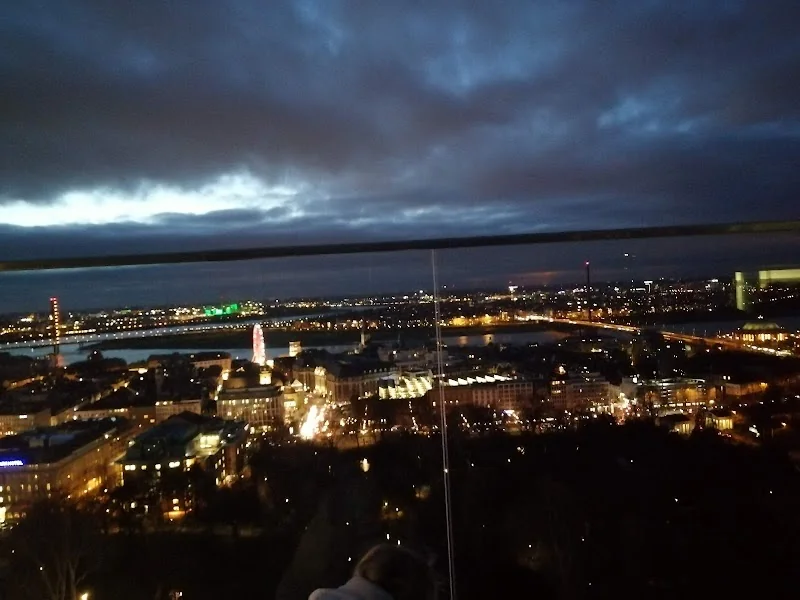
Another highlight is the rooftop terraces on the upper floors. The website and architectural project descriptions emphasize that the newly gained rental spaces on the 22nd to 24th floors, as well as the terraces on the upper floors, are among the special features of the revitalization. Visit Düsseldorf describes a terrace on the 22nd floor that is publicly accessible on selected days and is said to offer one of the most beautiful panoramic views over Düsseldorf. For search queries like Dreischeibenhaus view, rooftop terrace, or special places in Düsseldorf, this is a strong argument. Especially in connection with Hofgarten, Schauspielhaus, and the view towards the Rhine, a very urban yet green cityscape emerges. The building is therefore interesting not only as an office location during the day but also as a place for experiences in architecture, enjoyment, and views. The combination of lobby gastronomy, public atmosphere, and selectively accessible rooftop terrace makes the Dreischeibenhaus unique. It shows how a historic skyscraper, through careful modernization, can become a place that allows for work, visiting, and enjoyment alike. ([dreischeibenhaus.de](https://dreischeibenhaus.de/))
Gustaf-Gründgens-Platz, Christmas Market, and the Surroundings of Dreischeibenhaus
The Dreischeibenhaus is closely linked to its surroundings, and for this reason, Gustaf-Gründgens-Platz plays a significant role in many search queries. The building, together with the Düsseldorf Schauspielhaus and the Kö-Bogen area, forms one of the most well-known urban ensembles in the city. The city of Düsseldorf describes the area south of Gustaf-Gründgens-Platz as a central city location between Schauspielhaus and Dreischeibenhaus and emphasizes that retail, gastronomy, and office spaces have been legally enabled there. With the dismantling of the Tausendfüßler in 2013, a new, more open urban situation was created that consciously frees the sightlines to these buildings. This is important for visitors because the Dreischeibenhaus does not appear as an isolated skyscraper but as part of an urban staging that brings together architecture, green space, and urban use. The Hofgarten surroundings and the proximity to Königsallee also contribute to this special impression. Therefore, those searching for Dreischeibenhaus Düsseldorf Christmas market or Dreischeibenhaus Gustaf-Gründgens-Platz will automatically land at one of the most defining squares in the city center. ([duesseldorf.de](https://www.duesseldorf.de/stadtplanungsamt/projektuebersicht/bebauungsplaene/koe-bogen-suedlich-gustaf-gruendgens-platz))
Especially during the Advent season, this location becomes particularly visible. Düsseldorf Tourism has repeatedly described that Christmas market huts or the Kö-Bogen market have been set up on Gustaf-Gründgens-Platz between Kö-Bogen II, Dreischeibenhaus, and Schauspielhaus. This makes the surroundings of the building an important part of the Düsseldorf Christmas market experience. For visitors exploring the city center in the pre-Christmas season, the combination of light, architecture, and markets is particularly appealing. The Dreischeibenhaus remains the vertical constant in the picture: slender, elegant, cool, and at the same time festively embedded in a vibrant environment. Even outside of winter, the area is used for public events or urban staging, which underscores the multifunctionality of the place. Therefore, those visiting the Dreischeibenhaus experience not just a single building but a piece of Düsseldorf's city identity. This makes the location so strong for SEO, content, and visitor information: it is an office location, restaurant address, architectural monument, viewpoint, and orientation point in urban space at the same time. This multifaceted nature is the reason why the Dreischeibenhaus remains a fixed term in Düsseldorf for decades. ([visitduesseldorf.de](https://www.visitduesseldorf.de/informieren/kontakt/medienservice/pressemitteilungen/duesseldorfer-weihnachtsmarkt-veranstalter-zieht-gemischtes-fazit))
Visiting Tips, Highlights, and Why the Dreischeibenhaus Continues to Fascinate
Those who want to visit the Dreischeibenhaus meaningfully should choose the timing not only based on the occasion but also according to the time of day. In the morning and at noon, the facade appears particularly clear, while in the afternoon and evening, the reflections of the glass surfaces and the light mood of the city center become more pronounced. For business visits, the combination of central location, well-planned access, and representative entrance is ideal. For architecture enthusiasts, a look at the three offset slabs, the stainless steel sides, and the interplay with the neighboring Schauspielhaus is worthwhile. For gastronomy guests, the lobby and restaurant are the right starting points, while visitors interested in views should keep an eye on the publicly accessible terraces on selected days. The connection between everyday use and monument is what makes the charm of the building. It is not an isolated monument but a lively place where work, movement, architecture, and city life intertwine. ([visitduesseldorf.de](https://www.visitduesseldorf.de/en/attractions/dreischeibenhaus-a7a82de102))
The Dreischeibenhaus continues to fascinate today because it has achieved something very rare: it has not only survived the passage of time but has also preserved and even strengthened its radiance. From post-war modernism through the Thyssen years, the vacancy, and the monument-compliant renovation to today's multi-tenant use, the building remains legible. It tells the story of economic history, architectural history, and urban history at the same time. That is why search terms like Dreischeibenhaus Düsseldorf, Dreischeibenhaus address, Dreischeibenhaus parking, Dreischeibenhaus tenants, or Dreischeibenhaus restaurant are not merely practical search queries but gateways to a place with genuine urban significance. Anyone wanting to understand Düsseldorf should know this building. It shows how a single building can become a lasting trademark of a city through form, material, location, and use. ([dreischeibenhaus.de](https://dreischeibenhaus.de/?utm_source=openai))
Sources:
- Dreischeibenhaus - Official Website
- Dreischeibenhaus - Directions and Parking
- Dreischeibenhaus - Tenants
- Dreischeibenhaus - Restaurant & Bar
- Visit Düsseldorf - Dreischeibenhaus
- Visit Düsseldorf - Cecino's Restaurant & Bar
- HPP Architects - Dreischeibenhaus
- State Capital Düsseldorf - Kö-Bogen south of Gustaf-Gründgens-Platz
- Visit Düsseldorf - Christmas Market at Gustaf-Gründgens-Platz
Show moreShow less
Dreischeibenhaus | Address & Parking
The Dreischeibenhaus is one of the most distinctive buildings in Düsseldorf and much more than a classic office skyscraper. Its slender silhouette of glass and steel has shaped the city center since 1960, standing between Hofgarten and Schauspielhaus as an architectural statement of post-war modernism, and continues to connect heritage value, high-quality office space, gastronomy, and spectacular views to this day. Originally planned as an administrative building for Phoenix-Rheinrohr AG and later used by Thyssen for decades, the building is a symbol of the economic miracle and at the same time a vibrant workplace for modern companies. Today, it is a multi-tenant building with an international tenant base, publicly accessible areas, and a location that is exciting for business visits, architecture enthusiasts, and city explorers alike. Those searching for Dreischeibenhaus Düsseldorf, address, parking, tenants, or restaurant will find not only practical information here but also one of the most important architectural icons of the city. ([dreischeibenhaus.de](https://dreischeibenhaus.de/?utm_source=openai))
History and Architecture of the Dreischeibenhaus
The most important reason for searching around the Dreischeibenhaus is its history, and this is precisely where it becomes clear why the building is considered one of the great icons of German post-war modernism. The skyscraper was built between 1957 and 1960 based on the design by Helmut Hentrich and Hubert Petschnigg for Phoenix-Rheinrohr AG, which was later taken over by Thyssen. Characteristic is the division into three offset, narrow slabs, of which the middle one clearly towers over the outer parts of the building. This shape gave the building its name and made it an early symbol of modern skyscraper architecture in Germany. The official architectural description emphasizes the clear glass-aluminum facade, the stainless steel sides, and the pioneering role of the construction with steel skeleton and curtain wall at that time. For its time, this combination was extraordinarily progressive and set standards far beyond Düsseldorf. The building was placed under monument protection in 1988 because it was already considered a precursor to later skyscrapers. After ThyssenKrupp vacated, it initially stood empty before MOMENI and Black Horse Investments took over the building in 2011 and commissioned HPP with the modernization. The revitalization was carried out in accordance with monument protection and under high ecological standards. In 2015, the project received the MIPIM Award in the Best Refurbishment category. This not only restored a landmark but also brought a piece of architectural history into the present. ([dreischeibenhaus.de](https://dreischeibenhaus.de/?utm_source=openai))
For today's perception of the building, it is equally important that the architecture has not become stagnant in a museum. The Dreischeibenhaus continues to function as an urban solitaire at Gustaf-Gründgens-Platz and forms one of the most well-known sightlines in the city together with the Schauspielhaus. The renovation retained the clear design language, reinforced materiality and proportions, while also enabling contemporary use. In the office areas, new, flexible structures were created that can adapt to different rental concepts. Particularly noteworthy is that the design of the lobby and public zones picks up the original elegance: dark marble floor, understated materials, and an atmosphere that consciously recalls the original architectural idea. Therefore, those who visit the Dreischeibenhaus today experience not only a representative business location but also a carefully maintained monument of the post-war period. This is precisely the charm of this place: it is historically significant, visually extraordinary, and at the same time completely present. This makes it one of the most important building blocks of any SEO consideration around Dreischeibenhaus Düsseldorf architecture, history, and features. ([hpp.com](https://www.hpp.com/projekte/fallstudien/dreischeibenhaus/))
Address, Directions, and Parking at Dreischeibenhaus Düsseldorf
Those searching for the address of the Dreischeibenhaus need clear and reliable information. Officially, the address is Dreischeibenhaus 1, 40211 Düsseldorf. The building is located in the city center in close proximity to Gustaf-Gründgens-Platz and thus in one of the most prominent inner-city areas of Düsseldorf. The surroundings are characterized by the short distance to Königsallee, Schadowstraße, Hofgarten, and Schauspielhaus. This location makes the building attractive not only for office visitors but also for tourist architectural walks. The city of Düsseldorf and Visit Düsseldorf explicitly highlight the central city location. For public transport access, the official website recommends the subway lines U70, U74, U75, U76, U77, and U78 from the main station to Heinrich-Heine-Allee. From there, the building is reachable on foot in just a few minutes. Visitors to the Dreischeibenhaus use the above-ground access via Goltsteinstraße and Bleichstraße, while tenants can access their underground garage directly via Berliner Allee or Hofgartenstraße through the KÖ-Bogen tunnel. This is particularly important because the traffic routing around Gustaf-Gründgens-Platz is very specific after the redevelopment of the surroundings. ([visitduesseldorf.de](https://www.visitduesseldorf.de/en/attractions/dreischeibenhaus-a7a82de102))
When it comes to parking at Dreischeibenhaus, the official information is particularly helpful as it distinguishes between visitor and tenant traffic. In the immediate vicinity, the website lists the parking garages KII/Schauspielhaus APCOA, Schadowstraße/Bleichstraße, and KÖ-Bogen. These parking garages are reachable within a few minutes on foot and are the most practical solution for guests. For tenants, there is a separate underground garage access integrated into the underground traffic network of the KÖ-Bogen tunnel. This shows how closely architecture, traffic planning, and city center development are interconnected at this location. For SEO around Dreischeibenhaus Düsseldorf parking garage, directions, and address, not only the location itself is important, but also the proximity to other central destinations. Business travelers benefit from the short distance to the main station and the very good accessibility by subway and car. Tourists often combine their visit with Königsallee, Hofgarten, or Schauspielhaus. Thus, the Dreischeibenhaus is a location that offers convincing conditions for both mobility and urban quality of stay. ([dreischeibenhaus.de](https://dreischeibenhaus.de/anfahrt))
Tenants, Companies, and Flexible Office Spaces in Dreischeibenhaus
A central keyword theme around the Dreischeibenhaus is the question of tenants and companies, and here the building shows its current economic strength. According to the official tenant overview, modernized office spaces for flexible re-rental are located on floors 1 to 24. A total of around 1200 employees can be accommodated there. The tenant base is deliberately composed of high-quality and international companies. Among others, Allen Overy Shearman Sterling, Clyde & Co, DLA Piper, Gleiss Lutz, Hogan Lovells, Jones Lang LaSalle, Kearney, LGT Bank, MOMENI Group, National Football League, Rautenberg & Company, TechniRopa Holding, and other users are mentioned. Additionally, COLLECTION Business Center serves as a flexibly usable office provider. This mix of international law firms, consultancies, financial players, and corporate groups perfectly matches the character of the building as a premium-oriented location in the heart of Düsseldorf. For search queries like Dreischeibenhaus companies, Dreischeibenhaus tenants, or Dreischeibenhaus Düsseldorf companies, this multi-tenant concept is particularly relevant. It transforms the building from a mere landmark into a productive workplace with high visibility and a representative environment. ([dreischeibenhaus.de](https://dreischeibenhaus.de/mieter))
From an architectural perspective, the tenant usage is also remarkable. The renovation placed great emphasis on combining historical quality with modern work requirements. The interiors were partially built out by the tenants themselves and partly designed with references to the building, such as the green marble floor as a conscious motif. At the same time, the office spaces can be flexibly used as single offices, combination offices, or group rooms thanks to the new structure. This adaptability is an important reason why the Dreischeibenhaus became so attractive again after the revitalization. It combines prestige with usability. Companies receive an address that has an immediate impact but is also technically and spatially tailored to modern office needs. For those searching for offices in Dreischeibenhaus, companies in Dreischeibenhaus, or tenants in Düsseldorf city center, the building is therefore a reference object. The combination of prime location, monument protection, modern amenities, and international neighborhood clearly sets it apart from ordinary office properties. That a building from the peak phase of post-war modernism is now used for new work and multi-tenant concepts also shows how successfully good architecture can be adapted over decades. ([hpp.com](https://www.hpp.com/projekte/fallstudien/dreischeibenhaus/))
Restaurant, Bar, and Public Areas in Dreischeibenhaus
Those searching for Dreischeibenhaus restaurant, Dreischeibenhaus bar, or even Dreischeibenhaus Italian restaurant will come across an interesting gastronomic offer in the building. The official website describes PHOENIX as a restaurant with a bar operation in the lobby, serving as a culinary and social meeting point for the city. Seasonal dishes and modern interpretations of classics are offered there for lunch and dinner. Visit Düsseldorf additionally lists Cecino's Restaurant & Bar at the same address and describes it as an Italian address in Dreischeibenhaus 1, which is also open to guests from the surrounding area. For visitors, this means in practice: there is gastronomy directly in the building, which is not only intended for tenants but also for people exploring the city center or on business trips. Particularly important is the public accessibility of the lobby, which is explicitly highlighted by the website. The Dreischeibenhaus is therefore not just a closed office complex but partly an open urban building with quality of stay. ([dreischeibenhaus.de](https://dreischeibenhaus.de/phoenix))
Another highlight is the rooftop terraces on the upper floors. The website and architectural project descriptions emphasize that the newly gained rental spaces on the 22nd to 24th floors, as well as the terraces on the upper floors, are among the special features of the revitalization. Visit Düsseldorf describes a terrace on the 22nd floor that is publicly accessible on selected days and is said to offer one of the most beautiful panoramic views over Düsseldorf. For search queries like Dreischeibenhaus view, rooftop terrace, or special places in Düsseldorf, this is a strong argument. Especially in connection with Hofgarten, Schauspielhaus, and the view towards the Rhine, a very urban yet green cityscape emerges. The building is therefore interesting not only as an office location during the day but also as a place for experiences in architecture, enjoyment, and views. The combination of lobby gastronomy, public atmosphere, and selectively accessible rooftop terrace makes the Dreischeibenhaus unique. It shows how a historic skyscraper, through careful modernization, can become a place that allows for work, visiting, and enjoyment alike. ([dreischeibenhaus.de](https://dreischeibenhaus.de/))
Gustaf-Gründgens-Platz, Christmas Market, and the Surroundings of Dreischeibenhaus
The Dreischeibenhaus is closely linked to its surroundings, and for this reason, Gustaf-Gründgens-Platz plays a significant role in many search queries. The building, together with the Düsseldorf Schauspielhaus and the Kö-Bogen area, forms one of the most well-known urban ensembles in the city. The city of Düsseldorf describes the area south of Gustaf-Gründgens-Platz as a central city location between Schauspielhaus and Dreischeibenhaus and emphasizes that retail, gastronomy, and office spaces have been legally enabled there. With the dismantling of the Tausendfüßler in 2013, a new, more open urban situation was created that consciously frees the sightlines to these buildings. This is important for visitors because the Dreischeibenhaus does not appear as an isolated skyscraper but as part of an urban staging that brings together architecture, green space, and urban use. The Hofgarten surroundings and the proximity to Königsallee also contribute to this special impression. Therefore, those searching for Dreischeibenhaus Düsseldorf Christmas market or Dreischeibenhaus Gustaf-Gründgens-Platz will automatically land at one of the most defining squares in the city center. ([duesseldorf.de](https://www.duesseldorf.de/stadtplanungsamt/projektuebersicht/bebauungsplaene/koe-bogen-suedlich-gustaf-gruendgens-platz))
Especially during the Advent season, this location becomes particularly visible. Düsseldorf Tourism has repeatedly described that Christmas market huts or the Kö-Bogen market have been set up on Gustaf-Gründgens-Platz between Kö-Bogen II, Dreischeibenhaus, and Schauspielhaus. This makes the surroundings of the building an important part of the Düsseldorf Christmas market experience. For visitors exploring the city center in the pre-Christmas season, the combination of light, architecture, and markets is particularly appealing. The Dreischeibenhaus remains the vertical constant in the picture: slender, elegant, cool, and at the same time festively embedded in a vibrant environment. Even outside of winter, the area is used for public events or urban staging, which underscores the multifunctionality of the place. Therefore, those visiting the Dreischeibenhaus experience not just a single building but a piece of Düsseldorf's city identity. This makes the location so strong for SEO, content, and visitor information: it is an office location, restaurant address, architectural monument, viewpoint, and orientation point in urban space at the same time. This multifaceted nature is the reason why the Dreischeibenhaus remains a fixed term in Düsseldorf for decades. ([visitduesseldorf.de](https://www.visitduesseldorf.de/informieren/kontakt/medienservice/pressemitteilungen/duesseldorfer-weihnachtsmarkt-veranstalter-zieht-gemischtes-fazit))
Visiting Tips, Highlights, and Why the Dreischeibenhaus Continues to Fascinate
Those who want to visit the Dreischeibenhaus meaningfully should choose the timing not only based on the occasion but also according to the time of day. In the morning and at noon, the facade appears particularly clear, while in the afternoon and evening, the reflections of the glass surfaces and the light mood of the city center become more pronounced. For business visits, the combination of central location, well-planned access, and representative entrance is ideal. For architecture enthusiasts, a look at the three offset slabs, the stainless steel sides, and the interplay with the neighboring Schauspielhaus is worthwhile. For gastronomy guests, the lobby and restaurant are the right starting points, while visitors interested in views should keep an eye on the publicly accessible terraces on selected days. The connection between everyday use and monument is what makes the charm of the building. It is not an isolated monument but a lively place where work, movement, architecture, and city life intertwine. ([visitduesseldorf.de](https://www.visitduesseldorf.de/en/attractions/dreischeibenhaus-a7a82de102))
The Dreischeibenhaus continues to fascinate today because it has achieved something very rare: it has not only survived the passage of time but has also preserved and even strengthened its radiance. From post-war modernism through the Thyssen years, the vacancy, and the monument-compliant renovation to today's multi-tenant use, the building remains legible. It tells the story of economic history, architectural history, and urban history at the same time. That is why search terms like Dreischeibenhaus Düsseldorf, Dreischeibenhaus address, Dreischeibenhaus parking, Dreischeibenhaus tenants, or Dreischeibenhaus restaurant are not merely practical search queries but gateways to a place with genuine urban significance. Anyone wanting to understand Düsseldorf should know this building. It shows how a single building can become a lasting trademark of a city through form, material, location, and use. ([dreischeibenhaus.de](https://dreischeibenhaus.de/?utm_source=openai))
Sources:
- Dreischeibenhaus - Official Website
- Dreischeibenhaus - Directions and Parking
- Dreischeibenhaus - Tenants
- Dreischeibenhaus - Restaurant & Bar
- Visit Düsseldorf - Dreischeibenhaus
- Visit Düsseldorf - Cecino's Restaurant & Bar
- HPP Architects - Dreischeibenhaus
- State Capital Düsseldorf - Kö-Bogen south of Gustaf-Gründgens-Platz
- Visit Düsseldorf - Christmas Market at Gustaf-Gründgens-Platz
Dreischeibenhaus | Address & Parking
The Dreischeibenhaus is one of the most distinctive buildings in Düsseldorf and much more than a classic office skyscraper. Its slender silhouette of glass and steel has shaped the city center since 1960, standing between Hofgarten and Schauspielhaus as an architectural statement of post-war modernism, and continues to connect heritage value, high-quality office space, gastronomy, and spectacular views to this day. Originally planned as an administrative building for Phoenix-Rheinrohr AG and later used by Thyssen for decades, the building is a symbol of the economic miracle and at the same time a vibrant workplace for modern companies. Today, it is a multi-tenant building with an international tenant base, publicly accessible areas, and a location that is exciting for business visits, architecture enthusiasts, and city explorers alike. Those searching for Dreischeibenhaus Düsseldorf, address, parking, tenants, or restaurant will find not only practical information here but also one of the most important architectural icons of the city. ([dreischeibenhaus.de](https://dreischeibenhaus.de/?utm_source=openai))
History and Architecture of the Dreischeibenhaus
The most important reason for searching around the Dreischeibenhaus is its history, and this is precisely where it becomes clear why the building is considered one of the great icons of German post-war modernism. The skyscraper was built between 1957 and 1960 based on the design by Helmut Hentrich and Hubert Petschnigg for Phoenix-Rheinrohr AG, which was later taken over by Thyssen. Characteristic is the division into three offset, narrow slabs, of which the middle one clearly towers over the outer parts of the building. This shape gave the building its name and made it an early symbol of modern skyscraper architecture in Germany. The official architectural description emphasizes the clear glass-aluminum facade, the stainless steel sides, and the pioneering role of the construction with steel skeleton and curtain wall at that time. For its time, this combination was extraordinarily progressive and set standards far beyond Düsseldorf. The building was placed under monument protection in 1988 because it was already considered a precursor to later skyscrapers. After ThyssenKrupp vacated, it initially stood empty before MOMENI and Black Horse Investments took over the building in 2011 and commissioned HPP with the modernization. The revitalization was carried out in accordance with monument protection and under high ecological standards. In 2015, the project received the MIPIM Award in the Best Refurbishment category. This not only restored a landmark but also brought a piece of architectural history into the present. ([dreischeibenhaus.de](https://dreischeibenhaus.de/?utm_source=openai))
For today's perception of the building, it is equally important that the architecture has not become stagnant in a museum. The Dreischeibenhaus continues to function as an urban solitaire at Gustaf-Gründgens-Platz and forms one of the most well-known sightlines in the city together with the Schauspielhaus. The renovation retained the clear design language, reinforced materiality and proportions, while also enabling contemporary use. In the office areas, new, flexible structures were created that can adapt to different rental concepts. Particularly noteworthy is that the design of the lobby and public zones picks up the original elegance: dark marble floor, understated materials, and an atmosphere that consciously recalls the original architectural idea. Therefore, those who visit the Dreischeibenhaus today experience not only a representative business location but also a carefully maintained monument of the post-war period. This is precisely the charm of this place: it is historically significant, visually extraordinary, and at the same time completely present. This makes it one of the most important building blocks of any SEO consideration around Dreischeibenhaus Düsseldorf architecture, history, and features. ([hpp.com](https://www.hpp.com/projekte/fallstudien/dreischeibenhaus/))
Address, Directions, and Parking at Dreischeibenhaus Düsseldorf
Those searching for the address of the Dreischeibenhaus need clear and reliable information. Officially, the address is Dreischeibenhaus 1, 40211 Düsseldorf. The building is located in the city center in close proximity to Gustaf-Gründgens-Platz and thus in one of the most prominent inner-city areas of Düsseldorf. The surroundings are characterized by the short distance to Königsallee, Schadowstraße, Hofgarten, and Schauspielhaus. This location makes the building attractive not only for office visitors but also for tourist architectural walks. The city of Düsseldorf and Visit Düsseldorf explicitly highlight the central city location. For public transport access, the official website recommends the subway lines U70, U74, U75, U76, U77, and U78 from the main station to Heinrich-Heine-Allee. From there, the building is reachable on foot in just a few minutes. Visitors to the Dreischeibenhaus use the above-ground access via Goltsteinstraße and Bleichstraße, while tenants can access their underground garage directly via Berliner Allee or Hofgartenstraße through the KÖ-Bogen tunnel. This is particularly important because the traffic routing around Gustaf-Gründgens-Platz is very specific after the redevelopment of the surroundings. ([visitduesseldorf.de](https://www.visitduesseldorf.de/en/attractions/dreischeibenhaus-a7a82de102))
When it comes to parking at Dreischeibenhaus, the official information is particularly helpful as it distinguishes between visitor and tenant traffic. In the immediate vicinity, the website lists the parking garages KII/Schauspielhaus APCOA, Schadowstraße/Bleichstraße, and KÖ-Bogen. These parking garages are reachable within a few minutes on foot and are the most practical solution for guests. For tenants, there is a separate underground garage access integrated into the underground traffic network of the KÖ-Bogen tunnel. This shows how closely architecture, traffic planning, and city center development are interconnected at this location. For SEO around Dreischeibenhaus Düsseldorf parking garage, directions, and address, not only the location itself is important, but also the proximity to other central destinations. Business travelers benefit from the short distance to the main station and the very good accessibility by subway and car. Tourists often combine their visit with Königsallee, Hofgarten, or Schauspielhaus. Thus, the Dreischeibenhaus is a location that offers convincing conditions for both mobility and urban quality of stay. ([dreischeibenhaus.de](https://dreischeibenhaus.de/anfahrt))
Tenants, Companies, and Flexible Office Spaces in Dreischeibenhaus
A central keyword theme around the Dreischeibenhaus is the question of tenants and companies, and here the building shows its current economic strength. According to the official tenant overview, modernized office spaces for flexible re-rental are located on floors 1 to 24. A total of around 1200 employees can be accommodated there. The tenant base is deliberately composed of high-quality and international companies. Among others, Allen Overy Shearman Sterling, Clyde & Co, DLA Piper, Gleiss Lutz, Hogan Lovells, Jones Lang LaSalle, Kearney, LGT Bank, MOMENI Group, National Football League, Rautenberg & Company, TechniRopa Holding, and other users are mentioned. Additionally, COLLECTION Business Center serves as a flexibly usable office provider. This mix of international law firms, consultancies, financial players, and corporate groups perfectly matches the character of the building as a premium-oriented location in the heart of Düsseldorf. For search queries like Dreischeibenhaus companies, Dreischeibenhaus tenants, or Dreischeibenhaus Düsseldorf companies, this multi-tenant concept is particularly relevant. It transforms the building from a mere landmark into a productive workplace with high visibility and a representative environment. ([dreischeibenhaus.de](https://dreischeibenhaus.de/mieter))
From an architectural perspective, the tenant usage is also remarkable. The renovation placed great emphasis on combining historical quality with modern work requirements. The interiors were partially built out by the tenants themselves and partly designed with references to the building, such as the green marble floor as a conscious motif. At the same time, the office spaces can be flexibly used as single offices, combination offices, or group rooms thanks to the new structure. This adaptability is an important reason why the Dreischeibenhaus became so attractive again after the revitalization. It combines prestige with usability. Companies receive an address that has an immediate impact but is also technically and spatially tailored to modern office needs. For those searching for offices in Dreischeibenhaus, companies in Dreischeibenhaus, or tenants in Düsseldorf city center, the building is therefore a reference object. The combination of prime location, monument protection, modern amenities, and international neighborhood clearly sets it apart from ordinary office properties. That a building from the peak phase of post-war modernism is now used for new work and multi-tenant concepts also shows how successfully good architecture can be adapted over decades. ([hpp.com](https://www.hpp.com/projekte/fallstudien/dreischeibenhaus/))
Restaurant, Bar, and Public Areas in Dreischeibenhaus
Those searching for Dreischeibenhaus restaurant, Dreischeibenhaus bar, or even Dreischeibenhaus Italian restaurant will come across an interesting gastronomic offer in the building. The official website describes PHOENIX as a restaurant with a bar operation in the lobby, serving as a culinary and social meeting point for the city. Seasonal dishes and modern interpretations of classics are offered there for lunch and dinner. Visit Düsseldorf additionally lists Cecino's Restaurant & Bar at the same address and describes it as an Italian address in Dreischeibenhaus 1, which is also open to guests from the surrounding area. For visitors, this means in practice: there is gastronomy directly in the building, which is not only intended for tenants but also for people exploring the city center or on business trips. Particularly important is the public accessibility of the lobby, which is explicitly highlighted by the website. The Dreischeibenhaus is therefore not just a closed office complex but partly an open urban building with quality of stay. ([dreischeibenhaus.de](https://dreischeibenhaus.de/phoenix))
Another highlight is the rooftop terraces on the upper floors. The website and architectural project descriptions emphasize that the newly gained rental spaces on the 22nd to 24th floors, as well as the terraces on the upper floors, are among the special features of the revitalization. Visit Düsseldorf describes a terrace on the 22nd floor that is publicly accessible on selected days and is said to offer one of the most beautiful panoramic views over Düsseldorf. For search queries like Dreischeibenhaus view, rooftop terrace, or special places in Düsseldorf, this is a strong argument. Especially in connection with Hofgarten, Schauspielhaus, and the view towards the Rhine, a very urban yet green cityscape emerges. The building is therefore interesting not only as an office location during the day but also as a place for experiences in architecture, enjoyment, and views. The combination of lobby gastronomy, public atmosphere, and selectively accessible rooftop terrace makes the Dreischeibenhaus unique. It shows how a historic skyscraper, through careful modernization, can become a place that allows for work, visiting, and enjoyment alike. ([dreischeibenhaus.de](https://dreischeibenhaus.de/))
Gustaf-Gründgens-Platz, Christmas Market, and the Surroundings of Dreischeibenhaus
The Dreischeibenhaus is closely linked to its surroundings, and for this reason, Gustaf-Gründgens-Platz plays a significant role in many search queries. The building, together with the Düsseldorf Schauspielhaus and the Kö-Bogen area, forms one of the most well-known urban ensembles in the city. The city of Düsseldorf describes the area south of Gustaf-Gründgens-Platz as a central city location between Schauspielhaus and Dreischeibenhaus and emphasizes that retail, gastronomy, and office spaces have been legally enabled there. With the dismantling of the Tausendfüßler in 2013, a new, more open urban situation was created that consciously frees the sightlines to these buildings. This is important for visitors because the Dreischeibenhaus does not appear as an isolated skyscraper but as part of an urban staging that brings together architecture, green space, and urban use. The Hofgarten surroundings and the proximity to Königsallee also contribute to this special impression. Therefore, those searching for Dreischeibenhaus Düsseldorf Christmas market or Dreischeibenhaus Gustaf-Gründgens-Platz will automatically land at one of the most defining squares in the city center. ([duesseldorf.de](https://www.duesseldorf.de/stadtplanungsamt/projektuebersicht/bebauungsplaene/koe-bogen-suedlich-gustaf-gruendgens-platz))
Especially during the Advent season, this location becomes particularly visible. Düsseldorf Tourism has repeatedly described that Christmas market huts or the Kö-Bogen market have been set up on Gustaf-Gründgens-Platz between Kö-Bogen II, Dreischeibenhaus, and Schauspielhaus. This makes the surroundings of the building an important part of the Düsseldorf Christmas market experience. For visitors exploring the city center in the pre-Christmas season, the combination of light, architecture, and markets is particularly appealing. The Dreischeibenhaus remains the vertical constant in the picture: slender, elegant, cool, and at the same time festively embedded in a vibrant environment. Even outside of winter, the area is used for public events or urban staging, which underscores the multifunctionality of the place. Therefore, those visiting the Dreischeibenhaus experience not just a single building but a piece of Düsseldorf's city identity. This makes the location so strong for SEO, content, and visitor information: it is an office location, restaurant address, architectural monument, viewpoint, and orientation point in urban space at the same time. This multifaceted nature is the reason why the Dreischeibenhaus remains a fixed term in Düsseldorf for decades. ([visitduesseldorf.de](https://www.visitduesseldorf.de/informieren/kontakt/medienservice/pressemitteilungen/duesseldorfer-weihnachtsmarkt-veranstalter-zieht-gemischtes-fazit))
Visiting Tips, Highlights, and Why the Dreischeibenhaus Continues to Fascinate
Those who want to visit the Dreischeibenhaus meaningfully should choose the timing not only based on the occasion but also according to the time of day. In the morning and at noon, the facade appears particularly clear, while in the afternoon and evening, the reflections of the glass surfaces and the light mood of the city center become more pronounced. For business visits, the combination of central location, well-planned access, and representative entrance is ideal. For architecture enthusiasts, a look at the three offset slabs, the stainless steel sides, and the interplay with the neighboring Schauspielhaus is worthwhile. For gastronomy guests, the lobby and restaurant are the right starting points, while visitors interested in views should keep an eye on the publicly accessible terraces on selected days. The connection between everyday use and monument is what makes the charm of the building. It is not an isolated monument but a lively place where work, movement, architecture, and city life intertwine. ([visitduesseldorf.de](https://www.visitduesseldorf.de/en/attractions/dreischeibenhaus-a7a82de102))
The Dreischeibenhaus continues to fascinate today because it has achieved something very rare: it has not only survived the passage of time but has also preserved and even strengthened its radiance. From post-war modernism through the Thyssen years, the vacancy, and the monument-compliant renovation to today's multi-tenant use, the building remains legible. It tells the story of economic history, architectural history, and urban history at the same time. That is why search terms like Dreischeibenhaus Düsseldorf, Dreischeibenhaus address, Dreischeibenhaus parking, Dreischeibenhaus tenants, or Dreischeibenhaus restaurant are not merely practical search queries but gateways to a place with genuine urban significance. Anyone wanting to understand Düsseldorf should know this building. It shows how a single building can become a lasting trademark of a city through form, material, location, and use. ([dreischeibenhaus.de](https://dreischeibenhaus.de/?utm_source=openai))
Sources:
- Dreischeibenhaus - Official Website
- Dreischeibenhaus - Directions and Parking
- Dreischeibenhaus - Tenants
- Dreischeibenhaus - Restaurant & Bar
- Visit Düsseldorf - Dreischeibenhaus
- Visit Düsseldorf - Cecino's Restaurant & Bar
- HPP Architects - Dreischeibenhaus
- State Capital Düsseldorf - Kö-Bogen south of Gustaf-Gründgens-Platz
- Visit Düsseldorf - Christmas Market at Gustaf-Gründgens-Platz
Frequently Asked Questions
Reviews
No reviews found