
Adolph Schroedter
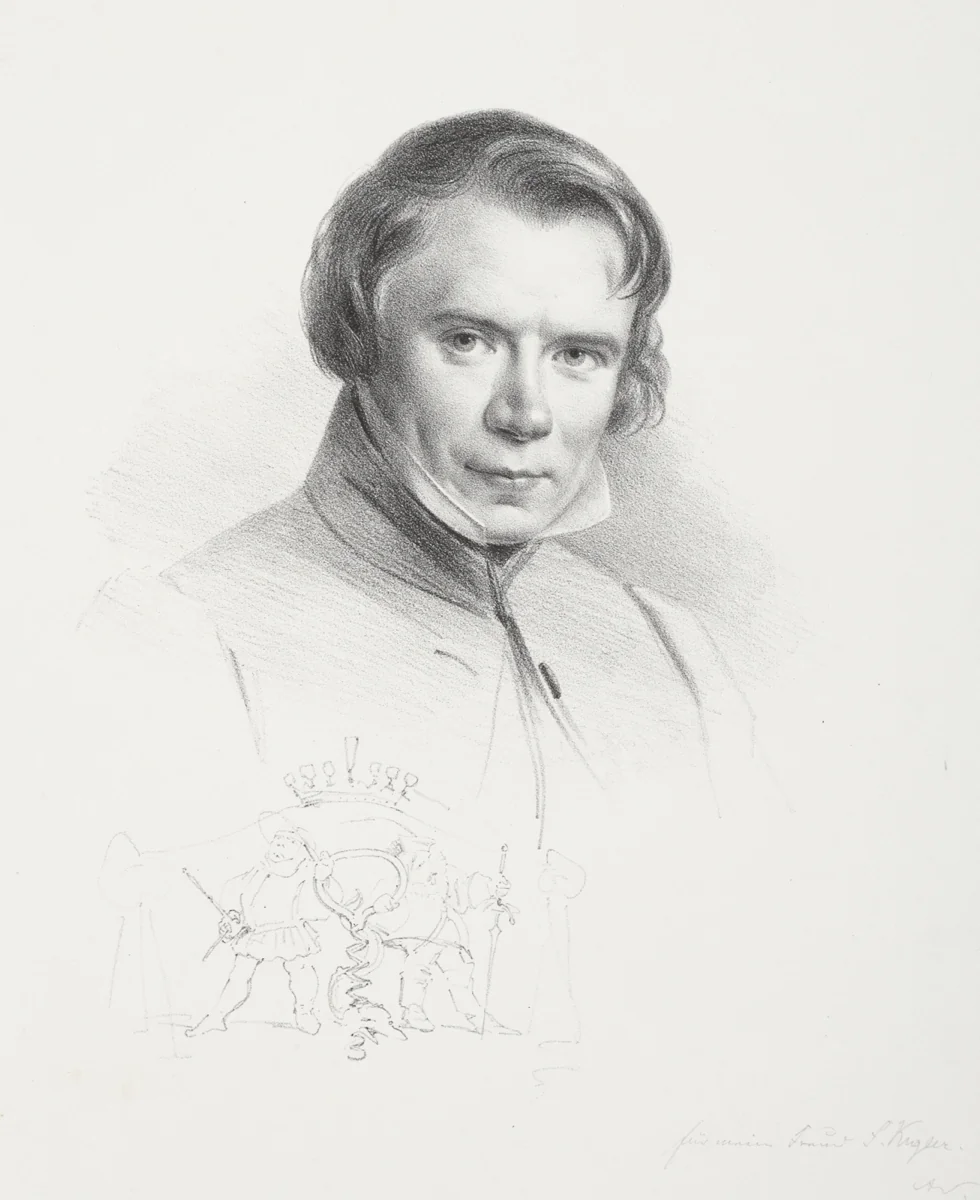
Image from Wikipedia
Image from Wikipedia
Adolph Schroedter: The Humorist of the Düsseldorf School and an Early Visionary of Visual Satire
Between Artistic Drawing, Caricature, and Narrative Imagination
Adolph Schroedter was much more than a painter of his time: he became one of the wittiest representatives of the Düsseldorf School of Painting, shaping a form of art through drawing, etching, lithography, and illustration that combined humor, observational talent, and social sharpness. Born on June 28, 1805, in Schwedt/Oder, and passed away on December 9, 1875, in Karlsruhe, the artist is today regarded as a pioneer of a visual language that already exhibits elements reminiscent of modern comic storytelling. His work navigates the realms of genre painting, satire, ornamentation, and artistic narrative graphics. ([de.wikipedia.org](https://de.wikipedia.org/wiki/Adolph_Schroedter))
Biographical Roots and Artistic Training
Schroedter came from a craft-oriented family: his father was a copper engraver, and it was there that his early training began. In 1820, he entered the Berlin Academy, completing his graphic training in the studio of the engraver Buchhorn. Even at this stage, his dual talent for precise line work and pictorial invention, which would later define his entire oeuvre, became evident. ([de.wikipedia.org](https://de.wikipedia.org/wiki/Adolph_Schroedter))
From 1829 onwards, he studied under Wilhelm Schadow in Düsseldorf, where he found the artistic space to develop his signature style. The Düsseldorf School provided him with a blend of academic discipline, narrative painting, and literary inspiration that proved crucial for his development. In this environment, he sculpted a visual language that focused not on pathetic elevation, but rather on human types, pointed situations, and fine wit. ([de.wikipedia.org](https://de.wikipedia.org/wiki/Adolph_Schroedter))
The Breakthrough: Humor as a Principle of Art
Schroedter quickly made a name for himself as an artist with a pronounced sense of character and comic exaggeration. Some of his favorite figures included Don Quixote, Falstaff, Till Eulenspiegel, and Baron Munchausen—literary heroes and rogues whose contradictions he highlighted with painterly precision. Particularly, his depiction of Don Quixote became widely known and was appreciated even in the Spanish cultural sphere; Heinrich Heine explicitly praised his interpretation of the material. ([deutsche-biographie.de](https://www.deutsche-biographie.de/sfz52424.html))
In these works, Schroedter's unique strength is especially evident: he translated literature into visual humor without reducing the characters to mere caricatures. His compositions fuse observation, narrative flow, and ironic distance. As a result, his art not only entertains but also makes the inherent logic of humor visible as a serious medium of design. ([deutsche-biographie.de](https://www.deutsche-biographie.de/sfz52424.html))
Düsseldorf, Frankfurt, London: Stations of a Dynamic Career
Since 1847, Schroedter contributed social-critical and political drawings to the Düsseldorfer Monathefte. This significantly expanded his artistic role: from a humorous observer of genres, he also became a pointed commentator of his time. In 1846 and 1847, he even took on the role of president of the Allgemeiner Verein der Carnevals-Freunde in Düsseldorf, showcasing how closely art, sociability, and urban culture were intertwined in his environment. ([de.wikipedia.org](https://de.wikipedia.org/wiki/Adolph_Schroedter))
In 1848, he undertook a study trip to London before living in Frankfurt am Main with his wife from 1848 to 1849, where he worked with Johann Hermann Detmold on the parody "Thaten und Meinungen des Herrn Piepmeyer, Abgeordneten zur constitutierenden Nationalversammlung zu Frankfurt am Main." This episode underscores his closeness to satirical journalism and political imagery. He returned to Düsseldorf in 1854, and in 1859, he received a professorship in Ornamentation at the Karlsruhe Polytechnic, a position he held until 1872. ([de.wikipedia.org](https://de.wikipedia.org/wiki/Adolph_Schroedter))
The Karlsruhe Years and Academic Recognition
With his move to Karlsruhe, Schroedter entered a new phase of his artistic career—where his practical experience began to align with institutional authority. As a professor of ornamentation, he imparted not only a sense of form and decorative art but also a precise eye for rhythm, repetition, and visual dramaturgy. His ornamental works and arabesques reveal how much he was engaged with the order of lines and the elegance of visual composition. ([de.wikipedia.org](https://de.wikipedia.org/wiki/Adolph_Schroedter))
In Karlsruhe, he solidified his reputation as a versatile artist and teacher. The city became a center of his later productivity, where he intertwined painting, graphics, and theoretical reflections on art. His simultaneous profile as a writer further reinforces the image of an artist who did not confine his creativity to a single discipline. ([de.wikipedia.org](https://de.wikipedia.org/wiki/Adolph_Schroedter))
Œuvre, Techniques, and Artistic Signature
Schroedter's oeuvre is remarkably diverse. He worked as a painter, illustrator of humorous poetry, copper engraver, etcher, woodcut artist, lithographer, political satirist, writer, botanist, and creator of ornaments and arabesques. This versatility is not a byproduct but rather the core of his artistic identity: his images thrive on precise composition, a fine sense of line, and the ability to condense meanings into small scenes. ([de.wikipedia.org](https://de.wikipedia.org/wiki/Adolph_Schroedter))
Particularly striking are his frieze-like compositions such as "Rheinische Bauernkirchweih," "The Triumph of King Wine," "Rheinwein, Maitrank, Punch, and Champagne," and "The Four Seasons." Such works demonstrate his sense of rhythmic picture sequences and decorative narrative style. His illustrations for "Peter Schlemihl," Musäus' folk tales, and Uhland's works further showcase how confidently he translated literary themes into visual scenes. ([de.wikipedia.org](https://de.wikipedia.org/wiki/Adolph_Schroedter))
Discography? No — a Visually and Artistically Rich Body of Work
As a historical artist, Schroedter does not have a discography in the musical sense, but the sequence of his works serves a similar function as an artistic catalog of development. The preserved works include early sheets such as "The Dying Abbot" and "The Mourning Tanners" as well as "Don Quijote Reading in His Study," "Münchhausen Telling His Hunting Adventures," or "Falstaff and His Page." These works mark important milestones in his oeuvre and illustrate the transition from romantically influenced genre studies to matured visual satire. ([de.wikipedia.org](https://de.wikipedia.org/wiki/Adolph_Schroedter))
The museum collections in Berlin, Frankfurt, and Karlsruhe document this development impressively. The Städel Museum lists him as a genre painter, copper engraver, draftsman, illustrator, caricaturist, and university teacher; the German Digital Library points to extensive holdings and correspondence. From this, a picture emerges of an artist whose influence lies not in chart successes but in art-historical resonance and lasting presence in significant collections. ([sammlung.staedelmuseum.de](https://sammlung.staedelmuseum.de/en/person/schroedter-adolf))
Critical Reception and Cultural Influence
Contemporary reception already recognized Schroedter's remarkable ability to choose themes witfully, compose confidently, and narrate vividly. German biographies and art historical accounts emphasize his humor, inventiveness, and his role as one of the notable representatives of Düsseldorf genre painting. It is also noteworthy that he anticipated elements of comics in his works. ([de.wikipedia.org](https://de.wikipedia.org/wiki/Adolph_Schroedter))
His cultural influence lies precisely in this connection between satire, narrative art, and visual emphasis. Schroedter demonstrated that visual art can not only idealize but also comment, caricature, and unveil social nuances. Thus, he stands at an exciting intersection between classical painting, graphic art, and modern visual culture. ([de.wikipedia.org](https://de.wikipedia.org/wiki/Adolph_Schroedter))
Private Environment and Family Connections
In 1840, Schroedter married Alwine Heuser, who became known as a painter of flowers and arabesques. The familial environment was also closely tied to the art world: Alwine's sister, Ida Heuser, married the painter Carl Friedrich Lessing in 1841, and the couple's daughter, Malwine, later married the painter and academy director Anton von Werner. These connections illustrate how deeply Schroedter's life journey was embedded in the artistic networks of the 19th century. ([de.wikipedia.org](https://de.wikipedia.org/wiki/Adolph_Schroedter))
The fact that Alwine Schroedter also emerged as an artist enhances the image of a creatively productive household. In such constellations, not only works were created, but also intellectual milieus where taste, technique, and aesthetic orientation mutually enriched one another. Thus, Schroedter's career can also be seen as part of a larger cultural context. ([de.wikipedia.org](https://de.wikipedia.org/wiki/Adolph_Schroedter))
Conclusion: An Artist with Wit, Depth, and Lasting Appeal
Adolph Schroedter continues to fascinate today because he combined intellectual agility with craftsmanship. His works are at once humorous, literary, decorative, and critical; this very mixture defines his status in art history. Anyone interested in the Düsseldorf School, early visual satire, or the origins of narrative comic aesthetics will discover in Schroedter an extraordinary name. Following him in museums and collections means experiencing an artist who made the image a speaking medium. ([de.wikipedia.org](https://de.wikipedia.org/wiki/Adolph_Schroedter))
Official Channels of Adolph Schroedter:
- Instagram: No official profile found
- Facebook: No official profile found
- YouTube: No official profile found
- Spotify: No official profile found
- TikTok: No official profile found