Political Discussions in Düsseldorf: Culture of Debate & Dialogue
Political Discussions & Talks in Düsseldorf: Find Dates, Choose Formats, Participate Well-Prepared (Outlook)
This overview looks ahead: Which political discussion formats typically take place in Düsseldorf in the coming months, how to reliably find suitable events, and how to prepare so that exchanges remain respectful, informative, and constructive.
What to Expect in Düsseldorf in the Future
If you want to attend political discussions and talks in Düsseldorf in the next weeks and months, you will likely encounter a wide range of public formats: moderated conversations, audience questions, dialogical workshops, and cultural evenings with subsequent discussion. Many organizers will focus on clear moderation, Q&A sessions, and a respectful conversation culture, so that even people without prior knowledge can participate.
For you as a visitor, this means: You will not only receive information, but in many formats you can also actively engage and ask questions—depending on the format, as an open discussion, structured Q&A, or small group format.
Formats: Talk, Panel, Reading, Film Discussion, Workshop
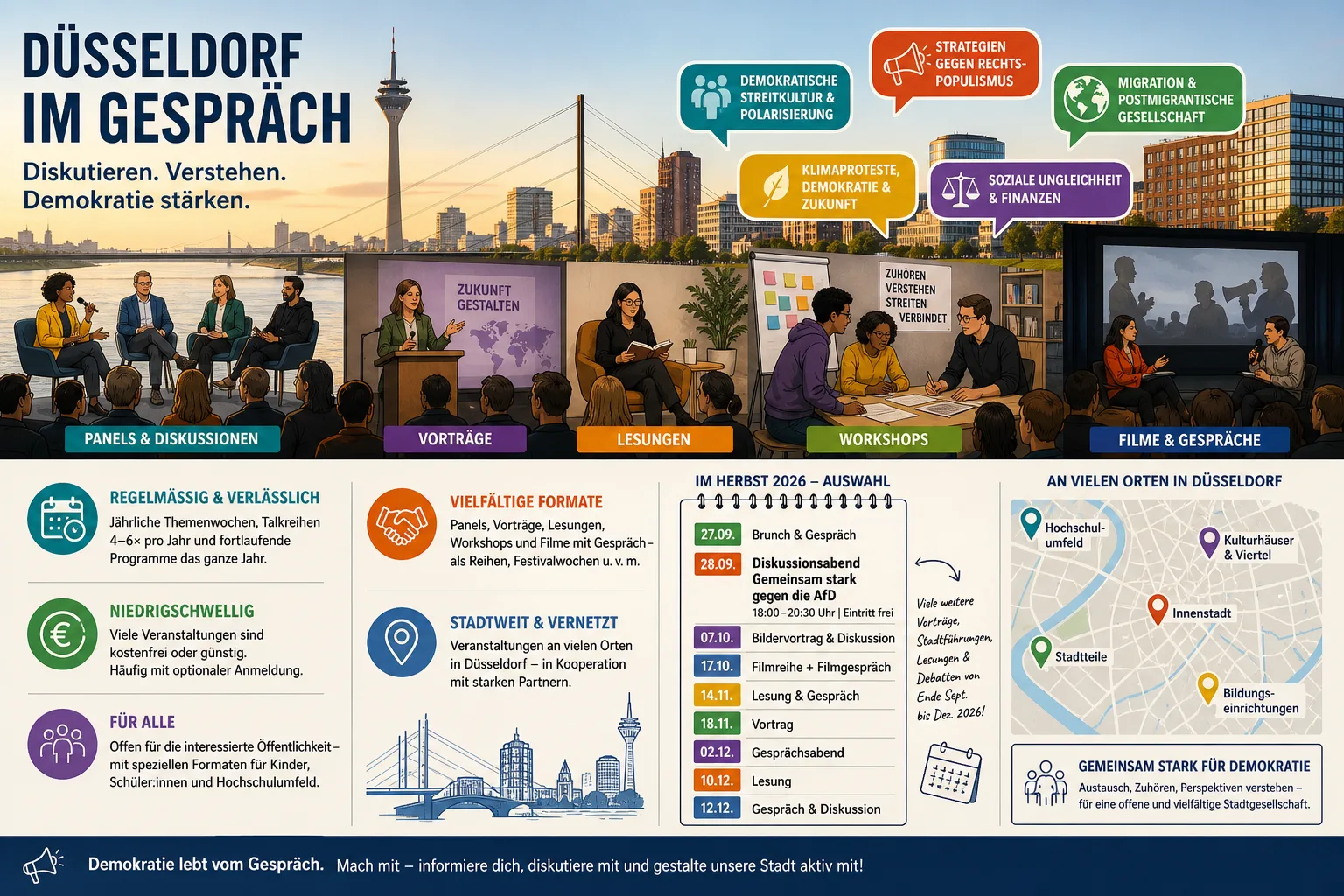
Panels & Moderated Talks (with Audience Questions)
Panels and talks in upcoming programs will often bring together multiple perspectives (e.g., science, journalism, civil society, practice). Typical are short inputs, followed by questions from the audience. If you are looking for controversial topics, you are most likely to find them here.
- Well suited for: Introduction to a topic, overview of arguments, discussion with experts.
- How to prepare: 10 minutes of preliminary reading (background article/official paper) and note 1–2 precise questions.
Readings & Book Discussions
Readings with subsequent discussion will continue to be a low-threshold access to politics and society. The conversation often follows the text and leads from there to current lines of conflict (e.g., democracy, social justice, migration, culture of remembrance).
- Well suited for: People who prefer to enter a topic through concrete stories/lines of argument.
- Tip: Look at the summary or reviews in advance to formulate targeted questions.
Film Screenings with Audience Discussion
Film evenings with discussion will be particularly useful in the coming months when topics are emotionally charged. A moderated post-discussion can help to classify impressions and make different perspectives heard.
- Well suited for: Discussion about values, experiences, societal consequences of political decisions.
- Note: Pay attention to the discussion part (duration, guest list, moderation) if exchange is important to you.
Workshops, Trainings & Participatory Formats
If you want to not only listen but also actively develop conversation skills, you will feel the greatest impact in workshops and trainings. Common elements are conversation rules, perspective shifts, dealing with disinformation, and practicing de-escalation.
- Well suited for: Volunteering, school, club, profession—anywhere conflicts occur "live".
- To be expected: Limited places and registration; sometimes a certificate of participation.
City Walks & Dialogical Urban Space Formats
City walks will often be used in upcoming programs to concretely locate political topics (housing, mobility, green spaces, social infrastructure). The conversation takes place on the go and is often structured by short stops and impulses.
- Well suited for: People who prefer concrete examples over abstract debates.
- Practical: Check weather, route, accessibility, and duration in advance.
Topics Likely to Be in Focus in Upcoming Programs
Which topics will appear particularly frequently on Düsseldorf stages, in educational offerings, and in neighborhood formats soon depends on the news situation, municipal decisions, and civil society debates. In practice, upcoming events will often revolve around the following focal points:
- Democracy & Cohesion: Dealing with polarization, protection of democratic institutions, participation culture.
- Media & Disinformation: Fact-checking, narratives, platform logics, constructive online debate.
- Migration & Diversity: Participation, belonging, anti-discrimination, post-migrant perspectives.
- Climate & Urban Development: Goal conflicts (mobility, housing, economy), acceptance and fair transformation policy.
- Social Issues & Justice: Cost of living, educational opportunities, housing policy, access to services.
If you are looking for a specific topic, it is worthwhile to filter not only by "politics" but also by keywords such as debate, dialogue, forum, workshop, conversation, or audience discussion.
How to Participate Well: Preparation, Conversation Rules, Asking Questions
So that you can get more out of political talks in Düsseldorf than just "opinions in the room" in the future, a short, practical preparation helps. This will work even if you attend spontaneously.
3-Minute Preparation On Site
- Clarify your goal: Do you want to understand, disagree, or share experiences?
- Formulate a question: Preferably concrete, concise, without presumption.
- Know a boundary: What do you not want to discuss (e.g., personal data, private stories)?
Questions That Move Discussions Forward
- "What assumption underlies your statement—and what data would disprove it?"
- "What would be the concrete consequences of this proposal for different groups in the city?"
- "What would be a realistic next step in the next 6–12 months?"
- "Where do you see the greatest goal conflict—and how do you prioritize?"
Arguing Respectfully (Without Diminishing Yourself)
For upcoming events, the following applies: Contradiction is common—personal devaluation is not. Helpful are I-messages ("I see it differently because…") and asking questions before evaluating. If moderation rules are mentioned, they usually apply to everyone; use them actively (e.g., hand signals, speakers' list, microphone times).
Practical Way: How to Find Future Dates in Düsseldorf
To really find future political discussions and talks in Düsseldorf (instead of outdated notices), a systematic search via official program calendars and established event portals is recommended. This approach is robust, whether you are planning a single evening or an entire series of talks.
Step-by-Step (10 Minutes)
- Set search parameters: Time period (e.g., next month), weekdays, time window, district.
- Combine sources: At least one official program page (culture/education/university) plus one event calendar.
- Use filters: "Politics", "Society", "Discussion", "Lecture", "Workshop".
- Check details: Moderation, Q&A share, registration, language, accessibility.
- Ensure up-to-dateness: Check date/time again on the event day (changes are possible).
How to Recognize Reliable Announcements
- Clear information on location, time, access (registration/entry), responsible persons/organizers.
- Transparent description of the format (lecture vs. discussion vs. workshop).
- Understandable information about guests (short bio, function, relevance to the topic).
- Notes on rules (e.g., house rules, photo/audio recordings, moderation).
Accessibility, Language, Costs: What to Pay Attention to in Advance
To select suitable events in the coming months, it is worth looking at organizational details that often determine good participation:
- Accessibility: Step-free access, seating, induction loop, accessible toilets (if indicated).
- Language: Event language (German/English), possibly sign language/translation (if offered).
- Costs: Admission, donation recommendation, reduced tickets (if indicated).
- Registration: Mandatory or recommended; waiting list; entry rules.
- Data protection: What data is requested upon registration, and for what purpose?
If information is missing, a short inquiry to the organizer is usually the quickest way to get planning security.
Safety & Respect: Boundaries, Moderation, House Rules
Political conversations can become heated in the future, especially when social conflicts are acute. Serious formats will therefore often work with moderation, clear rules, and reference to house rules. This protects participants and makes open debate possible in the first place.
- Moderation: Pay attention to whether speaking times, order, and handling of disruptions are explained.
- Boundaries: Discrimination, threats, and targeted intimidation are usually not tolerated in professional settings.
- Your own safety: If you feel uncomfortable, you may leave the conversation; if necessary, speak to the team.
This keeps the goal achievable: an exchange in which different positions can be expressed without people being devalued or threatened.
Sources & Further Information
The following basics help to classify conversation formats, discussion culture, and disinformation. They are intended as orientation if you want to inform yourself specifically before future events.
- UNESCO: Media and Information Literacy (MIL) — Overview of media and information literacy (retrieved on 2026-09-09)
- Federal Agency for Civic Education (bpb): Kurz & knapp — Introductory texts on politics & society (retrieved on 2026-09-09)
- European Commission: Digital Services Act (DSA) — Framework for platform responsibility and risks (retrieved on 2026-09-09)
- OECD: Open Government — Approaches to participation, transparency, and trust (retrieved on 2026-09-09)