Modern Architecture in Düsseldorf: MedienHafen & Kö-Bogen
Modern Architecture in Düsseldorf – Upcoming Experiences, Tours & Places to Discover in 2026/2027
Düsseldorf can be best understood through its new architecture: on the Rhine, in the city center, and even underground. This guide compiles ideas for future visits, recurring offers, and practical route planning – no retrospectives, but with a focus on the coming months and the upcoming season.
What to Expect in the Coming Months
For 2026/2027, it is worth planning modern architecture in Düsseldorf not just as a photo opportunity, but as a program: with guided tours, publicly accessible buildings, viewpoints, and an “underground” design route via the city railway. Many offers are bundled seasonally (spring to autumn) and additionally supplemented by special dates.
- Architecture tours and city walks (often thematic: MedienHafen, city center, Rhine front).
- Architecture from the inside: depending on the schedule, visits/public opening hours in cultural and administrative buildings.
- Route instead of single stop: Düsseldorf is suitable for compact half-day or full-day routes with short distances.
- Sustainability focus: Buildings and districts are increasingly discussed as examples of energy-efficient and circular-oriented planning.
Recommendation for the coming months: Plan at least two time slots – one for outdoor spaces (photo light, Rhine promenade) and one for indoor spaces (opening hours, tickets, security checks).
MedienHafen: Architecture Route on the Rhine
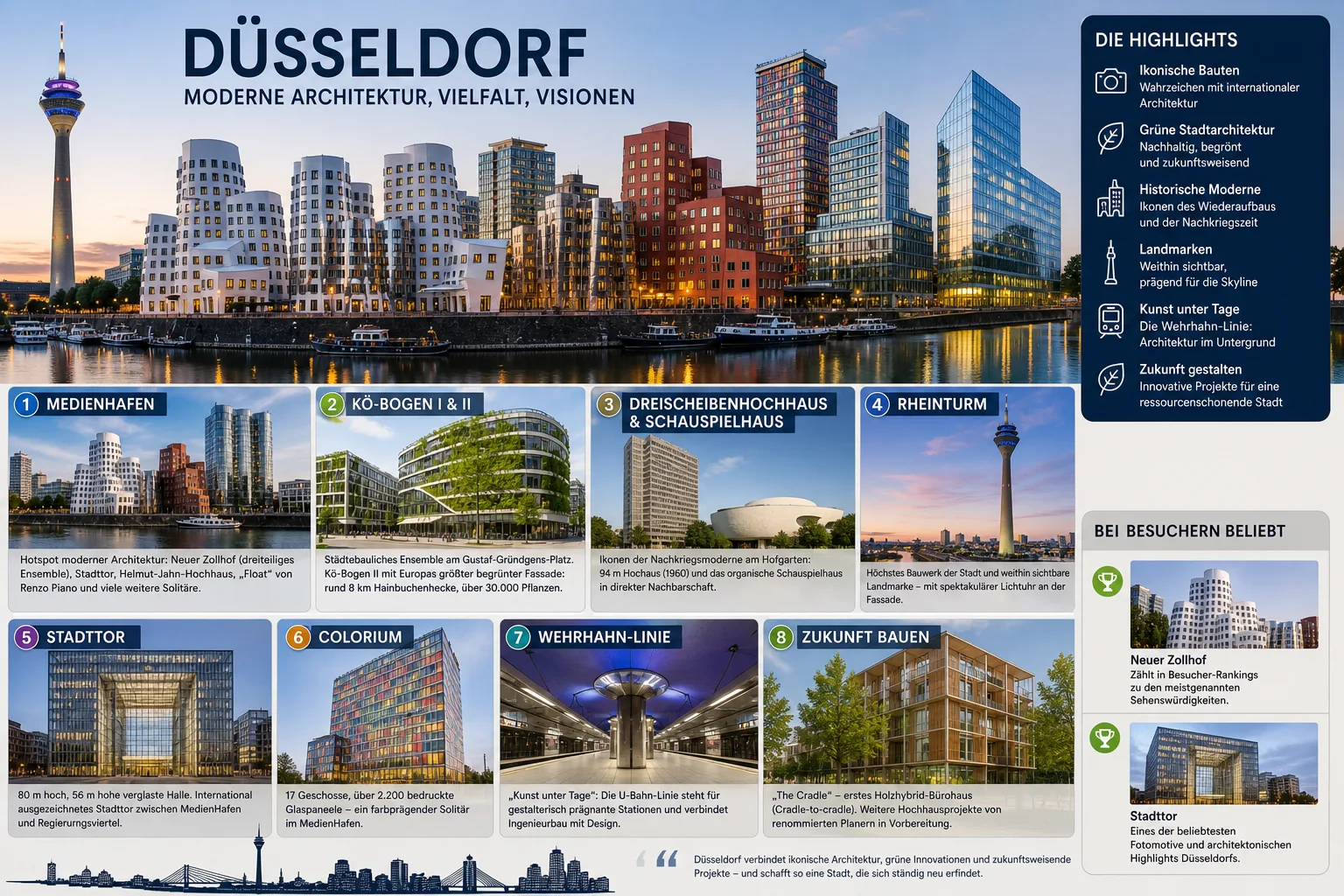
If you only plan to visit one area as an “architecture showcase” in 2026/2027, make it the MedienHafen. Here, you can experience very different styles in a short distance – from sculptural office and hotel buildings to more stringent glass facades. For the upcoming season, evening hours (light, reflections) and weekday mornings (less crowds) are especially suitable.
This is how to make it a successful tour
- Starting point by the water: Begin at the promenade to “read” the scale and silhouette.
- Change perspectives: Switch sides of the street several times – many facades look very different depending on the angle.
- Plan intermediate stops: Take your time for photos and details (material joints, glass prints, shading elements).
City Axis at Hofgarten: Kö-Bogen, Dreischeibenhochhaus & Cultural Venues
In the city center, a particularly dense “city lecture” is emerging for your next visit to Düsseldorf: buildings with clear lines, large-scale urban spaces, and a noticeable focus on quality of stay. Around Hofgarten, outdoor spaces, shopping, and cultural venues can be combined in one route.
Kö-Bogen & Green Urban Architecture
A focus for 2026/2027 is the topic of building greenery. At Kö-Bogen, you can observe how greening is conceived as a design element and as a climate component (shading, microclimate, quality of stay). If you are interested in details, pay attention to:
- Guidance of paths and sightlines between city and green space
- Transitions from facade greening to plaza areas
- Material contrasts (stone, glass, vegetation) and their effect in different weather
High-rise Silhouette & Urban Space
For the upcoming season, it is worth not only viewing the skyline “from afar,” but experiencing it in the urban space: Where do wind corridors arise? Where are base zones active? Which entrances appear open, which rather uninviting? Especially here, architecture becomes tangible as an everyday experience.
Cultural Venues as Architectural Stops
Plan for 2026/2027 – depending on the schedule and program – a detour to a cultural venue (e.g., theater or concert hall). Interiors often show proportion, acoustics, and routing more clearly than any exterior view. Check tickets and admission rules early on the official sites.
Rhine Axis: Rheinturm Area & Political Architecture
For 2026/2027, the Rhine axis is ideal if you want to combine architecture with a city panorama. The area around the Rheinturm is suitable for a route that brings together technology, public space, and urban environment.
View & Orientation
If you want to “read” Düsseldorf through architecture, a viewpoint is invaluable: the structure of the city (Rhine, districts, traffic axes) becomes visible as a complete system. When planning, pay attention to:
- Weather and visibility (for photo and orientation experience)
- Time slots/admission times (especially on weekends and during holidays)
- Accessibility and elevator/access information on the official operator site
Landtag NRW: Public Access, Entry, Visit
If you are interested in democratic architecture, the North Rhine-Westphalia state parliament is an obvious program point. For the upcoming season, it is recommended to plan via the visitor information (registration, security checks, ID rules, possible guided tour dates). This way, you avoid waiting times and ensure that a visit is actually possible.
Everyday on the Move: Wehrhahn Line as a Design Route
If you want to not only “look at” modern architecture in 2026/2027, but actually use it, plan a route via the Wehrhahn Line. Here, mobility becomes a design experience: materials, light, colors, and art shape the effect of the stations and make the journey itself a program point.
How to Use the Line as an Architectural Experience
- Short stages: Travel in sections and consciously get off at selected stations.
- Observe photo rules: Rules apply in stations and vehicles; follow local instructions.
- Avoid rush hours: For a quieter experience, off-peak times are usually better.
Practical: You can combine this route with city stops (Hofgarten/city center) and thus create a weatherproof alternative for rainy or very hot days.
Sustainability & New Projects: Circular Construction and High-rise Debates
For the coming months and the upcoming season, sustainability is the most important cross-cutting theme: energy-efficient buildings, timber and hybrid construction, deconstructability, and district planning with short distances. In Düsseldorf, corresponding projects and plans are publicly discussed – often accompanied by information offers, specialist events, or media reports.
Circular Orientation as a Visit Theme
If you want to see buildings that explicitly argue with material health, deconstructability, and reuse, research public formats in advance (e.g., architecture lectures, industry events, open house days) that are announced for the upcoming season. Pay attention to:
- Comprehensible information on materials and certifications
- Transparent operator and project information
- Documented goals (e.g., energy, CO₂, circular principles) instead of pure marketing terms
High-rise Planning: Urban Space, Mobility, Acceptance
New high-rises are a controversial topic in many cities – including Düsseldorf. For 2026/2027, it is worth understanding the discussion as part of the urban experience: How are shadowing, wind, traffic, public spaces, and social infrastructure evaluated? Official information can typically be found in municipal publications, meeting templates, or project pages.
How to Plan Your Architecture Days
Recommended Daily Structure (flexible, without fixed appointments)
- Morning: City center/Hofgarten (good light, short distances, many options in case of weather changes).
- Afternoon: MedienHafen (waterfront perspectives, facade details, photo stops).
- Evening: Rhine axis and possibly cultural program (clarify tickets/admission in advance).
Tickets, Admission, Security
For interiors (e.g., cultural or parliamentary visits), rules often apply regarding bags, IDs, and admission times. Allow for buffer time and rely on the current information from the operators shortly before your visit.
Accessibility
Many routes are generally well accessible by public transport. For reliable information (elevators, step-free access, construction-related restrictions), check the information from Rheinbahn and the respective venues/places before your appointment.
Note
This article is an editorial guide for travel and route planning. Opening hours, access requirements, security rules, and program details may change at short notice. Therefore, always check the official sites of the mentioned places and institutions before your visit.
Transparency note: No prices, availabilities, or guaranteed admissions are promised. On-site decisions (e.g., at events or security checks) take precedence.
Sources & Further Links
- State Capital Düsseldorf – Official City Information — Basic info on the city, planning, and current notices (accessed 2026-08-12)
- Visit Düsseldorf (Düsseldorf Tourism) — Information on city tours, sights, and visit planning (accessed 2026-08-12)
- Rheinbahn — Public transport, lines, service and accessibility information (accessed 2026-08-12)
- North Rhine-Westphalia State Parliament — Visitor information, dates, and access requirements (accessed 2026-08-12)
- D’haus / Düsseldorf Schauspielhaus — Program, tickets, admission and visitor information (accessed 2026-08-12)
- Tonhalle Düsseldorf — Program, tickets, visitor information (accessed 2026-08-12)
- City of Düsseldorf – Information on MedienHafen — Orientation, district info and notices (accessed 2026-08-12)