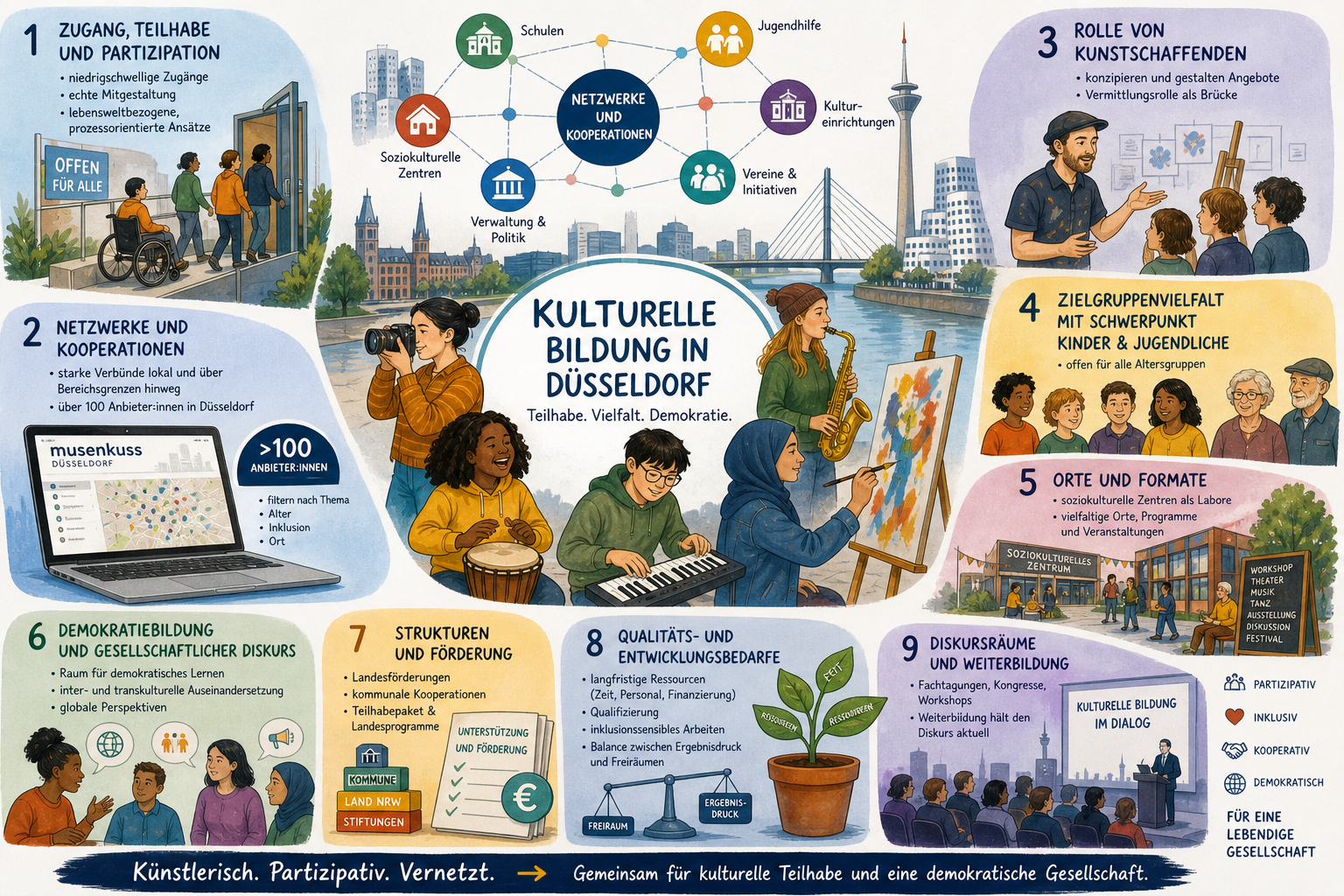
Cultural Education in Düsseldorf: Participation & Discourse
Cultural Education & Societal Discourse in Düsseldorf: Outlook on Upcoming Formats, Cooperations, and Spaces for Debate
How can Düsseldorf change in the coming months and years if cultural education is consistently considered a prerequisite for participation and translated into new spaces for discourse? This article compiles a future-oriented roadmap: Which event and project formats make sense next, how can cooperations be planned, and how can art and cultural venues foster democratic debates in the future.
Participation as a Program Principle: How to Plan Participatory Formats
If Düsseldorf wants to strengthen discourse and participation in the future, new projects should not treat participation as an “extra,” but as a core concept. For the next generations of projects, formats that firmly incorporate co-creation are particularly suitable:
Suggestions for Upcoming Project Formats
- Co-Design Workshops (4–8 weeks): Participants develop the topic, aesthetics, and presentation format together with artists and educators. The result can be a performance, exhibition, podcast, or short film.
- Neighborhood Labs (weekends or holiday blocks): Groups work artistically on local issues (e.g., cohesion, remembrance, climate, mobility) and test interventions in public space—with approval and safety concepts.
- Intergenerational Studios: Young people and older adults compose, tell stories, or design visually together. The format can combine future loneliness prevention, exchange, and media literacy.
- Post-digital Workshops: Production between analog and digital (e.g., zine + QR-audio, exhibition + AR elements, stage + live stream). Planning should include media education and copyright from the outset.
What Should Be Firmly Agreed Upon in the Next Planning Round
- Levels of Co-determination: Define before the project starts which decisions participants make (topic, roles, presentation venue, publications).
- Conflict Capability: Moderation, feedback rules, and protection concepts as standard—so that discourse remains possible without overwhelming participants.
- Documentation: For future funding and quality assurance, processes should be transparently documented (methods, participation, reach, learnings).
Networks & Cooperations: Next Steps for a Citywide Learning Field
For future collaboration in Düsseldorf, it will be crucial that cooperations do not arise by chance, but are planned as recurring structures. For this, three building blocks can be prioritized in the next 6–18 months:
- Cooperation Calendar: A shared annual rhythm (e.g., spring/autumn windows) for project launches, presentations, and training makes reliability easier for schools, providers, and cultural spaces.
- Matching Formats: Short “project exchanges” or digital matching rounds can help bring together schools/youth services, the independent scene, and institutions more quickly in the future.
- Transparency of Offerings: A continuously updated, well-filterable directory (target group, sector, accessibility, languages, duration, contact) makes participation more likely—especially for first-time users.
So that networks actually hold in the next cycle, cooperations should also start with clear roles: responsibility for spaces, public relations, protection concepts, budget management, and evaluation.
Artists as Mediators: Fair Frameworks for Upcoming Projects
In the next waves of projects, the quality of cultural education will largely depend on how artists are involved as mediators. For the future, three framework conditions are particularly important:
- Fairness & Clarity: Future contracts should transparently reflect the scope of services, preparation time, follow-up, rights to documentation, and cancellation regulations.
- Qualification: Training on group leadership, inclusion, child protection, anti-discrimination, and digital production should be planned as recurring offers.
- Collegial Formats: In the coming months, peer rounds (case discussions, method exchanges, job shadowing) can significantly increase the quality and resilience of projects.
For Düsseldorf, it will prove especially effective if mediation work is organized as a professional field—with realistic time budgets, reliable contacts, and a culture of reflection.
Democratic Discourse: Which Event Series Can Have an Impact in the Future
For art to become an engine for democratic debates in the future, upcoming programs need formats that are public, dialogical, and safe. For the next years, these event and series models are particularly suitable:
1) Discourse Evenings with Artistic Kickoff
A recurring series can start with a short artistic impulse (reading, performance, screening) and then move into a moderated discussion. When planning, topics should be chosen so that different perspectives become visible—without instrumentalizing those affected.
2) Workshop Forums “Behind the Scenes”
For upcoming semester and continuing education programs, forums that make processes in the cultural sector transparent are suitable: financing, production conditions, accessibility, audience development, ethics of documentation. Such formats can make the discourse more objective and create new access points.
3) Youth Juries & Audience Councils
If Düsseldorf wants to strengthen participation in the future, youth juries or audience councils can co-evaluate project ideas (e.g., criteria catalog, feedback loops, presentation formats). To ensure real participation, decision-making scopes and budgets should be defined in advance.
4) Mobile Conversation Spaces in Urban Areas
Pop-up formats (e.g., mobile stage, audio station, temporary exhibition) can reach people in the future who rarely visit cultural venues. Important for the future: permits, noise protection, accessibility, and a concept for respectful conversation management.
Implementation & Quality: How Future Initiatives Become Reliable
For the coming cycles, Düsseldorf should secure quality not only through “nice results,” but through reliable processes. For the next implementation phase, these practical instruments are suitable:
- Project Standards: Minimum requirements for protection concepts, consent forms, accessibility information, crisis and complaint procedures.
- Impact Logic Instead of Gut Feeling: Before the project starts, define which changes are realistically expected (e.g., participation, competence experience, access) and how this will be checked later (short surveys, reflection rounds, observation protocols).
- Multi-year Perspective: For sustainable impact, upcoming programs should enable repeatability (e.g., series models, advanced courses, transfer to school/youth services).
- Data Protection & Copyright: For future digital formats, rights to images/sound, publication, and archiving should be regulated early—especially when working with minors.
This will create a framework in the coming years in which creative risks remain possible without overwhelming participants, teams, or providers.