Insider Tips in Düsseldorf: Discover Hidden Places
Insider Tips in Düsseldorf: Your Tours and Experiences for the Coming Months
8 min readLaura Müller
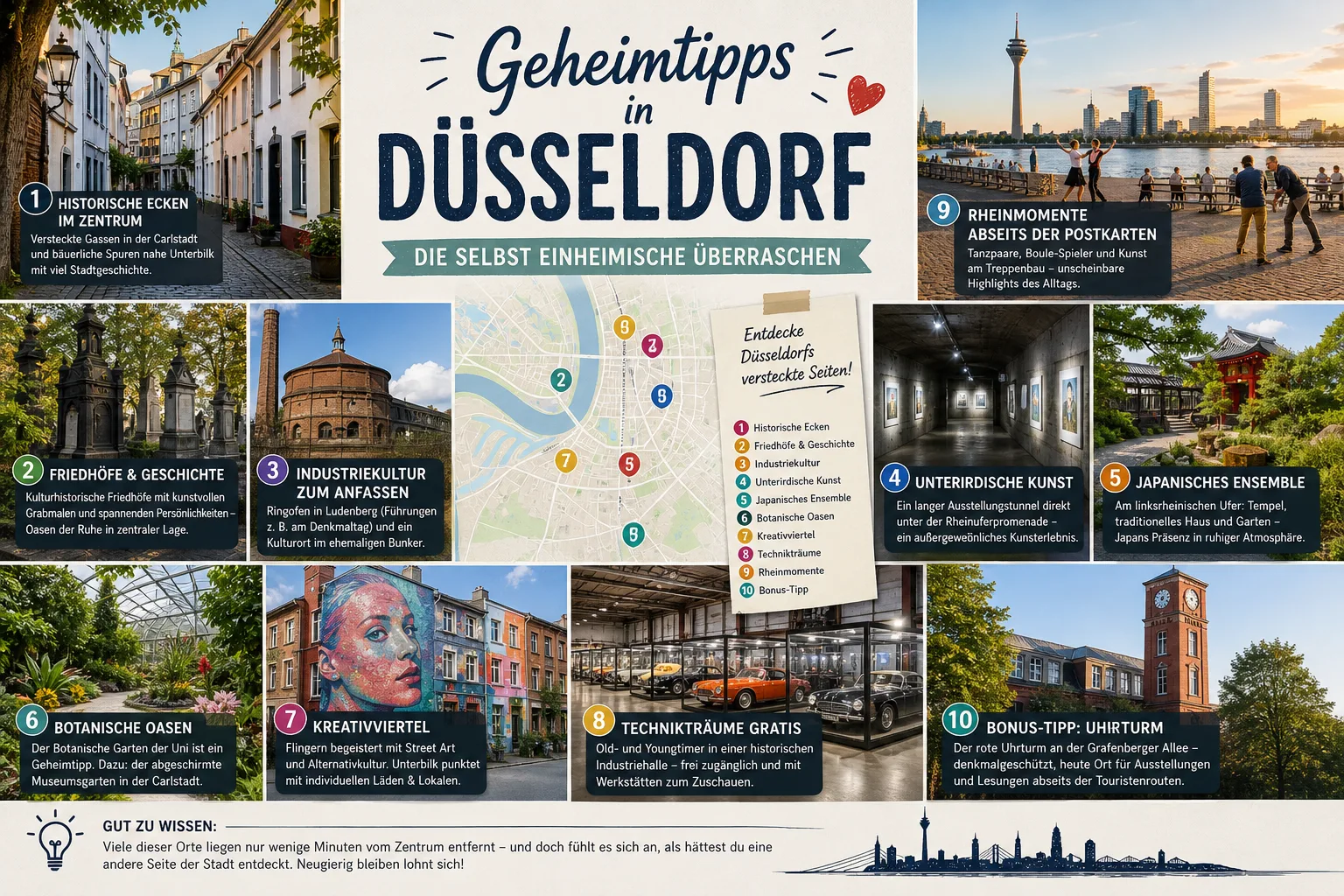
This planning aid bundles quiet paths, art venues, greenery, and neighborhood culture in Düsseldorf – as concrete suggestions for your next visits (Winter 2026/27 to 2027) including route ideas, timing, and preparation tips.
How to Use the Guide (for Your Next Outings)
This article is intended as planning for upcoming visits: You get several short routes that you can flexibly combine over the next few months. Instead of rigid program points, you will consciously find options that you can adapt to weather, daylight, and opening hours.
- Duration per route: approx. 60–150 minutes (depending on stops).
- Best time windows: mornings for quiet paths, late afternoons for lighting moods on the Rhine.
- Before setting off: Check opening hours/program of the respective places on the official sites (see sources).
City Center Route: Carlstadt, Quiet Walks, and Garden Break
If you want to deliberately avoid the hustle and bustle in the city in the coming weeks, this route is ideal: short distances, lots of atmosphere, and at least one reliable “wind-down” station.
Stop 1: Carlstadt as a Quiet Pedestrian Section
For your next city center stroll, consciously plan 20–40 minutes just for side streets, courtyards (where accessible), and short detours without a shopping goal. The aim is not to “see everything,” but to slow down the pace.
Stop 2: Museum Garden in Carlstadt as a Micro-Break
Afterwards, take a 10–25 minute break in a secluded garden area at a museum in Carlstadt, if open. Especially on cooler days (Winter 2026/27), this is worthwhile as a short oasis of calm between two program points.
Option: Quiet Paths Instead of Indoors
If you want to stay mostly outdoors in the coming months (e.g., with a full schedule), rely on this combination: short city walk + garden break + Rhine section (see route “Art on the Rhine”).
Industrial Culture Route: Monuments, Conversions, and Vantage Points
For your next free days, you can put together an industrial culture tour based on visible structures and changing access. Important: Some places are only accessible at certain times or as part of programs.
Stop 1: Ring Kiln Visit on an Official Opening Date
If you are looking for a place particularly suitable for a planned outing in 2027, put the ring kiln in Ludenberg on your list – preferably on a communicated opening or guided tour date. Many technical monuments open as part of bundled action days; inform yourself in good time via official program lists.
Recommendation for planning: Note the date (as soon as published) and plan your arrival so that you can add a short forest/hill walk in the area before or after.
Stop 2: Bunker Site in Bilk as a Program Point (Exhibition/Format)
In the coming months, a bunker site in Bilk is particularly suitable if you want to not only “visit” Düsseldorf but experience it as an event location. Plan the visit as an evening or bad weather option and specifically choose a format (exhibition, music, project) that is announced.
Stop 3: Red Clock Tower on Grafenberger Allee as a Short Photo Stop
If you prefer a route with short, clear stops in 2027, the red clock tower on Grafenberger Allee is a good “5-minute anchor”: stop briefly, look for a perspective, move on. Combine it with a café stop or a walk towards Flingern (see route “Creative & Technology”).
Art Route on the Rhine: Tunnel Space & Promenade Moments
This route is particularly practical for the next few months because it works even without much preparation: You combine an exhibition space in the tunnel (when open) with a promenade walk and targeted details that are easily overlooked.
Stop 1: Underground Exhibition Space under the Rhine Promenade
Plan a visit specifically for an ongoing or announced exhibition. Depending on the presentation, allow 20–60 minutes. Take conscious time for the space itself (lines of sight, sounds, transitions between light and shadow) – that’s what makes this station special.
Stop 2: Burgplatz Steps and Promenade as a “Detail Walk”
Afterwards (or before), take a 30–45 minute walk along the promenade – with the aim of consciously perceiving surfaces, patterns, and designed elements. Instead of “covering distance,” a slow pace with 2–3 photo stops works best here.
Japan & Green: Left-bank Tranquility and Botanical Diversity
If you want to travel more “slowly” in 2027, combine Japanese-influenced tranquil places (depending on opening/program situation) with a botanical destination. This is especially suitable for weekends and holidays.
Stop 1: Left-bank Japanese Ensemble as a Quiet Visit
Plan your visit so that you allow enough time for slow paths and short breaks. Depending on accessibility and daily program, this can be a good place to consciously go offline for 45–90 minutes and experience the surroundings without haste.
Stop 2: Botanical Garden (Uni Düsseldorf) as a Half-day Excursion
In the coming months, the Botanical Garden is particularly suitable as a reliable nature spot in the city. Depending on the season, plan 60–150 minutes: round through themed gardens, greenhouse sections (if open), and a short finish on a bench with notes or photos.
To really give the visit an “insider tip character,” set yourself a mini-theme for the day, e.g., “autumn/winter structures,” “leaf shapes,” or “greenhouse light.”
Creative & Technology: Flingern, Unterbilk, and a Hall Full of Vehicles
This route is suitable for the coming months if you want to experience Düsseldorf close to the neighborhood and at the same time visually varied: street art search, individual shops, and finally a technology spot that also works in the rain.
Stop 1: Flingern as a Street Art Walk (Self-guided)
Plan a 60–90 minute walk through side streets, specifically looking for murals, lettering, and small creative interventions. So that you don’t just “look by chance” in the coming months, a simple rule helps: Find, photograph, or note at least one motif per street – then the walk automatically becomes a little discovery tour.
Stop 2: Unterbilk as a Strolling Route with Shops & Cafés
Set a clear time window for Unterbilk (e.g., 45–75 minutes) and choose 1–2 categories that interest you beforehand: books/design, take-away food, or small gifts. This prevents the stroll from becoming unfocused – and makes it easier to repeat in everyday life.
Stop 3: Old and Youngtimers in a Hall as a Rain Option
If you are looking for a weather-independent conclusion for 2027, plan a stop in a publicly accessible hall with exhibited old and youngtimers. This station is ideal if you feel like observing details: body shapes, interiors, restoration work behind glass (if visible). Allow 45–90 minutes for a relaxed tour.
Practical Tips for Your Next Visits
- Opening hours & program situation: Check the official websites on the day of your visit (exhibitions, action/guided tour days, short-term closures).
- Arrival: For combined routes, public transport + short walks are often the most flexible; for outlying locations, a bike/car sharing section may be useful.
- Consideration: Behave quietly in tranquil places (gardens, facilities); observe house rules at event venues.
- Accessibility: Tunnel spaces, old town side paths, and older buildings may have steps/unevenness. Check the official information if you depend on it.
- Traffic safety: For photo stops on larger roads (e.g., clock tower area), only stop at safe places.
Note: This guide is an editorial planning aid and does not replace current operator information. The information from the respective institutions and the city of Düsseldorf is binding.